Cornell University

Image result for Cornell University

\”I would found an institution where any person can find instruction in any study,” is the motto of Cornell University, words first uttered by its co-founder Ezra Cornell. Cornell was founded in 1865 with the then radical intention of teaching and making contributions in all fields of knowledge. 
Since its founding, Cornell has been a co-educational, non-sectarian institution where admission has not been restricted by religion or race. These are liberal traditions that Cornell holds dear: a recent article in the Cornell Chronicle heralded the first all-female class admitted to its famous Farrier program in veterinary science. Cornell was also the first university to offer degrees in journalism and the first to teach modern Far Eastern languages. 
The main campus of Cornell is on East Hill in Ithaca, New York, overlooking the city and Cayuga Lake. It spreads over 2,300 acres and comprises laboratories, administrative buildings, and almost all the campus\’ academic buildings, athletic facilities, auditoriums, and museums. 
The architecture is an eclectic mix of Collegiate Gothic, Victorian, and Neoclassical buildings, international and modernist structures. There are other campuses and facilities in New York City itself such as the medical campus Weill Cornell in Manhattan, and the engineering campus Cornell Tech. Outside New York, Cornell has an outpost in the gulf state of Qatar, which is the first American medical college to open outside of the United States. 
Ithaca campus sits at the heart of the Finger Lakes region, surrounded by green space and natural beauty. Students here are as likely to be found sitting under a tree with their nose in a book as they are taking advantage of the many clubs, societies and activities Cornell has to offer. 
First-year undergraduates live on North Campus, while upper-level students often hone in on the communities that they have found, opting for a fraternity or sorority, a co-op, a themed residence hall, or an apartment off campus. 
There are more than 1,000 organizations on campus, ranging from skateboarding to volunteer programs. Sporty or outdoorsy students can take part in courses as diverse as caving and rope climbing, and there are four sports centers for the fitness inclined. 
Food lovers are also well catered for, with Cornell voted in the top ten universities for food, with more than 30 dining facilities across campus. 

Technical University of Munich

Image result for Technical University of Munich

Consistently featured as one of the highest-ranked universities in Germany in the QS World University Rankings®, Technical University of Munich (Technische Universität München), also known as TUM, was founded in 1868 and is a member of the TU9, an association of nine of Germany’s most prestigious technical universities. TUM has 14 academic departments and 40,124 students, of which around 24% are international. It calls itself The Entrepreneurial University and aims to foster a supportive environment for budding entrepreneurs. There are 172 degree programs available including a selection of English-taught courses.

Columbia University

Image result for Columbia University
Established in 1754, Columbia University is a private Ivy League research university in Upper Manhattan, New York City. It was established as King\’s College by royal charter of George II of Great Britain and renamed Columbia College in 1784 following the American Revolutionary War. 
With an undergraduate acceptance rate of 5.8 percent, Columbia is currently the third most selective college in the United States and the second most selective in the Ivy League after Harvard. Its first president was none other than the literary great Samuel Johnson, and over the years Columbia has produced numerous distinguished alumni, from Oscar winners and Nobel laureates to Supreme Court judges. Three US Presidents and the authors of the Declaration of Independence and American Constitution were also schooled at Columbia. It also runs the highly distinguished Pulitzer Prize, an annual award for achievements in journalism, literature and musical composition. 
The university is organized into 20 schools, including undergraduate schools such as Columbia College, the Fu Foundation School of Engineering and Applied Science, and the School of General Studies, as well as graduate schools such as Columbia Law School, Columbia College of Physicians and Surgeons, Columbia Journalism School and Columbia Business School. It also had global research outposts across the world. Its total student body numbers around 28,000 and is comprised mainly of postgraduates, with roughly 8,500 undergraduate students. 
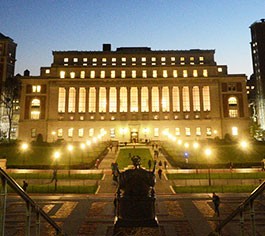
Columbia’s main campus is Morningside Heights, occupying around six city blocks in the Morningside Heights district of New York. It’s home to the neo-classical Butler library, one of the largest buildings on campus, and almost two dozen undergraduate dormitories. The university also owns 7,800 apartments in the local area, which house faculty members, students, and staff. 
The campus was designed along Beaux-Arts principles and was a late 19th century vision of a campus where all disciplines could be taught. Some of its standout features include the Low Memorial Library, a National Historic Landmark, the site of the invention of FM radio, and the location where the nuclear fission of uranium first took place. 
More significant for students are The Steps, a long series of granite steps which are a popular hangout and meeting place, and the bronze figure of Alma Mater, a female figure draped in an academic gown who serves as a daily reminder to students of their scholarly duties. 

University of Chicago

Image result for University of Chicago

Established in 1856, the University of Chicago is a private research university based in the urban center of Chicago, the third most populous city in the United States. Outside of the Ivy League, Chicago is one of America’s top universities, and holds top-ten positions in various national and international rankings. 
Beyond the arts and sciences, Chicago has a glowing reputation for its professional schools, including the Pritzker School of Medicine, the Booth School of Business, and the Harris School of Public Policy Studies. University of Chicago alumni are responsible for the development of many academic disciplines, such as sociology, economics, law, and literary criticism.  
The college’s crest sees a phoenix rising from the ashes, a reference to the fire, foreclosure, and demolition of the Old University of Chicago campus, with the current University of Chicago emerging triumphantly in its place in 1890. The old university was founded through a land endowment from the controversial senator Stephen Douglas, a supporter of slavery who authored the Kansas-Nebraska act. By contrast, the new University of Chicago was co-educational and funded through donations from wealthy Chicagoans and the oil magnet John D. Rockefeller. 
Today, the University of Chicago has approximately 16,000 students enrolled, with a male to female ratio of 56:44. A quarter of all students hail from overseas, a nod to the institution’s progressive credentials. 
Students run more than 400 clubs and societies, which consist of a typical mix of sports teams, arts, cultural and religious groups, academic and political groupings, and societies that promote eclectic common interests. Among the more famous examples are the University of Chicago bowl team, which has won 118 tournaments and 15 national championships, while the university\’s competitive Model United Nations team was the top ranked team in North America in 2013–14 and 2014–2015. 
If you have an interest in media and film, then you’re well catered for: the university is home to the longest continuously running student film society Doc Films and publishes several newspapers and magazines. Budding thespians can join renowned improvisational theater troupe Off-Off Campus, or learn how to broadcast at the university-owned radio station WHPK.
Notable faculty members past and present include 29 Nobel laureates and former US president Barack Obama. Illustrious alumni come in practically every field, including the novelists Philip Roth and Saul Bellow, political movers and shakers such as pollster Nate Silver and Obama strategist David Axelrod, pioneering balloonist Jeannette Piccard, and the fictional archaeologist Indiana Jones. 

Nanyang Technological University, Singapore (NTU)

Image result for Nanyang Technological University, Singapore (NTU)

Young and research-intensive, Nanyang Technological University, Singapore (NTU Singapore) is placed 12th globally, and 1st among the world’s best young universities for five consecutive years (QS university rankings).
 
Home to 33,000 students, NTU offers engineering, science, business, humanities, arts, social sciences, and education, and has a joint medical school with Imperial College London.
 
Ranked the top university in the world for citations in artificial intelligence (Nikkei and Elsevier 2017) for the period 2012-2016, NTU is embracing digital technologies for better learning and living as part of its Smart Campus vision. It has partnerships with the world’s leading technology companies such as Alibaba, Rolls-Royce, BMW, Volvo, Delta Electronics, and Singtel in many areas of societal importance and impact that include artificial intelligence, data science, robotics, smart transportation, computing, personalised medicine, healthcare and clean energy.
 
The NTU Smart Campus is not only a living testbed of tomorrow’s technologies, but it is also frequently listed among the world’s Top 15 most beautiful university campuses. It has 57 Green Mark-certified (equivalent to LEED-certified) building projects comprising more than 230 buildings, of which 95% are certified Green Mark Platinum.
 
Apart from its main campus, NTU also has a medical campus in Novena, Singapore’s healthcare district.

University of California, Los Angeles (UCLA)

Image result for University of California, Los Angeles (UCLA)

Based in warm and sunny Los Angeles, the University of California, Los Angeles (UCLA) was ranked the 31st best university in the world according to the QS World University Rankings® 2016-2017.
UCLA graduates are in the enviable position of being among the world’s most employable students fresh out of uni, as suggested by UCLA’s impressive performance in the QS Graduate Employability Rankings ® 2017.
UCLA ranks among the top 10 universities in the world for:
  • English language and literature
  • Geography, linguistics
  • Modern languages
  • Electrical and electronic engineering
  • Biological sciences
  • Medicine
  • Psychology
  • Chemistry
  • Mathematics
  • Communication and media studies
  • Education and training
  • Anthropology
  • Archaeology
  • Arts and humanities
  • Life sciences and medicine

Peking University

Image result for Peking University
The oldest higher education institution in China, Peking University was founded in 1898 as a replacement for the ancient Guozijian school (Imperial College). By the early 1920s, it had become a center for Chinese progressive thought, playing an important role in China\’s New Culture Movement, the May Fourth Movement, and the Tiananmen Square protest of 1989, among other significant historical events. 
Peking University has been consistently ranked as the top academic institution in China. As well as being renowned academically, it’s well-known for its stunning campus grounds and for the beauty of its traditional Chinese architecture. Peking University has educated some of the most prominent figures in Chinese history, including Mao Zedong. 
The main university campus is in the former site of the Qing Dynasty imperial gardens and as such features traditional Chinese-style landscaping, including traditional houses, gardens, pagodas, as well as many notable historical buildings and structures. Weiming Lake is to the north of the campus and is surrounded by walking paths and small gardens. 
The university grounds are also home to museums, such as the Museum of University History and the Arthur M. Sackler Museum of Art and Archaeology, in which students can view objects dating back thousands of years. It’s an environment to feed the enquiring minds of young students – not that the academic curriculum doesn’t already do that. 
Peking University is a leading university for science research and teaching and has successfully developed applied sciences research and teaching as well. There are 30 colleges and 12 departments, with 93 undergraduate programs, 199 master\’s degree programs, and 173 options for doctoral candidates. 
Peking is eager for students to receive not only comprehensive education, but to take part in student life to the full.  Life on campus is rich with sport and extracurricular fare, with more than 200 student organizations and a range of activities running year-round. 
Sport is important, with Beida Cup Athletic Championships taking place each year, while festivals and events such as the International Cultural Festival, or Singing Competition for Foreign Students, allow students to meet up, make friends and enjoy a balanced life outside of their studies. 

EPFL – Ecole Polytechnique Federale de Lausanne

Image result for EPFL - Ecole Polytechnique Federale de Lausanne

The École polytechnique fédérale de Lausanne (EPFL) is a research institute and university in Lausanne, Switzerland, specializing in the natural sciences and engineering. 
Its roots can be traced back to the foundation of a private school in 1853, which to start with only had 11 students. Those days are long gone though, with the modern day EPFL one of two Swiss Federal Institutes of Technology and student numbers in Lausanne now totaling over 10,000. 
Located in the French-speaking part of Switzerland, EPFL is twinned with the Swiss Federal Institute of Technology in Zurich (ETH Zurich). As part of its research and teaching activities, EPFL is one of the only universities to run a nuclear reactor, a fusion reactor, a Gene/Q Supercomputer, and have P3 bio-hazard facilities.
EPFL has a very singular admissions process, which, for would-be undergraduates who are Swiss nationals, is not selective at all. At the end of freshman year, however, a block exam determines whether students can continue or have to repeat the year, with many home students dropping out entirely at this point. 
The EPFL campus lies on the shores of Lake Geneva and consists of 65 buildings across 136 acres. Facilities include banks, bars, two museums – the Musee Bolo and Archizoom – as well as bars, restaurants and cafeterias. 
There are students of 112 different nationalities here, though as of 2014 women made up only 27 percent of the student body. Life on campus is vibrant, with many student-formed clubs and associations providing social and recreational opportunities. 
A wide range of sports and leisure facilities keep students physically active while studying. EPFL also has an active student media, publishing the monthly newspaper Flash and there are daily broadcasts on the student radio station. 
Another priority on campus is the arts, with the university holding several annual music festivals each year. The largest is Balélec Festival, where 15,000 visitors descend upon the university to watch 30 concerts on two outdoor and four indoor stages.