University of Michigan

One of the foremost research universities in the United States, the University of Michigan was founded in 1817, before Michigan had even become a state, and moved from Detroit to what is now its Central campus in Ann Arbor in 1837. 
Michigan spans 780 acres, which is made up of its Central and North campuses, two regional campuses, and a center in Detroit. It has a large student body of around 45,000, with undergraduates numbering two-thirds of that number. 
Michigan has been lauded for having high standards of research, and the university’s comprehensive graduate program offers doctoral degrees in the humanities, social sciences, and STEM fields (science, technology, engineering and mathematics) as well as professional degrees in architecture, business, medicine, law, pharmacy, nursing, social work, public health, and dentistry.
Michigan\’s body of living alumni comprises more than 540,000 people, which is one of the largest alumni bases of any university in the world and a valuable resource for current students when it comes to networking and building industry connections.
Around a quarter of all students are accommodated on campus, with three large residence halls serving undergraduates, and family housing which is intended mainly for graduates. There are also off-campus apartments, houses, and co-operatives, which generally house upper division and graduate students, as well as ‘theme communities’ within residence halls, where students can immerse themselves among peers with similar interests. 
Michigan has nearly 1,500 clubs and societies, including engineering project teams, community service organizations, and charitable projects. The Michigan Marching Band is over 100 years old and has 350 student members, and other noted musical ensembles include the University of Michigan Men’s Glee Club, a men’s chorus with over 100 members. 
Michigan has a history of student activism, and there are a number of groups dedicated to various worth causes. Some, such as the United Students Against Sweatshops (USAS), devote themselves to more left-wing causes, in this case holding to account multinational companies that exploit their workers in factories, but there are also conservative groups such as Young Americans for Freedom, as well as non-partisan groups. 
Cultural and ethnical student organizations help students forge smaller communities from the large university population, and publications such as the Michigan Daily, published five days a week during term time, allow students to keep abreast of the latest news on campus. 

Peking University

Related image

The oldest higher education institution in China, Peking University was founded in 1898 as a replacement for the ancient Guozijian school (Imperial College). By the early 1920s, it had become a center for Chinese progressive thought, playing an important role in China\’s New Culture Movement, the May Fourth Movement, and the Tiananmen Square protest of 1989, among other significant historical events. 
Peking University has been consistently ranked as the top academic institution in China. As well as being renowned academically, it’s well-known for its stunning campus grounds and for the beauty of its traditional Chinese architecture. Peking University has educated some of the most prominent figures in Chinese history, including Mao Zedong. 
The main university campus is in the former site of the Qing Dynasty imperial gardens and as such features traditional Chinese-style landscaping, including traditional houses, gardens, pagodas, as well as many notable historical buildings and structures. Weiming Lake is to the north of the campus and is surrounded by walking paths and small gardens. 
The university grounds are also home to museums, such as the Museum of University History and the Arthur M. Sackler Museum of Art and Archaeology, in which students can view objects dating back thousands of years. It’s an environment to feed the enquiring minds of young students – not that the academic curriculum doesn’t already do that. 
Peking University is a leading university for science research and teaching and has successfully developed applied sciences research and teaching as well. There are 30 colleges and 12 departments, with 93 undergraduate programs, 199 master\’s degree programs, and 173 options for doctoral candidates. 
Peking is eager for students to receive not only comprehensive education, but to take part in student life to the full.  Life on campus is rich with sport and extracurricular fare, with more than 200 student organizations and a range of activities running year-round. 
Sport is important, with Beida Cup Athletic Championships taking place each year, while festivals and events such as the International Cultural Festival, or Singing Competition for Foreign Students, allow students to meet up, make friends and enjoy a balanced life outside of their studies. 

The Australian National University

The Australian National University (ANU) is a world-leading centre for education and research. Ranked in Australia and in the world (QS World University Rankings 2016-17), Australia’s national university is further distinguished by an outstanding record for student satisfaction and graduate employability.

For academic and professional staff, ANU offers excellent conditions including flexible working arrangements, professional development opportunities, competitive pay and generous superannuation – all within an integrated and engaged on-campus community. Learn more about the benefits of working at ANU http://www.anu.edu.au/jobs

Northwestern University

Image result for northwestern university

Located on the shore of Lake Michigan 12 miles north of Chicago, Northwestern University was a glint in the eyes of its founders when they gathered in 1850 to plan a higher education institution. Without much money, land or higher education experience between them, their vision was ambitious, but through their shrewdness and hard work, they were able to purchase the 379-acre site on which the university now stands and begin classes in the fall of 1855. 
In those earliest days, the new university had only two faculty members and 10 students. Today, Northwestern has blossomed into a large research university with 21,000 students and a comprehensive doctoral program. Its undergraduate programs are among the most selective in the United States, with an admission rate of 9 percent, and NU also boasts some highly-prized graduate and professional schools such as the Kellogg School of Management, Pritzker School of Law, Feinberg School of Medicine, and Medill School of Journalism. 
The surrounding town of Evanston is named after the school’s founding father John Evans and is well-known for being a champion of sustainability. It’s also the hometown of actors Marlon Brando and Bill Murray, and the music producer Steve Albini. 
In addition to the main campus at Evanston, Northwestern has another campus in Chicago, which is home to the medical school, law school, part-time MBA program, and School of Professional Studies. The two campuses are 12 miles apart, bordered by Lake Michigan, and a free intercampus shuttle bus connects the two. 
The Evanston campus has all the facilities of a quintessential college town: beaches, shops, coffee houses, restaurants, and cinemas just a stone’s throw from classrooms, labs and lecture halls, while students at the Chicago campus in the bustling Streeterville neighborhood, are close to world class attractions such as the Magnificent Mile, the Museum of Contemporary Art and the John Hancock Center. 
On campus, Northwestern students suffer from an embarrassment of riches: concerts, plays, readings, exhibitions, and performances are easily accessible for cultural vultures, while sports enthusiasts can either watch or partake in all traditional American sports. 
With a thriving journalism and communications school, student media also proves popular at Northwestern too, with college newspaper the Daily Northwestern a going concern since 1881, and all manner of magazines and web publications. 
The combination of Northwestern’s strong academic pedigree and vibrant campus life is undoubtedly making it an increasingly popular choice for students at both undergraduate and postgraduate level.

University of Toronto

Image result for University of Toronto

Founded in 1827, the University of Toronto has evolved into Canada’s leading institution of learning, discovery and knowledge creation. We are proud to be one of the world’s top research-intensive universities, driven to invent and innovate.
Our students have the opportunity to learn from and work with preeminent thought leaders through our multidisciplinary network of teaching and research faculty, alumni and partners. 
The ideas, innovations and actions of more than 560,000 graduates continue to have a positive impact on the world.

The University of Melbourne

Image result for The University of Melbourne

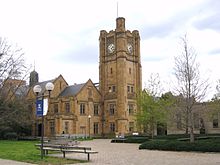
When the University of Melbourne was established in 1853, it was a mere cluster of buildings in a large park on the fringe of the city, with four professors and 16 students. The university now sits at the heart of a thriving international city and is consistently ranked among the leading universities in the world and number one in Australia. 
Over 8,000 academic and professional staff support a vibrant student body of more than 48,000, including 13,000 international students from over 130 countries around the world. Four Australian prime ministers and five governors-general have graduated from the University of Melbourne, located in the city dubbed Australia’s “cultural capital”. 
Indeed, Melbourne is a seven times winner of the Economist’s World’s Most Livable City award, and is a UNESCO City of Literature, as well as the birthplace of Australian rules football and a major center for street art, music, and theatre. 
Melbourne is known for offering students an experience that’s a lot more than just structured learning. The main Parkville campus is close to transport, cafes, shopping, arts and sports venues and accommodation. 
Students will find a blistering array of cultural activities on campus here, be it theatre, comedy, film or public lectures, and it’s easy to find people with matching interests by joining one of over 200 affiliated clubs and societies, ranging from Chess Club to Women in Science and Engineering, to the Chocolate Lovers’ Society. Sports enthusiasts are well catered for too, with a 25-metre six-lane heated indoor pool, an athletics track and sports field, and a large strength and fitness gym. 
The university has 11 residential colleges where most students live, which provide a quick way to build an academic and social network. Each college provides sporting and cultural programs to enrich the academic experience, which is at the center of university life. 
Degrees at the University of Melbourne stand out for being modelled on those from top institutions overseas. Students spend a year exploring a range of subject areas before choosing a major. They also study subjects outside as well as inside their chosen discipline, giving Melbourne students a breadth of knowledge that sets them apart.  

Nanyang Technological University, Singapore (NTU)

Image result for Nanyang Technological University, Singapore (NTU)

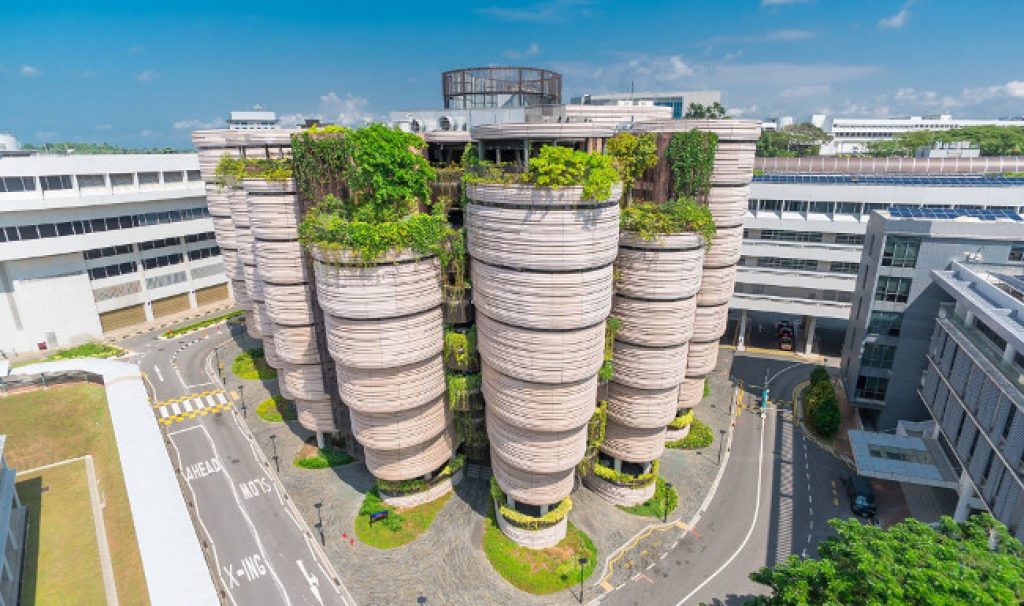
Young and research-intensive, Nanyang Technological University, Singapore (NTU Singapore) is placed 12th globally, and 1st among the world’s best young universities for five consecutive years (QS university rankings).
 
Home to 33,000 students, NTU offers engineering, science, business, humanities, arts, social sciences, and education, and has a joint medical school with Imperial College London.
 
Ranked the top university in the world for citations in artificial intelligence (Nikkei and Elsevier 2017) for the period 2012-2016, NTU is embracing digital technologies for better learning and living as part of its Smart Campus vision. It has partnerships with the world’s leading technology companies such as Alibaba, Rolls-Royce, BMW, Volvo, Delta Electronics, and Singtel in many areas of societal importance and impact that include artificial intelligence, data science, robotics, smart transportation, computing, personalised medicine, healthcare and clean energy.
 
The NTU Smart Campus is not only a living testbed of tomorrow’s technologies, but it is also frequently listed among the world’s Top 15 most beautiful university campuses. It has 57 Green Mark-certified (equivalent to LEED-certified) building projects comprising more than 230 buildings, of which 95% are certified Green Mark Platinum.
 
Apart from its main campus, NTU also has a medical campus in Novena, Singapore’s healthcare district.

The University of Hong Kong

Image result for The university of Hong Kong

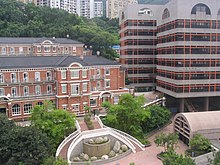
The University of Hong Kong (HKU), is Hong Kong’s oldest tertiary institution, with a history stretching back over a hundred years. The University of Hong Kong is ranked 26th amongst the most respected comprehensive research-led universities in the world.
  • A research driven university- 111 of our professors have been ranked as the world\’s top 1% scientists by Essential Science Indicators, Thomson Reuters.
  • A globally connected university with more than 340 leading universities across 43 countries.  
  • A diverse community with more than 9,000 international students from 96 countries.
  • A world class curriculum with English as medium of instruction.
  • Over 99.4% graduate employment rate for the last 11th consecutive years.

An Academic Powerhouse 
Apart from being the 26th best university overall globally, HKU has 6 subjects placed amongst Top 10 worldwide, while HKU Dentistry programme was ranked 1st in the world for the second consecutive years.  

HKU\’s exceptional academic standards and pioneering research attract many top-performing scholars in Hong Kong, Mainland China and overseas. Studying at HKU, you will have a chance to meet and learn with some of the world’s top scholars.

 A Globally Connected Campus
At HKU, you will meet students from 96 countries and learn from some of the best professors in the world, amongst which 60% are from outside Hong Kong. You get the opportunity to have a life experience abroad during your studies at HKU. In 2015, more than 4,000 HKU undergraduate students have gone on either one semester or one year\’s student exchange programme at our partner universities, or have participated in service learning projects, field trips, undergraduate research programme or internships in overseas. With HKU as your base, you get to go to places like Cambridge, MIT or Harvard to Myanmar, or South Africa to further expand your horizons!
A Degree that Opens Doors
For the last 11 years, more than 99.4% of our graduates have received at least one job offer in every consecutive academic year, with many embarking on careers in fields as diverse as finance, law, engineering and technology, and working at international corporate including the likes of Apple, Google and Goldman Sachs.

 There is a whole lot more to HKU. To find out more about the educational adventures awaiting you in one of the world’s most exciting cities and leading universities, just spend some time on our admissions website.

New York University (NYU)

New York University (NYU) was rated the maximum five QS stars, achieving full marks in the categories research, innovation, facilities and specialist criteria.

Ranked 46th in the QS World University Rankings® 2016-2017, NYU is one of the best universities in the world, and its graduates are favoured by recruiters, as indicated by NYU’s excellent performance in the Graduate Employability Rankings 2017.

NYU ranks among the top universities in the world in the QS World University Rankings® by Subject for:
  • Accounting and finance
  • Mathematics
  • Law and legal studies
  • Psychology
  • Philosophy
Based in New York City, NYU has campuses in Manhattan and Brooklyn, with the core of its buildings around the lovely Washington Square Park in the Greenwich Village. Famous alumni include actor Alec Baldwin, the pop star Lady Gaga, and celebrated playwright Tony Kushner.

Bocconi University

Image result for bocconi university

Università Bocconi was established in Milan in 1902, with a generous endowment from Ferdinando Bocconi, a wealthy merchant. Named for his lost son, Università Commerciale Luigi Bocconi thus became the first Italian institution of higher education to grant a degree in economics. Since its inception, Bocconi has stood for liberalism, pluralism, and social and economic progress. While a private institution, Bocconi has traditionally been more than an elite university. It has consistently promoted and practiced equality of opportunity among its many generations of students, by actively subsidizing the education of disadvantaged and deserving students. In the words of its first Rector and President, Leopoldo Sabbatini, Bocconi\’s mission is to \”promote harmony between school and life.\” Today, Bocconi is a research university of international standing in business, economics, and law. Its research projects are funded by national and supranational institutions. By virtue of being a major node in the European and global network of business and economics universities, Bocconi exchanges faculty and cooperates on large projects with like-minded European and American universities and business schools. Bocconi has close relations with major corporations and international agencies, as well as their managers and officials, and constantly interacts with the business and economic environment to assess new issues, implement new techniques, and start new research endeavors. Università Bocconi has an Undergraduate School, a Graduate School, a School of Law and a PhD School. SDA Bocconi School of Management, founded in 1971, takes care of the post-experience management education. Bocconi grants Bachelor, Master of Science, and PhD degrees in Management, Economics, Law and other disciplines. It also offers a number of post-experience programs, and administers hundreds of advanced courses to managers and professionals in all realms of private and public management. In keeping with the ideals of its founders, Bocconi seeks to address the research and education needs of the European and global economy, by favoring cultural progress, international exchange, and economic integration. Bocconi conceives higher education as a continuous process that spans the entire professional life of an individual. The University promotes both economic advancement and civic values, by instilling in Bocconians solid analytical skills and a strong emphasis on ethics, so that they can contribute to the innovation and development of European business and society.

The University of Tokyo

Image result for The University of Tokyo

Established in 1877 as the first imperial university, the University of Tokyo is one of Japan’s most storied and prestigious higher education establishments. In 2011, the university, which is nicknamed Todai, was ranked second in the world behind Harvard for the number of alumni in CEO positions at Fortune 500 companies. Also, 15 of Japan’s 62 prime ministers were educated at the University of Tokyo, and five alumni have gone on to become astronauts. 
Tokyo consists of 10 faculties and 15 graduate schools, and has 30,000 students enrolled, of which 2,100 are from overseas. Unusually for a Japanese university, it also runs undergraduate programs taught entirely in English: the International Program on Japan in East Asia and the International Program on Environmental Sciences. 
In 2014, the university’s School of Science introduced an all-English undergraduate transfer program called Global Science Course. Todai has five campuses, in the districts of Hongō, Komaba, Kashiwa, Shirokane and Nakano. 
Tokyo is a vibrant metropolis with a distinct urban character and unique culture that is ideal for growing minds and youthful adventure. The main Hongo campus occupies the former estate of the Maeda family, once the feudal lords of Kaga Province. It therefore attracts tourists due to landmarks such as Akamon (the Red Gate) and the majestic Yasuda Auditorium. It’s also where UTokyo’s annual May festival is held. 
The other campuses have more modern features. Komaba campus ¬– home to the College of Arts and Sciences, the Graduate School of Arts and Sciences, and the Graduate School of Mathematical Sciences – is home to 7,000 freshmen and sophomores. 
The undergraduate experience at the University of Tokyo is unique as it’s the only Japanese university with a system of two years of general education before students choose their major. The campus has been designated a \”center of excellence\” for three new areas of research by Japan’s Ministry of Education and Science.

Princeton University

Image result for princeton university

Princeton is one of the oldest and most prestigious universities in the United States. It was founded in 1746 and moved to its current site in New Jersey in 1896. 
Princeton is renowned for the spectacular greenery of its campus and for the architectural splendor of some of its landmark buildings, such as its Lewis Library, which was designed by Frank Gehry. Its student body is relatively small, with fewer than 10,000 enrolled in total, and international students make up 12 per cent of undergraduates. 
Princeton is one of the world’s foremost research universities, and has educated two US presidents, James Madison and Woodrow Wilson. Other distinguished graduates include Michelle Obama, actors Jimmy Stewart and David Duchovny, Google chairman Eric Schmidt and Apollo astronaut Pete Conrad.
Princeton was founded by New Light Presbyterians to provide training to its ministers. After the American Civil War, the college expanded, and its curriculum was overhauled. Around the turn of the 20th century, it officially became a university and its famous graduate school opened. 
Today’s Princeton provides undergraduate and graduate education in the humanities, social sciences, natural sciences, and engineering as well as offering a number of professional degrees. 
Princeton’s main campus is spread across 500 acres and has around 180 buildings, including 10 libraries. The main campus was named one of the most beautiful in the United States by New York’s Travel+Leisure magazine. Most Princeton students live, eat, study, work, and are at leisure on campus.  
The Ivy League institution guarantees accommodation to all of its undergraduate students across the four years of their degree and is committed to building a diverse campus community. Residential colleges offer a variety of academic, social, cultural and recreational programs, and opportunities abound for students to engage in interests beyond their academic study, whether that be writing for a literary publication, learning the science of beekeeping, or singing with an a capella group. 
The university is within easy reach of both New York City and Philadelphia, with the “Dinky” shuttle train providing a regular one-hour service to both cities. 
Studying at Princeton surrounded by natural beauty and architectural gems brings the best out in students. Several alumni and faculty members have been awarded Nobel prizes, and the university is consistently ranked in the top ten worldwide. Admissions are need-blind and, through a combination of grants and college jobs, few students graduate in debt – even though 60 percent of incoming students receive financial aid. 

University of Chicago

Image result for university of chicago

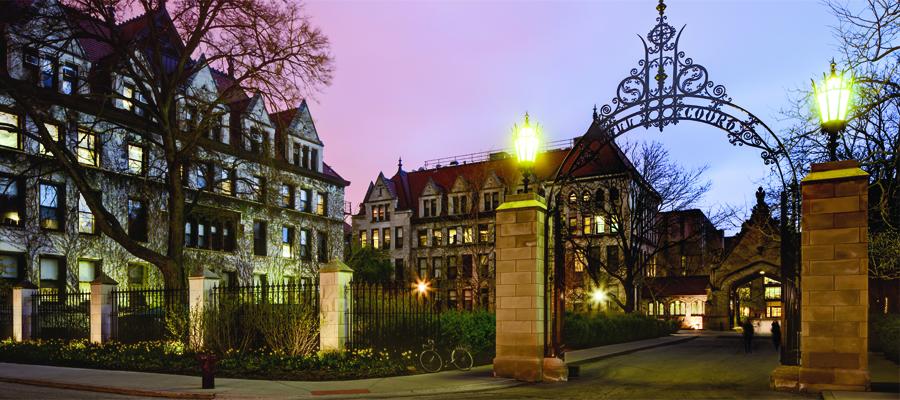
Established in 1856, the University of Chicago is a private research university based in the urban center of Chicago, the third most populous city in the United States. Outside of the Ivy League, Chicago is one of America’s top universities, and holds top-ten positions in various national and international rankings. 
Beyond the arts and sciences, Chicago has a glowing reputation for its professional schools, including the Pritzker School of Medicine, the Booth School of Business, and the Harris School of Public Policy Studies. University of Chicago alumni are responsible for the development of many academic disciplines, such as sociology, economics, law, and literary criticism.  
The college’s crest sees a phoenix rising from the ashes, a reference to the fire, foreclosure, and demolition of the Old University of Chicago campus, with the current University of Chicago emerging triumphantly in its place in 1890. The old university was founded through a land endowment from the controversial senator Stephen Douglas, a supporter of slavery who authored the Kansas-Nebraska act. By contrast, the new University of Chicago was co-educational and funded through donations from wealthy Chicagoans and the oil magnet John D. Rockefeller. 
Today, the University of Chicago has approximately 16,000 students enrolled, with a male to female ratio of 56:44. A quarter of all students hail from overseas, a nod to the institution’s progressive credentials. 
Students run more than 400 clubs and societies, which consist of a typical mix of sports teams, arts, cultural and religious groups, academic and political groupings, and societies that promote eclectic common interests. Among the more famous examples are the University of Chicago bowl team, which has won 118 tournaments and 15 national championships, while the university\’s competitive Model United Nations team was the top ranked team in North America in 2013–14 and 2014–2015. 
If you have an interest in media and film, then you’re well catered for: the university is home to the longest continuously running student film society Doc Films and publishes several newspapers and magazines. Budding thespians can join renowned improvisational theater troupe Off-Off Campus, or learn how to broadcast at the university-owned radio station WHPK.
Notable faculty members past and present include 29 Nobel laureates and former US president Barack Obama. Illustrious alumni come in practically every field, including the novelists Philip Roth and Saul Bellow, political movers and shakers such as pollster Nate Silver and Obama strategist David Axelrod, pioneering balloonist Jeannette Piccard, and the fictional archaeologist Indiana Jones. 

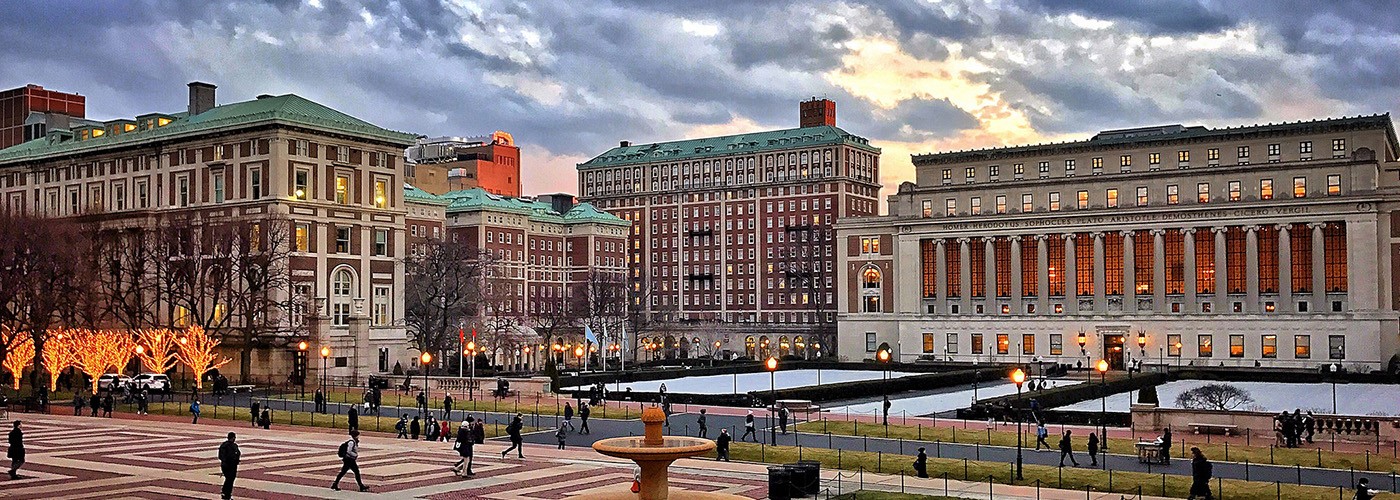
Columbia University

Image result for Columbia University

Established in 1754, Columbia University is a private Ivy League research university in Upper Manhattan, New York City. It was established as King\’s College by royal charter of George II of Great Britain and renamed Columbia College in 1784 following the American Revolutionary War. 
With an undergraduate acceptance rate of 5.8 percent, Columbia is currently the third most selective college in the United States and the second most selective in the Ivy League after Harvard. Its first president was none other than the literary great Samuel Johnson, and over the years Columbia has produced numerous distinguished alumni, from Oscar winners and Nobel laureates to Supreme Court judges. Three US Presidents and the authors of the Declaration of Independence and American Constitution were also schooled at Columbia. It also runs the highly distinguished Pulitzer Prize, an annual award for achievements in journalism, literature and musical composition. 
The university is organized into 20 schools, including undergraduate schools such as Columbia College, the Fu Foundation School of Engineering and Applied Science, and the School of General Studies, as well as graduate schools such as Columbia Law School, Columbia College of Physicians and Surgeons, Columbia Journalism School and Columbia Business School. It also had global research outposts across the world. Its total student body numbers around 28,000 and is comprised mainly of postgraduates, with roughly 8,500 undergraduate students. 
Columbia’s main campus is Morningside Heights, occupying around six city blocks in the Morningside Heights district of New York. It’s home to the neo-classical Butler library, one of the largest buildings on campus, and almost two dozen undergraduate dormitories. The university also owns 7,800 apartments in the local area, which house faculty members, students, and staff. 
The campus was designed along Beaux-Arts principles and was a late 19th century vision of a campus where all disciplines could be taught. Some of its standout features include the Low Memorial Library, a National Historic Landmark, the site of the invention of FM radio, and the location where the nuclear fission of uranium first took place. 
More significant for students are The Steps, a long series of granite steps which are a popular hangout and meeting place, and the bronze figure of Alma Mater, a female figure draped in an academic gown who serves as a daily reminder to students of their scholarly duties. 

University of Pennsylvania

The University of Pennsylvania is a private Ivy League research university located in the city of Philadelphia. It was founded in 1740 by Benjamin Franklin, one of the United States’ founding fathers, who was eager to create a school to educate future generations. 
Franklin advocated a concept of higher education that focused not merely on the education of the clergy, but on teaching knowledge of arts and humanities, as well as the practical skills needed to make a living and to do public good. His maxim of “well done is better than well said” lives on today through its commitment to inclusive policies and innovation. 
As of fall 2017, there were 21,599 students studying at Penn, split equally between undergraduate and graduate students. Penn has a strong focus on interdisciplinary learning and research, offering double degree programs, unique majors and academic flexibility. This means competition to study at Penn is fierce, particularly at undergraduate level. The admission rate for the class of 2021 was 9.3 percent, of which 46 percent were either black, Hispanic Asian, or Native American. Unusually for an Ivy League school, women comprise over half (54 percent) of all students enrolled.  
Penn’s core campus covers more than 279 acres in a contiguous area of West Philadelphia\’s University City. All of Penn\’s schools and most of its research institutes are located on this campus, with the surrounding neighborhood including restaurants and pubs, a large supermarket and cinema. 
Student life at Penn serves up opportunities to discover new interests and passions galore, through a wide diversity of social, political, religious, and cultural activities. There are cultural centers and one-of-a-kind museums on campus that allow the arts to play a leading role in student life such as the Annenberg Center for the Performing Arts, the Arthur Ross Gallery, and Institute of Contemporary Art, which are all major cultural destinations and easy for Penn students to access. 
The university also takes sports and recreation very seriously, with students taking part in ice hockey, athletics and joining a variety of competitive, instructional and recreational sports clubs.  
With its arts and sciences programs ranking in the top 10 nationally, and the employment prospects for its students among the brightest (Penn boasts one of the highest numbers of graduates who go on to become Fortune 500 CEOs), there is little doubt that the University of Pennsylvania deserves its Ivy League status and reputation.