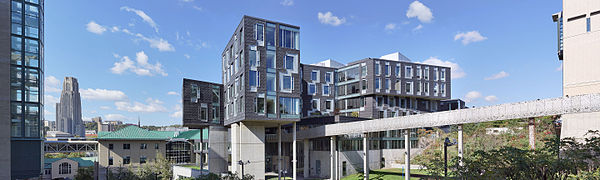
Carnegie Mellon University

Image result for Carnegie Mellon University
Located three miles from downtown Pittsburgh in a 140-acre campus, Carnegie Mellon is a private research university, founded in 1900 by Andrew Carnegie as the Carnegie Technical Schools. 
Carnegie was a Scottish-American industrialist and philanthropist whose vision was to open a vocational training school for the offspring of working class Pittsburghers. In 1967, Carnegie Tech merged with the Mellon Institute, a science research center founded by the Mellon family of Pittsburgh. 
Today, Carnegie Mellon is home to 13,650 students from 114 countries, split roughly evenly between undergraduates and postgraduates. Globally, it regularly ranks in the top 50 universities, but excels in certain disciplines: in 2018, Carnegie Mellon was ranked third in the world for computer science in the QS World University Rankings by Subject. It also featured in the top 10 globally for statistics and operational research. 
For the Class of 2021, Carnegie Mellon had an overall admissions rate of 13.53 percent, with the acceptance rates of individual colleges varying significantly: for the Dietrich College of Humanities and Social Sciences it was 22 percent, while applicants had a meagre 7 percent chance of admission to the School of Computer Science. 
Carnegie Mellon has a distinctive interdisciplinary approach to research and education, establishing programs and centers outside the limitations of departments or colleges and becoming a leader in new fields such as computational finance, information systems, and cognitive sciences. 
There are seven academic divisions at Carnegie Mellon, including one of the oldest colleges of fine arts in the United States, as well as schools in the humanities and social sciences; engineering; information systems and public policy; science; and computer science.  
Student life at Carnegie Mellon features over 225 student societies and organizations, art galleries, and various singular traditions. Carnegie Mellon\’s campus houses galleries such as The Frame, and the Regina Gouger Miller Gallery, which specializes in contemporary art. 
Top class performing arts are staged by students at the Carnegie Mellon School of Music, the Carnegie Mellon School of Drama and the student-run theatrical organization Scotch\’n\’Soda. 
Inspired by Andrew Carnegie\’s Scottish heritage, as well as the Mellon family\’s Scots-Irish ancestry, a Celtic flavor runs through the campus, manifested in Scotty, the Scottish Terrier mascot, The Tartan student newspaper, Skibo Gymnasium, The Thistle yearbook, and the Céilidh weekend every fall semester for homecoming.

The University of New South Wales (UNSW Sydney)

Image result for The University of New South Wales (UNSW Sydney)

UNSW Sydney (The University of New South Wales) is one of the world’s leading research and teaching universities. Established in 1949, we are home to more than 59,000 students from over 130 countries and an alumni community of 300,000 that spans the world.
No longer young in years we remain young in spirit, committed to pioneering research and preparing the next generation of talented global citizens for career success.
Our students are the number one choice among Australia’s top employers and we are ranked 24th in the world for employer reputation. Our 4,300 researchers lead the world in solar power, HIV treatment and quantum computing and they are internationally renowned in many other fields.
Our main campus is located on a 38-hectare site at Kensington, seven kilometres from the centre of Sydney, voted 9th best student city in the world. Other campuses are UNSW Art & Design (Paddington) and UNSW Canberra at ADFA (Australian Defence Force Academy).
UNSW Sydney is a founding member of the prestigious Group of Eight (Australia) and the PLuS Alliance, and is a member of Universitas 21, the Association of Pacific Rim Universities, and the Global Alliance of Technological Universities where we were the only Australian university invited to join.

The University of Sydney

Related image
The University of Sydney was founded on the principle of giving everyone the opportunity to realise their potential through education and still holds that belief just as strongly today.

Currently ranked 4th in the world, and 1st in Australia, for graduate employability*, the University of Sydney is also consistently placed among the top 50 universities in the world**. With a reimagined undergraduate curriculum, world-class facilities, inspirational academics and a vibrant campus life, it is a place where students can attain widely recognised and respected qualifications.
The University offers Australia’s broadest range of disciplines and its research focuses on finding solutions to society’s biggest challenges. With more than 400 areas of study to choose from, students have the flexibility to follow their interests, broaden their skills, and enjoy internship and global exchange opportunities.
Outside the classroom, students can make lifelong friends and connections, and enjoy unforgettable experiences, with more than 200 student-run clubs and societies bringing the campus to life. Our community – which covers the world – includes more than 50,000 students, 3400 academic staff, and 320,000 alumni.
Explore courses at the University of Sydney.

* QS Graduate Employability Rankings, 2017
** QS World University Rankings, 2016–17

Fudan University

Image result for Fudan University
Ask any would-be Chinese undergraduate where they most would like to study, and chances are Fudan will be mentioned. Based in downtown Shanghai amid the bustle and beauty of this urban metropolis, Fudan is one of China’s most prestigious and selective schools. 
It was founded in 1905 shortly before the end of China’s imperial Qing dynasty. The two Chinese characters that make up the name of the university are taken from Confucian philosophy and mean “heavenly light shines day after day” – an indication of the school’s high ideals and aspirations. 
Throughout China’s travails during the 20th century, from the Japanese invasion in 1937 to the Cultural Revolution, Fudan University has been a constant presence, evolving with the times into a modern, comprehensive-style university. 
It has over 45,000 Chinese students on its books, and an additional 1,750 from overseas – the second highest total nationally. Students study in 17 schools and 69 departments, and the university confers 73 bachelor\’s and 201 master’s degree programs across a wide range of disciplines. It’s consistently ranked among the top five universities in China. 
Most students live and study at the main Handan campus. Life on campus is acknowledged as an important part of students’ personal development, and as such there are a wide range of clubs – 310 student clubs in total, including 260 undergraduate organizations, 30 graduate student clubs, and 19 international student clubs. Some have a long history, such as the Fudan Opera Troupe, established in 1925, or the Painting and Calligraphy Society. 
Volunteering in the community has also become an important part of student life, with more than 50 college and department volunteer service teams. After the Wenchuan earthquake, 1,077 volunteers from Fudan were part of disaster relief teams, and another 1,300 students volunteered at the Beijing Olympic Games, Paralympics, and World Aquatics Championships. 
Fudan is beginning to spread its tentacles over the world, with academic exchange programs and partnerships with more than 200 universities and research institutions, including Harvard, Columbia, and the London School of Economics. 
Its alumni are prominent politicians, artists, and scientists who have excelled in their fields, and include the director of the World Bank, Zhang Shengman, as well as Chen Zhongwei, a pioneer of the process of reattaching severed limbs. 

New York University (NYU)

New York University (NYU) was rated the maximum five QS stars, achieving full marks in the categories research, innovation, facilities and specialist criteria.

Ranked 46th in the QS World University Rankings® 2016-2017, NYU is one of the best universities in the world, and its graduates are favoured by recruiters, as indicated by NYU’s excellent performance in the Graduate Employability Rankings 2017.

NYU ranks among the top universities in the world in the QS World University Rankings® by Subject for:
  • Accounting and finance
  • Mathematics
  • Law and legal studies
  • Psychology
  • Philosophy
Based in New York City, NYU has campuses in Manhattan and Brooklyn, with the core of its buildings around the lovely Washington Square Park in the Greenwich Village. Famous alumni include actor Alec Baldwin, the pop star Lady Gaga, and celebrated playwright Tony Kushner.


University of California, San Diego (UCSD)

The University of California, San Diego (also known as UC San Diego), is one of the top 20 universities in the United States, according to the 2018 edition of the QS World University Rankings. The seventh oldest of the 10 campuses which comprise the University of California, UC San Diego is home to approximately 22,700 undergraduates and 6,300 postgraduates. The university is split into six different residential colleges, as well as three graduate schools and two professional medical schools. The campus is decorated by over a dozen public art projects, providing the university with a distinctive look unlike other
institutions in the state of California.
The University of California San Diego is located in the neighborhood of La Jolla in northern San Diego, California, where it’s bordered by the communities of La Jolla Shores, Torrey Pines, and University City. The main campus consists of 761 buildings that occupy a huge 1,152 acres, with natural reserves covering about 889 acres. 
Around 37,000 students attend UC San Diego, the lion’s share of which are undergraduates, with the school offering over 200 undergraduate and graduate degree programs. The origins of UC San Diego go back to the early 20th century and the founding of the Scripps Institution of Oceanography, the first permanent marine science facility in the Western hemisphere and a pioneer in climate change theory. 


UC San Diego is a public research university organized into six undergraduate residential colleges, five academic divisions (arts and humanities, biological sciences, engineering, physical sciences and social sciences), and five graduate and professional schools (Rady School of Management, Scripps Institution of Oceanography, School of Global Policy and Strategy, UC San Diego School of Medicine and Skaggs School of Pharmacy and Pharmaceutical Sciences). 
UC San Diego has been ranked in the top five best public universities in the world, and of its current academic staff, 29 have been elected to the National Academy of Engineering, 70 to the National Academy of Sciences, 45 to the Institute of Medicine and 110 to the American Academy of Arts and Sciences.
Students can get involved in all the cultural activities, clubs, societies, and sports that you would expect from a top-ranking US university. There are over 550 student organizations and 38 national and local Greek organizations hosted on campus, with 20 percent of students joining fraternities and sororities. 
Highlights of student life include the Price Center (PC), a social hub comprising multiple restaurants, the central bookstore, a cinema, and office space. The Ché Café is a student worker cooperative, social center and vegan café which is also a prominent underground music venue. In the past, bands including Green Day, Bon Iver, and Bright Eyes have played here. 

KAIST – Korea Advanced Institute of Science & Technology

Related imageFormerly known as the Korea Advanced Institute of Science and Technology, KAIST was South Korea’s first research-oriented science and engineering institution when it was founded in 1971. 
For such as young university, KAIST’s standing is growing rapidly: it is widely acknowledged as the best university in Korea and has been named the most innovative university in the Asia-Pacific region. 
One of its stand-out research projects of recent years saw researchers develop an electric transport system, where vehicles get power from cables underneath the road via non-contact magnetic charging. It’s an example of how KAIST is leading the field in developing new technologies that might tackle world problems such as energy consumption and congestion in cities. 
Around 10,000 full-time students attend KAIST, split between 4,000 undergraduates and 6,000 postgraduates. Science, engineering and technology are the school’s main focuses, though the university has branched out in recent years and is now internationally accredited in business education too. It has also adopted dual degree programs with leading world universities such as Carnegie Mellon in the United States and the Technical University of Berlin, and these offer its students diverse educational opportunities. 
The university’s main campus is in Daedeok Science Town in the city of Daejeon, 150 kilometers south of the South Korean capital, Seoul. There’s also another campus in Seoul itself, which is home to the business school as well as the graduate schools of finance, management and information and media management. 
Most lectures and research activities take place on the Daejeon main campus, which is also where most students live. There is a total of 29 dormitories on the outskirts of the Daedeok campus, strictly segregated along gender lines. There are also apartments for married students outside the campus. Extracurricular activities on campus may not be a priority at KAIST, although there are clubs and societies for students, and the university holds regular arts events including opera, drama, pop concerts, dance and classical recitals. 

The University of Melbourne

Image result for The University of Melbourne
ABOUT
When the University of Melbourne was established in 1853, it was a mere cluster of buildings in a large park on the fringe of the city, with four professors and 16 students. The university now sits at the heart of a thriving international city and is consistently ranked among the leading universities in the world and number one in Australia. 

Over 8,000 academic and professional staff support a vibrant student body of more than 48,000, including 13,000 international students from over 130 countries around the world. Four Australian prime ministers and five governors-general have graduated from the University of Melbourne, located in the city dubbed Australia’s “cultural capital”. 
Indeed, Melbourne is a seven times winner of the Economist’s World’s Most Livable City award, and is a UNESCO City of Literature, as well as the birthplace of Australian rules football and a major center for street art, music, and theatre. 
Melbourne is known for offering students an experience that’s a lot more than just structured learning. The main Parkville campus is close to transport, cafes, shopping, arts and sports venues and accommodation. 
Students will find a blistering array of cultural activities on campus here, be it theatre, comedy, film or public lectures, and it’s easy to find people with matching interests by joining one of over 200 affiliated clubs and societies, ranging from Chess Club to Women in Science and Engineering, to the Chocolate Lovers’ Society. Sports enthusiasts are well catered for too, with a 25-metre six-lane heated indoor pool, an athletics track and sports field, and a large strength and fitness gym. 
The university has 11 residential colleges where most students live, which provide a quick way to build an academic and social network. Each college provides sporting and cultural programs to enrich the academic experience, which is at the center of university life. 
Degrees at the University of Melbourne stand out for being modelled on those from top institutions overseas. Students spend a year exploring a range of subject areas before choosing a major. They also study subjects outside as well as inside their chosen discipline, giving Melbourne students a breadth of knowledge that sets them apart.  

London School of Economics and Political Science (LSE)

Image result for London School of economics And Political Science

The London School of Economics and Political Science (LSE) offers you the opportunity to study the social sciences in an institution with a worldwide academic reputation, while enjoying the cultural, social and recreational facilities of one of the world’s greatest capital cities.
The School is a place of genuine intellectual excitement and cutting-edge research. In the most recent national Research Excellence Framework (REF) LSE had the highest percentage of world-leading research of any university in the United Kingdom.
All LSE’s teaching and research is undertaken from a social science perspective, giving the institution a unique approach to otherwise common fields. LSE academics are at the forefront of developments in the social sciences and their expertise is called upon by governments, businesses and media around the globe.
The School offers over 40 undergraduate programmes and over 140 taught and research postgraduate programmes. LSE’s academic profile spans a wide range of social science disciplines, from accounting to law, management to social policy.  
The character of LSE is inseparable from its location. Situated in central London, the School is located in one of the most cosmopolitan cities in the world. Only a short distance from Europe’s financial, legal and cultural centres, LSE stands at the crossroads of international debate. This is fundamental to our identity as an outward-looking institution with an active involvement in UK and world affairs. 
The student community at LSE is one of the most internationally diverse in the world, with students from over 140 countriesregistered each year. This mix encourages a truly international approach to intellectual discovery and academic life at LSE which cannot be matched elsewhere. 
The School has one of the most prestigious public events programmes in the world. Leading figures from all walks of life have spoken at LSE, including Bill Clinton, Nancy Pelosi, Amartya Sen, Christine Lagarde, Bill Gates, Helen Clark and George Soros.

McGill University

Image result for mcgill university

Based in Montreal, McGill University ranks among Canada\’s most prestigious universities, attracting thousands of international students from over 150 countries every year, and the highest percentage of PhD students of any Canadian research university. McGill University owes its reputation to its 50 research centers and institutes, 400+ programs, rich history and thriving alumni network of 250,000 people around the globe.
Graduates are highly sought after by employers, with the following percentages of graduates in education or employment two years after graduation:
·         81% of art graduates
·         95% of engineering graduates
·         91% of medicine graduates
·         84% of science graduates
·         92% of all PhD respondents  
Montreal also came first in the QS Best Student Cities 2017, a ranking of the most student-friendly cities around the world. Both safe and affordable, Montreal is infused with art and different cultures. Of its 3.5 million residents, 800,000 were born overseas and 220,000 are engaged in higher education. Rental costs here are significantly lower than in other major university cities, while many international institutes, pharmaceutical firms, financial companies, and aeronautical firms are based here, providing ample employment opportunities for students.
If, like 32% of McGill University’s graduate students, you are international, you are strongly urged to apply for any scholarships you may be eligible for, including any of these six international fellowships
Maclean\’s ranking  – top Canadian medical-doctoral university, #1 for 13 years in a row!
Follow Graduate and Postdoctoral Studies, McGill University on Facebook and Twitter for the latest in video and news.
For more inquiries, please contact gradapplicants.gps@mcgill.ca

University of California, Los Angeles (UCLA)

Image result for university of california los angeles

ABOUT
Based in warm and sunny Los Angeles, the University of California, Los Angeles (UCLA) was ranked the 31st best university in the world according to the QS World University Rankings® 2016-2017.
UCLA graduates are in the enviable position of being among the world’s most employable students fresh out of uni, as suggested by UCLA’s impressive performance in the QS Graduate Employability Rankings ® 2017.
UCLA ranks among the top 10 universities in the world for:
  • English language and literature
  • Geography, linguistics
  • Modern languages
  • Electrical and electronic engineering
  • Biological sciences
  • Medicine
  • Psychology
  • Chemistry
  • Mathematics
  • Communication and media studies
  • Education and training
  • Anthropology
  • Archaeology
  • Arts and humanities
  • Life sciences and medicine

King\’s College London

Image result for King\'s College London
ABOUT
King\’s College London is one of the top 25 universities in the world (2016/17 QS World University Rankings) and among the oldest in England. King\’s has more than 27,600 students (of whom nearly 10,500 are graduate students) from some 150 countries worldwide, and some 6,800 staff.
King\’s has an outstanding reputation for world-class teaching and cutting-edge research. In the 2014 Research Excellence Framework (REF) King’s was ranked 6th nationally in the ‘power’ ranking, which takes into account both the quality and quantity of research activity, and 7th for quality according to Times Higher Education rankings. Eighty-four per cent of research at King’s was deemed ‘world-leading’ or ‘internationally excellent’ (3* and 4*). The university is in the top seven UK universities for research earnings and has an overall annual income of more than £684 million.
King\’s has a particularly distinguished reputation in the humanities, law, the sciences (including a wide range of health areas such as psychiatry, medicine, nursing and dentistry) and social sciences including international affairs. It has played a major role in many of the advances that have shaped modern life, such as the discovery of the structure of DNA and research that led to the development of radio, television, mobile phones and radar.
King\’s College London and Guy\’s and St Thomas\’, King\’s College Hospital and South London and Maudsley NHS Foundation Trusts are part of King\’s Health Partners. King\’s Health Partners Academic Health Sciences Centre (AHSC) is a pioneering global collaboration between one of the world\’s leading research-led universities and three of London\’s most successful NHS Foundation Trusts, including leading teaching hospitals and comprehensive mental health services. For more information, visit: www.kingshealthpartners.org.
King’s £600 million campaign, World questions|KING’s answers, has delivered huge global impact in areas where King’s has particular expertise. Philanthropic support has funded new research to save young lives at Evelina London Children’s Hospital; established the King’s Dickson Poon School of Law as a worldwide leader in transnational law; built a new Cancer Centre at Guy’s Hospital; allowed unique collaboration between leading neuroscientists to fast-track new treatments for Alzheimer’s, Parkinson’s, motor neurone disease, depression and schizophrenia at the new Maurice Wohl Clinical Neuroscience Institute; created the Cicely Saunders Institute: the first academic institution in the world dedicated to palliative care, and supported the King’s Sierra Leone Partnership in the Ebola crisis. Donations provide over 300 of the most promising students with scholarships and bursaries each year.More information about the campaign is available at www.kcl.ac.uk/kingsanswers.

King\’s College London

Image result for King\'s College London
ABOUT
King\’s College London is one of the top 25 universities in the world (2016/17 QS World University Rankings) and among the oldest in England. King\’s has more than 27,600 students (of whom nearly 10,500 are graduate students) from some 150 countries worldwide, and some 6,800 staff.
King\’s has an outstanding reputation for world-class teaching and cutting-edge research. In the 2014 Research Excellence Framework (REF) King’s was ranked 6th nationally in the ‘power’ ranking, which takes into account both the quality and quantity of research activity, and 7th for quality according to Times Higher Education rankings. Eighty-four per cent of research at King’s was deemed ‘world-leading’ or ‘internationally excellent’ (3* and 4*). The university is in the top seven UK universities for research earnings and has an overall annual income of more than £684 million.
King\’s has a particularly distinguished reputation in the humanities, law, the sciences (including a wide range of health areas such as psychiatry, medicine, nursing and dentistry) and social sciences including international affairs. It has played a major role in many of the advances that have shaped modern life, such as the discovery of the structure of DNA and research that led to the development of radio, television, mobile phones and radar.
King\’s College London and Guy\’s and St Thomas\’, King\’s College Hospital and South London and Maudsley NHS Foundation Trusts are part of King\’s Health Partners. King\’s Health Partners Academic Health Sciences Centre (AHSC) is a pioneering global collaboration between one of the world\’s leading research-led universities and three of London\’s most successful NHS Foundation Trusts, including leading teaching hospitals and comprehensive mental health services. For more information, visit: www.kingshealthpartners.org.
King’s £600 million campaign, World questions|KING’s answers, has delivered huge global impact in areas where King’s has particular expertise. Philanthropic support has funded new research to save young lives at Evelina London Children’s Hospital; established the King’s Dickson Poon School of Law as a worldwide leader in transnational law; built a new Cancer Centre at Guy’s Hospital; allowed unique collaboration between leading neuroscientists to fast-track new treatments for Alzheimer’s, Parkinson’s, motor neurone disease, depression and schizophrenia at the new Maurice Wohl Clinical Neuroscience Institute; created the Cicely Saunders Institute: the first academic institution in the world dedicated to palliative care, and supported the King’s Sierra Leone Partnership in the Ebola crisis. Donations provide over 300 of the most promising students with scholarships and bursaries each year.More information about the campaign is available at www.kcl.ac.uk/kingsanswers.

King\’s College London

Image result for King\'s College London
ABOUT
King\’s College London is one of the top 25 universities in the world (2016/17 QS World University Rankings) and among the oldest in England. King\’s has more than 27,600 students (of whom nearly 10,500 are graduate students) from some 150 countries worldwide, and some 6,800 staff.
King\’s has an outstanding reputation for world-class teaching and cutting-edge research. In the 2014 Research Excellence Framework (REF) King’s was ranked 6th nationally in the ‘power’ ranking, which takes into account both the quality and quantity of research activity, and 7th for quality according to Times Higher Education rankings. Eighty-four per cent of research at King’s was deemed ‘world-leading’ or ‘internationally excellent’ (3* and 4*). The university is in the top seven UK universities for research earnings and has an overall annual income of more than £684 million.
King\’s has a particularly distinguished reputation in the humanities, law, the sciences (including a wide range of health areas such as psychiatry, medicine, nursing and dentistry) and social sciences including international affairs. It has played a major role in many of the advances that have shaped modern life, such as the discovery of the structure of DNA and research that led to the development of radio, television, mobile phones and radar.
King\’s College London and Guy\’s and St Thomas\’, King\’s College Hospital and South London and Maudsley NHS Foundation Trusts are part of King\’s Health Partners. King\’s Health Partners Academic Health Sciences Centre (AHSC) is a pioneering global collaboration between one of the world\’s leading research-led universities and three of London\’s most successful NHS Foundation Trusts, including leading teaching hospitals and comprehensive mental health services. For more information, visit: www.kingshealthpartners.org.
King’s £600 million campaign, World questions|KING’s answers, has delivered huge global impact in areas where King’s has particular expertise. Philanthropic support has funded new research to save young lives at Evelina London Children’s Hospital; established the King’s Dickson Poon School of Law as a worldwide leader in transnational law; built a new Cancer Centre at Guy’s Hospital; allowed unique collaboration between leading neuroscientists to fast-track new treatments for Alzheimer’s, Parkinson’s, motor neurone disease, depression and schizophrenia at the new Maurice Wohl Clinical Neuroscience Institute; created the Cicely Saunders Institute: the first academic institution in the world dedicated to palliative care, and supported the King’s Sierra Leone Partnership in the Ebola crisis. Donations provide over 300 of the most promising students with scholarships and bursaries each year.More information about the campaign is available at www.kcl.ac.uk/kingsanswers.

King\’s College London

Image result for King\'s College London
ABOUT
King\’s College London is one of the top 25 universities in the world (2016/17 QS World University Rankings) and among the oldest in England. King\’s has more than 27,600 students (of whom nearly 10,500 are graduate students) from some 150 countries worldwide, and some 6,800 staff.
King\’s has an outstanding reputation for world-class teaching and cutting-edge research. In the 2014 Research Excellence Framework (REF) King’s was ranked 6th nationally in the ‘power’ ranking, which takes into account both the quality and quantity of research activity, and 7th for quality according to Times Higher Education rankings. Eighty-four per cent of research at King’s was deemed ‘world-leading’ or ‘internationally excellent’ (3* and 4*). The university is in the top seven UK universities for research earnings and has an overall annual income of more than £684 million.
King\’s has a particularly distinguished reputation in the humanities, law, the sciences (including a wide range of health areas such as psychiatry, medicine, nursing and dentistry) and social sciences including international affairs. It has played a major role in many of the advances that have shaped modern life, such as the discovery of the structure of DNA and research that led to the development of radio, television, mobile phones and radar.
King\’s College London and Guy\’s and St Thomas\’, King\’s College Hospital and South London and Maudsley NHS Foundation Trusts are part of King\’s Health Partners. King\’s Health Partners Academic Health Sciences Centre (AHSC) is a pioneering global collaboration between one of the world\’s leading research-led universities and three of London\’s most successful NHS Foundation Trusts, including leading teaching hospitals and comprehensive mental health services. For more information, visit: www.kingshealthpartners.org.
King’s £600 million campaign, World questions|KING’s answers, has delivered huge global impact in areas where King’s has particular expertise. Philanthropic support has funded new research to save young lives at Evelina London Children’s Hospital; established the King’s Dickson Poon School of Law as a worldwide leader in transnational law; built a new Cancer Centre at Guy’s Hospital; allowed unique collaboration between leading neuroscientists to fast-track new treatments for Alzheimer’s, Parkinson’s, motor neurone disease, depression and schizophrenia at the new Maurice Wohl Clinical Neuroscience Institute; created the Cicely Saunders Institute: the first academic institution in the world dedicated to palliative care, and supported the King’s Sierra Leone Partnership in the Ebola crisis. Donations provide over 300 of the most promising students with scholarships and bursaries each year.More information about the campaign is available at www.kcl.ac.uk/kingsanswers.