Launch of IRCTC iMudra

IRCTC since its inception has been one of the
front-runners of bringing e-commerce to the doorstep of common-man and
has also been a pioneer in bringing many digital innovations in
different railway domains.
Continuing with the same spirit, passion, and lots of enthusiasm, IRCTC has now launched its new product named “IRCTC iMudra” to increase its footprint in the digital payment’s domain.
IRCTC iMudra, a powerful prepaid card cum wallet is
safe, secure and easy to use customer oriented B2C product. It will open
a world of possibilities for you, empowering you with the true power of
going 
cashless on every transaction, whether you are doing a transaction
through POS machines, peer to peer money transfer, withdrawing cash at
ATMs or buying goods and services online.
  • Accessible Across All Channels like mobile app, tablet and desktop.
  • Comes with a virtual and physical card for purchasing goods online or offline.
  • Easy way to send or receive money to friends and family within the network.
  • Widely accepted across all VISA enabled ATMs in India to withdraw cash.
  • Hassle-free ticket booking on IRCTC through wallet as well as prepaid card.
  • Exclusive Launch Offers.

New Education Policy, the way to Nalanda, Takshasila glory

Expressing
concern over India’s slide from the heights of Nalanda and Takshasila
to not being among the world’s top 100 educational institutions now, the
Vice President of India and Chairman of Rajya Sabha, Shri M. Venkaiah
Naidu has said that the New Educational Policy will make India a global
educational hub. He urged the public to give their views and suggestions
on the draft NEP by the stipulated time of 15th of this month.
Shri
Naidu further called for a holistic and value-based education that will
lay strong foundations for the vibrant economy that India is emerging
as. He spoke on the challenges to Indian education after releasing a
book ‘The Dynamics of Indian Education’ authored by Prof. J.S. Rajput at
the Vice President’s residence, here today.
The
Vice President said; “These are the critical times for the country and
there is a need for having a fresh look at the education system. I have
been consistently advocating the need for revamping the education system
to not only make our universities world-class, but to make India the
knowledge hub. I am glad that the draft of the New Education Policy
makes several out of the box suggestions that have the potential to turn
India into a global education hub.”
Shri
Naidu stressed that primary education shall be in the mother tongue
which enables learning other languages effectively at later stages.
Highlighting the knowledge traditions of India, he referred to several
German Universities promoting Sanskrit to decipher ancient palm leaves
and scriptures for clues for scientific innovation.
Former
Union Minister Shri Arif Mohammad Khan who spoke on the occasion said
that the land of India for ages is marked by the tradition of knowledge
and wisdom. He referred to Prophet Mohammad as having said; “Sitting in
Mecca, I am feeling the cool breeze of Knowledge from India. I am an
Arab without Arabness; I am not an Indian but feel the Indianness.”
Prof.
Rajput, former Secretary-General of Lok Sabha, Shri Subhash Kashyap and
Chairman of Prasar Bharti, Shri A. Surya Prakash spoke on various
aspects of Indian Education.
Following is the text of Vice President’s address:
I am immensely pleased to release the book “The Dynamics of Indian Education” written by well-known educationist, Prof Rajput. 
The
book covers a whole gamut of issues relating to Indian education system
and I must compliment the author for this timely work on a topic that
is very close to my heart.
As
we all are aware, India has a rich history, tradition and culture of
education system from Vedic times. The Gurukul system of imparting
knowledge and skills used to focus on holistic development of
individuals. Education of women was also accorded huge importance during
ancient times and there were well-known women scholars during the Vedic
period.
In
fact, India was once known as Vishwaguru because of its world class
centres of learning like Takshashila, Pushpagiri, Nalanda and others. It
was stated that around 10,000 students, including many from foreign
shores used to study diverse subjects at Takshashila.
India
contributed not only in philosophy and spirituality, but in sciences,
mathematics, astronomy and other areas. The objective was “welfare of
one and all – Sarva Bhut Hite Ratah”
Subsequently,
following foreign invasions and the colonial rule, India lost its
pre-eminent position. Today, one finds that not a single Indian
university figures in the top-ranking global educational institutions.
These
are the critical times for the country and there is a need for having a
fresh look at the education system. I have been consistently advocating
the need for revamping the education system to not only make our
universities world class, but to make India the knowledge and innovation
hub.
We
need to recapture the past glory. Our education system must remain
deeply rooted to culture, while simultaneously steadfastly pursuing new
frontiers of knowledge.
Undoubtedly,
our post-Independence achievements in education are praiseworthy. We
have near total enrolment in schools in spite of over-threefold increase
in population!
The
recent launch of Chandrayaan -2 and other remarkable achievements in
space sciences have unveiled before the world the Indian tradition for
the quest of knowledge. It inspires and motivates young Indians and our
scientists deserve all the praise for making us proud. Elsewhere,
Indians working at NASA and Silicon Valley have made the country proud
with their contributions.
I
feel that the need of the hour is to provide quality education at all
levels to all people. I am glad that the draft of the New Education
Policy makes several out-of-box suggestions that have the potential to
turn India into a Global education Hub. With the draft report placed for
another round of receiving inputs, I hope that many more suggestions
would come forth to make Indian universities achieve their rightful
place in the global rankings.
I
must however, mention that in our march towards a knowledge society, we
need to strengthen our school education on priority basis. In
particular, special attention has to be bestowed to improve government
schools.
We
must reform the education system to do away with rote learning. We need
to promote concept learning, critical thinking, creativity, problem
solving skills as also multilingualism and digital literacy to enable
the students to confidently face challenges and successfully pursue
their careers.
I
need not once again enumerate the importance of teaching in mother
tongue from a young age. In fact, I have consistently been advocating
the need to make it mandatory for mother tongue to be the medium of
instruction up to primary level.
I
am told that some of the top universities in Germany teach Sanskrit to
enable the scholars of the subject decipher ancient palm leafs and
scriptures and find clues for scientific innovation. We should not
neglect Sanskrit. I feel that no language should be imposed, nor any
language opposed.
Teachers
are the pivot of national educational endeavors. We need best of the
minds in teaching profession. Once in the profession they need to
internalize “yavadjeevait adhiyate viprah” – the wise continue to gain knowledge throughout life.
Teachers
should be torchbearers of the society. I am told that there are around 1
crore teachers and 30 crore students from KG to PG level in the
country. Filling up all the vacant positions of teachers is equally
important to make our education effective.
Teachers
play the most crucial role in shaping the character of a child after
his or her parents. Therefore, teachers should have societal concerns.
We must develop a model of education that reflects Indian culture and
ethos. We need to inculcate cultural, moral, ethical and spiritual
values among children.
I
hope the new educational policy will address various concerns on
reforming the system and fulfill the need for India-centric education
architecture. The draft policy should be studied with an open mind.
People should give constructive suggestions rather than criticize it for
the sake of criticism.
We
need education for progress and development. Probably more than that,
we need Education for Character Development. Value based education that
prepares the young for an India that abounds in ‘social cohesion and
religious amity’ is our goal.
The
book practically covers all the aspects mentioned by me. Prof. Rajput
strongly pleads for value education, character formation and celebration
of unity in diversity. I wish him well in his efforts.


Commerce & Industry Minister holds discussions with CEOs of Indian IT Companies to explore new markets

Union
Minister of Commerce & Industry and Railways, Piyush Goyal,held a
meeting with senior managers of IT companies in New Delhi yesterday. The
meeting was held to discuss opportunities for Indian IT companies to
invest and grow their business in new markets like the Nordic countries,
Eastern and Central Europe, Canada, Australia and Africa and also
exploreavenues for greater investments and growth in East Asian markets
like China, Japan and Korea.
India’s
IT industry contributed 7.7% to the country’s GDP in FY 2017 and is
expected to contribute 10% of India’s GDP by 2025. According to NASSCOM,
the sector aggregated revenues of USD 160 billion in 2017. The United
States account for 2/3rds of India’s IT services exports.
India’s
IT and ITeS industry grew to USD 181 billion in 2018-19. Exports from
the industry increased to USD 137 billion in FY 2019 while domestic
revenues (including hardware) advanced to USD 44 billion.
During
the discussions with Commerce and Industry Ministry, the
representatives of the companies informed that although the Chinese IT
services market is the third largest in the world India’s investments
and business have not been able to grow in China due to various
non-tariff barriersand challenges faced by Indian companies to set up
their entity in China. Marketaccess issues that create hurdles for
Indian companies to open their business in China was also discussed.
The
top five Indian IT service companies like TCS, WIPRO, Infosys, Tech
Mahindra and HCL are doing business in China for more than a decade and
are employing 90% of local people in their China operations but returns
are very low and thereforeIndian IT service companies are not showing
much interest to invest and expand their operations in China.
Commerce
and Industry Minister during the discussions requested National
Association of Software and Services Companies (NASSCOM) and the senior
managers of the companies attending the meeting to share specific data
regarding non-tariff barriers being faced by them inChina and other East
Asian markets. Government of India will give all support for the global
growth of India’s flagship industry and will make all efforts to
facilitate the IT service industry and for that it is ready to engage
with China and also Japan and Korea, informed Piyush Goyal.
Commerce
and Industry Minister urged India’s IT services companies to explore
other markets and not be inhibited in operating in countries that are
non-English speaking. He urged the top five Indian IT firms to create a
corpus that will be spent on training manpower in languages like
Mandarin, Japanese and Korean for accessing the markets in these
countries.
The
meeting was attended by senior managers of TCS, Satyam Venture
engineering, HCL, NIIT Tech, Infosys, Invento Robotics, Tech Mahindra
and WIPRO. SangeetaGodbole, DG of Services Export Promotion Council
(SEPC) and President of NASSCOM, Debjani Ghosh, were also present during
the discussions with Commerce and Industry Minister.
India
is the largest exporter of IT services in the world and exports
dominate the Indian IT industry and constitutes about 79% of the total
revenue of theindustry. India’s IT service sector is now gearing up to
be the digital partner of intelligent automation like smart algorithms,
bots and AI tools, which arefast becoming a part of every industry and
an increasingly digital world.

Army Launches E Car to Combat Pollution

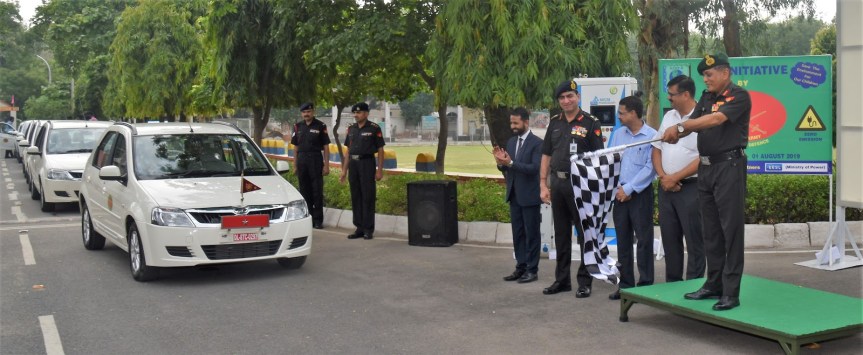
The
Indian Army in step with government policies on environmental
protection has launched an ecological initiative with employing E Cars
for use of its officials in New Delhi in partnership with Energy
Efficiency Services Ltd (EESL), a joint Venture of Central PSUs under
Ministry of Power. The introduction of E-Car in Army at Delhi was
visualised on World Environment Day and launched on 01 Aug 2019 with
flagging off the first lot of E-Cars for Indian Army by QMG, Lt Gen
Gopal R. Army plans to operate the first batch of 10 E-Cars as a pilot
project and develop further on this initiative and increase the number
of E Cars in Delhi to ensure economy, efficiency and minimal emissions.
It
is pertinent to mention that Army has always been at the forefront of
environmental initiatives. Indian Army has a large number of Territorial
Army Battalions (ECO) which have done a yeoman service in environmental
protection initiatives such as forestation. Army units posted in remote
and ecologically sensitive areas from Kashmir to Kanya Kumari have been
carrying out various activities in close coordination with local
populace to conserve the ecological balance and protect the environment.
Air
pollution has been a major challenge in Delhi. Governments across the
World are investing a lot of resources in fighting this menace. Electric
vehicle technology has proved to be a viable alternative by reducing
the carbon emission footprint. Indian companies like Tata Motors and
Mahindra have taken a lead in R&D and manufacturing of Electric
Cars. EESL has been the main facilitator in providing these vehicles to
various Government agencies. Army’s initiative in encouraging these
electric vehicles will go a long way in further development of this
technology and its adoption for the general public in near future.

Drones to undertake Large scale Mapping of Village areas in Maharashtra

Survey
of India ,the national mapping agency of the country under the Min of
Science & Technology has signed an MoU with Department of revenue
& Land records, Govt of Maharashtra to undertake the Large scale
Mapping of Village Gaothan (Aabadi)  areas in the State of Maharashtra
using drones.
Chief
Minister of Maharashtra ,Shri Devendra Fadnavis inaugurated the Drone
based Mapping Project being carried out by Survey of India at Nimgaon
Korhale in Ahmednagar district on 31st July, 2019. Minister
of Rural Development, Women and Child Welfare Pankaja Gopinath Munde;
Surveyor General of India Lt Gen Girish Kumar, VSM; Commissioner Revenue
& Land Records; Commissioner Rural Development and Secretary, RDD
from Govt of Maharashtra along with other officials were also present
during the launch of the project. This large scale mapping project is
being carried out by Survey of India, Min of Science & Technology,
Govt of India for Dept of Revenue and Land Records, Govt of Maharashtra
using Professional Survey grade Drone covering more than 40,000 Village
Gaothan (Aabadi) areas in Maharashtra State. 
These
village Gaothan areas not been surveyed earlier will be mapped at 1:500
scale covering all land parcels in the village for preparing the
accurate revenue maps and GIS database. Drone survey will be pivotal to
fix locations of village boundaries, canals, canal limits and roads in
these villages.
A detailed presentation about this Large scale Mapping Project was also made in the National Workshop and Conference of Sarpanch and Upsarpanch organized
jointly by Department of Rural Development, Govt of Maharashtra and All
India Sarpanch Association Shirdi, Ahmednagar district on 31st July. This national conference was organized under the guidance of  CM Shri Devendra Fadnavis, presided by Minister
of Rural Development, Women and Child Welfare Pankaja Gopinath Munde
and attended by other Ministers, MP, MLAs and other dignitaries. This
conference was attended by thousands of Sarpanch, Upsarpanch and farmers
across the country and the Maharashtra state.

Sea to be The next Gateway for Tourism in The Country

The
Minister of State for Shipping (I/C) and Chemicals & Fertilizers,
Shri Mansukh Mandaviya and  Minister of State (I/C) for Tourism &
Culture, Shri. Prahlad Singh Patel discussed  the immense potential for 
maritime tourism in the country. In a  meeting between the two
Ministers held in New Delhi yesterday, the two  ministers  emphasised 
the need to promote the important tourist destinations in the coastal
areas of the country through coastal tourism .
It
was decided in the meeting to set up a committee of senior officials of
the two Ministries to explore the avenues for coastal tourism  in the
country and work out ways to promote the same. It was also  decided to
explore  the possibilities and opportunities in the areas of  Coastal
Tourism, Cruise Tourism, Sea Sports, Light House Viewing Gallery.  It
was suggested that every coastal area can create a calendar of events
for  tourist engagement, with activities like beach volleyball, sand
art, food festivals, dances of the fishing community, to name a few.
The
Shipping Ministry is promoting tourism in maritime states under the
Sagarmala Programme. This is being done in convergence with the Ministry
of Tourism and Tourism Development Departments of maritime state
governments.
These
new, unexplored tourism areas will open a door to coastal communities
of the maritime states where they will find many new and diverse job
opportunities. In the coming years, coastal and maritime tourism will be
a source for growth and job creation in the coastal states of India.
The
two Ministers  also underscored the need  for better coordination and
synergy between their respective Ministries so that desired results can
be achieved in a time bound manner.