‘One Nation One Ration Card’, Inter-State portability in two clusters of adjoining States of Andhra Pradesh & Telangana and Gujarat & Maharashtra

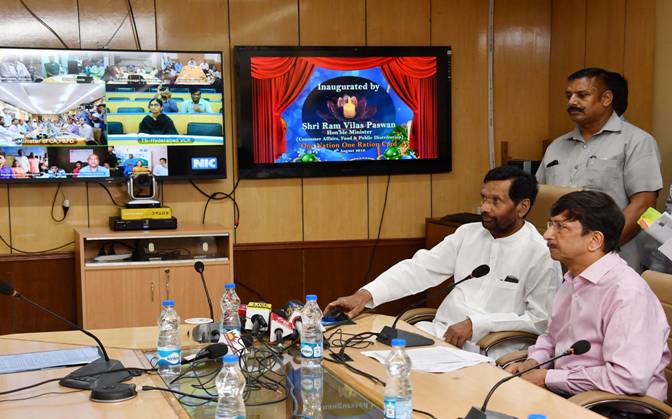
In a major step towards achieving the objective of ‘One Nation One Ration Card’, the Union Minister for Consumer Affairs, Food and Public Distribution Shri Ram Vilas Paswan today inaugurated the inter-State portability in two clusters of adjoining States of Andhra Pradesh & Telangana and Gujarat & Maharashtra. This will enable beneficiaries from either States’ cluster to avail the benefits accruing to them under the National Food Security Act from any of the two States.

Addressing the media after inaugurating the inter-State portability Shri Ram Vilas Paswan said that today marks the beginning of National level portability of Ration Cards which has begun with the two States’ clusters.Shri Paswan further stated that after leveraging the progress under Computerization scheme, 11 States/UT of Andhra Pradesh, Gujarat, Haryana, Jharkhand, Karnataka, Kerala, Maharashtra, Punjab, Rajasthan, Telangana and Tripura have implemented the intra-State portability of ration card holders to lift the entitled foodgrains from any Fair Price Shop within their State.Further, it is envisaged that the inter-State portability shall be introduced in the 11 States having already implemented intra-State portability by 1stJanuary 2020. 
Shri Paswan further added that all other States/UTs having attained requisite readiness for inter-State portability, shall be integrated in a phased manner. Thereby, enabling nation-wide portability of ration card holders to receive subsidized foodgrains under NFSA from anywhere in the country by 1st June 2020. The Union Minister said that this initiative shall be very helpful for the large migratory population of the country who migrate from one part of the country to other in search of job/employment, marriage, or any other reason and find difficulty in accessing subsidized foodgrains in the present system.
To sustain the reforms brought in by the ongoing scheme of ‘End-to-End Computerization of TPDS Operations’ and to introduce new reforms, the Department of Food & Public Distribution, is targeting implementation of nation-wide portability in distribution of subsidised foodgrains to the beneficiaries without the need of obtaining a new ration card under ‘One Nation One Ration Card’ System.
Installation of electronic Point of Sale (ePoS) devices at Fair Price Shops (FPSs) is the main enabler of portability of ration card holders, supported by the biometric/Aadhaar authentication.More than 4.1 lakh (77%) ePoS devices are already operational across the country. 25 States/UTs have either completed the installation in all FPSs or having significant progress in this area. Further, more than 85% ration cards (at least one member) in the country have been seeded with the Aadhaar numbers of the beneficiaries.        

‘Samagra Shiksha-Jal Suraksha’ Drive for School Students

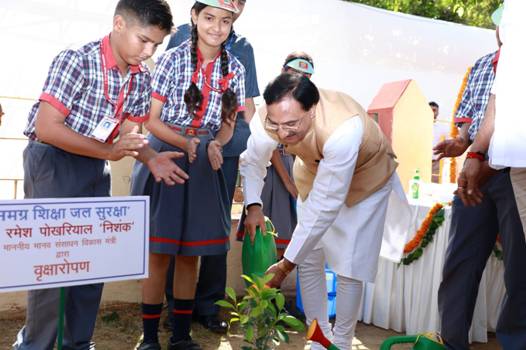
Union HRD Minister Sh. Ramesh Pokhriyal ‘Nishank’ and Union Minister for Jal Shakti Sh. Gajendra Singh Shekhawat launched ‘Samagra Shiksha-Jal Suraksha’ drive at KV no. 2 Delhi Cantt today. The dignitaries planted more than 350 saplings along with School Students and inaugurated Drip Irrigation System in the School campus. In order to create awareness about water conservation among school students, this mega drive targets to connect more than 10 crore students with this programme.
Union HRD Minister Shri Ramesh Pokhriyal ‘Nishank’ while launching the Drive asked School Students to take pledge for saving one litre water every day. 10 Crore Students together can save 10 Cr. Litres of water per day, he said. He appealed all School Students to become brand ambassador of water conservation. Students shall spread awareness about water conservation in their School, home and locality on the lines of Swachh Bharat Abhiyan.
Union Minister for Jal Shakti Shri Gajendra Singh Shekhawat expressed his deep concern on water scarcity in the Country and discussed various methods of water conservation. Quoting the example of Israel he explained how a small country with very limited sources of water generated innovative methods of water conservation and became a water exporting country. He also appreciated the efforts of Ministry of HRD and Kendriya Vidyalaya Sangathan towards water conservation.
Shri ‘Nishank’ and Shri Gajendra Singh Shekhawat also launched a booklet prepared by Department of School Education and Literacy, titled- ‘How I am going to save 1 litre water every day?’ This booklet discusses those small efforts which can save a lot of water.
Inspired by Prime Minister’s impetus on Jal Sanchay, Government of India has launched the Jal Shakti Abhiyan (JSA). It is a time bound campaign with a mission mode approach. This concept of water conservation is essential for students so that they can understand the importance of water and how it is shaping their lives meaningfully, thereby enabling them to participate in water conservation activities in their day to day lives.
The Department of School Education & Literacy, MHRD has launched the ‘Samagra Shiksha-Jal Suraksha’ drive to promote water conservation activities for School Students, so that they can become competent, conscientious and committed water citizens of our nation. The Department has prepared a detailed outline to implement this programme in all the schools of the country.
Five Major Objectives:
  1. To educate Students learn about conservation of water
  2. To sensitize Students about the impact of scarcity of water
  3. To empower Students to learn to protect the natural sources of water
  4. To help every Student to save at least one litre of water per day
  5. To encourage Students towards judicious use and minimum wastage of water at home and school level

Union Home Minister Amit Shah to release Vice President’s book on two years in office

A book chronicling two years in the office of the Vice President Shri M Venkaiah Naidu will be released at the Kalaivanar Arrangam, Chennai on August 11, 2019, by Union Home Minister Shri Amit Shah.
The function is being hosted by Shri Prakash Javadekar, Union Minister of Environment & Forests & Climate Change and Information and Broadcasting. The book titled “LISTENING, LEARNING & LEADING” captures a few glimpses of the Vice President’s 330 public engagements in all the States and Union Territories of our country during the last two years.

Crisscrossing the length and breadth of our vast country, the Vice President has delivered 61 convocation addresses, interacted with students on 35 occasions, visited 97 scientific and technological research institutions and delivered 25 special lectures.
The book contains Shri Naidu’s important diplomatic engagements including his visits to 19 countries in 4 continents. He was the first Indian Vice President to visit Panama, Guatemala, Costa Rica, and Malta.
The book will showcase his achievements as Rajya Sabha Chairman and his initiatives to enhance effectiveness, and promote the efficiency of Rajya Sabha.
Shri Banwarilal Purohit, the Governor of Tamil Nadu, Shri Edappadi K. Palaniswami Chief Minister of Tamil Nadu, Shri O. Panneerselvam, Hon’ble Deputy Chief Minister of Tamil Nadu will be attending the event.
Eminent Agriculture Scientist Prof. M.S. Swaminathan, Former Director ISRO, Dr. Krishnaswamy Kasturirangan, Former Attorney General of India Shri K. Parasaran, Editor of Tughlak Shri Swaminathan Gurumurthy, Chairman of Apollo Hospitals Group Dr Pratap C Reddy, Founder & Chancellor of VIT Dr.G.Viswanathan, Chief National Coach of Indian Badminton Team Shri Pullela Gopichand and several other dignitaries and eminent personalities will also attend the event.

People must participate actively in governance process to fast-track development

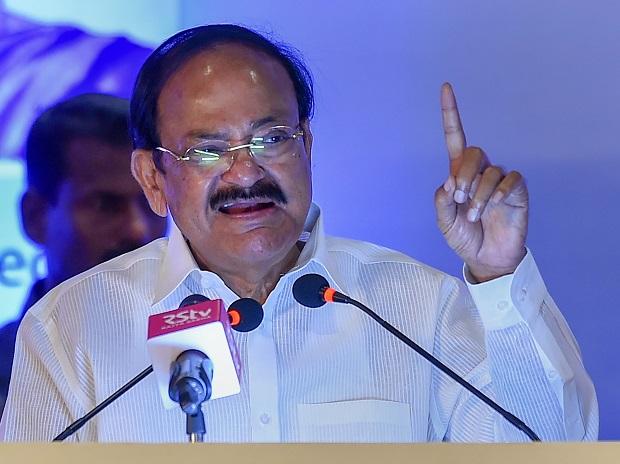
The Vice President of India, Shri M. Venkaiah Naidu has said that people of the country must be active participants in governance to fast-track the process of development. He said that merely enacting legislations would not create solutions to problems and stressed that laws must be backed by political skill and administrative will.
 
The Vice President was addressing the gathering at the 117th Birth Anniversary celebrations of Shri Gujar Mal Modi, after presenting the Gujar Mal Modi Innovative Science and Technology Awards 2019 to Prof. S.K. Satheesh and Dr. Maharaj Kishan Bhan (Padma Bhushan) at Vigyan Bhawan, here today. Shri. Naidu lauded the Gujar Mal Modi Science Foundation for their initiative of encouraging scientists and innovators and said that we must preserve the age old Indian tradition of honouring excellence, to motivate the younger generations to do well.
Shri Naidu called for innovative and out-of-box solutions to formidable challenges like poverty, pollution, climate change, diseases, not-so-profitable agriculture and low-efficiency industrial processes.
Calling for a culture of innovation, the Vice President said that innovation was imperative to address these challenges and take India forward on the path to inclusive and sustainable development at a faster pace.
The Vice President called for a reorientation of the education system to promote creativity. Asserting that foundations for the culture of innovation must be laid in our schools and colleges, he observed that a ‘new model of education’ was needed.
“We must build on the ‘best practices’ we have developed over centuries as learners, and create ‘next practices’ that would suit our vision for our future,” he added.
Saying that research in basic sciences forms the bedrock of all technological advancement, Shri Naidu said that it was crucial to create an environment where the government, universities, corporate houses, and others come together to propel the entire science eco-system forward with special emphasis on sustainability.
Expressing his desire to develop Indian universities into centers of excellence in basic sciences as well as cutting edge technology, Shri Naidu said that our universities must become the power houses of research and development.
Observing that innovation and entrepreneurship must hand in hand, the Vice President said that universities must serve as safe spaces for entrepreneurship to flourish.
The Vice President presented Gujar Mal Modi Innovative Science and Technology Awards to Prof. S.K. Satheesh and Dr. Maharaj Kishan Bhan (Padma Bhushan). The President of the Gujar Mal Modi Science Foundation, Shri. Satish Kumar Modi, trustees of the foundation, Shri. Krishan Kumar Modi, Shri. Umesh Kumar Modi and others were present on the occasion.
Following is the text of Vice President’s address:
I am delighted to be with the Modi family and all of you to participate in the 117th Birth Anniversary celebrations of late Shri Gujar Mal Modi, and to felicitate Prof. S.K. Satheesh and Dr. Maharaj Kishan Bhan (Padma Bhushan) with the ‘Gujar Mal Modi Award-2019’.
On this occasion, I pay tribute to Shri Gujar Mal Modi, the founder of the Modi Group of Industries, who was a great humanitarian. He was one of the prominent architects of modern industrial India
I am told that Bahadur Gujar Mal Modi undertook several welfare initiatives for his employees and their families. He built schools, educational institutions, hospitals, temples and residential complexes for them. He believed in taking peoples’ wealth back to people and made conscious efforts to plough back a large part of the profit made by his business undertakings for social good.
Shri Gujar Mal Modi was presented the prestigious Padma Bhushan by the Government of India, in recognition of his achievements as an enterprising industrialist and for his immense philanthropic work.
Today, the Modi Family is celebrating the 117th birth anniversary of this great philanthrope.
I am glad to know that, since 1988, the Foundation has already recognized thirty three personalities of the country who have excelled in their respective fields. The list includes Dr. A.P.J. Abdul Kalam, Dr. Anil Kakodkar, Prof. M.G.K. Menon and Dr. Kasturirangan.
I am happy to know that the Jury, under the chairmanship of Dr. K. Kasturirangan, former Member, Planning Commission, has decided to honour Prof. S.K. Satheesh and Dr. Maharaj Kishan Bhan this year.
Prof. S.K. Satheesh, the Chairman of Divecha Centre for Climate Change and Professor of Centre for Atmosperic and Oceanic Sciences at Indian Institute of Science (IISc), has made outstanding contributions to understanding the significant impact of light – absorbing atmospheric aerosol particles on the radiation balance of the Earth-atmosphere system and regional climate.
Prof. Satheesh’s efforts in the assessment of the radiative impact of aerosols, which is widely used in climate models to study monsoon, are indeed praiseworthy. I extend my hearty congratulations to him for the honour that he received today.
  1. Bhushan Dr. Maharaj Kishan Bhan from Kashmir, is currently the Chair of the Health Systems Transformation Platform, established by the Tata Trusts and of the Technical Advisory Group of the National Biopharma Mission.
I am glad to note that his pioneering research lead to development of a Rotavirus vaccine from a novel virus strain he isolated at AIIMS, New Delhi. The vaccine developed through a decade long effort is now delivered through the country’s immunization program and used in other developing countries. Over 100 million of this vaccine doses given to children in last few years has saved countless lives. His efforts have inspired translational biomedical science and innovation by Indian academia and industry.
He is globally recognized as an innovation leader in medical research and technology development. I congratulate Dr. Bhan on his outstanding achievements.
It is common knowledge that research in basic sciences form the bedrock of all technological advancement. It is crucial to create an environment where the government, universities, corporate houses and others come together to propel the entire science eco-system forward with special emphasis on sustainability.
One way to motivate and encourage talented youngsters is by recognizing and applauding the accomplishments of our researchers and scientists, a step taken by the G.M. Modi Foundation years ago. My congratulations to this Foundation for encouraging scientists in the way you have been doing for the past 31years.
My dear brothers and sisters,     
I am sure that all of you are aware of the tremendous progress that our country is making on several fronts. We have a stable democracy and a vibrant economy. We have huge potential in our demography with 65% of the population being below 35 years of age.
I strongly believe that for India to move ahead on the path of inclusive and sustainable development, at a faster pace, innovation is an imperative. Today, we face a number of formidable challenges like poverty, pollution, climate change, diseases, not-so-profitable agriculture, and low-efficiency industrial processes.
We have to find solutions to these problems using the limited resources that are available to us.
Innovation and out-of-box solutions are the only way forward.
Innovation is a culture, a mindset.
Once you have an innovation culture, even those who are not scientists or engineers would also embrace innovation and scientific literacy. Thus innovation would get embedded as one of the core values of a society, promoting economic growth and development.
This culture of constant innovation is what India needs today, it is what will make India a global leader.
Investing in innovation is investing in a bright future.
The foundation for this culture of innovation must be laid in our schools and colleges.
Children are born with a natural curiosity about the world around us. This curiosity is the foundation of all invention. We must encourage our children to ask questions, to critique and to reject the irrational.
Our education system must be overhauled to inspire creativity and curiosity. It must seek to turn this native curiosity among children into knowledge that gives us the power to invent, to find solutions to problems.
We must build a new model of education together, a model that does not resist change but remains forever open and adaptable. We must build on the ‘best practices’ we have developed over centuries as learners, and create ‘next practices’ that would suit our vision for our future.
A start has been made through initiatives like ‘Atal Tinkering labs’ set up in more than 5500 schools in India, under the Atal Innovation Mission, to foster curiosity, creativity, and imagination in young minds and inculcate skills such as design mindset, computational thinking, adaptive learning, physical computing etc.. Many more such initiatives which serve as platforms for innovation, should come up.
Our universities must serve as centres for excellence in basic sciences as well as cutting edge technology. They must be power houses of research and development.
To meet this objective, the research projects that are undertaken by our universities must live up to international standards and benchmarks. It has very often been said that a major weakness of Indian education and research is the relatively very small part played by the universities in the sum total of Indian research.
At the institutional level, there is a need to link teaching with research. The government needs to invest in faculty development, provide incentives for research, promote collaborative efforts between institutions in research.
Our universities must move beyond adopting technology to embracing it.
Initiatives such as outcome based research financing, setting up of Incubation Centers for innovative research and setting up Research Parks in central educational institutions can go a long way in making our universities thriving knowledge-creation centres.
Unlike in the past, tight boundaries between various disciplines have almost disappeared. Today’s researchers cannot confine themselves to compartmentalized silos and must have a basic understanding of other related disciplines. The issues are also no longer discipline-specific and cut across several disciplines. A holistic research approach needs to be adopted in an inter-disciplinary manner.
For example, health, education and environment are of immense concern to all and cannot be confined to particular disciplines.
The canvas of new research both in science and social science is vast and will definitely help young researchers to get a wider perspective on various phenomena. The emerging areas in bio-technology, genetic engineering, biodiversity, new materials, micro-machines, bio-medical simulations and equipment, new dominions in space research and technology including permanent human habitat in space, and similar new frontiers in oceans, are some of the examples.
I urge our educational institutions to come together for creating new knowledge at the intersections of existing disciplines.
My dear sisters and brothers,
Much is being said about promoting entrepreneurship. The priority accorded by the government to innovation is clearly reflected in missions such as ‘start-up India’ and Stand-up India’.
I strongly believe that innovation and entrepreneurship go hand in hand. Our universities must serve as safe spaces for entrepreneurship to flourish. We must encourage our brilliant youngsters to collaborate and work together in teams to come up with business ideas that are feasible, sustainable and most importantly, socially relevant.
The ultimate aim of all innovation is the betterment of the human condition, the alleviation of suffering and the promotion of stability, peace and harmony.
I urge all of you, especially young innovators to have a big vision and then take small steps to realize your vision. Sometimes, innovation is not about cutting edge technology, it is about simple solutions to complex problems. India is a country that is well known for its frugal innovations. We must keep this competitive advantage of ours alive and use it to the best possible extent to defeat challenges.
Let me also caution you that every single cutting edge technology brings with it its own disruptive interventions. We as a society must be mature and prudent enough to manage these disruptions which are very often paradigm altering.
Let me impress upon you that Science is a moving target, forever advancing and progressing. We need to keep ourselves updated and be ready to work hard.
I once again congratulate Prof. S.K. Satheesh and Dr. Maharaj Kishan Bhan. I hope that the legacy of philanthropic activities left behind by Bahadur Gujar Mal Modi will be carried forward by his family in the times to come. I wish all of you all the very best in your future endeavours.
Thank You!
Jai Hind!”


5375 Persons Rescued And More Than 42,000 Evacuated By NDRF

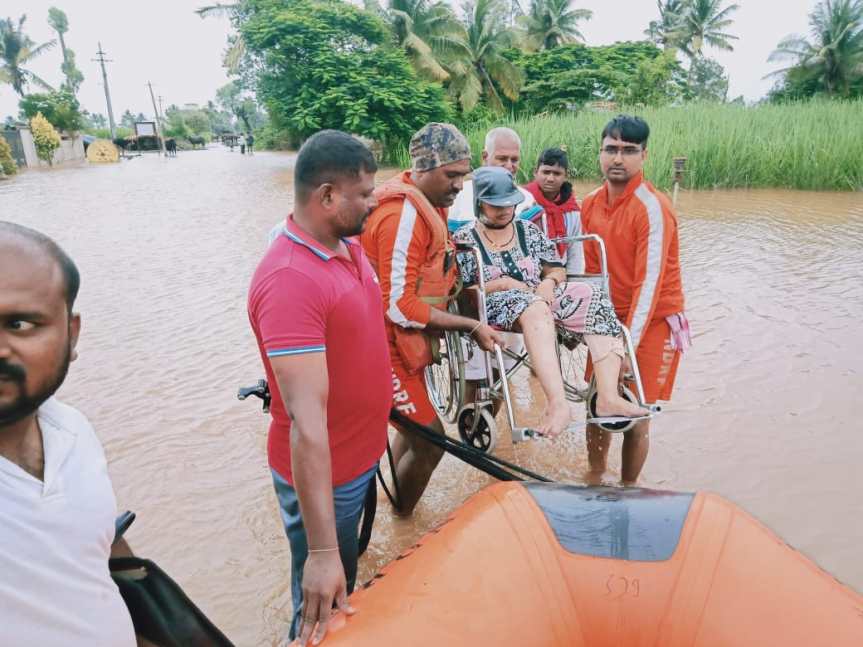
5375 people rescued & more than 42,000 stranded persons & 268 livestock have been evacuated and taken to safer locations by National Disaster Response Force (NDRF) across the country since operation commenced. The NDRF is engaged in rescue & evacuation work with full zeal & commitment at various districts of flood affected states viz. Kerala, Karnataka, Maharashtra, Andhra Pradesh, Madhya Pradesh and Gujarat. Total 173flood rescue teams are deployed by Force across the country for rescue & relief work during the recent monsoon season.
In Kerala the incessant rainfall across the region has affected most of the districts of the state viz. Ernakulam, Idukki, Thrissur, Malappuram, Palakkad, Kozhikode, Wayanad, Kozhikode and Kannur. Bridges, roads are vulnerable to flood which has affected the normal life of the populace. Yesterday, incessant rainfall triggered a major landslide at Ipadi, Puttupala, Wayanad in Kerala, which trapped several people under the debris. NDRF team immediately rushed to the incident site. However, heavy rains and debris on the way obstructed the movement of NDRF team. Despite all odds, NDRF team managed to reach incident site and immediately started the operation with other agencies. In a joint operation, rescue agencies evacuated 194 persons. In addition, NDRF team operational at Mallapuram evacuated 27 person from flood affected areas, today. 13NDRF teams are deployed in Kerala.
In Karnataka, 09 additional teams (05 from Kolkata & 04 from Ghaziabad) are in the State to expedite operations. Presently, 20 NDRF teams are engaged in rescue & relief work with full zeal & commitment at Kodagu, Raichur, Belagavi, Bagalkot & Dharwad districts. Today, teams evacuated 374 persons at Belagavi and 12 at Dharwad . Till Now, NDRF has evacuated over 3400 persons & 24 live Stocks to safer places in Karnataka.

In Maharashtra,  32 NDRF teams are present in the flood affected areas of the State for quick response. Today, NDRF has rescued 2750 persons & evacuated 883 persons at Sangli whereas 300 persons rescued and 246evacuated to safer locations at Kolhapur by NDRF teams. So far, NDRF has rescued 5292 persons and also evacuated more than 18,000 persons & 40 livestock’s in Maharashtra. Besides, team also retrieved 07 dead bodies. The operations are still on.
In Andhra Pradesh, 05 NDRF teams are deployed in Andhra Pradesh. NDRF team deployed at East Godavari commenced rescue operation and evacuated36 people to safer places, today. Total 76 persons evacuated in Andhra Pradesh, till now.
In Madhya Pradesh, 03 NDRF teams are deployed in the State. Today, team evacuated 86 persons at Badwani. So far, 115 persons & 17 livestock have been evacuated by NDRF in Madhya Pradesh.
And In Gujarat today, NDRF team evacuated 150 persons from flooded areas of Chota Udaipur where a total of 4245 persons and 57 livestock have been evacuated by NDRF. 18 teams are deployed in Gujarat.
24×7, NDRF Control Room in New Delhi is functioning round the clock to keep the close vizil over the development of situation and is in touch with other agencies & stakeholder. DG, NDRF is personally monitoring the rescue & relief operations by NDRF and additional teams are on standby at various NDRF locations.

NITI Aayog launches Fourth Edition of Women Transforming India Awards; invites nominations for the Awards

NITI Aayog, the premier think tank of the Government of India, has launched the Fourth Edition of Women Transforming India (WTI) Awards, in collaboration with the United Nations in New Delhi today. UN Resident Coordinator in India, Ms. Renata Lok-Dessallien, opened the nomination process for WTI Awards 2019, in the presence of CEO NITI Aayog, Mr. Amitabh Kant, senior government officials and partners of Women Entrepreneurship Platform (WEP).
The applications for the awards are now live, and nominations can be filed on behalf of individuals or by the individual themselves at https://wep.gov.in.
The WTI Awards, since its inception in 2016, has been recognising and celebrating stories of exemplary women from across India. The theme for WTI Awards 2019 is “Women and Entrepreneurship”, in continuation with last edition’s theme that recognizes women entrepreneurs who are breaking the glass ceiling and challenging stereotypes, through businesses and enterprises and are providing innovative developmental solutions to building a dynamic New India.
Whatsapp has collaborated with the WEP for the WTI Awards of 2019, and will be providing support equivalent toUS$100,000 to the winners.
The campaign builds on the success of the WTI Awards for the past three years. WTI Awards 2018 received more than 2,300 nominations. Through a highly objective and rigorous selection process, 15 women entrepreneurs doing inspirational work from diverse sectors viz. Renewable Energy, Education, Sanitation, Art and Culture, Social Innovation and Impact, were recognised. The first two editions of the WTI Awards felicitated 12 phenomenal stories each of women undertaking phenomenal work to transform societies across India’s cities, towns and villages; and empowering themselves and their communities.
Addressing on the occasion, Mr. Amitabh Kant CEO NITI Aayog said,“WTI Awards is a flagship initiative of NITI Aayog. For the past three years, we have been celebrating the power of women and recognising their efforts in championing the cause of their societies. The next wave of disruption in India’s start-up ecosystem would be led by women-led enterprises. I am personally invested in ensuring the success of winners of the WTI Awards”.
 
Calling Women Transforming a movement, Ms Dessallien said, “We chose women’s entrepreneurship as our theme because at the heart of these Awards, this movement rather, is the idea that women lead change. I believe that if there is any one group, which can decisively accelerate India, and the world’s, achievement of the Sustainable Development Goals, it is India’s women. The over half a billion women are not a target audience. They are not the recipients of development. They are stakeholders. Their full and equal participation changes conversations, the way we talk about development; it transforms politics and decision making; it improves policy.”
About WEP
WEP is one of its kind facilitation platform, which enables convergence of multiple stakeholders on a single platform, work in collaboration with these stakeholders to bridge the gap in the entrepreneurial ecosystem, host relevant information about several schemes and partner organizations on WEP website to connect women entrepreneurs with relevant partners.
Established under the leadership of Ms. Anna Roy, Sr. Adviser of NITI Aayog, WEP focuses on both reaching out to the community through online means as well as increasing interaction of stakeholders with grass root women entrepreneur community through offline activities so that the benefits can reach the bottom-most of the pyramid. WEP, through its partners, in various verticals such as Finance, Marketing and Networking, Entrepreneurship Development, Mentoring, Incubation and Acceleration aims at providing services such as free credit ratings, skill development, local support, corporate partnerships, funding support etc. to women entrepreneurs.
WEP also works to enable sharing of best practices amongst women entrepreneurs and partner organizations and act as a facilitation platform through which relevant data can be collected and research activities can be undertaken, in association with partner organizations to understand and provide solution to women centric problems in entrepreneurial space.
In the span of past 15 months, WEP has seen several success stories emerging. WEP has more than 5,000 women entrepreneurs registered on the platform, more than 30 partners and has committed funding of more than US$10mn for these startups.

Is Education Overrated?


Importance of Literacy Rate

When discussing the well-being of any country or state of human development of a country; literacy rate is considered to be one of the key parameters. Disparity between literacy rates across genders, geographies, communities tells government where she needs to focus most. Literacy rate is perfect litmus test of a country’s human development.

But why literacy rate is so important?

One of the key requirements for modern societies to function is our abilities to coordinate and communicate effectively. For example, Government launches a new scheme to provide free polio shots for kids.

Unless the general public understands and appreciates this, the rupees spent on this will not yield anything. The citizens need to be able to read on and understand about the government’s role responsibility and actions. Especially when we talk about democracy, it becomes even more important for the citizens to understand various sides of the argument and choose the best alternative.

Literate vs Educated

Literacy is basically understood as ability to read and write. But is it sufficient? Can a person who can read constitution, understand it?
There is a huge gap between being literate and being educated. The third world countries are often blamed for portraying incorrect picture about literacy rates. As they do not take into account the kind of education the person has received.

Formal Education in India

The formal education in India is divided in 10+2+3 followed by specializations. The first 10 years formal education is common for all, before in +2 students are allowed to choose a stream. +2 does not offer lot of options to diverge, but after 2 years of Intermediate, students are ready to take up specialization course- The Graduation. Graduation normally takes 3 years, but for more technically complex courses like Engineering or medicine, it may take little longer. Post graduation, students are free to choose super-specialization courses- the master’s degree. After Masters, student can go for doctorate (PhD) and so on.

Purpose of Education

For a long time, Indian education system was very formal and people studied on as needed basis. Unless someone had deeper interests in literature or another particular field, the purpose of education was very limited. People learned for their interests, there was no burden.
But then came the British. With Merlo-Minto reforms in early 20th century, the Britishers changed the purpose of education from just education to making people job-ready. While this may sound good, it also made the education just a rat race. People read nowadays just to get a job without exploring their interests or even pursuing their interests.
As a result, such students perform very mediocrely in their jobs, with no passion at all, they just go with the flow without attaining their true potential.

The Indian education system believed in
सा विद्या या विमुक्तये|
This means education is the one that sets us free. In other words, if it is does not set us free, it is not education. And this is where the modern education is failing the humanity. It does not set us free from our doubts, our misbeliefs- it does not make us human.
A concentration camp survivor once said that education does not make the world a better place. The concentration camps and the nuclear bombs were built by some of the brightest minds the world has ever seen. Being a better human being is far too important than anything else.
Role of a “good” education becomes more important in today’s world when it is more fragmented than ever. Democratization of media has created so much noise that differentiating black from white is more difficult and more necessary than ever before. We are using our “education” as a weapon. Such type of education does not set us free; it makes us prisoners of our own devise. If the world has to survive, if the world has to be a happy place we need an education system that frees us, that liberates us. Afterall,
सा विद्या या विमुक्तये|