‘India’s participation at WorldSkills International Competition must be seen as big as the Olympics’

The 48-member Indian Team representing the country at WorldSkills Kazan 2019 was given a grand send-off at a ceremony in the capital today, organized by National Skill Development Corporation (NSDC) under the aegis of Ministry of Skill Development and Entrepreneurship (MSDE), to motivate the participants as they gear up to pit their skills against the best in the world. India is the sixth largest team that will take part in the competition.

Nearly 1,500 competitors from 60 countries will compete in 56 skill competitions at this mega event in Kazan, Russia on August 22-27. The 48-member Indian team will participate in 44 skills, including mobile robotics, prototype modelling, hairdressing, baking, confectionary & patisserie, welding, brick laying, car painting, floristry, etc. Forty-four experts and 14 interpreters are also accompanying the participants to Kazan. In 2017, a 28-strong contingent took part in the WorldSkills International at Abu Dhabi, winning one silver, one bronze and nine Medallions of Excellence.
Addressing the candidates Dr. Mahendra Nath Pandey, Minister for Skill Development and Entrepreneurship, said, “My heartiest congratulations to the 48 of you who have proven your mark at the national level. You all will now represent the country at the world’s biggest skill competition in Russia. My advice to you is to compete in the true spirit of participation and make India proud on the global platform and at the same time learn from your international peers competing with you. You are the brand ambassadors of India and your victory will be an inspiration for every Indian youth who aspires to make it big in their life. Participating at events of such scale adds to the larger cause of skill development which is integral to Prime Minister, Shri Narendra Modi’s vision of a Skilled India.”
“I am happy to learn that we have six young girls also bearing the flag of the country at Kazan. I am positive you will inspire many more and we will see increased female participation in the years to come. I also hope with Team India’s participation at WorldSkills, the event will gain the same level of popularity in the country, as the Olympics and the Asian Games,” he added.
The desire to excel in the trades of their choice has played a crucial part in the candidates realising their dream of performing at a global stage. Mohammed Rabith from Malappuram, Kerala is one such example of grit and determination. The 22-year-old whose father works as a coolie and mother is a homemaker, aims to make his parents and his country proud by winning the gold medal in Wall & Floor Tiling Skill at the WorldSkills. Stories like Rabith are abound in the Indian team, where the spirit of youth is motivated by aspiration and the desire to excel.
Himanshu Vohra, a final-year civil engineering student from Chitkara University in Punjab, is representing India in Plumbing and Heating Trade. Himanshu’s passion and interest in plumbing has taken him to multiple competitions, including Global Skills Competition in Australia, before he found himself as a contender for the WorldSkills in Russia.
About 75% participants come from tier II and tier III cities, with 25% from rural areas. Most belong to humble backgrounds, parents work as farmers, coolie, daily wage laborers and security guards. Among states/UTs, Maharashtra tops the chart with seven contestants participating in the competition, followed by five from Karnataka and four from Uttar Pradesh. Over 50,000 youth had registered for the IndiaSkills Competitions that was organized across several legs last year.
Participants spoke about their experiences at the send-off. Present among the audience were proud parents who greeted them with loud cheers as the Minister felicitated all 48 contestants.
The 48 contestants have been shortlisted through a series of contests conducted at district, state, regional and national levels over the past year. These candidates were provided extensive training in skills ranging from Wall and Floor Tiling, Brick Laying, Cabinet Making, Car Painting, CNC Turning, Hair Dressing, Welding, Restaurant Service, Beauty Therapy, Auto-body Repair to Mobile Robotics, Mechatronics, Prototype Modelling, Visual Merchandising, etc, by leading corporate entities with NSDC acting as a facilitator and have been gained extensive support from Sector Skill Councils, Industry and Corporates.
Candidates have been exposed to international training with industry support from over 100 companies. More than 100 companies have Renowned experts such as Vinesh Johny – Chef/Trainer, winner of Forbes 30-under-30; Samantha Kochhar, renowned beauty expert and director of Aroma Magic; JP Shroff, Chairman of Kushal Credai; Seema Jhaveri, Director of IFD and Vaishali Shah, Principal of LTA Beauty School came together to prepare the contestants for the mega-event. Leading organisations such as Maruti, Mahindra, Toyota, Daikin, Saint Gobain, Tata Motors are among the 100+ partners which have extended support via infrastructure, equipment, expert trainers, facilities, training and more.
Aimed at promoting world-class standards in technical education and vocational training, NSDC, under the aegis for MSDE, is working to make skills aspirational and create a pathway for a career in vocational trades. 

Abolition of Triple Talaq will ensure dignity and equality to crores of Muslim women

Union Minister of Home Affairs Shri Amit Shah addressed an audience on “Abolition of Triple Talaq – correction of a historic wrong” at the Constitution Club of India earlier today.
Tracing the journey of the Act, Shri Shah said that he had spoken on the issue of Triple Talaq when it was in the ordinance format and when it was a bill. He said that it was a proud moment for him to speak of the issue of Triple Talaq when it had finally been enacted by the Parliament.

Blaming the policy of appeasement for the opposition to the removal of Triple Talaq, he said that while removal of social evils is generally welcomed by society, it was appeasement that led to some opposition to the move.
Shri Shah asserted that social unity and holistic development are hampered because of appeasement. He said that development of an entire society takes hard work and rigorous planning, and requires dedication, commitment and empathy. Calling appeasement a “shortcut”, he said that appeasement never leads to development.
Shri Shah said that those who are left behind in the journey of development must be empowered, and that holistic, all-encompassing, last-mile development is the philosophy of the government under the leadership of Prime Minister Shri Narendra Modi.
Giving the examples of nations that had abolished Triple Talaq, Shri Shah said that several Islamic nations had already taken the step decades ago, and this proves that such a barbaric practice is not part of Islamic culture.
Praising the tenacity and decisiveness of the government, Shri Shah said that the road to ending Triple Talaq was not easy, as the Bill was not able to pass through Rajya Sabha multiple times. However, the government persisted with the passage of the Bill and was ultimately successful.
Commenting on the Constitutional Status of the issue, Shri Shah said that a five judge Constitution Bench had pronounced with a majority of 3-2 that the practice of Triple Talaq violates Article 14 of the Constitution – Equality before the law and equal protection of the law. Thus, Supreme Court itself has declared the practice of Triple Talaq to be illegal, unconstitutional, arbitrary and void.
Shri Shah said that a soicety must progress with time, otherwise it becomes stale. He also said that the abolition of Triple Talaq would ensure dignity and equality for crores of Muslim women.
Commenting on the aspect of imprisonment for the violation of the Act, Shri Shah remarked that the correction of many social evils required the application of criminal laws – from Sati Pratha and child marriages to polygamy and dowry.
Regarding the maintenance of the aggrieved wife and children, Shri Shah said that the husband will be required to provide for the wife he divorces through Triple Talaq, as well as their children.
Shri Shah said that the law stipulates 3 years of imprisonment for violators, and bail is possible only after the aggrieved woman has had a chance to present her side to the court. Thus, this law empowers Muslim women in the truest sense of the word. Commenting on the results of a survey, Shri Shah said that 92.1% Muslim women wanted Triple Talaq gone.
He said that he was proud of having voted against ending the social evil of Triple Talaq.
Shri Shah observed that nepotism, casteism and appeasement have collectively damaged the nation’s polity, and emphasized that under the leadership of Prime Minister Shri Narendra Modi, the government had taken steps to remove all three from India’s polity.
Shri Shah stated that with the passage of the Act, the Prime Minister’s promise to the nation stands fulfilled. He also said that the world looks up to India with respect because of this move.
He remarked that great social reformers like Raja Rammohan Roy, Jyotiba Phule, Kavi Narmad Mahatma Gandhi, Veer savarkar and Dr Ambedkar have all contributed to uplifting our society and removing social evils. He said that Prime Minister Shri Narendra Modi’s name would find a place in the list of great social reformers because of his leadership in the quest for abolishing the practice of Triple Talaq.
Hailing the Prime Minister for the decision, Shri Shah said that the journey of the nation towards development must not stop here. He emphasized that the nation must function not on nepotism, casteism or appeasement, but on merit.

Text of PM’s Address at the Royal University of Bhutan, Thimpu

Anyone visiting Bhutan is struck as much by its natural beauty as by the warmth, compassion and simplicity of its people. Yesterday, I was at Semtokha Dzong, the fore-most example of the richness of Bhutan’s past and the greatness of its spiritual heritage. During this visit, I have had the opportunity to interact closely with the present leadership of Bhutan. I once again received their guidance for the India-Bhutan relationship, which has always benefitted from their close and personal attention.
Now, today, I am here, with the future of Bhutan. I can see the dynamism, and feel the energy. I am confident that these will shape the future of this great nation and its citizens. Whether I look at Bhutan’s past, present or future, the common and constant threads are – deep spirituality, and youthful vigour. These are also the strengths of our bilateral relationship.
Friends,
It is natural that the people of Bhutan and India experience great attachment to each other.  After all, we are close not just due to our geography. Our history, culture and spiritual traditions have created unique and deep bonds between our peoples and nations. India is fortunate to be the land where Prince Siddhartha became Gautam Buddha. And from where the light of his spiritual message, the light of Buddhism, spread all over the world. Generations of monks, spiritual leaders, scholars and seekers have burnt that flame bright in Bhutan. They have also nurtured the special bond between India and Bhutan.
As a result, our shared values have shaped a common world-view. This is visible in Varanasi and Bodh Gaya. And also in Dzong and Chorten. And as people, we are fortunate to be the living vehicle of this great legacy. No other two countries in the world understand each other so well or share so much. And no two countries are such natural partners in bringing prosperity to their peoples.
Friends,
Today, India is witnessing historic transformations in a wide range of sectors.
India is eliminating poverty faster than ever before. The pace of infrastructure construction has doubled in the last five years. We have just pledged about 15 billion dollars for next-generation infrastructure. India is home to the world’s largest health-care programme, Ayushman Bharat that offers health assurance to 500 million Indians.
India has among the cheapest data connectivity in the world, which is directly and indirectly empowering millions. India is also home to among the biggest start-up eco-systems in the world. This is indeed a great time to innovate in India!  These, and many other transformations have the dreams and aspirations of the youth of India at their core.
Friends,
Today, I stand here among the best and brightest youth of Bhutan. His Majesty told me yesterday that he interacts with you regularly and had addressed the last convocation.  It is from you all that Bhutan’s future leaders, innovators, business persons, sports persons, artists and scientists will emerge.
A few days back, my good friend, Prime Minister Doctor Tshering wrote a Facebook post that touched my heart. In that post he mentioned about Exam Warriors, and just now also a student mentioned about that book. Exam Warriors, a book I wrote about how to face exams without stress. Everyone faces exams in schools and colleges and also in the larger class-room of life. Can I tell you something? Much of what I wrote in Exam Warriors is influenced by the teachings of Lord Buddha. Particularly, the importance of positivity, over-coming fear and living in oneness, be it with the present moment or with Mother Nature. You are born in this great land.
Therefore, these traits come naturally to you and shape your personality. When I was young, the search of these traits took me all the way to the Himalayas! As children of this blessed soil, I am confident that you will contribute to finding solutions to the problems of our world.
Yes, we have challenges. But for every challenge, we have young minds to find innovative solutions to over-come them. Let no limitation constrain you.
I want to tell you all- there is no better time to be young than now! The world today offers more opportunities than ever before. You have the power and potential to do extra-ordinary things, which will impact generations to come. Find your real calling and pursue it with full passion.
Friends,
India-Bhutan cooperation in hydro-power and energy is exemplary. But the real source of power and energy of this relationship are our people. So, it is people first, and people will always be at the centre of this relationship. This spirit is clearly seen in the outcomes of this visit. Going beyond the traditional sectors of cooperation, we are seeking to cooperate extensively in new frontiers, from schools to space, digital payments to disaster management. Our cooperation in all these sectors will have a direct impact on young friends like you. Let me give some examples. In this day and age, it is crucial to connect scholars and academics beyond borders, so that creativity and talent of our students bring them at par with the best in the world. Cooperation between India’s National Knowledge Network and Bhutan’s DrukREN, which became a reality yesterday, will serve this purpose.
It will provide secure and fast connectivity between our universities, research institutions, libraries, health-care and agricultural institutions. I urge you all to make full use of this facility.
Friends, Another example is the frontiers of space. At this very moment, India’s second Moon mission, Chandrayaan-2 is on the way to the moon. By 2022 we intend to place an Indian in space, on an Indian space-craft. All these are the results of India’s own achievements. For us, the space programme is not just a matter of national pride. It is a vital instrument of national development and global cooperation.
Friends,
Yesterday, Prime Minister Tshering and I also inaugurated the Thimphu Ground Station of the South Asia Satellite and expanded our space cooperation. Through satellites, benefits of tele-medicine, distance education, resource mapping, weather fore-cast and even warning of natural disasters will reach even remote areas. It is even a matter of great happiness that young Bhutanese scientists will travel to India to work on designing and launching Bhutan’s own small satellite. I hope that someday soon, many of you will be scientists, engineers and innovators.
Friends,
For centuries, education and learning have been central to the ties between India and Bhutan. In ancient times, Buddhist teachers and scholars formed the bridge of learning between our peoples. This is a price-less heritage, which we wish to preserve and promote. Therefore, we welcome more students of Buddhism from Bhutan in institutions such as Nalanda University – a historical global seat of learning and Buddhist traditions, which is revived at the very place where it existed fifteen hundred years ago. The bond of learning between us is as modern as it is ancient. In the 20th century, many Indians came to Bhutan as teachers. Most Bhutanese citizens of older generations would have had at least one Indian teacher during their education. Some of them were honoured by His Majesty last year. And we are grateful for this generous and kind gesture.
Friends,
At any point, over four thousand students from Bhutan are engaged in studies in India. This number can and should grow. As we march forward to develop our countries, we also need to keep pace with ever-changing technological landscape. It is, therefore, Important that we collaborate in all areas of emerging technologies and education.
I am happy that yesterday we have begun new chapters of engagement between India’s premier IITs and this prestigious University. We hope that these will lead to more collaborative learning and research.
Friends,
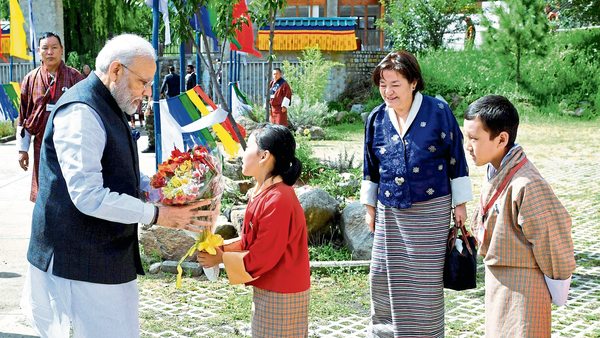
In any part of the world, if we ask the question what do you associate with Bhutan, the answer will be the concept of Gross National Happiness. I am not surprised. Bhutan has understood the essence of happiness. Bhutan has understood the spirit of harmony, togetherness and compassion. This very spirit radiates from the adorable children who lined the streets to welcome me yesterday. I will always remember their smiles.
Friends,
Swami Vivekananda had said, “Every nation has a message to deliver, a mission to fulfill, a destiny to reach”. Bhutan’s message to humanity is happiness. Happiness which springs from harmony. The world can do with a lot more happiness.  Happiness, which shall prevail over mindless hate. If people are happy, there will be harmony, where there is harmony, there will be peace. And it is peace that will help societies achieve progress through sustainable development. In a time where development is often seen in conflict with traditions and the environment, the world has much to learn from Bhutan.  Here, development, environment and culture are not at loggerheads but are in synergy. With the creativity, energy and commitment of our youth, our nations can achieve all that is required for a sustainable future –   whether it is water conservation or sustainable agriculture or making our societies free of single-use plastic.
Friends,
During my last visit to Bhutan, I had the privilege to visit the temple of democracy, the Parliament of Bhutan. Today, I have the honour to visit this temple of learning. Today, we also have in the audience Honourable Members of the Parliament of Bhutan. I especially thank them for their distinguished presence. Democracy and education both aim to set us free. Neither can be complete without the other. And both help us to achieve our fullest potential, and be the best we can. This seat of learning will once again set free our spirit of enquiry and will also keep the student within us alive.
As Bhutan soars high in these endeavours, your 1.3 billion Indian friends will not only just look on and cheer you with pride and happiness. But also they will partner you, share with you and learn from you. With these words, I would like to thank the chancellor of the Royal University of Bhutan His Majesty the King, the Vice Chancellor and the Faculty of the University, and all of you – my young friends.
You all have honoured me with your invitation and given me so much time, attention, and even more affection.  I go back with a lot of happiness and positive energy from you all.

Successful Supervisor/PhD student Relationship

A good relationship is the basis for a good performance in science and a way to promote collaboration and the success of all the members in a research group. At the core of all the labs relationships is the professor/student relationship. If this works properly, it can be the seed for the whole lab relationship.
Yet, as higher education has transformed over the decades, so have traditional relationships in academia – some more effectively than others.
Decades ago, this relationship was based on the authority of the master over the disciple. The professor/student relationship was a sort of dictatorship where the student had to follow any small desire or suggestion of the professor. The professor was a superhuman that possessed all the knowledge and wisdom, and the student was obliged do what the professor said without any doubt or discussion.
In most disciplines, the supervisor/PhD student relationship is established through the bonding process that occurs during the development of a doctoral thesis, where the student is supposed to be guided by the professor. This relationship, during a specific and limited period of time, can generate links that endure over the time, far beyond an employment relationship that is established for the fulfillment of the objectives of a project.
This does not happen today, at least not in most of the advanced research centers. Previously, the authority of the professor was based on their supposed possession of all the knowledge and the nearly absolute dependence of the student on the decisions of the professor. Now, we live in a society where access to knowledge is almost unlimited, and the professor’s preponderance over the student is based fundamentally on experience more than access to knowledge.
Also, whereas the student’s success used to require obedience and unwavering loyalty to the professor, the modern student has no need for such dependence. This has been lost in an open world, in the entire global village. Today, students have a contract and labor rights, so their survival does not depend on the whim or arbitrariness of a professor.
Apart of this, when a professor/student relationship begins, there is a need to combine two wills, each with their circumstances, to achieve a single objective. This objective is usually linked to a research project and usually leads to a doctoral thesis. Years ago, this was usually just a manuscript.
But today, the thesis is not enough; we must add on to it. From this professor-student relationship, other fruits grow, such as articles in journals, conference papers, patents, and collaborations with other research groups, some of them abroad. PhD students in my research group have gone on to work at research centers in the Netherlands, Italy, France, Sweden, Switzerland, Germany, Austria and the United States as well as in other parts of Spain. See ranking of institutions here. https://ranking.eduindex.org/ 
Normally in this relationship, the seed of the idea for a research topic comes from the professor. The professor introduces the idea to the student and provides all the necessary means for growth: laboratories, libraries, consumable material, trips (if necessary). It is the student who takes the shovel to nurture the seed with soil, water it and monitor its growth. The professor must also watch that everything goes well so the tree can grow. If problems arise, such as a plague, hail or drought, the professor must provide solutions and the means to reach them advised or helped by the student, of course, who cares directly for the tree and probably knows it better than the professor. But the main responsibility to find solutions belongs to the professor.
When time has passed and the fruits appear, they will be the fruits of both of them. Both are responsible for the final product, and both will benefit (or experience harm) from what has been achieved.
For this relationship to function well, there must be rules, which will ensure this co-responsibility becomes an eternal and enduring positive relationship over the time. When a student believes that their thesis is good or bad because of the professor, or vice versa, it is because the norms for the professor/student coexistence have not been followed.
These are the ingredients for the recipe for a healthy and fruitful relationship:
1. A relationship between equals. The professor, from the first day, should establish a personal relationship of mutual respect, equal to equal. The student will respect the professor (who is usually is wiser and older) but starting from the reality that it is a relationship between equals. Mutual respect must be the basis for the relationship.
2. Inspiration and creation of ideas. The professor should be a source of inspiration and creation of ideas. But also, the student will endeavor to learn the state of art that allows him or her to propose alternative ways in the creative process. The student must generate, from the beginning, ideas that enrich the work.
It is normal for ideas to come from the professor. Usually, when the first contact is established, the professor has a running research line established, often with funding allocated to the project. But the idea must be taken by the student as their own, and the student must strive to expand the possibilities of the work thorough their own input.
3. Means. The professor must provide the student with all the necessary means to carry out their work, including a decent salary. At the same time, the student will make every effort to make the work evolve to achieve the objectives set by the professor, and to take advantage of everything that has been put in their hands.
In former times, where a research activity often progressed thanks to the goodwill of the participants, who had to overcome what seemed like an obstacle course where even the tools to be used were not provided, is a nonsense today. Any research endeavor should ensure the basic resources in order to be developed with enough guarantees for success. The times where PhD work is done under the principle of generosity have passed. There must be enough funding to allow the research to progress, and the focus of the student should be the development of their creative work.
4. Progress of the work. The professor must monitor the progress of the student’s work at all times. The student must help the professor find solutions to the seemingly unresolvable problems that will surely come up along the way.
The times where the professor does not “give audience” to the student, waiting on their “throne hall” for the “vassal,” are long gone. In today’s research environment, if a professor does not have time to supervise PhD students properly, the supervising activity must be redefined. Also, the student must put all effort and energy in trying to solve the problems by themselves before discussing it with the professor.
5. Cooperation. The professor will become the first ally (partner, associate) of the student in the performance of the work. And the student must go to the professor whenever there is any problem or contingency related to the work along the way. The basis for the cooperation is communication. It is quite normal that students try not to disturb the professor, even though most of the time, the professor could solve the problem faster than any other person. Both professor and student must consider the work relationship as teamwork.
6. Encouragement. The professor should always encourage the student (in the best positive attitude), especially in those moments when things do not go as expected.
7. Discrepancies management. The student will discuss with the professor any possible discrepancy of criteria that may arise in the development of the work. The student will comply with the decisions of the professor, decisions that will be the result of a prior discussion.
When discrepancies appear, the best way to reach an agreement is discussion, discussion and discussion, and then reaching an agreement. Sometimes, discrepancies appear because someone fails: the professor in the guidance or the student in the execution. In those cases, before starting the discussion the first step should be communication, trying to explain what’s happened.
Failure to comply with this rule will generate a great mutual distrust that can end with a mutual hostile attitude that can, in turn, make the project fail.
8. Knowledge transfer. The student must be aware that having accepted the supervision of the professor, he becomes an essential link in the propagation of the knowledge previously accumulated by the professor. The professor will try to put all their effort in giving international relevance to the work of the student, which is also is the professor’s work.
In the today’s society, knowledge transfer is more important than ever, so both professor and student must assume that one of the main objectives in their research work is to promote, as much as possible, the transfer of the generated knowledge to the society. This can be done through scientific papers, patents, spin-offs – and scientific divulgation today is a must. This task, easier now thanks to social networks. Even when using social media for self-interest purposes, scientists that have high impact in social networks are cited more in academic metrics, according to a 2016 study in PLOS One.
In this effort to disseminate the knowledge, the student plays an important role as the main link between the professor and future students.
9. Professional projection. The professor should be aware that no matter how much he or she gives to the student, that student is putting into the hands of the professor several years of their life, in their moment of more physical and intellectual splendor. The professor will seek the greatest professional projection he or she can provide to the student.
The better the future of the student, the better the future of both of them. One well promoted student is the best way for the professor to assure future scientific networks, future collaboration and future projects. Today’s students must be future partners. To promote your students is actually a way to promote yourself.
10. Relationship forever. The professor, from the moment he or she accepts the student, must be their mentor forever. And the student must expect and ask for advice and help from the professor for the development of their later professional career.
If both are intelligent people (which is supposed), they will try to maintain, forever, this mentor/mentored relationship. With time, the student could even play the mentor role with their former professor. Both of them will grow personally and professionally, and this will allow them to help each other. If the relationship is an equal relationship from the beginning, with the passing of the years, it will be much even more egalitarian, if it is possible. This kind of relationship could promote connections as strong father/mother and son or daughter. And this could be one of the best ways to enrich the personal lives of both.