
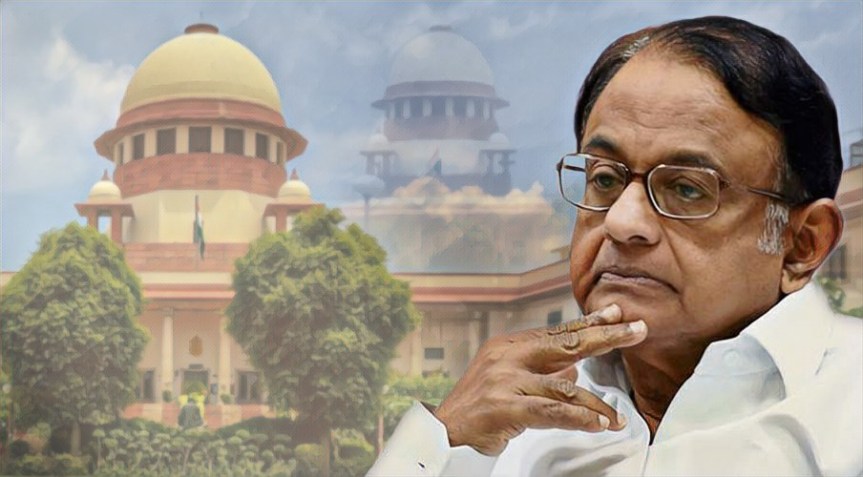
SC Dismisses Pre-Arrest Bail Plea Of P Chidambaram

In a big jolt to former Finance Minister – P Chidambaram, the Supreme Court most recently on September 5, 2019 in the notable judgment titled P Chidambaram Vs Directorate Of Enforcement in Criminal Appeal No. 1340 of 2019 (Arising out of SLP (Cri.) No. 7523 of 2019) has dismissed the fervent plea of pre-arrest bail plea made by him. It has also made some important observations vis-à-vis application of Prevention of Money Laundering Act and the scope of power vested under Section 438 of CrPC to grant anticipatory bail. The Bench of Apex Court comprising of Justice R Banumathi and Justice AS Bopanna also made it clear that though it disapproved the approach of the High Court Judge in extracting the note produced by the Enforcement Directorate but agreed with his conclusion that it is not a case fit to grant anticipatory bail.

To start with, the ball is set rolling in this noteworthy judgment authored by Justice R Banumathi for herself and Justice AS Bopanna by first and foremost observing in para 2 after granting leave in para 1 that, “This appeal relates to the alleged irregularities in Foreign Investment Promotion Board (FIPB) clearance given to the INX Media for receiving foreign investment to the tune of Rs 305 crore against approved inflow of Rs 4.62 crores. The High Court of Delhi rejected the appellant’s plea for anticipatory bail in the case registered by Central Bureau of Investigation (CBI) being RC No. 220/2017-E-0011 under Section 120B IPC read with Section 420 IPC, Section 8 and Section 13(2) read with Section 13(1)(d) of the Prevention of Corruption Act, 1988. By the impugned order dated 20.08.2019, the High Court also refused to grant anticipatory bail in the case registered by the Enforcement Directorate in ECIR No. 07/HIU/2017 punishable under Sections 3 and 4 of the Prevention of Money-Laundering Act, 2002.”
Going forward, it is then pointed out in para 3 that, “Grievance of the appellant is that against the impugned order of the High Court, the appellant tried to get the matter listed in the Supreme Court on 21.08.2019; but the appellant could not get an urgent hearing in the Supreme Court seeking stay of the impugned order of the High Court. The appellant was arrested by the CBI on the night of 21.08.2019. Since the appellant was arrested and remanded to custody in CBI case, in view of the judgment of the Constitution Bench in Shri Gurbaksh Singh Sibbia and others v. State of Punjab (1980) 2 SCC 565, the appellant cannot seek anticipatory bail after he is arrested. Accordingly, SLP (Cri.) No. 7525 of 2019 preferred by the appellant qua the CBI case was dismissed as infructuous vide order dated 26.08.2019 on the ground that the appellant has already been arrested and remanded to custody. This Court granted liberty to the appellant to work out his remedy in accordance with law.”
What’s more, it is then brought out in para 4 that, “On 15.05.2017, CBI registered FIR in RC No. 220/2017-E-0011 under Section 120B IPC read with Section 420 IPC, Section 8 and Section 13(2) read with Section 13(1)(d) of the Prevention of Corruption Act, 1988 against the accused viz. (i) INX Media through its Director Indrani Mukherjea; (ii) INX News through its Director Sh. Pratim Mukherjea @ Peter Mukherjea and others; (iii) Sh. Karti P. Chidambaram and others; (v) Advantage Strategic Consulting through its Director Ms. Padma Vishwanathan @ Padma Bhaskararaman and others; (vi) unknown officers/officials of Ministry of Finance, Govt. of India; and (vii) other unknown persons for the alleged irregularities in giving FIPB’s clearance to INX Media to receive overseas funds of Rs 305 crores against approved Foreign Direct Investment (FDI) of Rs. 4.62 crores.” 
Furthermore, it is then also brought out in para 5 that, “Case of the prosecution in the predicate offence is that in 2007, INX Media Pvt. Ltd. approached Foreign Investment Promotion Board (FIPB) seeking approval for FDI upto 46.216 percent of the issued equity capital. While sending the proposal by INX Media to be placed before the FIPB, INX Media had clearly mentioned in it the inflow of FDI to the extent of Rs. 4,62,16,000/- taking the proposed issue at its face value. The FIPB in its meeting held on 18.05.2007 recommended the proposal of INX Media subject to the approval of the Finance Minister-the appellant. In the meeting, the Board did not approve the downstream investment by INX Media in INX News. In violation of the conditions of the approval, the recommendation of FIPB:- (i) INX Media deliberately made a downstream investment to the extent of 26% in the capital of INX News Ltd. without specific approval of FIPB which included indirect foreign investment by the same Foreign Investors; (ii) generated more than Rs. 305 crores FDI in INX Media which is in clear violation of the approved foreign flow of Rs 4.62 crores by issuing shares to the foreign investors at a premium of more than Rs. 800/- per share.”
Moving on, para 6 then further states that, “Upon receipt of a complaint on the basis of a cheque for an amount of Rs. 10,00,000/- made in favour of M/s Advantage Strategic Consulting Private Limited (ASCPL) by INX Media, the investigation wing of the Income Tax Department proceeded to investigate the matter and the relevant information was sought from the FIPB, which in turn, vide its letter dated 26.05.2008 sought clarification from the INX Media which justified its action saying that the downstream investment has been authorised and that the same was made in accordance with the approval of FIPB. It is alleged by the prosecution that in order to get out of the situation without any penal provision, INX Media entered into a criminal conspiracy with Sh. Karti Chidambaram, Promoter Director, Chess Management Services Pvt. Ltd. and the appellant-the then Finance Minister of India. INX Media through the letter dated 26.06.2008 tried to justify their action stating that the downstream investment has been approved and the same was made in accordance with approval.”
What is even more damning is what is stated in para 7 that, “The FIR further alleges that for the services rendered by Sh. Karti Chidambaram to INX Media through Chess Management Services in getting the issues scuttled by influencing the public servants of FIPB unit of the Ministry of Finance, consideration in the form of payments were received against invoices raised on INX Media by ASCPL. It is alleged in the FIR that the very reason for getting the invoices raised in the name of ASCPL for the services rendered by Chess Management Services was with a view to conceal the identity of Sh. Karti Chidambaram inasmuch as on the day when the invoices were raised and payment was received. It is stated that Sh. Karti Chidambaram was the Promoter, Director of Chess Management Services whereas ASCPL was being controlled by him indirectly. It is alleged that the invoices approximately for an amount of Rs. 3.50 crores were falsely got raised in favour of INX Media in the name of other companies in which Sh. Karti Chidambaram was having sustainable interest either directly or indirectly. It is alleged that such invoices were falsely got raised for creation of acquisition of media content, consultancy in respect of market research, acquisition of content of various genre of Audio Video etc. It is alleged that INX Media Group in his record has clearly mentioned the purpose of payment of Rs. 10,00,000/- to ASCPL as towards “management consultancy charges towards FIPB notification and clarification”. Alleging that the above acts of omission and commission prima facie disclose commission of offence, CBI has registered FIR in RC No.220/2017-E-0011 on 15.05.2017 under Section 120B read with Section 420 IPC, Section 8 and Section 13(2) read with Section 13(1)(d) of the Prevention of Corruption Act, 1988 against the aforesaid accused.”
Be it noted, it is then illustrated in para 8 that, “On the basis of the said FIR registered by CBI, the Enforcement Directorate registered a case in ECIR No.07/HIU/2017 against the aforesaid accused persons for allegedly committing the offence punishable under Sections 3 and 4 of the Prevention of Money-Laundering Act, 2002 (PMLA). Ever since the registration of the cases in 2017, there were various proceedings seeking bail and number of other proceedings pending filed by Sh. Karti Chidambaram and other accused. Finally, the Delhi High Court granted bail to Sh. Karti Chidambaram in INX Media case filed by CBI on 23.03.2018. Thereafter, the appellant moved Delhi High Court seeking anticipatory bail both in CBI case and also in money-laundering case filed by Enforcement Directorate. On 25.07.2018, the Delhi High Court granted the appellant interim protection from arrest in both the cases and the same was extended till 20.08.2019 – the date on which the High Court dismissed the appellant’s petition refusing to grant anticipatory bail.”
While continuing in the same vein, it is then envisaged in para 9 that, “The High Court dismissed the application refusing to grant anticipatory bail to the appellant by holding that “it is a classic case of money-laundering”. The High Court observed that “it is a clear case of money-laundering”. The learned Single Judge dismissed the application for anticipatory bail by holding “that the alleged irregularities committed by the appellant makes out a prima facie case for refusing pre-arrest bail to the appellant”. The learned Single Judge also held that “considering the gravity of the offence and the evasive reply given by the appellant to the questions put to him while he was under the protective cover extended to him by the court are the twin factors which weigh to deny the pre-arrest bail to the appellant”. Being aggrieved, the appellant preferred this appeal.” 
More importantly, it is then very rightly pointed out in para 55 that, “Of course, while considering the request for anticipatory bail and while perusing the materials/note produced by the Enforcement Directorate/CBI, the learned Single Judge could have satisfied his conscience to hold that it is not a fit case for grant of anticipatory bail. On the other hand, the learned Single Judge has verbatim quoted the note produced by the respondent-Enforcement Directorate. The learned Single Judge was not right in extracting the note produced by the Enforcement Directorate/CBI which in our view, is not a correct approach for consideration of grant/refusal of anticipatory bail. But such incorrect approach of the learned Single Judge, in our view, does not affect the correctness of the conclusion in refusing to grant of anticipatory bail to the appellant in view of all other aspects considered herein.”
Of course, while clarifying that pre-arrest bail should be given only in exceptional cases, it is then made absolutely clear in para 67 that, “Ordinarily, arrest is a part of procedure of the investigation to secure not only the presence of the accused but several other purposes. Power under Section 438 Cr.P.C. is an extraordinary power and the same has to be exercised sparingly. The privilege of the pre-arrest bail should be granted only in exceptional cases. The judicial discretion conferred upon the court has to be properly exercised after application of mind as to the nature and gravity of the accusation; possibility of applicant fleeing justice and other factors to decide whether it is a fit case for grant of anticipatory bail. Grant of anticipatory bail to some extent interferes in the sphere of investigation of an offence and hence, the court must be circumspect while exercising such power for grant of anticipatory bail. Anticipatory bail is not to be granted as a matter of rule and it has to be granted only when the court is convinced that the exceptional circumstances exist to resort to that extraordinary remedy.”
Needless to say, it is then clarified in para 69 that, “Article 21 of the Constitution of India states that no person shall be deprived of his life or personal liberty except according to procedure prescribed by law. However, the power conferred by Article 21 of the Constitution of India is not unfettered and is qualified by the later part of the Article i.e. “…except according to a procedure prescribed by law.” In State of M.P. and another v. Ram Krishna Balothia and another (1995) 3 SCC 221, the Supreme Court held that the right to anticipatory bail is not a part of Article 21 of the Constitution of India and held as under:-
“7. …..We find it difficult to accept the contention that Section 438 of the Code of Criminal Procedure is an integral part of Article 21. In the first place, there was no provision similar to Section 438 in the old Criminal Procedure Code. The Law Commission in its 41st Report recommended introduction of a provision for grant of anticipatory bail. It observed:
“We agree that this would be a useful advantage. Though we must add that it is in very exceptional cases that such power should be exercised.”
In the light of this recommendation, Section 438 was incorporated, for the first time, in the Criminal Procedure Code of 1973. Looking to the cautious recommendation of the Law Commission, the power to grant anticipatory bail is conferred only on a Court of Session or the High Court. Also, anticipatory bail cannot be granted as a matter of right. It is essentially a statutory right conferred long after the coming into force of the Constitution. It cannot be considered as an essential ingredient of Article 21 of the Constitution. And its non-application to a certain special category of offences cannot be considered as violative of Article 21.” [underlining added]”
Frankly speaking, it is then conceded in para 70 that, “We are conscious of the fact that the legislative intent behind the introduction of Section 438 Cr.P.C. is to safeguard the individual’s personal liberty and to protect him from the possibility of being humiliated and from being subjected to unnecessary police custody. However, the court must also keep in view that a criminal offence is not just an offence against an individual, rather the larger societal interest is at stake. Therefore, a delicate balance is required to be established between the two rights – safeguarding the personal liberty of an individual and the societal interest. It cannot be said that refusal to grant anticipatory bail would amount to denial of the rights conferred upon the appellant under Article 21 of the Constitution of India.” 
While explaining why anticipatory bail should not be given at the stage of investigation and in economic offences, it is then usefully pointed out in para 81 that, “Grant of anticipatory bail at the stage of investigation may frustrate the investigating agency in interrogating the accused and in collecting the useful information and also the materials which might have been concealed. Success in such interrogation would elude if the accused knows that he is protected by the order of the court. Grant of anticipatory bail, particularly in economic offences would definitely hamper the effective investigation. Having regard to the materials said to have been collected by the respondent-Enforcement Directorate and considering the stage of the investigation, we are of the view that it is not a fit case to grant anticipatory bail.”
Most importantly, while explaining why bail should not be given to P Chidambaram, it is then held in para 82 that, “In a case of money-laundering where it involves many stages of “placement”, “layering i.e. funds moved to other institutions to conceal origin” and “interrogation i.e. funds used to acquire various assets”, it requires systematic and analysed investigation which would be of great advantage. As held in Anil Sharma, success in such interrogation would elude if the accused knows that he is protected by a pre-arrest bail order. Section 438 Cr.P.C. is to be invoked only in exceptional cases where the case alleged is frivolous or groundless. In the case in hand, there are allegations of laundering the proceeds of the crime. The Enforcement Directorate claims to have certain specific inputs from various sources, including overseas banks. Letter rogatory is also said to have been issued and some response have been received by the department. Having regard to the nature of allegations and the stage of the investigation, in our view, the investigating agency has to be given sufficient freedom in the process of investigation. Though we do not endorse the approach of the learned Single Judge in extracting the note produced by the Enforcement Directorate, we do not find any ground warranting interference with the impugned order. Considering the facts and circumstances of the case, in our view, grant of anticipatory bail to the appellant will hamper the investigation and this is not a fit case for exercise of discretion to grant anticipatory bail to the appellant.”
Finally, it also cannot be lost on us as to what is then held in the last para 83 that, “In the result, the appeal is dismissed. It is for the appellant to work out his remedy in accordance with law. As and when the application for regular bail is filed, the same shall be considered by the learned trial court on its own merits and in accordance with law without being influenced by any of the observations made in this judgment and the impugned order of the High Court.”
What followed next was as we saw how a Delhi court on September 5 sent former Union Home Minister and former Finance Minister – P Chidambaram to custody till September 19 in Tihar jail in the INX Media case even as another court granted anticipatory bail to him and his son Karti in the Aircel-Maxis money laundering case. Special Judge Ajay Kumar Kuhar said that, “Having considered all the facts and circumstances of the case, the nature of offences and the stage of investigation, which is still in progress, the accused is remanded in judicial custody till September 19.” In other words, P Chidambaram will be in judicial custody in Tihar jail for the next fourteen days from September 5 to September 19! After being sentenced, P Chidambaram was taken in a blue police bus to Tihar prison from a special CBI court in Rouse Avenue – a distance of 18 km and was ironically lodged in the same jail No. 7 where his son Karti was locked up for 12 days in the same case last year. This is so because Jail No. 7 usually houses those facing ED cases. This is also the first time that a former Union Finance Minister and also a former Union Home Minister has been sent to Tihar jail! But all is not over for Chidambaram. 
In conclusion, there can be no gainsaying that his vastly experienced legal team comprising of senior lawyers like Kapil Sibal and Abhishek Manu Singhvi are certainly not going to give up so easily! They will certainly strive to again try more harder when his case comes up for regular bail in a trial court! But they too must have now realized that the going would not be so smooth as they had anticipated earlier which they saw for themselves first in Delhi High Court and now in the Supreme Court! 
Sanjeev Sirohi, Advocate,
s/o Col BPS Sirohi,
A 82, Defence Enclave,
Sardhana Road, Kankerkhera,
Meerut – 250001, Uttar Pradesh.

Should I pay for additional Google One storage?

Best answer: If you use Google Drive for a home-based or small business, are a student, or have a hobby, such as photography, that requires a lot of online storage, then it’s best to bump up your storage space a bit. But the amount of free space you get with a basic account may be tapped out even if you use Google Drive for personal use, too, so go ahead and invest in some storage space and give yourself a safe buffer. Price vary depending on your country.

What you get with a basic account

A free Google Drive account gives you 15GB of online storage space. This is shared among all Google’s programs including Gmail, Docs and Photos. This means all the messages in your Gmail inbox, plus the files saved in Drive folders, chip away from that 15GB of space. For a lot of people, this is plenty of space to keep a few personal documents, photos, and email messages saved for later, but there are times when more space is definitely warranted, and even necessary.

Do you need more space?

One situation where more online space is needed is when using Google Drive to save a substantial number of digital images. If you sync your Google Drive to your phone’s camera, you can upload pictures taken with your camera to your Google Photo files, which is a great way to keep your images in one place and free up space on your devices.
However, because images are much larger than a document or email message files, they will gobble up 15GB pretty quickly. If you’re a photography junkie than you’ll definitely need some extra space. If you use photography for work, it’s probably even mandatory.
Google Drive storage
For students, especially college students, Google Drive is invaluable. It’s a great place to keep all your research notes, essays and projects together. This lets you reference old assignments, notes, and ideas throughout your college career. From Drive, you can also share editing access to teachers and study groups or submit finished homework from right within Drive. With four, or more, years of college, students need a good amount of space. Google offers several packages that fit within a student’s budget.
If you run a home-based business, whether you have an Etsy store or freelance, having more than 15GB of online storage is needed. With purchase orders, contracts, shipping tracking, price sheets, and invoices, plus all the messages coming through Gmail, a paid Drive account would be helpful. Google has several packages that make it easy to step up as your need and budget grows, so you don’t have to feel trapped with an expense that’s hard to pay while working on your bottom line.

Additional storage packages and pricing

Google Drive has six different storage upgrade packages available ranging from 100GB to 30TB of space. Each one is paid through a monthly or yearly subscription, meaning you need to continue to pay the subscription so you don’t lose files saved beyond the 15GB of the basic, free plan.
Google recommends its 100GB tier for most people. Prices vary via country, but this costs $2 per month, or $20 a year, which is very reasonable for nearly 600% more storage. All Google’s paid plans let you add family members to your account so they, too, can use the storage space, and access Google Experts, specialty tech support personnel that will help you set up and maneuver through all that Google Drive has to offer. Paid Google Drive accounts also tap you into a few extra perks including Google Play and special hotel and travel rates.
Other packages available include 200GB for $3 per month and 2TB for $10 per month. For between $100 and $300 per month, you can pay for between 10TB and 30TB of space, although most people won’t need that much.

Jio Fiber Prepaid Plans starts from 699 – Know more here

Jio Fiber Prepaid Plans starts from 699 – Know more here

Jio Fiber broadband plans start at as low as Rs 699 for 100Mbps speed offering 100GB with additional 50GB data for 30 days period. To get the Jio Fiber broadband service, interested users will have to pay a one-time payment of Rs 2,500 which is the security deposit of Rs 2,500 and non-refundable installation of Rs 1,000.
Making the deal sweeter, Reliance Jio is offering Norton device security with all its broadband plans that cover up to 5 devices. For those unaware, the Norton security plan costs Rs 999 per year if purchased separately.
As part of Jio Fiber Welcome offer, Reliance Jio is bundling some offers on long term plans which is being marketed as Jio Forever annual plan. Under long term plans, customers opting for Rs 699 yearly plan will end up paying Rs 8,388 annually and will get 6W Bluetooth speaker worth Rs 2,999 for free. Similarly, Jio Fiber Gold annual plan worth Rs 31,176 will offer users a free HD TV with a 24-inch display worth Rs 12,990 for free.
Jio Fiber monthly prepaid tariffs:
Bronze pack starts at Rs 699 and offers 150GB data in total where 100GB is regular data quota that comes with the pack while 50GB is additional data. The Jio Fiber Bronze pack comes with other freebies as free voice calls anywhere in India via Jio landline, TV video calling or conferencing. As showcased at the Reliance AGM last month, the features will be rolled out soon to Jio Fiber users.
Silver broadband pack is priced at Rs 849 and offers 100Mbps speed. It provides 200GB data for 30 days; however, as welcome offer Jio is offering addition 200GB data for 30 days. It will also offer free voice calls across India. The Jio Fiber Silver pack users will have to pay Rs 1,200 per year for TV video calling and gaming experience as currently listed by Reliance Jio. We will update the story as and when we receive more details.
Gold pack worth Rs 1,299 offering 250Mbps speed and provides 500GB data alongside 250GB additional data for a month. It also comes with all the benefits that Silver pack users are getting.
Diamond pack is worth Rs 2,499 and offers 500Mbps speed with FUP of 1250GB for a month. Under the welcome offer, Jio is offering an additional 250GB every month for 30 days. It also comes with all the benefits.
Platinum pack comes at Rs 3,999 and offers 1Gbps speed. It comes with 2500GB data for a month.
Platinum pack comes at Rs 3,999 and offers 1Gbps speed. It comes with 2500GB data for a month. 

Titanium pack priced at Rs 8,499 for a month that offers 1Gbps speed with FUP of 5000GB data. 

Jio Welcome Offer

Reliance Jio has confirmed that every Jio Fiber user will get additional benefits on subscribing to Jio Forever annual plans. User can get Jio Home Gateway, Jio 4K set-top box, a Television (in Gold plan and above), and subscription to OTT apps. There are unlimited voice and data available with all  JioForever annual plans. Jio Fiber long-term plans will come with 3, 6 and 12-month plans that will offer higher value. “Through bank tie-ups, Jio will provide attractive EMI schemes, so customers get the benefits of annual plans by paying only monthly EMI,” the company says in a statement.

A Legal Giant Named Ram Jethmalani Finally Passes Away

“One of the best aspects of Shri Ram Jethmalani Ji was the ability to speak his mind. And, he did so without any fear. During the dark days of the Emergency, his fortitude and fight for public liberties will be remembered. Helping the needy was an integral part of his persona.”
– Prime Minister Narendra Modi
It is most depressing to learn that a legal giant named Ram Jethmalani finally passed away at the age of 95 just short by 6 days ahead of his 96th birthday on 14 September on 8 September after suffering from prolonged illness! But we all were witness to the irrefutable fact that he was physically very fit till the end and did all his works himself! He had announced retirement from legal profession in 2017!

It is my good luck that I had the fortune and privilege of listening exclusively to one of the most eminent, experienced and expert lawyer of Supreme Court named Ram Jethmalani while he came to deliver lecture in our class while I was doing LLB from Symbiosis Law College in Pune way back in 1996-97 and he spoke with not just extreme eloquence and brilliance but also encouraged students like me to not just answer any question which we liked but also answered them to our fullest satisfaction. I still remember that he spoke with a lot of cheerfulness and politeness inspite of being such a great legal giant that it is beyond the capacity of my pen to describe in words! He always advised that never term anyone a criminal unless and until a person is finally convicted and that too not just by lower court or high court but by the top court itself and here too until all his/her remedies are exhausted he/she has the right to be treated just like any other individual! He also advised law students like me that lawyers should never refuse brief from any client even though the cases may be most heinous because those cases may be false and in most of the cases they actually turn out to be false also! Most importantly, he said that it is lawyers job to take up any case whatever he/she gets! 
When I asked Ram Jethmalani about Pakistan’s belligerence towards India, he replied most eloquently that, “China keeps instigating Pakistan against India. China is the most dangerous country in the world. It will eliminate the very existence of Pakistan if it keeps on walking into their trap. China is the root cause of Pakistan’s belligerence against India. China is the real enemy of not just India but also of Pakistan whom it is fooling in the name of friendship just like it fooled us in 1962 and stabbed us most grievously. Pakistan must wake up its ideas before it is too late. Pakistan must develop good relations with India by shunning terror policy because this will benefit Pakistan most than anything else!” I can never forget his priceless words ever which I heard from him then which I remember now more than anytime else as he has finally and forever left for his heavenly abode! He also recounted his hardships which he faced after partition when he migrated to Bombay from Pakistan and lived in an Indian refugee camp. He said that his hard experience made him believe firmly that, “India and Pakistan must forget the tribulations of the tragic Partition and develop a relationship of trust and cooperation.” Pakistan must pay heed to what Ram Jethmalani said and shun its blind hatred for India! Only then can both the countries prosper and progress in the true sense! 
It must be mentioned here that Ram Jethmalani was born in Shikarpur which is now in Pakistan. He was an exceptionally bright student right from the scratch! He completed his matriculation at the age of 13. He became a lawyer at the age of just 17 years at Sindh which is now in Pakistan which itself demonstrates how brilliant he was!
It would be relevant to mention here that he began his career at 17 when he pleaded his own case against the minimum age rule for a lawyer to enroll at the bar which was 21. The rules were amended especially for him! He started his practice in Karachi in Pakistan as till 1947 there was no Pakistan but only India before moving to Mumbai post-partition!
Interestingly enough, Ram Jethamalani did not graduate in law but only obtained a two-year diploma – a condensed course introduced by Bombay University in 1939! Despite having spent six years at the bar in Sindh, he had to qualify the Bombay bar once his family moved there after partition which he did with excellence! Among the highest paid criminal lawyers in the country, Ram Jethamalani got his first shot at fame that is rightly called his first big break in 1969 when he was a part of the team of lawyers that engaged in the famous Naval Commander KM Nanvati case. He appeared for Prem Ahuja, the man killed by Naval Commander KM Nanavati. Ahuja’s sister roped in Jethmalani. Though he did not appear in the trial court after Nanavati was let off by the jury and the Judge referred the case to the Bombay High Court. He assisted the public prosecutor for Maharashtra – YV Chandrachud who later became the longest serving Chief Justice of India as a prosecution lawyer in this case and secured a conviction for Nanavati. 
It cannot be dismissed lightly that during the Emergency imposed by the then PM late Mrs Indira Gandhi, he in his capacity as the Chairman of the Bar Council of India mobilized lawyers against the government. As a consequence, arrest warrant was issued against him! A group of around 300 lawyers led by legendary Constitutional and tax law expert Nani Palkhiwala who refused to become Judge of Supreme Court at the age of just 32 as he was most happy and satisfied being a lawyer along with former Attorney General Soli J Sorabjee appeared before the Bombay High Court and succeeded in securing a stay on the arrest warrant issued against him! He was never afraid of anything and never shied away from speaking even against the most powerful whenever he felt that they were wrong! This was what distinguished Ram Jethmalani from the rest of the crowd! 
It is well known that Ram Jethmalani never shied away from defending even terrorists as he felt that they are innocent until they are finally convicted by the top court and all their legal remedies stood exhausted! It was Ram Jethmalani who defended the men charged with assassinating Indira Gandhi as well as the accused in the killing of Rajiv Gandhi seven years later. It was Ram Jethmalani who said that he was not bothered about BJP expelling him for his decision to represent Mrs Indira Gandhi’s killing which led to the acquittal of one of the accused Balbir Singh who was given the death sentence!
It cannot be ignored that he defended the likes of Harshad Mehta, Ketan Parekh, underworld don Haji Mastan and even political leaders like LK Advani and Amit Shah among others. He headed Manu Sharma’s defence in the Jessica Lal murder’s case and saved him from death penalty by arguing exceptionally well! His daughter – Rani Jethmalani was not happy with this but he said without mincing any words that for him what matters most is his duty which he owes to the legal profession to represent any client who approaches him with a lot of hope!
It was Ram Jethmalani who was never afraid of even Judges! He lost no opportunity to convey his point in simple and straight language! He never forgot to remind Judges that they had not even started their legal careers when he was already a senior lawyer. Very rightly so! Who can deny that Ram Jethmalani dominated for more than seven decades in legal profession single handedly and even his worst critics were gracious enough to always concede this!
It must be recalled here that once while arguing well after normal court hours his petition to bring back black money, Jethmalani noticed that the Judges along with CJI sneaked a peek at the clock. He lost no time in promptly addressing the then Chief Justice of India, saying that, “You tired? Your Lordships are half my age.” Such was the physical fitness and hard working nature of his! How can this not be admired by anyone?
It must also be recalled here that he did not shy away to even write admonishing letter to the Madras High Court Judge – CS Karnan who was facing contempt of court which was the first in history by a sitting High Court Judge for misconduct explaining that he felt that the dignity of an institution could not be overawed by the idiosyncrasies of one man. In his letter, Jethamalani told CS Karnan that he was writing as a “senior member of the Bar and living in the departure lounge of God’s airport.” He rightly advised him to apologize to the Supreme Court but Karnan did not pay heed and had to go to prison as a consequence! Jethmalani signed off with “If you do not know the enormity of your madness, do meet me and I might put some sense in your head.”
It must be also recalled that did not falter to call the National Judicial Appointments Commission which gave primacy to the government in judicial appointments to constitutional courts as an “evil absurdity”. We have seen that how it was finally struck down by the Apex Court! It is the government which is responsible for not paying heed to what he said so plainly!
When he was faced with barbs and uncomfortable questions about his role as a defence lawyer for the powerful, he remained indifferent and said confidently and calmly that, “He was serving the law as an officer of the court. The law allowed the accused to put forward his best defence. It was up to the courts to declare a person guilty.”
Ram Jethmalani had even ventured into politics. It is well known that he contested the Bombay North West seat in the Lok Sabha in 1977 and won by a huge margin! He was twice elected to the Lok Sabha from Bombay. In 1988 he was returned as a Rajya Sabha member with the help of Ramakrishna Hegde and Ramnath Goenke. It was he who pioneered the trend for senior lawyers contributing their best to Parliament by entering through Rajya Sabha! He was also the Union Law Minister when Atal Bihari Vajpayee was Prime Minister! 
No doubt, his passing away has left a void which can never be filled by anyone! The former PM Dr Manmohan Singh rightly said that, “In his death India has lost an eminent jurist, an able administrator and a seasoned parliamentarian.” Solicitor General Tushar Mehta also rightly said that, “With the passing away of Ram Jethmalani, the country has lost a ‘giant of a man’ who was a rare combination of constitutional expertise, razor-sharp understanding of criminal law and a ‘roaring tiger’ when it comes to defending his clients.” Also, British-Indian industrialist Gopichand Hinduja too rightly said that, “India is yet to see a better criminal lawyer than Ram Jethmalani. He was well respected not only by the Judiciary but also by the legal fraternity…Courageous to the core, he undertook many legal struggles against the high and mighty. He was a saviour of democracy in the truest sense.” Sanjay Hegde who is also a senior and an eminent Supreme Court lawyer paid his rich tributes by aptly saying that, “While we mourn Ram Jethmalani’s passing away, we cannot but celebrate his life. He became a lawyer at 17 and continued to contribute till almost his end just short of his 96th birthday. A successful legal career of 78 years is unlikely to be matched anywhere in the world!” His contribution to the legal profession can never be described fully in words! He defended Lalu Prasad Yadav, Karnataka CM BS Yediyurappa, former Tamil Nadu Chief Minister late J Jayalalithaa among many others! He is an inspiration and an example worth emulating for every lawyer and every person who wants to achieve something in life! He was an extraordinary lawyer who pulled no punches and fought hard for all his clients with full vigour always! Words cannot be enough to describe his priceless contribution which he rendered in his various capacities as a lawyer, as a politician and as a Minister among others! 
Undoubtedly, he has died but only after giving his best to society! He has lived his life to the fullest! He is survived by his son Mahesh Jethmalani who too is a renowned senior Supreme Court lawyer who has dabbled in politics also very well! He has a daughter who lives in US. His other daughter – Rani Jethmalani pre-deceased him in 2011 at age of just 52 which had shaken him even though he never showed this to anyone in public! May his departed soul rest in peace! 
Sanjeev Sirohi, Advocate,
s/o Col BPS Sirohi,
A 82, Defence Enclave,
Sardhana Road, Kankerkhera,
Meerut – 250001, Uttar Pradesh.

ISRO and Chandrayaan-2: Proud Moment of India

In 1962, India achieved a great place in the space-history of world when Indian Space Research Organisation, popularly known as (ISRO) was established with its headquarters at Bengaluru. It was established with the vision to “harness space technology for national development while pursuing space science research and planetary exploration”. ISRO was set up under the leadership of Dr. Vikram Sarabhai who is considered as the Father of the Space Programme. The principal objective of ISRO is to use space technology for the development of the country. He once told, “There are some who question the relevance of space activities in a developing nation. To us, there is no ambiguity of purpose. We do not have the fantasy of competing with the economically advanced nations in the exploration of the Moon or the planets or manned space-flight. But we are convinced that if we are to play a meaningful role nationally, and in the community of nations, we must be second to none in the application of advanced technologies to the real problems of man and society, which we find in our country. And we should note that the application of sophisticated technologies and methods of analysis to our problems is not to be confused with embarking on grandiose schemes, whose primary impact is for show rather than for progress measured in hard economic and social terms”. 

ISRO and Chandrayaan-2: Proud Moment of India
The former President of India, A. P. J. Abdul Kalam who was also associated with the ISRO, said, “Very many individuals with myopic vision questioned the relevance of space activities in a newly independent nation which was finding it difficult to feed its population. But neither Prime Minister Nehru nor Prof. Sarabhai had any ambiguity of purpose. Their vision was very clear: if Indians were to play meaningful role in the community of nations, they must be second to none in the application of advanced technologies to their real-life problems. They had no intention of using it merely as a means of displaying our might”.
From the quotations of above two eminent persons, it is evident that few persons in those days were not in favour of India’s space programme. Anyhow today India is a great name in the space programme. Dr. Sarabhai started a project for the fabrication and launch of an Indian satellite as a result, the first Indian satellite Aryabhata, was put in orbit in 1975 from a Russian cosmodrome. In 2008, India launched as many as eleven satellites, including nine foreign and went on to become the first nation to launch ten satellites on one rocket. 
One of the greatest achievements in present days is Chandrayaan-2 which is the second lunar exploration mission developed by the Indian Space Research Organisation (ISRO) after Chandrayaan-1. Chandrayaan-2 comprises of a lunar orbiter, the Vikram lander, and the Pragyan lunar rover, all of which have been developed in India. The main scientific objective is to map the location and abundance of lunar water via Pragyan, and on-going analysis from the orbiter circling at a lunar polar orbit of 100 × 100 kilometres. However, regarding the landing of Chandrayaan-2, Indians are aware about the issue but the recent news items reveal that the health of lander Vikram of Chandrayaan-2 is yet not fully ascertained (up to 10 September 2019), although it has been accurately located. 
All Indians are proud of Dr K. Sivan, the Chairperson of the Indian Space Research Organization (ISRO) and his team members for their excellent endeavour to take Chandrayaan-2 at the pinnacle.
Dr. Shankar Chatterjee
Former Professor& Head (CPME)
NIRD &PR, 
Hyderabad-500 030
Telangana, India 
Email <shankarjagu@gmail.com>