

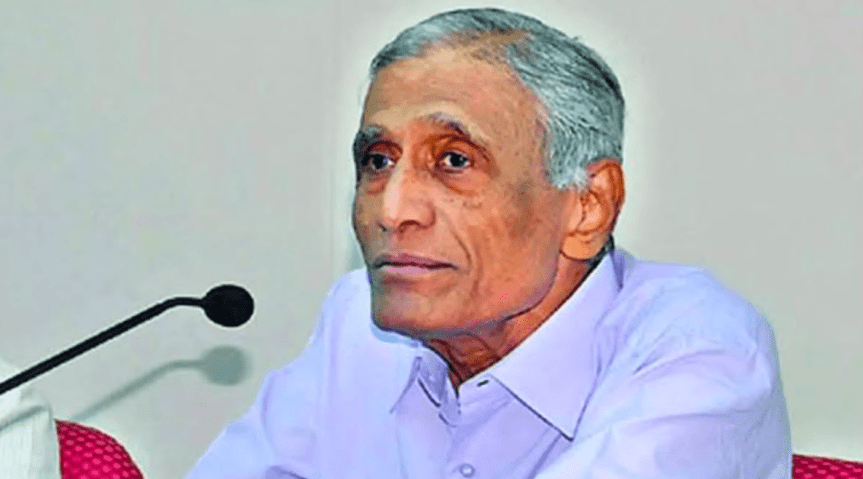
On 13 September 2019, country has lost a dedicated IAS officer (retired) of 1962 batch, Sri Bukkapuram Nadella Yugandhar, popularly known as B.N. Yugandhar, who served in many important positions in Union Government including Prime Minister’s Office and the Planning Commission. He also worked as Director Lal Bahadur Shastri National Academy of Administration, Mussoorie. Sri Yugandhar is from Anantapur district of Andhra Pradesh. It is known to all that great son of India, Sri Neelam Sanjiva Reddy who served as Sixth President of India was also from Anantapur district.

In 2014, Sri BN Yugandhar’s life added a ‘feather in the cap’ when his erudite son Sri Satya Nadella became CEO of Microsoft. It is pertinent to mention that Microsoft founder Bill Gates was all praises for Sri Satya Nadella, saying “he has successfully charted a course for making the most of the opportunities created by technology and helped the IT giant to stand out in the computing industry”. Sri B.N. Yugandhar reached at the zenith because of his dedication, sincerity and hardwork. He was popular in the country not only among the officials but among the common persons also. When he was Secretary Rural Development in the Government of India, he with his team used to visit different regions of the country to assess and review rural development programmes implemented in their respective state and thus accountability for everyone is assured. And in those days progress of self-employment, wage employment and housing programmes of Ministry of Rural Development, Government of India in all the states were creditable. During his tenure few praiseworthy steps taken by him inter alia, were:
He was instrumental for institutionalise money flow for watershed development direct to districts from the Central government, bypassing states so that time can be saved.
He played a pivotal role in the SC/ST special component plans — where resources were exclusively allotted to them
As member of Planning Commission, Sri Yugandhar was instrumental in getting an entire chapter on disability issues included in the Plan.
He worked for upliftment of the marginalised sections of the society and to improve life in rural India. In this regard by quoting Poguri Chennaiah of AP Vyavasaya Vruthidarula Union, it may be stated that “He was instrumental in 30,000 acres passing on to farmers in Anantapur when he was the collector. The issue had festered for years with farmers tilling the land that was on paper classified as government land. Once we brought the issue to his notice, it was solved in three months”.
He authored some books on decentralised planning, land reforms and rural development. After his retirement on superannuation, he for a short period of time served in the National Institute of Rural Development and Panchayati Raj (NIRD&PR), Hyderabad which (NIRD&PR) is an autonomous organisation under the Union Ministry of Rural Development. It is a premier national centre of excellence in rural development and Panchayati Raj. In addition to the main campus at Hyderabad, the Institute has North-Eastern Regional Centre at Guwahati, Assam.
While serving at NIRD&PR, Sri Yugandhar has proved his academic brilliancy for which many faculty members were inspired. Although he left for heavenly abode on 13 September 2019 but his contributions both tangible and intangible will never be erased.
Dr Shankar Chatterjee
Former Professor & Head (CPME),NIRD & PR ( Govt. of India), Hyderabad, India
Former Associate Professor, Eritrea
Former Assistant Prof, Govt. Degree College, Tripura, India
Former Senior Planning Officer, Govt of Assam, India
PRESENT ADDRESS
Prof. Shankar Chatterjee
Lidom Villa, No.13
Peranchuru, Bandlaguda(Jagir), Hyderabad-5000091
Lidom Villa, No.13
Peranchuru, Bandlaguda(Jagir), Hyderabad-5000091


 Eduindex