
The Seven Myths That Make Education Difficult To Improve

Have you ever had the experience of failing to open a lock till you discovered that you were using the wrong key? That\’s a little like discovering after years or decades of work that perhaps some of the things we\’ve been taking for granted all along don\’t necessarily hold true. There are probably many such notions, but here are what seem to be the seven most crucial ones. Each one of these is elaborated upon in a separate post, and followed by a note on what we can do – all over the next eight days.
The Seven Myths:
1. Children are homogenous

·      All must learn the same thing, in the same way, with the same material.
·      All must learn the same amount

If someone falls behind, something must be wrong with them – they don’t conform to the norm!
2. All children must attend school every day
3. There is one form of knowledge and it belongs to the ‘educated classes’.
4. Students learn mainly by listening to the teacher.
5. Teachers can improve by following instructions given to them by their seniors.
6. Stakeholders are concerned about education (as educationists understand it)
7. The education system exists to improve education.

Myth # 1 – Children are homogenous

·      All must learn the same thing, in the same way, with the same material.
·      All must learn the same amount

It’s quite amazing, isn’t it? What daily observation and commonsense (backed by vast, vast amounts of in-depth research) tells us is that children are very different from each other. That it is indeed difficult to expect all of them to learn the same amount in a year, that all ‘averages’ are mere guess work, certainly in terms of subject-related expectations after the early years. In fact, even the idea of putting children into classes or grades may not have sufficient basis – it is more management friendly than learning friendly. The question is not ‘How can the teacher teach if all children have to learn differently?’ but ‘How can naturally diverse children learn if the teacher teaches the same thing and in the same way to all?’
As a result of all this, if some children fall behind, it is assumed something must be wrong with them – they don’t conform to the norm! The ones falling behind are actually often those from under-resourced backgrounds – because the ‘norm’ and design of education is such that you are likely to do better if you are from an economically better background. Which is why it is actually news if a child from a poor family does well in a board exam!
And of course if you happen not to be able to learn the way in which you are being taught (you might be from a privileged family) even then something is wrong with you (though less wrong than if you were poor). You may not like school, but you can be sure the school does not like you too.
This myth is so common, so prevalent that it’s hard to imagine there might be other ways… what do you think?
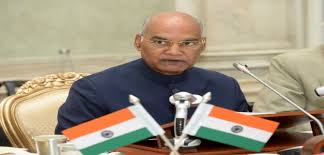
President of India witnesses an exhibition of paintings set up by Artists-In-Residence; Exhibition open for public viewing from November 19 to 24

The President of India, Shri Ram Nath Kovind, witnessed an exhibition of paintings set up by the Artists-in-Residence at Rashtrapati Bhavan today (November 17, 2019). The President also felicitated the artists after witnessing the exhibition. 
The paintings, at display at the exhibition, were made by the Artists-in-Residence during their week-long stay at Rashtrapati Bhavan. Under the In-Residence programme, artists stayed within the Rashtrapati Bhavan premises from November 10 to 17, 2019.  They included eminent and internationally acclaimed artists – Krishen Khanna, Ganesh Haloi, Anjolie Ela Menon, Lalu Prasad Shaw, Sanat Kar, Arpita Singh, Paramjit Singh, Suhas Bahulkar, Chandra Bhattacharjee, Anwar Khan, Sanjay Bhattacharya, and Chinmay Roy – and young artists – Siddarth Shingade, Parnita Parveen Bora and Vimmi Indra. 
During the stay at Rashtrapati Bhavan, Artists-in-Residence put their creating thinking on canvas and also mentored around 65 school children. The art works created by these children were also in display at the exhibition.
The visitors to the Rashtrapati Bhavan Museum can also witness the exhibition of these paintings from November 19 to 24, 2019 between 0900 hrs and 1600 hrs.  Entry will be from Gate Number 30 (Mother Teresa Crescent) of Rashtrapati Bhavan. More information can be sought from Visitors’ Management Cell (011-23015321 Extn. 4751 and 011- 23017820). 
The aim of the ‘In-Residence’ programme is to provide artists an opportunity to stay in Rashtrapati Bhavan and be a part of the life of Rashtrapati Bhavan. It seeks to provide an environment which will inspire creative thinking and rejuvenate artistic impulses. It is also intended to honour and recognize eminent and established artists as well as encourage young upcoming talent from different parts of the country.
***

WCD Ministry to announce Bharatiya Poshan Krishi Kosh

The Union Minister of Women and Child Development (WCD) and Textiles, Smriti Zubin Irani, will announce Bharatiya Poshan Krishi Kosh (BPKK) on Monday, 18th November 2019 in New Delhi. The BPKK will be a repository of diverse crops across 128 agro-climatic zones in India for better nutritional outcomes.
Smriti Zubin Irani will deliver the keynote address during the function.  Mr. Bill Gates, Co-chair, Bill & Melinda Gates Foundation will deliver a special address. Eminent agricultural scientist Prof. M. S. Swaminathan will give a special message on this occasion.
The launch of POSHAN Abhiyaan in 2018, the Prime Minister’s Overarching Scheme for Holistic Nutrition to reduce malnutrition through a multi-sectoral results-based framework, offers India an opportunity to reduce malnutrition. The Mission aims at targeted reduction of stunting, undernutrition, anemia and low birth weight babies. A novel feature of the POSHAN Abhiyaan is its focus on social and behavioral change among parents and for improving linkages between communities and the health systems towards paving the way for a mass movement to promote a transformative change. 
The Government of India’s efforts towards better nutrition has revolved around providing nutritional supplement and other supply side schemes. However, two other approaches are required to complement the Government’s efforts to promote healthy dietary practices. One, addressing the challenge of malnutrition at such a vast scale requires a basic understanding of the social, behavioral and cultural practices that promote and reinforce healthy dietary behaviours both at the individual and community level including the variation in such practices across India. Two, creating the first ever data base that links relevant agro-food system data at the district, with an aim to map the diversity of native crop varieties that will be more cost-effective and sustainable over the long run.
At the request of the Ministry of WCD the Harvard Chan School of Public Health through its India Research Center and the Bill and Melinda Gates Foundation will document and evaluate promising regional dietary practices and the messaging around them and develop a food atlas on regional agro-food systems. Both efforts are aimed at mobilizing the diverse sectors of the society.
In consultation with Ministry of WCD and Bill & Melinda Gates Foundation, the project team will select around 12 high focus states which are representative of the geographical, social, economic, cultural and structural diversities of India. In each of the states or group of states the team will identify a local partner organization which has relevant work experience in Social and Behavior Change Communication (SBCC) and nutrition for developing the food atlas.
***