Several steps have been taken to increase non-fare revenue of Indian Railways by monetization of land and other assets. These include:
i. Policy for leveraging Mobile Assets, Out of Home Advertising, Rail Display Network, Unsolicited proposals and Content on Demand.
ii. Commercial utilization of vacant land through Rail Land Development Authority (RLDA).
Government of India has permitted 100% Foreign Direct Investment (FDI) on automatic route in the following activities/areas of Railway Infrastructure:
i. Suburban corridor projects through Public Private Partnership.
ii. High speed train projects.
iii. Dedicated freight lines.
iv. Rolling stock including train sets, and locomotives or coaches manufacturing and maintenance facilities.
v. Railway Electrification.
vi. Signalling systems.
vii. Freight terminals.
viii. Passenger terminals.
ix. Infrastructure in industrial park pertaining to railway lines or sidings including electrified railway lines and connectivities to main railway line.
x. Mass Rapid Transport Systems.
Foreign Direct Investment in these areas is subject to sectoral guidelines, which include necessary safety certification from central government or its authorized entity. The FDI policy is also open for U.S. businesses.
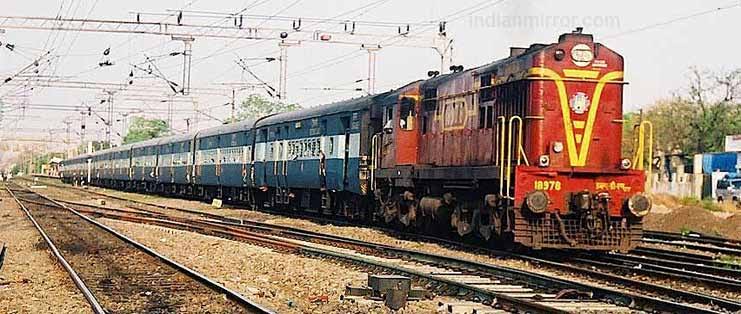
In order to give a facelift to the Indian Railways and cater to diverse needs of passengers, some of the steps taken include:
i. Significant step-up in investment for capacity enhancement, Safety and Modernization of Railways.
ii. Improvement and upgradation of various passenger amenities like foot over bridges, lifts, escalators, toilets, battery operated vehicles, wheel chairs, waiting rooms.
iii. Leveraging information technology for online ticketing and enquiry services.
iv. Introduction of various premium train services like Humsafar, Tejas, Antyodaya, Utkrisht Double Decker Air-conditioned Yatri (UDAY), Mahamana and coaches like Deen Dayalu and Anubhuti.
This information was given by the Minister of Railways and Commerce & Industry, Shri Piyush Goyal in a written reply to a question in Lok Sabha today.
Ministry of Railways through various agencies is undertaking techno-economic feasibility studies of Railway stations. Based on the outcome of these feasibility studies, stations are planned to be taken up for redevelopment in phases. The cost of station redevelopment project is to be met by leveraging commercial development of land and air space in and around the stations. Presently, work of redevelopment is in progress at Gandhinagar(Gujarat) and Habibganj(Bhopal) stations.
Redevelopment of Railway Stations
The facilities proposed in a redeveloped station include congestion free non-conflicting entry/exit to the station premises, segregation of arrival/departure of passengers, adequate concourse without overcrowding, integration of both sides of the city wherever feasible, integration with other modes of transport systems e.g. Bus, Metro, etc., user friendly international signage, well illuminated circulating area and sufficient provision for drop off, pick up & parking etc.
Various developers have shown interest in redevelopment of stations on Indian Railways. All major railway stations on Indian Railways are planned to be taken up for redevelopment, especially the stations located in major cities, pilgrimage centres and important tourist destination, including Sawai Madhopur station.
This information was given by the Minister of Railways and Commerce & Industry, Shri Piyush Goyal in a written reply to a question in Lok Sabha today.
The Lok Sabha passed the Special Protection Group (Amendment) Bill, 2019, after negating all the proposed amendments today.
Initiating the debate on the Special Protection Group (Amendment) Bill, 2019 today in the Lok Sabha, Union Home Minister Shri Amit Shah said that SPG shall provide proximate security to the Prime Minister and his immediate family members residing with him at his official residence. The Bill says that family members of a former Prime Minister who reside with him at his allotted accommodation will get security cover of the SPG only for five years, from the date he/she ceases to hold the office of Prime Minister.
Special Protection Group (Amendment) Bill, 2019
Replying to the debate, the Home Minister noted that there is a perception in the country that the amendment in SPG Act is only for the purpose to remove the SPG security cover for the Gandhi family. Contrary to this, the change of the security cover has been done only on the basis of yearly security threat perception review by the government. Such a security review has been a part of the original act, he added.
Shri Shah emphasized that the security cover of the Gandhi family has not been reduced or taken away, rather it has just been changed from SPG cover to Z Plus security cover by the CRPF, along with ASL and ambulance, across the country. The level of the security cover has been maintained and not even one security personnel has been reduced. He also said that the SPG security cover is being formed by the same security personnel who comprise of the Z plus security cover.
Shri Shah informed that based on the recommendations of the Birbal Nath committee report, SPG came into existence in 1985. From 1985 to 1988, SPG was governed by an Executive Order and only in 1988 the SPG Act came into existence to provide security to the Prime Minister and his/her family.
Shri Shah said that the SPG Act was enacted in 1988 to provide for the constitution and regulation of the SPG as an armed force to provide proximate security to the Prime Minister and his/her immediate family members. Amendments to the Act were effected in 1991, 1994, 1999 and 2003 and today a further amendment is being brought to revert back to the original spirit of the Act.
Shri Shah stated that the previous amendments to the 1988 Act have been carried out each time to provide security cover only to one family. According to the original Act, SPG is a specialised force to provide comprehensive security cover to the Prime Minister of the country and not a particular family. SPG doesn’t only provide physical security, but it takes care about protection of Prime Minister’s office, his/her communication systems, foreign tours and issues pertaining to his/her health and well being.
Dismissing the charge of vindictiveness for removal of SPG cover of Gandhi family, Shri Shah stated that such security cover reviews have happened in the past with respect to ex prime ministers, including Shri P.V. Narasimha Rao, Shri I.K. Gujaral, Shri Chandra Shekhar, Shri H.D. Deve Gowda and Dr. Manmohan Singh, but there was no such opposition ever when SPG cover was withdrawn. The Home Minister said that the Government is committed to secure each citizen of the country.
Shri Shah further stated that the Modi government never takes decision of providing security cover on the basis of vendetta politics but on scientific threat analysis for a particular individual. He also said that security cover has been provided to members of all political parties based on individual case based threat analysis. Security cover must not be treated as a status symbol by individuals. The security cover meant specifically for the Prime Minister, must not be enjoyed by any other individual. Moreover, the three protectees of the Gandhi family who have been specially mentioned here, have been on many trips without informing SPG, the Home Minister pointed out.
Talking about the rationale behind bringing the amendment, Shri Shah informed the House that in the Act, there is no cut off period for providing the SPG protection to former Prime Ministers or members of their immediate families. Thus, the number of individuals to be provided SPG cover can potentially become quite large. In such a scenario, there can be severe constraint on the resources, training and related infrastructure of SPG. This can also impact the effectiveness of SPG in providing adequate cover to the principle protectee, the Prime Minister in office.
Shri Shah said that the main aim of bringing this amendment is to make SPG more efficient. This would ensure that no omission happens in carrying out its core mandate, as the security of the Prime Minister, as Head of the Government, is of paramount importance for Government, governance and national security. The Bill says that when the proximate security is withdrawn from a former Prime Minister, such proximate security shall also stand withdrawn from members of his or her immediate family.




 Eduindex
You must be logged in to post a comment.