The Case for Children\’s News Programmes

Imagine regular news programmes for children
While advertising and entertainment programmes have begun to cater to children\’s needs, for some reason news channels have ignored children altogether! Imagine a regular children\’s news programme, at a fixed time, presented in a lively way, as something for children to look forward to daily. It could be on radio and better still, on TV.

What such programmes could contain
While national and international events would figure in it, children\’s news would focus on the world as seen by children. Background information would make the news more accessible, along with activities that can be done at home or school. There might even be discussions and debates on issues that children have views and opinions on, along with scope to engage with the channel through phone calls / sms / email.

Newspapers too
And perhaps newspapers would follow with some space for children\’s news, based on what came on TV the previous night. This would not only enable greater understanding of the news itself, it would greatly boost higher order literacy (apart from newspaper circulation). This would also provide teachers with more current material for use in different classes across a range of subjects!

Many benefits
The immediate benefits for the channels themselves would be in terms of developing loyal viewers for the future (and perhaps an expanded revenue source through increased advertising range).

However, the longer term implications for children themselves, for society and the country would be enormous.

  • Children who have had the opportunity to engage with a world beyond their immediate environment would develop cognitively and socially (well exceeding the abysmal levels attained at present!) 
  • Focusing the programming at special groups (e.g. girls, or children with disabilities or the rural poor or those who need help to learn the state language – such as tribal children – or English) would dramatically increase learning opportunities for the marginalized and the disadvantaged.
  • Wide spread use of such programmes would also help harness the demographic dividend India has at the present.

If handled sensitively, this could help create a nation where plurality is cherished and the narrow confines of identity are not allowed to become a source of conflict.

The Case for Children\’s News Programmes

Imagine regular news programmes for children
While advertising and entertainment programmes have begun to cater to children\’s needs, for some reason news channels have ignored children altogether! Imagine a regular children\’s news programme, at a fixed time, presented in a lively way, as something for children to look forward to daily. It could be on radio and better still, on TV.

What such programmes could contain
While national and international events would figure in it, children\’s news would focus on the world as seen by children. Background information would make the news more accessible, along with activities that can be done at home or school. There might even be discussions and debates on issues that children have views and opinions on, along with scope to engage with the channel through phone calls / sms / email.

Newspapers too
And perhaps newspapers would follow with some space for children\’s news, based on what came on TV the previous night. This would not only enable greater understanding of the news itself, it would greatly boost higher order literacy (apart from newspaper circulation). This would also provide teachers with more current material for use in different classes across a range of subjects!

Many benefits
The immediate benefits for the channels themselves would be in terms of developing loyal viewers for the future (and perhaps an expanded revenue source through increased advertising range).

However, the longer term implications for children themselves, for society and the country would be enormous.

  • Children who have had the opportunity to engage with a world beyond their immediate environment would develop cognitively and socially (well exceeding the abysmal levels attained at present!) 
  • Focusing the programming at special groups (e.g. girls, or children with disabilities or the rural poor or those who need help to learn the state language – such as tribal children – or English) would dramatically increase learning opportunities for the marginalized and the disadvantaged.
  • Wide spread use of such programmes would also help harness the demographic dividend India has at the present.

If handled sensitively, this could help create a nation where plurality is cherished and the narrow confines of identity are not allowed to become a source of conflict.

The Case for Children\’s News Programmes

Imagine regular news programmes for children
While advertising and entertainment programmes have begun to cater to children\’s needs, for some reason news channels have ignored children altogether! Imagine a regular children\’s news programme, at a fixed time, presented in a lively way, as something for children to look forward to daily. It could be on radio and better still, on TV.

What such programmes could contain
While national and international events would figure in it, children\’s news would focus on the world as seen by children. Background information would make the news more accessible, along with activities that can be done at home or school. There might even be discussions and debates on issues that children have views and opinions on, along with scope to engage with the channel through phone calls / sms / email.

Newspapers too
And perhaps newspapers would follow with some space for children\’s news, based on what came on TV the previous night. This would not only enable greater understanding of the news itself, it would greatly boost higher order literacy (apart from newspaper circulation). This would also provide teachers with more current material for use in different classes across a range of subjects!

Many benefits
The immediate benefits for the channels themselves would be in terms of developing loyal viewers for the future (and perhaps an expanded revenue source through increased advertising range).

However, the longer term implications for children themselves, for society and the country would be enormous.

  • Children who have had the opportunity to engage with a world beyond their immediate environment would develop cognitively and socially (well exceeding the abysmal levels attained at present!) 
  • Focusing the programming at special groups (e.g. girls, or children with disabilities or the rural poor or those who need help to learn the state language – such as tribal children – or English) would dramatically increase learning opportunities for the marginalized and the disadvantaged.
  • Wide spread use of such programmes would also help harness the demographic dividend India has at the present.

If handled sensitively, this could help create a nation where plurality is cherished and the narrow confines of identity are not allowed to become a source of conflict.

The Case for Children\’s News Programmes

Imagine regular news programmes for children
While advertising and entertainment programmes have begun to cater to children\’s needs, for some reason news channels have ignored children altogether! Imagine a regular children\’s news programme, at a fixed time, presented in a lively way, as something for children to look forward to daily. It could be on radio and better still, on TV.

What such programmes could contain
While national and international events would figure in it, children\’s news would focus on the world as seen by children. Background information would make the news more accessible, along with activities that can be done at home or school. There might even be discussions and debates on issues that children have views and opinions on, along with scope to engage with the channel through phone calls / sms / email.

Newspapers too
And perhaps newspapers would follow with some space for children\’s news, based on what came on TV the previous night. This would not only enable greater understanding of the news itself, it would greatly boost higher order literacy (apart from newspaper circulation). This would also provide teachers with more current material for use in different classes across a range of subjects!

Many benefits
The immediate benefits for the channels themselves would be in terms of developing loyal viewers for the future (and perhaps an expanded revenue source through increased advertising range).

However, the longer term implications for children themselves, for society and the country would be enormous.

  • Children who have had the opportunity to engage with a world beyond their immediate environment would develop cognitively and socially (well exceeding the abysmal levels attained at present!) 
  • Focusing the programming at special groups (e.g. girls, or children with disabilities or the rural poor or those who need help to learn the state language – such as tribal children – or English) would dramatically increase learning opportunities for the marginalized and the disadvantaged.
  • Wide spread use of such programmes would also help harness the demographic dividend India has at the present.

If handled sensitively, this could help create a nation where plurality is cherished and the narrow confines of identity are not allowed to become a source of conflict.

D for Discipline, D for Democracy!

The moment the word \’discipline\’ is mentioned in a gathering of teachers or educational functionaries (or even parents or community members), it acquires a special meaning, as in \’children have to be kept in discipline\’. Here, the quintessential role of the teacher is that of the \’shepherd\’ (with stick and all), and children are seen as unruly sheep that have no mind of their own and need \’order\’ in their lives. I hope this sounds as dated in the reading as it does in the writing!

Perhaps this is more the case in Asian societies. Apart from most Indian states, I\’ve found myself caught in this discussion  in Bangladesh, Afghanistan, China, Nepal, Sri Lanka, Cambodia, Laos… and there\’s an amazing unity of thought across these varying geographies and cultures! Children need to be guided and taught — if their errors are not corrected as soon as the occur, it will be too late to correct them later on! (All this is said in a deep, sonorous tone to emphasize its seriousness.)

Interestingly, these are also cultures that teach you to respect your elders (whether they have any quality other than age or not!). In short, in societies where control has a role to play, \’discipline\’ comes to mean doing the will of the powerful (because they are adult, or older or richer or occupy a \’position\’). These are also the same places where the guru or the master or the preceptor is venerated (i.e. given a status next to God herself).

This sits a little uneasily with the clamor for greater democracy in the classroom. Active / joyful learning is now advocated in most of the countries mentioned. In India, the recently enacted Right to Education actually mandates activity-based classrooms where children will construct their own knowledge. The National Curriculum Framework 2005 makes an eloquent plea for \’democracy in the classroom\’, where collaboration and partnership with children (rather than their \’sincerity and obedience\’) will be the hallmark of quality.

As you can guess, change is a long way coming. Despite the fact that democratic classrooms are \’Official Policy\’ backed by law, and nearly a decade and a half of yearly rounds of in-service teacher training emphasizing the virtue of active learning,  classroom teaching tends to remain teacher-directed, instruction-based, with asking questions and offering one\’s opinions being considered almost a sin on the part of children.

When reports last came in, thus, D for Discipline was clearly winning over D for Democracy!

The Case for Children\’s News Programmes

Imagine regular news programmes for children
While advertising and entertainment programmes have begun to cater to children\’s needs, for some reason news channels have ignored children altogether! Imagine a regular children\’s news programme, at a fixed time, presented in a lively way, as something for children to look forward to daily. It could be on radio and better still, on TV.

What such programmes could contain
While national and international events would figure in it, children\’s news would focus on the world as seen by children. Background information would make the news more accessible, along with activities that can be done at home or school. There might even be discussions and debates on issues that children have views and opinions on, along with scope to engage with the channel through phone calls / sms / email.

Newspapers too
And perhaps newspapers would follow with some space for children\’s news, based on what came on TV the previous night. This would not only enable greater understanding of the news itself, it would greatly boost higher order literacy (apart from newspaper circulation). This would also provide teachers with more current material for use in different classes across a range of subjects!

Many benefits
The immediate benefits for the channels themselves would be in terms of developing loyal viewers for the future (and perhaps an expanded revenue source through increased advertising range).

However, the longer term implications for children themselves, for society and the country would be enormous.

  • Children who have had the opportunity to engage with a world beyond their immediate environment would develop cognitively and socially (well exceeding the abysmal levels attained at present!) 
  • Focusing the programming at special groups (e.g. girls, or children with disabilities or the rural poor or those who need help to learn the state language – such as tribal children – or English) would dramatically increase learning opportunities for the marginalized and the disadvantaged.
  • Wide spread use of such programmes would also help harness the demographic dividend India has at the present.

If handled sensitively, this could help create a nation where plurality is cherished and the narrow confines of identity are not allowed to become a source of conflict.

What We Learn Cannot Be Burnt – \’An Afghan Neo-Literate Woman

As we work in education, it often tends to get too \’sanitized\’ – as if it is not about real people in real situations, where education has a meaning that\’s almost impossible to comprehend. Here\’s a story from Afghanistan, from a programme called Learning for Life that sought to provide initial literacy and health awareness to enable women to become CHWs (community health workers, sorely needed in the country). This story was documented in June 2005, by Judie Schiffbauer, and shared by Katy Anis.


Each morning, six days a week, 40 year old Zeba Gul wraps a light gray shawl around her head and shoulders and leaves her family’s mud-walled compound in the Afghan village of BegToot.  She follows a path that winds through dusty alleyways and then along green fields to arrive at a two-story building constructed of unbaked brick made from mud and straw.  Inside, a set of narrow stairs leads to the Learning for Life classroom, where other women are already gathered.  Removing her shoes at the doorway, she enters and lowers herself to the mat-covered floor, tucking her long legs beneath her.  
In December 2004, when the LfL health-based literacy program began in BegToot, wind whipped snow against the classroom windows, but on this fine summer day, the windows are open to admit a pleasant breeze.  The room looks out over groves of mulberry trees, for which the village is named.  Tall, creviced mountains rise high in the distance, still bearing traces of winter snow.
But the 26 women in the class are not admiring the view.  Instead, each attends to Qotsia, their 21-year-old teacher, who stands beside a small blackboard at the front of the room.  One of millions of Afghans who fled the war-torn country, Qotsia grew up as a refugee in Iran, where she received 12 years of formal education.  Now she has returned to BegToot, and the women are grateful.
 Dressed and coifed in black, Qotsia begins to write with a piece of chalk.  Carefully demonstrating each stroke, she writes a word in Dari composed of several letters from the alphabet displayed on a poster on the wall.  The dark black letters on the poster are easy to see, but six months ago, no woman in the class could have named or written a single one.  Today, hands shoot up when Qotsea asks someone to spell out and then read what she has written.  One woman rises and comes forward:  k a r u m (worm).  “Very good, Pashtoon Jan!” says Qotsia.  Pashtoon Jan smiles as her fellow learners sound out the word, repeat it in unison, and write it in their notebooks:   k a r u m.  Worms are the topic of today’s lesson.  
To the left of the blackboard, a series of drawings depicts women busy with women’s chores:  one is cleaning vegetables; one is boiling water to be stored in an earthenware jar; another is feeding a sick baby; and one is washing a child’s dirty hands.  Now the women in this Level One literacy class are going to learn how worms and a child’s dirty hands are related. 
As one of six Community Health Workers enrolled in the class, Zeba Gul already knows a lot about worms.  Their life cycle and method of transmission were explained to her when BRAC, a REACH NGO-grantee, trained her as a CHW.  But until now, Zeba Gul has never known how to spell, read or write the names of the parasites– roundworm, tapeworm, and pinworm—that sicken so many children and adults in the village. 
As Qotsia begins the lesson, Zeba Gul leans forward and points to a young woman sitting nearby: “That’s my daughter,” she whispers. “Because of this class, she is learning to read and write before her hair turns gray.”
Later, the class at an end and women lingering to talk, Zeba Gul told her story.  She was born in Paghman, but she has not always lived there.  When she was sixteen, she married and moved to Kabul with her husband to live with his family. Her daughter and several other children were born in the city.
“It was good,” says Zeba Gul.  “My husband had a small shop.  He worked hard.  In the morning, he opened the shop.  In the afternoon, he had a second job in a government building.”
Even during the dark days of war, the family chose not to leave Afghanistan for sanctuary in Pakistan or Iran.  “We stayed,” she says, remembering their struggles with a hint of pride in her voice.  “We were hard workers, and we stayed.” 
For a time after the Russians left, Zeba Gul thought the worst was behind them.  But peace did not last long.  “After that,” she said, “I wasn’t sure what the fighting was about; I know only that it did not stop.  So much fighting.”
When Zeba Gul explains that both the family’s shop and home were near Damazang in Karte Seh, the room grows very quiet.  Everyone knows that Karte Seh was virtually destroyed during the civil war.  “Ay, Khoda!” the women whisper, as Zeba Gul continues her story:
“One night, our shop was ablaze. How it burned!  And our house burned too.  Everything we had was swallowed in fire.  Oh, God.  What could we do?  We had nothing left!  So we returned to Paghman.  It was more than ten years ago.  Here, my husband is a farmer.  Thanks to Allah, he is alive.” 
Many of her listeners have been less fortunate, and the widows nod in agreement as Zeba Gul utters her prayer of gratitude.  The women in the room have known great sorrows, but it is resilience that binds them. 
“Now,” continues Zeba Gul, “I am a CHW.  And I am learning to read and write in this class.  See there: my daughter is also here! Faz l’Khoda–Give thanks to God.  What we learn cannot be burned.”  

What We Learn Cannot Be Burnt – \’An Afghan Neo-Literate Woman

As we work in education, it often tends to get too \’sanitized\’ – as if it is not about real people in real situations, where education has a meaning that\’s almost impossible to comprehend. Here\’s a story from Afghanistan, from a programme called Learning for Life that sought to provide initial literacy and health awareness to enable women to become CHWs (community health workers, sorely needed in the country). This story was documented in June 2005, by Judie Schiffbauer, and shared by Katy Anis.


Each morning, six days a week, 40 year old Zeba Gul wraps a light gray shawl around her head and shoulders and leaves her family’s mud-walled compound in the Afghan village of BegToot.  She follows a path that winds through dusty alleyways and then along green fields to arrive at a two-story building constructed of unbaked brick made from mud and straw.  Inside, a set of narrow stairs leads to the Learning for Life classroom, where other women are already gathered.  Removing her shoes at the doorway, she enters and lowers herself to the mat-covered floor, tucking her long legs beneath her.  
In December 2004, when the LfL health-based literacy program began in BegToot, wind whipped snow against the classroom windows, but on this fine summer day, the windows are open to admit a pleasant breeze.  The room looks out over groves of mulberry trees, for which the village is named.  Tall, creviced mountains rise high in the distance, still bearing traces of winter snow.
But the 26 women in the class are not admiring the view.  Instead, each attends to Qotsia, their 21-year-old teacher, who stands beside a small blackboard at the front of the room.  One of millions of Afghans who fled the war-torn country, Qotsia grew up as a refugee in Iran, where she received 12 years of formal education.  Now she has returned to BegToot, and the women are grateful.
 Dressed and coifed in black, Qotsia begins to write with a piece of chalk.  Carefully demonstrating each stroke, she writes a word in Dari composed of several letters from the alphabet displayed on a poster on the wall.  The dark black letters on the poster are easy to see, but six months ago, no woman in the class could have named or written a single one.  Today, hands shoot up when Qotsea asks someone to spell out and then read what she has written.  One woman rises and comes forward:  k a r u m (worm).  “Very good, Pashtoon Jan!” says Qotsia.  Pashtoon Jan smiles as her fellow learners sound out the word, repeat it in unison, and write it in their notebooks:   k a r u m.  Worms are the topic of today’s lesson.  
To the left of the blackboard, a series of drawings depicts women busy with women’s chores:  one is cleaning vegetables; one is boiling water to be stored in an earthenware jar; another is feeding a sick baby; and one is washing a child’s dirty hands.  Now the women in this Level One literacy class are going to learn how worms and a child’s dirty hands are related. 
As one of six Community Health Workers enrolled in the class, Zeba Gul already knows a lot about worms.  Their life cycle and method of transmission were explained to her when BRAC, a REACH NGO-grantee, trained her as a CHW.  But until now, Zeba Gul has never known how to spell, read or write the names of the parasites– roundworm, tapeworm, and pinworm—that sicken so many children and adults in the village. 
As Qotsia begins the lesson, Zeba Gul leans forward and points to a young woman sitting nearby: “That’s my daughter,” she whispers. “Because of this class, she is learning to read and write before her hair turns gray.”
Later, the class at an end and women lingering to talk, Zeba Gul told her story.  She was born in Paghman, but she has not always lived there.  When she was sixteen, she married and moved to Kabul with her husband to live with his family. Her daughter and several other children were born in the city.
“It was good,” says Zeba Gul.  “My husband had a small shop.  He worked hard.  In the morning, he opened the shop.  In the afternoon, he had a second job in a government building.”
Even during the dark days of war, the family chose not to leave Afghanistan for sanctuary in Pakistan or Iran.  “We stayed,” she says, remembering their struggles with a hint of pride in her voice.  “We were hard workers, and we stayed.” 
For a time after the Russians left, Zeba Gul thought the worst was behind them.  But peace did not last long.  “After that,” she said, “I wasn’t sure what the fighting was about; I know only that it did not stop.  So much fighting.”
When Zeba Gul explains that both the family’s shop and home were near Damazang in Karte Seh, the room grows very quiet.  Everyone knows that Karte Seh was virtually destroyed during the civil war.  “Ay, Khoda!” the women whisper, as Zeba Gul continues her story:
“One night, our shop was ablaze. How it burned!  And our house burned too.  Everything we had was swallowed in fire.  Oh, God.  What could we do?  We had nothing left!  So we returned to Paghman.  It was more than ten years ago.  Here, my husband is a farmer.  Thanks to Allah, he is alive.” 
Many of her listeners have been less fortunate, and the widows nod in agreement as Zeba Gul utters her prayer of gratitude.  The women in the room have known great sorrows, but it is resilience that binds them. 
“Now,” continues Zeba Gul, “I am a CHW.  And I am learning to read and write in this class.  See there: my daughter is also here! Faz l’Khoda–Give thanks to God.  What we learn cannot be burned.”  

What We Learn Cannot Be Burnt – \’An Afghan Neo-Literate Woman

As we work in education, it often tends to get too \’sanitized\’ – as if it is not about real people in real situations, where education has a meaning that\’s almost impossible to comprehend. Here\’s a story from Afghanistan, from a programme called Learning for Life that sought to provide initial literacy and health awareness to enable women to become CHWs (community health workers, sorely needed in the country). This story was documented in June 2005, by Judie Schiffbauer, and shared by Katy Anis.


Each morning, six days a week, 40 year old Zeba Gul wraps a light gray shawl around her head and shoulders and leaves her family’s mud-walled compound in the Afghan village of BegToot.  She follows a path that winds through dusty alleyways and then along green fields to arrive at a two-story building constructed of unbaked brick made from mud and straw.  Inside, a set of narrow stairs leads to the Learning for Life classroom, where other women are already gathered.  Removing her shoes at the doorway, she enters and lowers herself to the mat-covered floor, tucking her long legs beneath her.  
In December 2004, when the LfL health-based literacy program began in BegToot, wind whipped snow against the classroom windows, but on this fine summer day, the windows are open to admit a pleasant breeze.  The room looks out over groves of mulberry trees, for which the village is named.  Tall, creviced mountains rise high in the distance, still bearing traces of winter snow.
But the 26 women in the class are not admiring the view.  Instead, each attends to Qotsia, their 21-year-old teacher, who stands beside a small blackboard at the front of the room.  One of millions of Afghans who fled the war-torn country, Qotsia grew up as a refugee in Iran, where she received 12 years of formal education.  Now she has returned to BegToot, and the women are grateful.
 Dressed and coifed in black, Qotsia begins to write with a piece of chalk.  Carefully demonstrating each stroke, she writes a word in Dari composed of several letters from the alphabet displayed on a poster on the wall.  The dark black letters on the poster are easy to see, but six months ago, no woman in the class could have named or written a single one.  Today, hands shoot up when Qotsea asks someone to spell out and then read what she has written.  One woman rises and comes forward:  k a r u m (worm).  “Very good, Pashtoon Jan!” says Qotsia.  Pashtoon Jan smiles as her fellow learners sound out the word, repeat it in unison, and write it in their notebooks:   k a r u m.  Worms are the topic of today’s lesson.  
To the left of the blackboard, a series of drawings depicts women busy with women’s chores:  one is cleaning vegetables; one is boiling water to be stored in an earthenware jar; another is feeding a sick baby; and one is washing a child’s dirty hands.  Now the women in this Level One literacy class are going to learn how worms and a child’s dirty hands are related. 
As one of six Community Health Workers enrolled in the class, Zeba Gul already knows a lot about worms.  Their life cycle and method of transmission were explained to her when BRAC, a REACH NGO-grantee, trained her as a CHW.  But until now, Zeba Gul has never known how to spell, read or write the names of the parasites– roundworm, tapeworm, and pinworm—that sicken so many children and adults in the village. 
As Qotsia begins the lesson, Zeba Gul leans forward and points to a young woman sitting nearby: “That’s my daughter,” she whispers. “Because of this class, she is learning to read and write before her hair turns gray.”
Later, the class at an end and women lingering to talk, Zeba Gul told her story.  She was born in Paghman, but she has not always lived there.  When she was sixteen, she married and moved to Kabul with her husband to live with his family. Her daughter and several other children were born in the city.
“It was good,” says Zeba Gul.  “My husband had a small shop.  He worked hard.  In the morning, he opened the shop.  In the afternoon, he had a second job in a government building.”
Even during the dark days of war, the family chose not to leave Afghanistan for sanctuary in Pakistan or Iran.  “We stayed,” she says, remembering their struggles with a hint of pride in her voice.  “We were hard workers, and we stayed.” 
For a time after the Russians left, Zeba Gul thought the worst was behind them.  But peace did not last long.  “After that,” she said, “I wasn’t sure what the fighting was about; I know only that it did not stop.  So much fighting.”
When Zeba Gul explains that both the family’s shop and home were near Damazang in Karte Seh, the room grows very quiet.  Everyone knows that Karte Seh was virtually destroyed during the civil war.  “Ay, Khoda!” the women whisper, as Zeba Gul continues her story:
“One night, our shop was ablaze. How it burned!  And our house burned too.  Everything we had was swallowed in fire.  Oh, God.  What could we do?  We had nothing left!  So we returned to Paghman.  It was more than ten years ago.  Here, my husband is a farmer.  Thanks to Allah, he is alive.” 
Many of her listeners have been less fortunate, and the widows nod in agreement as Zeba Gul utters her prayer of gratitude.  The women in the room have known great sorrows, but it is resilience that binds them. 
“Now,” continues Zeba Gul, “I am a CHW.  And I am learning to read and write in this class.  See there: my daughter is also here! Faz l’Khoda–Give thanks to God.  What we learn cannot be burned.”  
What We Learn Cannot Be Burnt – \’An Afghan Neo-Literate Woman

As we work in education, it often tends to get too \’sanitized\’ – as if it is not about real people in real situations, where education has a meaning that\’s almost impossible to comprehend. Here\’s a story from Afghanistan, from a programme called Learning for Life that sought to provide initial literacy and health awareness to enable women to become CHWs (community health workers, sorely needed in the country). This story was documented in June 2005, by Judie Schiffbauer, and shared by Katy Anis.


Each morning, six days a week, 40 year old Zeba Gul wraps a light gray shawl around her head and shoulders and leaves her family’s mud-walled compound in the Afghan village of BegToot.  She follows a path that winds through dusty alleyways and then along green fields to arrive at a two-story building constructed of unbaked brick made from mud and straw.  Inside, a set of narrow stairs leads to the Learning for Life classroom, where other women are already gathered.  Removing her shoes at the doorway, she enters and lowers herself to the mat-covered floor, tucking her long legs beneath her.  
In December 2004, when the LfL health-based literacy program began in BegToot, wind whipped snow against the classroom windows, but on this fine summer day, the windows are open to admit a pleasant breeze.  The room looks out over groves of mulberry trees, for which the village is named.  Tall, creviced mountains rise high in the distance, still bearing traces of winter snow.
But the 26 women in the class are not admiring the view.  Instead, each attends to Qotsia, their 21-year-old teacher, who stands beside a small blackboard at the front of the room.  One of millions of Afghans who fled the war-torn country, Qotsia grew up as a refugee in Iran, where she received 12 years of formal education.  Now she has returned to BegToot, and the women are grateful.
 Dressed and coifed in black, Qotsia begins to write with a piece of chalk.  Carefully demonstrating each stroke, she writes a word in Dari composed of several letters from the alphabet displayed on a poster on the wall.  The dark black letters on the poster are easy to see, but six months ago, no woman in the class could have named or written a single one.  Today, hands shoot up when Qotsea asks someone to spell out and then read what she has written.  One woman rises and comes forward:  k a r u m (worm).  “Very good, Pashtoon Jan!” says Qotsia.  Pashtoon Jan smiles as her fellow learners sound out the word, repeat it in unison, and write it in their notebooks:   k a r u m.  Worms are the topic of today’s lesson.  
To the left of the blackboard, a series of drawings depicts women busy with women’s chores:  one is cleaning vegetables; one is boiling water to be stored in an earthenware jar; another is feeding a sick baby; and one is washing a child’s dirty hands.  Now the women in this Level One literacy class are going to learn how worms and a child’s dirty hands are related. 
As one of six Community Health Workers enrolled in the class, Zeba Gul already knows a lot about worms.  Their life cycle and method of transmission were explained to her when BRAC, a REACH NGO-grantee, trained her as a CHW.  But until now, Zeba Gul has never known how to spell, read or write the names of the parasites– roundworm, tapeworm, and pinworm—that sicken so many children and adults in the village. 
As Qotsia begins the lesson, Zeba Gul leans forward and points to a young woman sitting nearby: “That’s my daughter,” she whispers. “Because of this class, she is learning to read and write before her hair turns gray.”
Later, the class at an end and women lingering to talk, Zeba Gul told her story.  She was born in Paghman, but she has not always lived there.  When she was sixteen, she married and moved to Kabul with her husband to live with his family. Her daughter and several other children were born in the city.
“It was good,” says Zeba Gul.  “My husband had a small shop.  He worked hard.  In the morning, he opened the shop.  In the afternoon, he had a second job in a government building.”
Even during the dark days of war, the family chose not to leave Afghanistan for sanctuary in Pakistan or Iran.  “We stayed,” she says, remembering their struggles with a hint of pride in her voice.  “We were hard workers, and we stayed.” 
For a time after the Russians left, Zeba Gul thought the worst was behind them.  But peace did not last long.  “After that,” she said, “I wasn’t sure what the fighting was about; I know only that it did not stop.  So much fighting.”
When Zeba Gul explains that both the family’s shop and home were near Damazang in Karte Seh, the room grows very quiet.  Everyone knows that Karte Seh was virtually destroyed during the civil war.  “Ay, Khoda!” the women whisper, as Zeba Gul continues her story:
“One night, our shop was ablaze. How it burned!  And our house burned too.  Everything we had was swallowed in fire.  Oh, God.  What could we do?  We had nothing left!  So we returned to Paghman.  It was more than ten years ago.  Here, my husband is a farmer.  Thanks to Allah, he is alive.” 
Many of her listeners have been less fortunate, and the widows nod in agreement as Zeba Gul utters her prayer of gratitude.  The women in the room have known great sorrows, but it is resilience that binds them. 
“Now,” continues Zeba Gul, “I am a CHW.  And I am learning to read and write in this class.  See there: my daughter is also here! Faz l’Khoda–Give thanks to God.  What we learn cannot be burned.”  

What We Learn Cannot Be Burnt – \’An Afghan Neo-Literate Woman

As we work in education, it often tends to get too \’sanitized\’ – as if it is not about real people in real situations, where education has a meaning that\’s almost impossible to comprehend. Here\’s a story from Afghanistan, from a programme called Learning for Life that sought to provide initial literacy and health awareness to enable women to become CHWs (community health workers, sorely needed in the country). This story was documented in June 2005, by Judie Schiffbauer, and shared by Katy Anis.


Each morning, six days a week, 40 year old Zeba Gul wraps a light gray shawl around her head and shoulders and leaves her family’s mud-walled compound in the Afghan village of BegToot.  She follows a path that winds through dusty alleyways and then along green fields to arrive at a two-story building constructed of unbaked brick made from mud and straw.  Inside, a set of narrow stairs leads to the Learning for Life classroom, where other women are already gathered.  Removing her shoes at the doorway, she enters and lowers herself to the mat-covered floor, tucking her long legs beneath her.  
In December 2004, when the LfL health-based literacy program began in BegToot, wind whipped snow against the classroom windows, but on this fine summer day, the windows are open to admit a pleasant breeze.  The room looks out over groves of mulberry trees, for which the village is named.  Tall, creviced mountains rise high in the distance, still bearing traces of winter snow.
But the 26 women in the class are not admiring the view.  Instead, each attends to Qotsia, their 21-year-old teacher, who stands beside a small blackboard at the front of the room.  One of millions of Afghans who fled the war-torn country, Qotsia grew up as a refugee in Iran, where she received 12 years of formal education.  Now she has returned to BegToot, and the women are grateful.
 Dressed and coifed in black, Qotsia begins to write with a piece of chalk.  Carefully demonstrating each stroke, she writes a word in Dari composed of several letters from the alphabet displayed on a poster on the wall.  The dark black letters on the poster are easy to see, but six months ago, no woman in the class could have named or written a single one.  Today, hands shoot up when Qotsea asks someone to spell out and then read what she has written.  One woman rises and comes forward:  k a r u m (worm).  “Very good, Pashtoon Jan!” says Qotsia.  Pashtoon Jan smiles as her fellow learners sound out the word, repeat it in unison, and write it in their notebooks:   k a r u m.  Worms are the topic of today’s lesson.  
To the left of the blackboard, a series of drawings depicts women busy with women’s chores:  one is cleaning vegetables; one is boiling water to be stored in an earthenware jar; another is feeding a sick baby; and one is washing a child’s dirty hands.  Now the women in this Level One literacy class are going to learn how worms and a child’s dirty hands are related. 
As one of six Community Health Workers enrolled in the class, Zeba Gul already knows a lot about worms.  Their life cycle and method of transmission were explained to her when BRAC, a REACH NGO-grantee, trained her as a CHW.  But until now, Zeba Gul has never known how to spell, read or write the names of the parasites– roundworm, tapeworm, and pinworm—that sicken so many children and adults in the village. 
As Qotsia begins the lesson, Zeba Gul leans forward and points to a young woman sitting nearby: “That’s my daughter,” she whispers. “Because of this class, she is learning to read and write before her hair turns gray.”
Later, the class at an end and women lingering to talk, Zeba Gul told her story.  She was born in Paghman, but she has not always lived there.  When she was sixteen, she married and moved to Kabul with her husband to live with his family. Her daughter and several other children were born in the city.
“It was good,” says Zeba Gul.  “My husband had a small shop.  He worked hard.  In the morning, he opened the shop.  In the afternoon, he had a second job in a government building.”
Even during the dark days of war, the family chose not to leave Afghanistan for sanctuary in Pakistan or Iran.  “We stayed,” she says, remembering their struggles with a hint of pride in her voice.  “We were hard workers, and we stayed.” 
For a time after the Russians left, Zeba Gul thought the worst was behind them.  But peace did not last long.  “After that,” she said, “I wasn’t sure what the fighting was about; I know only that it did not stop.  So much fighting.”
When Zeba Gul explains that both the family’s shop and home were near Damazang in Karte Seh, the room grows very quiet.  Everyone knows that Karte Seh was virtually destroyed during the civil war.  “Ay, Khoda!” the women whisper, as Zeba Gul continues her story:
“One night, our shop was ablaze. How it burned!  And our house burned too.  Everything we had was swallowed in fire.  Oh, God.  What could we do?  We had nothing left!  So we returned to Paghman.  It was more than ten years ago.  Here, my husband is a farmer.  Thanks to Allah, he is alive.” 
Many of her listeners have been less fortunate, and the widows nod in agreement as Zeba Gul utters her prayer of gratitude.  The women in the room have known great sorrows, but it is resilience that binds them. 
“Now,” continues Zeba Gul, “I am a CHW.  And I am learning to read and write in this class.  See there: my daughter is also here! Faz l’Khoda–Give thanks to God.  What we learn cannot be burned.”  

What We Learn Cannot Be Burnt – \’An Afghan Neo-Literate Woman

As we work in education, it often tends to get too \’sanitized\’ – as if it is not about real people in real situations, where education has a meaning that\’s almost impossible to comprehend. Here\’s a story from Afghanistan, from a programme called Learning for Life that sought to provide initial literacy and health awareness to enable women to become CHWs (community health workers, sorely needed in the country). This story was documented in June 2005, by Judie Schiffbauer, and shared by Katy Anis.


Each morning, six days a week, 40 year old Zeba Gul wraps a light gray shawl around her head and shoulders and leaves her family’s mud-walled compound in the Afghan village of BegToot.  She follows a path that winds through dusty alleyways and then along green fields to arrive at a two-story building constructed of unbaked brick made from mud and straw.  Inside, a set of narrow stairs leads to the Learning for Life classroom, where other women are already gathered.  Removing her shoes at the doorway, she enters and lowers herself to the mat-covered floor, tucking her long legs beneath her.  
In December 2004, when the LfL health-based literacy program began in BegToot, wind whipped snow against the classroom windows, but on this fine summer day, the windows are open to admit a pleasant breeze.  The room looks out over groves of mulberry trees, for which the village is named.  Tall, creviced mountains rise high in the distance, still bearing traces of winter snow.
But the 26 women in the class are not admiring the view.  Instead, each attends to Qotsia, their 21-year-old teacher, who stands beside a small blackboard at the front of the room.  One of millions of Afghans who fled the war-torn country, Qotsia grew up as a refugee in Iran, where she received 12 years of formal education.  Now she has returned to BegToot, and the women are grateful.
 Dressed and coifed in black, Qotsia begins to write with a piece of chalk.  Carefully demonstrating each stroke, she writes a word in Dari composed of several letters from the alphabet displayed on a poster on the wall.  The dark black letters on the poster are easy to see, but six months ago, no woman in the class could have named or written a single one.  Today, hands shoot up when Qotsea asks someone to spell out and then read what she has written.  One woman rises and comes forward:  k a r u m (worm).  “Very good, Pashtoon Jan!” says Qotsia.  Pashtoon Jan smiles as her fellow learners sound out the word, repeat it in unison, and write it in their notebooks:   k a r u m.  Worms are the topic of today’s lesson.  
To the left of the blackboard, a series of drawings depicts women busy with women’s chores:  one is cleaning vegetables; one is boiling water to be stored in an earthenware jar; another is feeding a sick baby; and one is washing a child’s dirty hands.  Now the women in this Level One literacy class are going to learn how worms and a child’s dirty hands are related. 
As one of six Community Health Workers enrolled in the class, Zeba Gul already knows a lot about worms.  Their life cycle and method of transmission were explained to her when BRAC, a REACH NGO-grantee, trained her as a CHW.  But until now, Zeba Gul has never known how to spell, read or write the names of the parasites– roundworm, tapeworm, and pinworm—that sicken so many children and adults in the village. 
As Qotsia begins the lesson, Zeba Gul leans forward and points to a young woman sitting nearby: “That’s my daughter,” she whispers. “Because of this class, she is learning to read and write before her hair turns gray.”
Later, the class at an end and women lingering to talk, Zeba Gul told her story.  She was born in Paghman, but she has not always lived there.  When she was sixteen, she married and moved to Kabul with her husband to live with his family. Her daughter and several other children were born in the city.
“It was good,” says Zeba Gul.  “My husband had a small shop.  He worked hard.  In the morning, he opened the shop.  In the afternoon, he had a second job in a government building.”
Even during the dark days of war, the family chose not to leave Afghanistan for sanctuary in Pakistan or Iran.  “We stayed,” she says, remembering their struggles with a hint of pride in her voice.  “We were hard workers, and we stayed.” 
For a time after the Russians left, Zeba Gul thought the worst was behind them.  But peace did not last long.  “After that,” she said, “I wasn’t sure what the fighting was about; I know only that it did not stop.  So much fighting.”
When Zeba Gul explains that both the family’s shop and home were near Damazang in Karte Seh, the room grows very quiet.  Everyone knows that Karte Seh was virtually destroyed during the civil war.  “Ay, Khoda!” the women whisper, as Zeba Gul continues her story:
“One night, our shop was ablaze. How it burned!  And our house burned too.  Everything we had was swallowed in fire.  Oh, God.  What could we do?  We had nothing left!  So we returned to Paghman.  It was more than ten years ago.  Here, my husband is a farmer.  Thanks to Allah, he is alive.” 
Many of her listeners have been less fortunate, and the widows nod in agreement as Zeba Gul utters her prayer of gratitude.  The women in the room have known great sorrows, but it is resilience that binds them. 
“Now,” continues Zeba Gul, “I am a CHW.  And I am learning to read and write in this class.  See there: my daughter is also here! Faz l’Khoda–Give thanks to God.  What we learn cannot be burned.”  

Are teachers villains or victims?

At some point or the other in their lives, almost everyone has held the view: \’If only teachers did their work better, so many problems would be solved…\’  Schools would be so much better off, isn\’t it? Education would be great and our lives very different as a result; in fact, society itself would change, if only teachers did their work better.

People who think thus are, of course, only being \’nice\’. Because there are any number of others who have less \’nice\’ ways of putting it. \’Bloody teachers, curse them, they don\’t work at all. They\’re never there in school, and when they\’re there they don\’t teach. And if they teach, they don\’t teach properly, beat children, and don\’t even know themselves what they\’re supposed to teach. All they\’re interested in is their salaries, and making money from the grants that flow to the school.\’

In fact, this is unfortunately a very widely held view, especially among officials, supervisors, trainers and others who are in any way responsible for and towards teachers. Condemn them, point out all their flaws (exaggerate where it helps) and hold them accountable for all the ills of the education system. Teacher condemnation remains the starting point of many discussions related to improving education.

Anyone who spends time in school trying to implement what teachers are asked do on a daily basis soon finds that motivation has a way of evaporating rather rapidly. You\’re supposed to teach children of one class, but you find yourself teaching more than one class, of children at different ages, with huge variations among them.  Often, you don\’t know their language, and whatever you do, so many of them seem not to be getting it at all (partly also because they cannot attend regularly). Far from support, you get indifference (often derision) from those who are supposed to support you (head teachers, community representatives, supervisors, officials). Soon, if you happen to be from another area than your posting, you start trying to get yourself transferred.

Those \’above\’ them are not immune to exploiting teachers either – using their services to support their own administrative tasks, or even asking them to pay bribes for getting their travel allowance or even school grants (I came across a state where teachers used to be paid only Rs.400 as the TLM grant, with someone siphoning off Rs.100!).

But this doesn\’t mean teachers should absent themselves from school or beat children up, you would say. It\’s true, they shouldn\’t. It\’s just that it\’s so hard (and rare) to experience success as a teacher that it\’s not so surprising. Perhaps our system is victimizing teachers such that they\’re becoming villains? Or do you think they\’re only victims? Or are they really villains?

The Qualities of a Change-Maker

Improving educational quality ends up being about change rather than tinkering with some elements. 

What then are the qualities of those involved in bringing about this change? 

Here are my guesses. As can be expected, this is a long wish-list! I need your help to identify which ones are really important. And suggestions, too, about how to generate these qualities in the people we work with.
A change-maker:
  1. is sharp, can quickly see what needs to be changed, and has effective ways of helping others see this too, but without getting into a conflict!
  2. can spot opportunities for introducing change
  3. does not have a sense of hierarchy; does not discriminate
  4. has a sense of humour, which gives her/him the ability to live with the difficulties and slow pace of change
  5. at the same time, s/he can take quick decisions and act fast if needed
  6. is aware that he may himself by a victim of the old ways of thinking and living; so is constantly examining himself and trying to improve himself
  7. can help a person see what is wrong without feeling bad or without that person feeling he is being disliked.
  8. has a sense of strategy – that is, of actions that will slowly, perhaps indirectly, bring about the change desired, in stages
  9. is honest and has the greatest accountability to herself, on behalf of those she works for
  10. is aware that there will be some conflicts, and has a plan and ability to deal with this; if necessary, generates conflict, though in a calibrated manner
  11. is aware that his role is that of enabling others to deliver rather than deliver on their behalf
  12. knows how long change takes, and does not give up
  13. Can work as a team member, and also get others to work as a team – for which, helps by:
  • Sharing goals

  • Sharing information

  • Recognizing, utilizing and balancing the strengths and weaknesses of the group

  • Ensuring recognition as a team


What kind of process would help develop these qualities? 
What kind of reflection, debate and conversation do you think is needed? 
And can it be done in the kind of time-frames we usually have

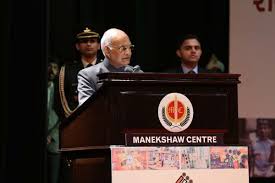
Address by the Hon’ble President of India Shri Ram Nath Kovind on the Occasion of the Inauguration of the Constitution Day

  1. feel honoured to be here today to inaugurate the Constitution Day celebrations. Today I feel doubly blessed as before coming to the Supreme Court, I addressed a joint session of parliament on the occasion of the 70th anniversary of adopting the Constitution. I have the rare privilege of being associated with both the institutions, Parliament and the Supreme Court, which are temples of our Republic.
  1. On this occasion I also feel humbled when I recall our Founding Fathers. Guided solely by the light of liberty and justice, they sat down to write this document of our destiny amid historic events and challenges. They created institutions and designed the right balance among them to ensure that their core objectives are not compromised. The co-existence of our fully independent judiciary with a vibrant parliamentary democracy is a testimony to their sagacity and foresight.
  1. These sages put in words the noble vision of our Republic in the Constitution after marathon deliberations over three years. The nation will always remain grateful to all the members and office-bearers of the Constituent Assembly, particularly its President, Dr Rajendra Prasad, and the Chairman of the Drafting Committee, Dr Babasaheb Bhimrao Ambedkar, who is rightly known as the architect of the Constitution. Their zeal and devotion to meet the task of such magnitude was matched by contributions from the titans like Jawaharlal Nehru and Sardar Vallabhbhai Patel. They headed various committees and sub-committees, along with ‘Acharya’ Kripalani, H. C. Mookerjee, Gopinath Bordoloi and Amritlal Thakkar.
  1. I would like to also pay homage especially to the 15 women members of the Constituent Assembly. They included Sarojini Naidu, Rajkumari Amrit Kaur, Hansaben Jivraj Mehta, Sucheta Kripalani and G. Durgabai, who spoke of equal rights for one and all, when women in many parts of the world were denied basic rights.
  1. In his speech before the Constitution was adopted, Dr Rajendra Prasad rightly noted that the successful working of democratic institutions requires willingness to respect the views of others, and capacity for compromise and accommodation. He said, [quote] “Many things which cannot be written in a Constitution are done by conventions. Let me hope that we shall show those capacities and develop those conventions.” [Unquote] Seventy years later, we have reasons to believe that the nation has lived up to his hopes to a fair degree.
  1. As Rajen Babu, Babasaheb and many others pointed out that day, a Constitution is after all a mere document, recording in words the inspired ideas. It can come alive and enter our world only when it is translated into life of the nation and its ideals put into practice. It is the scripture of our nation that has to be read in a sensitive and delicate manner. The Constitution gave this onerous task to the judiciary. Keeping the role of the Supreme Court as final interpreter of the constitution and the laws enacted under it, the judiciary assumes the role of its guardian. The authors of our Constitution took extra care in providing it the necessary powers and freedoms to function without any undue influence. Over these eventful seven decades, the judiciary has remained alive to the high responsibility placed on it. I am aware of the fact that it has initiated several innovative measures to reach out to people.
  1. But for a large section of people, justice is still beyond reach. While we celebrate the 150th birth anniversary of Mahatma Gandhi, let me refer to his views on the issue. Neither was the Father of the Nation a member of the Constituent Assembly, nor do we know his views on our founding document. What we know for sure is that he had played a crucial role in the making of the Constituent Assembly and blessed this historic endeavour. In a sense, the Constitution is the product of the values inspired by the Freedom Struggle. It, thus, very much reflects the democratic virtues Gandhiji lived by. Still, the closest we have as his views on a possible Constitution is a book called ‘Gandhian Constitution for Free India’. Shriman Narayan Agarwal wrote it in 1946, based on his understanding of Gandhian principles. The book had the benefit of being read and approved by Gandhiji himself, even though the words are not his.
  1. The book is critical of the British judicial system in India. In panchayats of the old times, it says, [Quote] “Justice was cheap and fair. Modern courts, on the contrary, are very expensive; even very ordinary cases are disposed of only after months, if not years.” [Unquote] What I wish to point out here is that Gandhiji would have been unhappy at the high cost of justice.
  1. Indeed, the Constitution itself calls for making justice accessible to all. Consider the Preamble, which is the ‘seed text’ of the whole document. Why did ‘We, the People of India’, solemnly resolve to constitute India into a republic”? Obviously this pledge seeks, “To secure to all its citizens: JUSTICE—Social, Economical and Political”. Like any religious scripture, this grand statement or “Mahavakya” of the constitution aims to secure liberty, equality and fraternity along with justice.

Ladies and gentlemen,

  1. On today’s occasion, let us deliberate how we can make justice accessible to all. One way out of the high cost is the provision of free legal aid. Pro-bono service is a subject close to my heart. As many of you know, during my days as a Supreme Court advocate, I provided pro-bono aid to weaker sections of society in general, and women and the poor in particular. I remain grateful to veteran lawyer Ashoke Sen who showed me the way. In the multiple roles he played in the field over a long career, his sole objective was the pursuit of justice, for one and all. I hope more and more law professionals will take inspiration from the example of Shri Sen and distribute freely the fruits of their knowledge among the needy. I would like to stress here that the task of making justice more accessible to all has to be a collective effort of all the stakeholders in the bench and the bar.
  1. The question of access is not limited to the cost factor alone. Language too has been a barrier for many, for a long time. On this count, however, I am happy that the Supreme Court has followed up my suggestion and started making its judgments available in nine regional languages. In the days to come, the list can include more languages, so that common people can read the verdicts of the highest court.
  1. Another hurdle in the way of justice is the delay and the resulting backlog. Clearing this bottleneck requires detailed deliberations and systemic efforts. I also understand it is an ongoing process. Information and communication technology can bring about amazing results in this domain, and I am happy to learn that beginnings have been made to take help of technological innovations. In this context, I am glad to learn that three apps for mobile phones are being launched today. This litigant-friendly move will bring the portals of the apex court closer to the people.

Ladies and gentlemen,

  1. In listing the obstacles before the delivery of justice, I have in mind the words of Dr Ambedkar. In his concluding speech before the Constituent Assembly, he exhorted us not to be tardy in the recognition of the evils that lie across our path and not to be weak in our initiative to remove them. He said, [QUOTE] “That is the only way to serve the country. I know of no better.” [UNQUOTE]
  1. To answer Babasaheb’s call, we should also strive to spread the awareness about the making of the Constitution, its provisions and its fundamental principle of equality. We need to especially narrate to the young generation the grand vision of our founding fathers. After all, we stand as a mere link between two generations in the continuing saga of this nation. Interpretation of the Constitution is a work in progress, and it will be up to the youth of the nation to carry forward the task of realizing its ideals.

Ladies and Gentlemen,

  1. Let me share something with you on a personal note. As I mentioned before, I come here after having addressed the Parliament. Standing before you, I recall that in 1993-94, I had made a journey from here to there; from being an advocate here to being a member of the Upper House. Such journeys have enriched my perspectives on the functioning of the republic. The framers of our Constitution rightly underlined the doctrine of separation of powers among the organs of the state. This, however, was not to be a hurdle in serving the people. Indeed, it was meant to serve the people better. Observing the life of the nation from more than one station in my journey, I now better appreciate the vision of our Founding Fathers.
  1. I thank you for inviting me to share my views. I congratulate the nation on the occasion of the Constitution Day, and extend my best wishes to all of you for the celebrations.


Thank you,

Jai Hind!