What is (more) \’Educationally Responsible\’?

What is more educationally responsible from among the alternatives below. Anytime you feel it\’s all very clear, don\’t ignore the possibility that there may a trap somewhere…
  • Encouraging someone to ask questions or give answers to questions no one is asking?
  • Helping learners discover worlds of fascinating and worthwhile knowledge around them versus providing them information from books?
  • Setting challenging tasks versus \’telling\’ children, giving explanatory lectures ?
  • Encouraging reflection or ensuring memorization of the right answers?
  • Preventing errors or letting children discover for themselves when they\’ve made a mistake?
  • Giving feedback versus giving marks (and remarks)?
  • Ensuring all children get the same opportunity versus ensuring different children get different opportunities?
  • Doing everything oneself (if you\’re a teacher) versus passing on some of your tasks to children (e.g. marking attendance, ensuring participation of peers)
  • Maintaining all provided materials in good shape or using them at the risk of their getting spoilt, torn, etc.?
  • Asking community to help with their knowledge heritage versus asking community to contribute to improvement in mid day meal?
  • Using a textbook as a resource versus using a textbook as a definitive material (i.e. assuming it is the curriculum)
  • Reading this blog or reading a useful book on education?!

So what is more educationally responsible? Let me have more such pairs / alternatives to choose from, and also your views on the above!

What is (more) \’Educationally Responsible\’?

What is more educationally responsible from among the alternatives below. Anytime you feel it\’s all very clear, don\’t ignore the possibility that there may a trap somewhere…
  • Encouraging someone to ask questions or give answers to questions no one is asking?
  • Helping learners discover worlds of fascinating and worthwhile knowledge around them versus providing them information from books?
  • Setting challenging tasks versus \’telling\’ children, giving explanatory lectures ?
  • Encouraging reflection or ensuring memorization of the right answers?
  • Preventing errors or letting children discover for themselves when they\’ve made a mistake?
  • Giving feedback versus giving marks (and remarks)?
  • Ensuring all children get the same opportunity versus ensuring different children get different opportunities?
  • Doing everything oneself (if you\’re a teacher) versus passing on some of your tasks to children (e.g. marking attendance, ensuring participation of peers)
  • Maintaining all provided materials in good shape or using them at the risk of their getting spoilt, torn, etc.?
  • Asking community to help with their knowledge heritage versus asking community to contribute to improvement in mid day meal?
  • Using a textbook as a resource versus using a textbook as a definitive material (i.e. assuming it is the curriculum)
  • Reading this blog or reading a useful book on education?!

So what is more educationally responsible? Let me have more such pairs / alternatives to choose from, and also your views on the above!

What is (more) \’Educationally Responsible\’?

What is more educationally responsible from among the alternatives below. Anytime you feel it\’s all very clear, don\’t ignore the possibility that there may a trap somewhere…
  • Encouraging someone to ask questions or give answers to questions no one is asking?
  • Helping learners discover worlds of fascinating and worthwhile knowledge around them versus providing them information from books?
  • Setting challenging tasks versus \’telling\’ children, giving explanatory lectures ?
  • Encouraging reflection or ensuring memorization of the right answers?
  • Preventing errors or letting children discover for themselves when they\’ve made a mistake?
  • Giving feedback versus giving marks (and remarks)?
  • Ensuring all children get the same opportunity versus ensuring different children get different opportunities?
  • Doing everything oneself (if you\’re a teacher) versus passing on some of your tasks to children (e.g. marking attendance, ensuring participation of peers)
  • Maintaining all provided materials in good shape or using them at the risk of their getting spoilt, torn, etc.?
  • Asking community to help with their knowledge heritage versus asking community to contribute to improvement in mid day meal?
  • Using a textbook as a resource versus using a textbook as a definitive material (i.e. assuming it is the curriculum)
  • Reading this blog or reading a useful book on education?!

So what is more educationally responsible? Let me have more such pairs / alternatives to choose from, and also your views on the above!

What is (more) \’Educationally Responsible\’?

What is more educationally responsible from among the alternatives below. Anytime you feel it\’s all very clear, don\’t ignore the possibility that there may a trap somewhere…
  • Encouraging someone to ask questions or give answers to questions no one is asking?
  • Helping learners discover worlds of fascinating and worthwhile knowledge around them versus providing them information from books?
  • Setting challenging tasks versus \’telling\’ children, giving explanatory lectures ?
  • Encouraging reflection or ensuring memorization of the right answers?
  • Preventing errors or letting children discover for themselves when they\’ve made a mistake?
  • Giving feedback versus giving marks (and remarks)?
  • Ensuring all children get the same opportunity versus ensuring different children get different opportunities?
  • Doing everything oneself (if you\’re a teacher) versus passing on some of your tasks to children (e.g. marking attendance, ensuring participation of peers)
  • Maintaining all provided materials in good shape or using them at the risk of their getting spoilt, torn, etc.?
  • Asking community to help with their knowledge heritage versus asking community to contribute to improvement in mid day meal?
  • Using a textbook as a resource versus using a textbook as a definitive material (i.e. assuming it is the curriculum)
  • Reading this blog or reading a useful book on education?!

So what is more educationally responsible? Let me have more such pairs / alternatives to choose from, and also your views on the above!

What is (more) \’Educationally Responsible\’?

What is more educationally responsible from among the alternatives below. Anytime you feel it\’s all very clear, don\’t ignore the possibility that there may a trap somewhere…
  • Encouraging someone to ask questions or give answers to questions no one is asking?
  • Helping learners discover worlds of fascinating and worthwhile knowledge around them versus providing them information from books?
  • Setting challenging tasks versus \’telling\’ children, giving explanatory lectures ?
  • Encouraging reflection or ensuring memorization of the right answers?
  • Preventing errors or letting children discover for themselves when they\’ve made a mistake?
  • Giving feedback versus giving marks (and remarks)?
  • Ensuring all children get the same opportunity versus ensuring different children get different opportunities?
  • Doing everything oneself (if you\’re a teacher) versus passing on some of your tasks to children (e.g. marking attendance, ensuring participation of peers)
  • Maintaining all provided materials in good shape or using them at the risk of their getting spoilt, torn, etc.?
  • Asking community to help with their knowledge heritage versus asking community to contribute to improvement in mid day meal?
  • Using a textbook as a resource versus using a textbook as a definitive material (i.e. assuming it is the curriculum)
  • Reading this blog or reading a useful book on education?!

So what is more educationally responsible? Let me have more such pairs / alternatives to choose from, and also your views on the above!

What is (more) \’Educationally Responsible\’?

What is more educationally responsible from among the alternatives below. Anytime you feel it\’s all very clear, don\’t ignore the possibility that there may a trap somewhere…
  • Encouraging someone to ask questions or give answers to questions no one is asking?
  • Helping learners discover worlds of fascinating and worthwhile knowledge around them versus providing them information from books?
  • Setting challenging tasks versus \’telling\’ children, giving explanatory lectures ?
  • Encouraging reflection or ensuring memorization of the right answers?
  • Preventing errors or letting children discover for themselves when they\’ve made a mistake?
  • Giving feedback versus giving marks (and remarks)?
  • Ensuring all children get the same opportunity versus ensuring different children get different opportunities?
  • Doing everything oneself (if you\’re a teacher) versus passing on some of your tasks to children (e.g. marking attendance, ensuring participation of peers)
  • Maintaining all provided materials in good shape or using them at the risk of their getting spoilt, torn, etc.?
  • Asking community to help with their knowledge heritage versus asking community to contribute to improvement in mid day meal?
  • Using a textbook as a resource versus using a textbook as a definitive material (i.e. assuming it is the curriculum)
  • Reading this blog or reading a useful book on education?!

So what is more educationally responsible? Let me have more such pairs / alternatives to choose from, and also your views on the above!

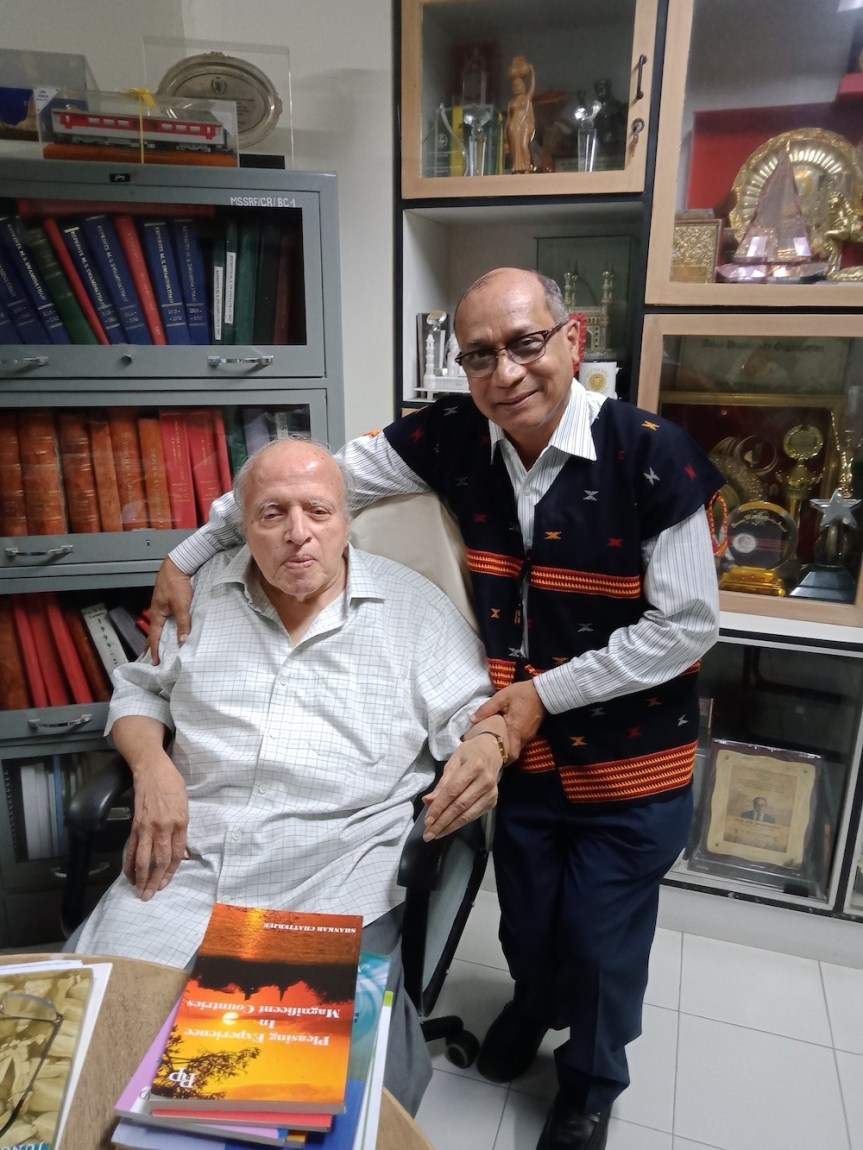
Wonderful Experience to meet Father of Green Revolution: Prof M S Swaminathan Sir

Prof. Mankombu Sambasivan Swaminathan, popularly known as M.S. Swaminathan, (born 7 August 1925) is a great personality not only in India but across the world as he has shown the path how a country can be self-sufficient in food-grains after experiencing severe food shortage because of drought. And for his enormous contributions in the field of agriculture, he was awarded with many national and international awards. The recent one is the first World Agriculture Prize in 2017. There is not an iota of doubt that because of Prof M.S. Swaminathan sir’s contribution today India is self-sufficient in food grains and 130 crores people are getting food. In the backdrop, we all know severity of the food problem in 1943, the Bengal famine and later on in 1965 because of monsoon failure India seriously suffered from food crisis. Now all are in history as Swaminathan sir has shown the path to both Indian Government and our farmers, how one can be self-sufficient which all know as ‘Green Revolution’. His vision is to get rid of the world from hunger and poverty and he is great believer of sustainable development, especially using environmentally sustainable agriculture and preservation of biodiversity, which he calls an “evergreen revolution.” He successfully completed various coveted positions and inter alia of which are – Director General of Indian Council of Agricultural Research from 1972 to 1979, after that Principal Secretary, Ministry of Agriculture, Government of India from 1979 to 1980. He served as prestigious post of Director General of the International Rice Research Institute (1982–88) and selected as the President of the International Union for the Conservation of Nature and Natural Resources. For his excellent contributions, in 1999 the prestigious Time Magazine placed him in the ‘Time 200’ list of most influential Asian people of the 20th century.

Another praiseworthy contribution of Swaminathan Sir to the world in general and India in particular is setting up of the MS Swaminathan Research Foundation, popularly known as MSSRF in Chennai, Tamil Nadu. MSSRF (established in 1988) is a non-profit organisation.

The MSSRF aims to accelerate use of modern science for sustainable agricultural and rural development. It focuses specifically on tribal and rural communities with a pro-poor, pro-women and pro-nature approach. The Foundation applies appropriate science and technology options to address practical problems faced by rural populations in agriculture, food and nutrition.

MSSRF is carrying out research and development in the following major areas:

I had the opportunity to meet Prof Swaminathan sir on 18 December 2019 at MSSRF in Chennai and took his blessing as I feel he is ‘Annadata’ (food provider) to all of us. Interaction was although few minutes but I was greatly enlightened.  I was charmed to see such a simple and wonderful human being although endowed with ‘ocean of knowledge’, awards etc.; he is ‘down to earth’ person. Immediately the Sanskrit proverb, which I read in school days, came to my mind ‘Vidya Dadati Vinayam’ (simple meaning Knowledge makes a man perfect).


Dr. Shankar Chatterjee

Former Professor& Head (CPME)

NIRD &PR (Govt. of India), 

Hyderabad-500 030

Telangana, India 

Email <shankarjagu@gmail.com>


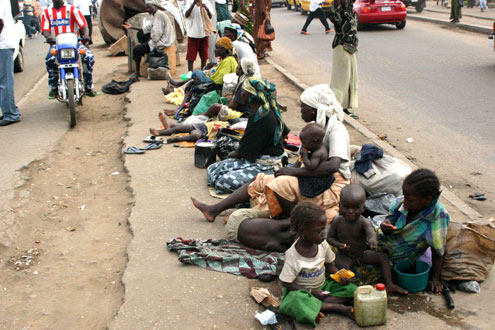
Beggars in Nigeria will start paying tax !


So says the Finance Minister of Nigeria. Beggars will have to pay taxes. Apparently some beggars are earning millions in Nigeria. Perhaps its fair enough that Mrs Adeosun , the Finance Minster said “proceeds from begging are taxable. You are supposed to pay taxes even if your means of income is begging”.
Nigeria is a notoriously corrupt country and tax evasion is blatant and has been elevated to a fine art.  Hence the startling “fact” that beggars are earning millions. Nigeria should, by all rights, should be a very prosperous country. It has oil wealth and is a net oil exporter. It has a  young , bright and growing population.  It has a decent education system and some of the ablest people in the African continent. It is a large economy – second largest after South Africa.  And yet, it is a huge underperformer economically. 
Periodically the Nigerian government tries to tackle corruption and the also shore up the country’s finances. Bolstering tax revenue by cracking down on rampant tax evasion keeps getting tried periodically, but with not much success. The latest is the Voluntary Assets and Income Declaration Scheme ( with the unfortunate acronym – VAIDS) . Good luck for the latest attempt.
India suffers from similar evasion, with its own home grown quirks. Agricultural income is not taxed , but much of what is claimed as agricultural income has nothing to do with farming. Similarly the tax entity called Hindu Undivided Family is nothing but an institutionalised way to manage taxes.  The irony that “Undivided” and “Family” cannot be put adjacent to each other when it comes to money matters is completely lost on Ramamritham !
The United States being the leader of the world in all matters offers a rich variety of such dodges in the law. Walt Disney in Florida and other big landowners collectively dodged $950 m in  taxes by renting a few cows to graze on their large land holdings and thereby qualified as agricultural land inviting lower taxes. And since two of my usual commenters are from the great state of Oregon, they may wish to declare that two of their limbs are useless and thereby earn a tax credit of $50 !
Back to begging. Actually no country exempts the proceeds of begging from taxation. If your earnings from begging exceed the minimum threshold, you have to pay tax on it anywhere in the world. Mrs Adeosun was only stating an universal truth ! Beggars of the world, beware !!

    The Seven Myths That Make Education Difficult To Improve

    If you’re from a poor family, there’s a lot more to life than just attending school! Siblings and domestic animals have to be cared for, parents have to be helped, essentials such as water or firewood have to be fetched, birds and animals kept away from the farm, you may need to migrate with your parents…. It’s not necessary that all this is a waste – in fact, despite the shadow child labour, a lot of this is also learning for life.  Children who are in a position to attend daily too might learn a lot if they spent a day or two every week doing things other than school – such as tending to gardens, pursuing a passion, trying to earn something by putting their learning to use, solving a neigbhourhood problem, helping their siblings and parents, making things…. Or helping their underprivileged classmates so that they can spend more time in school.
    The kind of focused (and therefore limited) scholastic learning our ‘advanced’ children end up doing has resulted in several luminaries pointing out that (even from institutions such as the IITs) our graduates are ‘unemployable’. One might add they haven’t developed many other aspects of their personality – including civic consciousness.
    However, what this requirement of daily attendance does is to marginalize great numbers of children, since the teaching-learning process tends to be sequential (rather than re-iterative). If you miss out an earlier part, you can’t ‘keep up with the class’ and slowly head for being left out or pushed out or dropping out. Effectively, the school is saying: if you are poor and cannot attend regularly (as the we require), you shall not learn. Instead of: attend when you can, we’ll find a way to support you and make sure you learn (which is what the business of the school really is).
    There are a few walk-in centres in the country (though of course only for poor and/or working children) and some of them do manage to attract and keep children for a long time even though there is no compulsion to attend. That kind of flexibility is perhaps too much to hope for in the school system. Enabling the school to be more responsive to children’s real living situations, though – that’s both possible and desirable. It needs a spiraling rather than linear flow, a variety and range of materials, and providing children engaging activities in many of which they will work on their own, and the use of a tracking system to keep record of progress. This gels with every provision of the RTE, with expectations put forward in our National Curriculum Framework, and much that contemporary understanding of pedagogy tells us. However, to make it happen what we need is not methods and materials but a way to get rid of this myth and the fear that everything will fall apart if the school seeks to respond (by adapting to children’s needs) rather than coerce (by making children adjust to its needs).

    How Do We Measure Change?

    We repeatedly find ourselves saying that working on improving education implies change. That is because the very core of education – in terms of key relationships, processes and the critical outcomes desired – itself is expected to undergo a transformation. Some of the biggest differences expected are in terms of

    • undoing the existing hierarchy,
    • increasing accountability,
    • evolving the role of the key stakeholders such as children and community from passive to active,
    • in fact even a reversal of the notion of the \’beneficiary\’ (especially after the RTE, children and the community are the reasons why the education system exists; and teachers, educational officers and others in the system are the beneficiaries in that they get their salaries because children have a right to education)
    • preparing children for life rather than just for examinations.


    Thus it is not just a case of revision in components such as curriculum or textbooks or training or assessment but bringing about much deeper changes that will then manifest themselves in the different components. Change, therefore, in the underpinnings or the foundations themselves, implies major shift in emphasis, ways of working, the means used, the technical and human / social capabilities required, and a myriad other things. All this adds up to one word: change.

    Much has been said on the issue of what this change is and the different ways of bringing it about (and more will appear too). But the one unresolved question confronting us is: how will we know if real change is actually happening, and to what extent? Is there any way in which we can capture / describe and \’measure\’ such deep change? As of now, the question really has us stumped. Any suggestions? 

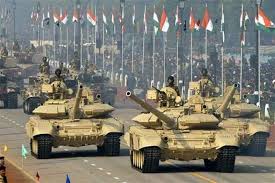
    Export and Import of Defence Equipment

    Capital procurement of defence equipment is undertaken from various domestic as well as foreign vendors, based on operational requirements of the Armed Forces, the availability or capacity to produce the equipment in India and abroad, to keep the Armed Forces in a state of readiness to meet the entire spectrum of security challenges. During last three financial years (2016-17 to 2018-19), 149 capital acquisition contracts have been concluded, out of which  58 contracts worth about   Rs. 1,38,727.16 crores and 91 contracts worth about Rs.76,955.73 crores have been placed on foreign vendors and Indian vendors respectively for procurement of defence equipment for the Indian Defence Forces. The countries from which defence equipment imports are being undertaken include Russia, USA, Israel, France and United Kingdom.

    There are 41 Ordnance Factories and 9 Defence Public Undertakings (DPSUs) in the Public sector in India manufacturing defence equipment. In addition, 452 number of Industrial Licenses (ILs) have been issued to defence industry in private sector for manufacturing of defence equipment.

    The major defence equipment exported during the last three years by India to foreign countries are Patrol Vessels, Helicopters, Sonars and Radars, Avionics, Radar Warning Receivers(RWR), Small Arms, Small Caliber Ammunition, Grenades, Telecommunication equipment, Coastal Surveillance, Simulators, Bullet Proof Jackets and Body Armour. The details of defence export authorisations for the last 3 years are as follows:-

    Year Value (Rs. in crore)
    2016-17 1,521
    2017-18 4,682
    2018-19 10,745

    This information was given by Raksha Rajya Mantri Shri Shripad Naik in a written reply to Shri Md. Nadimul Haque in Rajya Sabha today.

    ABB/Nampi/DK/Savvy/MTJ/ADA

    What does \’taking pride in being an Indian\’ mean?

    Anyone working on curriculum or materials or education in general, ends up wanting children to take pride in being an Indian. But what does \’taking pride in being an Indian\’ mean? Though the idea of \’taking pride\’ can be questioned, here are some things a person \’proud of being an Indian\’ would do / not do (not in any particular order):

    • celebrate the uniqueness and successes of those who are \’different\’ from us – whether belonging to different religion, ethnicity, language, region, profession…
    • not spit out in the open anywhere (surprised? well, this is a leading cause of diseases like TB still being active and killing people)
    • stop complaining about what is wrong (hoping someone else will do something about it) and start taking small steps to make things better, and also urging others to do the same (there\’s power in numbers!)
    • not restrict their sense of identity to a state or a region or a sub-set of India…
    • taking the responsibility of being at one\’s best (whether in health, or talent or work or socializing) so that one can ADD to what is already good in India 
    • taking responsibility of keeping one\’s immediate surroundings at the best we can (in terms of things being well-organized and clean/hygienic as well as in an \’ecological\’ sense) 
    • not simply keep harping on the \’golden days\’ of India\’s past but be aware of what we are at present… and hence 
    • not be afraid to face what is really wrong, accept it and work to changing it (e.g. recognize the \’ugly Indian\’ who jumps lines, is rude and selfish, flouts rules and grins when he gets away with it. Or, of course, the bigger issues of poverty, security, discrimination…)


    So what does it mean for you, to be a \’proud Indian\’?


    And once we\’ve sorted it out, how should it reflect in our curriculum, materials, textbooks and classroom processes?

    What does \’taking pride in being an Indian\’ mean?

    Anyone working on curriculum or materials or education in general, ends up wanting children to take pride in being an Indian. But what does \’taking pride in being an Indian\’ mean? Though the idea of \’taking pride\’ can be questioned, here are some things a person \’proud of being an Indian\’ would do / not do (not in any particular order):

    • celebrate the uniqueness and successes of those who are \’different\’ from us – whether belonging to different religion, ethnicity, language, region, profession…
    • not spit out in the open anywhere (surprised? well, this is a leading cause of diseases like TB still being active and killing people)
    • stop complaining about what is wrong (hoping someone else will do something about it) and start taking small steps to make things better, and also urging others to do the same (there\’s power in numbers!)
    • not restrict their sense of identity to a state or a region or a sub-set of India…
    • taking the responsibility of being at one\’s best (whether in health, or talent or work or socializing) so that one can ADD to what is already good in India 
    • taking responsibility of keeping one\’s immediate surroundings at the best we can (in terms of things being well-organized and clean/hygienic as well as in an \’ecological\’ sense) 
    • not simply keep harping on the \’golden days\’ of India\’s past but be aware of what we are at present… and hence 
    • not be afraid to face what is really wrong, accept it and work to changing it (e.g. recognize the \’ugly Indian\’ who jumps lines, is rude and selfish, flouts rules and grins when he gets away with it. Or, of course, the bigger issues of poverty, security, discrimination…)


    So what does it mean for you, to be a \’proud Indian\’?


    And once we\’ve sorted it out, how should it reflect in our curriculum, materials, textbooks and classroom processes?

    What does \’taking pride in being an Indian\’ mean?

    Anyone working on curriculum or materials or education in general, ends up wanting children to take pride in being an Indian. But what does \’taking pride in being an Indian\’ mean? Though the idea of \’taking pride\’ can be questioned, here are some things a person \’proud of being an Indian\’ would do / not do (not in any particular order):

    • celebrate the uniqueness and successes of those who are \’different\’ from us – whether belonging to different religion, ethnicity, language, region, profession…
    • not spit out in the open anywhere (surprised? well, this is a leading cause of diseases like TB still being active and killing people)
    • stop complaining about what is wrong (hoping someone else will do something about it) and start taking small steps to make things better, and also urging others to do the same (there\’s power in numbers!)
    • not restrict their sense of identity to a state or a region or a sub-set of India…
    • taking the responsibility of being at one\’s best (whether in health, or talent or work or socializing) so that one can ADD to what is already good in India 
    • taking responsibility of keeping one\’s immediate surroundings at the best we can (in terms of things being well-organized and clean/hygienic as well as in an \’ecological\’ sense) 
    • not simply keep harping on the \’golden days\’ of India\’s past but be aware of what we are at present… and hence 
    • not be afraid to face what is really wrong, accept it and work to changing it (e.g. recognize the \’ugly Indian\’ who jumps lines, is rude and selfish, flouts rules and grins when he gets away with it. Or, of course, the bigger issues of poverty, security, discrimination…)


    So what does it mean for you, to be a \’proud Indian\’?


    And once we\’ve sorted it out, how should it reflect in our curriculum, materials, textbooks and classroom processes?

    What does \’taking pride in being an Indian\’ mean?

    Anyone working on curriculum or materials or education in general, ends up wanting children to take pride in being an Indian. But what does \’taking pride in being an Indian\’ mean? Though the idea of \’taking pride\’ can be questioned, here are some things a person \’proud of being an Indian\’ would do / not do (not in any particular order):

    • celebrate the uniqueness and successes of those who are \’different\’ from us – whether belonging to different religion, ethnicity, language, region, profession…
    • not spit out in the open anywhere (surprised? well, this is a leading cause of diseases like TB still being active and killing people)
    • stop complaining about what is wrong (hoping someone else will do something about it) and start taking small steps to make things better, and also urging others to do the same (there\’s power in numbers!)
    • not restrict their sense of identity to a state or a region or a sub-set of India…
    • taking the responsibility of being at one\’s best (whether in health, or talent or work or socializing) so that one can ADD to what is already good in India 
    • taking responsibility of keeping one\’s immediate surroundings at the best we can (in terms of things being well-organized and clean/hygienic as well as in an \’ecological\’ sense) 
    • not simply keep harping on the \’golden days\’ of India\’s past but be aware of what we are at present… and hence 
    • not be afraid to face what is really wrong, accept it and work to changing it (e.g. recognize the \’ugly Indian\’ who jumps lines, is rude and selfish, flouts rules and grins when he gets away with it. Or, of course, the bigger issues of poverty, security, discrimination…)


    So what does it mean for you, to be a \’proud Indian\’?


    And once we\’ve sorted it out, how should it reflect in our curriculum, materials, textbooks and classroom processes?