7 Ways to Retain Optimism (Even If You Work In Improving Elementary Education!)

Got you, didn\’t it! Sooner or later, you hit a wall. There\’s a feeling that nothing works. That the system is so overwhelming that hardly anything can be done. Eventually, if you\’re someone trying to improve elementary education – whether as a teacher or resource person or administrator – you find yourself unwillingly accepting that the poor quality of education will continue to prevail in hundreds of thousands of classrooms.
Ok, so that\’s stated a little too strongly. But there is grain of truth there! Which is why, in the interest of millions of children, we need to look at how to retain the enthusiasm and optimism we started out with. So here are some ways to preserve your cheer, mental health and youthful looks despite the years you\’ve put in.
1. Think \’how\’, not \’should\’
Much too often we find ourselves talking about what \’should\’ be happening. Slowly the discussion slides into a list of things we are dissatisfied with – teachers not working, infrastructure remaining poor, lack of leadership, absence of commitment…. You can hear the pitch rising, can\’t you? Keep the pitch raised and you\’re bound to have a stressed heart!
To retain your desire to make things better (and keep your heart healthy), it would be so much better to talk of the how. What ordinary things can a teacher do? E.g. smile at children, read the textbook before the class, solve a puzzle herself to find out how much fun it is, read aloud a book to children once in a while – nothing that requires an \’order\’ or funding or special mandate or skill or training. Similarly, what can a head teacher do, burdened as she is with administrative tasks made difficult by lack of support? Share and delegate (e.g. make it fun for other teachers to participate and work as a group), discuss some of the records maintained in the school (e.g. connect children\’s attendance rates and test performance), and so on.
As you can see, you would have something doable to share. Chances are, some of the ideas might actually get picked up – in which case don\’t forget to really appreciate the person implementing them.
2. Focus on outcomes, not inputs
This is much more if you\’re a planner, administrator, supervisor, programme leader. Very often we\’re so focused on the inputs flowing from our side that we ignore what these are for. Thus it seems important to see whether material is supplied or not, the number of days of in-service training covered, physical targets fulfilled – and then one day it suddenly turns out that all this has not had much impact. We\’re left feeling that all our effort didn\’t amount to much, and a sinking feeling starts to grow. Of course we don\’t tell anyone else about it but we\’re aware it\’s there, isn\’t it?
How to overcome this situation? After all, inputs have to be provided. Sure they have – but for a purpose. It might be more useful to take a look at what all this is meant to bring about. For instance, the issue is not whether material is supplied or not but whether it is used as intended by children. This suddenly makes us see that we need to focus on training, incorporate this into the monitoring and academic support, share examples with teachers, encourage children and parents to lose inhibitions and start using material in school and at home… All of which, if done even on a small scale and only partially successful, has the wonderful effect of making you feel giddy with success. Pessimism – gone!
3. Be incremental
This point is so commonsensical and obvious that it gets ignored. Don\’t try to do everything or too much in one go (especially if you are at the district / sub-district level). For instance, for any teacher to make a real change in the classroom processes, some 40 different practices are likely to change. Try doing a full \’training\’ and expect all these changes – there\’s only chaos. Teachers do try but fail – no one\’s sure what to start with, the sequence in which to implement these changes, the steps to be taken. All it takes is one or two failures for teachers and schools to feel that nothing much can be done, that it\’s all too difficult, and doesn\’t work and is therefore not worth the effort. Soon, you begin to feel the same and are a pale shadow of the enthusiastic person who set out on a journey of change.
To get back on track on this journey, scale things down a little. Expect only a few changes at a time. E.g.
  • Give teachers a list of 6-8 possible changes (ranging from calling each child by the name, to making use of activities given in the textbooks to encouraging children to ask questions).
  • Ask them to select only 3-4 from this list (making a choice generates ownership and commitment); discuss the steps they need to take in order to bring about these changes.
  • Encourage them to make a 2-3 month implementation plan around these steps and help them monitor themselves and each other to see if the changes are actually happening.
  • Extend this cycle at the end of each 2-3 month period. Over a year or two, a dramatic change would occur – only it would have been less noticed as it happened, more successful, and breeding optimism rather than pessimism.
For those in the know, this is precisely what ADEPTS is all about and has made a positive change happen in over 22,000 (that\’s right, 22 thousand) schools in Gujarat.
4. Enter with questions, leave with (people\’s) ideas
Trainers, facilitators and academics trying to communicate with teachers end up being frustrated very soon – \’they don\’t pay any attention to whatever we say\’ is a common complaint. To which the reply is – why should they? The days are over when someone followed your ideas / views / instructions simply because you came from a so-called \’superior\’ level such as a university or senior position in the hierarchy. No, people will do things differently only if they are convinced and feel like doing it from inside. Our role is to touch people\’s hearts and minds rather than trying to shape them or fill them with our views.
How can one do this? It\’s so simple that I\’m almost ashamed to mention it! Don\’t enter a training session or a meeting with a list of things to tell. Instead, concentrate on a few key questions to ask. Questions that will generate response, reflection, and provoke people into coming out with their own views and ideas. For instance, ask questions such as:
  • If material is so easy to generate, why should we supply anything? What do you think?
  • Suggest ways in which you can use a library along with the textbook?
  • Shouldn\’t we trust children and get them to mark their own attendance instead of the teacher spending time on it?
  • When children don\’t understand decimals, exactly where do you think the problem lies?
Don\’t believe me, try it out and see what happens. At any rate, the tired old complaint will not be heard any more.

5. Don\’t see people as they are but as they\’re going to be…
Anyone who\’s responsible for helping people be different usually ends up using phrases such as \’dog\’s tail that can never be straightened\’. But that\’s because they see people as they actually are rather than what they can be like. Try this out the next time you\’re in such a situation – 
  • Look at your students / participants / team members and visualise them as being different. 
  • What qualities can you visualise them as having? 
  • What ways do you seem them adopting to make good use of the capabilities they already have? 
  • And what do you see yourself learning from them?
Gives you a different perspective, doesn\’t it? Every time I\’ve worked with a group that has been called \’difficult\’, this is what has helped me make good friends with the participants and support them in changing themselves. Not exactly rocket science, and works very well too. End result? You can imagine…
6. The system is people too
When you work on an impersonal, solid thing called a \’system\’, it\’s hard to see it changing. Indeed, it has an inertia of its own because it has usually arrived at some degree of stability over the years – and here you are, trying to destabilise it for reasons of your own! Why on earth would it meekly go along?
But if you look upon a system as a number of people bound in a set of relationships, you have several entry points where there didn\’t seem to be any in the beginning. There are bound to be persons in the system trying to make good things happen (if nothing else, just the law of averages determines that there have to be at least a few of these). Can you locate such persons? Is there a way of interacting with them, perhaps even bringing together a few of them? Can you change a few persons at a time? Is there an activity that would support or recognize their efforts, and given them the feeling that they\’re not alone? And when success (even small success) happens and is recognized, the circle of those willing to engage and dialogue, grows. With it grows the possibility of real change happening, thus reducing the chances of your growing old before your time out of sheer frustration and pessimism.
7. This is where I need your help
Please be so kind as to let me know the 7th (and 8th, and 9th) way…

Merry Christmas

For the next few days, I will be living “off the grid” so that I can focus this Christmas season on Christ, on Church, and on family. I will return next week to continue my series on Christ’s Sermon on the Mount, and to write of other things.

Let me take this opportunity to wish each of you a merry and blessed Christmas. May God richly bless you and those you love during this holy season and in the coming new year. And (as I said yesterday to two coworkers who are retiring), may you have as much fun and excitement as you want and as much peace and calm as you want. J.

Several initiatives taken by the Ministry of Steel to support a competitive, efficient, environment friendly steel industry, adhering to global safety and quality standards

The Government’s vision to achieve a $5 trillion economy by 2024 entails investments worth INR 100 lakh crore in infrastructure sectors, including several steel intensive sectors like Housing for All, 100% electrification, piped water for all etc. Steel has several inherent advantages of durability, faster completion time, reduced environmental impact, and creation of a circular economy. Steel will have a crucial role to play in India’s rise to a $5 trillion economy.

Payroll Reporting in India – A Formal Employment Perspective

The National Statistical Office (NSO), Ministry of Statistics and Programme Implementation has released the press note on Employment Outlook of the country covering the period September, 2017 to October, 2019, based on the administrative records available with selected government agencies to assess the progress in certain dimensions. A detailed note is annexed.

Click here to access the detailed note.


****

Year End Review 2019- Ministry of Shipping

In the year 2019, the government has undertaken several important progressive policy interventions and new initiatives to accelerate the overall development of the shipping sector.

Enactment of the landmark Recycling of Ships Act, 2019; accession to IMO’s Hong Kong International Convention for Safe and Environmentally Sound Recycling of Ships in November, 2019; measures to promote employment of seafarers; improved connectivity with neighbours and other countries for ease of movement of cargo and passengers; emphasis on cruise tourism; taking up new projects under flagship Sagarmala project are some of the key highlights of achievements of Ministry of Shipping in the year 2019.

The main achievements of Ministry of Shipping during 2019 are as below:

Enactment of Recycling of Ships Act, 2019 &accession to IMO’s Hong Kong International Convention

India became a prime destination for green ship recycling with the passing and enactment of the landmark Recycling of Ships Act, 2019. India has also acceded to IMO’s Hong Kong International Convention for Safe and Environmentally Sound Recycling of Ships in November,2019.The new Act provides a legislative framework for implementation of the provisions of the Hong Kong Convention. It also contains provisions of the Convention which are not covered in the Shipbreaking Code (Revised), 2013.Withenactment of this Act, ship recycling volume is expected to double by 2024.

Accession to IMO’s Hong Kong International Convention will give boost to the domestic ship recycling industry inIndia which is one of the world’s five major ship recycling countries

Biometric Seafarers Identity Document (BSID)

India has become the first country in the world to issue Biometric Seafarers Identity Document (BSID) capturing the facial biometric data of seafarers. The new document will give a foolproof identification to our seafarers which will facilitate their movement across countries, providing ease of getting jobs and also helping in identification at any location in the world.

International Cooperation

The year 2019 saw a series of international cooperation agreements and events. In order to boost the bilateral trade with other countries and to ensure cooperation and coordination in the maritime sector, severalMoUs weresigned with neighbouring, South Asian and other countries like Bangladesh, Nepal, Myanmar, Bhutan Maldives, Denmark and Sweden.One of the significant MoUs signed between India and Maldives will pave the way for ferry and cargo services between Maldives & Kerala. Another agreement has been signed with Sweden for mutual recognition of the certificates of seafarers in December, 2019. This will enable the employment of Indian seafarers on-board Swedish flag ships.

In another significant development, to promote movement of passenger, cruise services andcargo transit to North East Region (NER),thealternative connectivity route via Bangladesh’s Chattogram and Mongla Portswas first timeused to North East Region.This will increase trade volumes and reduce logistic costs of the cargo. Eight routes are also provided under the Agreement which would enable access of NER via Bangladesh.

The Minister of State for Shipping (I/C) and Chemicals & Fertilizers, Shri Mansukh Mandaviya digitally flagging off the IWAI vessel carrying cargo from Bhutan to Bangladesh through NW2 and Indo Bangla Protocol Route in New Delhi.

A MoU was also signed with the Germany for technology collaboration for the Central Inland & Coastal Maritime Technology (CICMT) at IIT Kharagpur during the state visit of German Chancellor.

India and Nepal have agreed to include Inland Waterways connectivity as an additional mode of transport in the Treaty of Transit.An Indian waterway was used for transportation of cargo between Bangladesh and Bhutan, using India for transit on 12.07.2019, for the first time ever.

Three Memorandums of Understanding (MoUs) were signed between Ranong Port (Port Authority of Thailand) and the Port Trusts of Chennai, Vishakhapatnam and Kolkata. These MoUs will enhance economic partnership by cutting down the sea travel time between India and Thailand from 10- 15 days to 7 days.

Ease of Doing Business

India has improved its ranking under the Trading Across Border (TAB) parameter of Ease of Doing business (EoDB) from 80 to 68. This impressive record has been facilitated due to various measures like Direct Port Delivery (DPD), Direct Port Entry (DPE), Introduction of RFID, Installation of scanners/container scanners, Simplification of procedures etc., taken by the major ports.

Cruise Operations

Promotion of Cruise Tourism and Coastal Shipping was one of the top most priorities of the Ministry of Shipping throughout this year. As Cruise Tourism has huge potential, the Ministry has taken various steps for promotion of international and domestic cruise services in India.

The arrival of the first private premium luxury cruise liner ‘KARNIKA’ has added another chapter in domestic cruise tourism in India. “KARNIKA” is offering for the first time opportunity to Indians to experience cruise tourism between Mumbai – Goa, Mumbai – Ganpatipule (Jaigad), Mumbai – Diu, Mumbai – Gulf routes.

With state of the art facilities developed at Mumbai Port, four cruise ships docked on the same day in November, 2019 at Mumbai port, a momentous occasion in its history.

Inaugural cruise services were started between Dhaka and Kolkata this year.Four cruise vessels have already travelled between India and Bangladesh in 2019.

Measures for Employment of Seafarers& Skill Development

The number of seafarers increased from 1,54,349 in 2017 to 2,08,799 in 2018 and to 2,31,776 in 2019. India has seen an unprecedented growth of Indian seafarers employed on-board Indian and foreign flagged vessels, as a result of cumulative impact of decisions of the Government to improve the quality of Maritime Training, increase in the training capacity, increase in the number of training berths, standardization of course curriculum and course material, improvement in examination system and above all by ease of doing business brought through simplified processes and with e-governance modules in the year 2019.

Issuing Biometric Seafarers Identity Document (BSID) is revolutionary step in this direction.

An agreement has been also signed with Sweden for mutual recognition of the certificates of seafarers in December, 2019.

The Minister of State for Shipping (I/C) and Chemicals & Fertilizers, Shri Mansukh Mandaviya launches the World’s first ever  “ Face Recognition Based Seafarer Identification document in India” in New Delhi.

For skill development, under the Phase 2 of Sagarmala DeenDayalUpadhyaya Grameen Kaushal Yojana (DDUGKY) for convergence for skill development in Port and Maritime Sector has been launched in Gujarat, Maharashtra, Kerala, Andhra Pradesh and Tamil Nadu. Besides this dedicated training centres have also been inaugurated in Kerala, Andhra Pradesh and Tamil Nadu.A Multi Skill Development Centre (MSDC) in Maritime Logistics at Jawaharlal Nehru Port Trustwas also inaugurated in 2019. The MSDC will provide skill development in Maritime Logistics to over 1050 students per year in the Port and Maritime sector. Multi-skill Development Centres (MSDC) are being setup at all major ports.

The foundation stone for the Central Inland & Coastal Maritime Technology (CICMT) at IIT Kharagpur was laid in March, 2019. The establishment of CICMT signifies a major leap in indigenous innovation and cutting-edge technology support to the Port and Maritime sector directly contributing to the Sagarmala programme and support ‘Make in India’ and is based on close collaboration amongst government, academic institutions and industry to make applied research relevant to day to day ground work in the port and maritime sector.

The Minister of State for Shipping (I/C) and Chemicals & Fertilizers, Shri Mansukh Mandaviya witnessing the signing ceremony of the Memorandum of Agreement between Ministry of Shipping and IIT Kharagpur for setting up the CICMT at IIT Kharagpur, in New Delhi.

A MoU was also signed with the Germany for technology collaboration for the centre during the state visit of German Chancellor.

Shipyards and Ports

The first ever BIMSTEC Conclave of Ports was held in India in 2019. The conclave provided a platform to strengthen maritime interaction, port-led connectivity initiatives and sharing best practices among member countries.

The Minister of State for Shipping (I/C) and Chemicals & Fertilizers, Shri Mansukh Mandaviya witnessing the exchange of an MoU at BIMSTEC Ports Conclave-2019 at Visakhapatnam, AP.


In 2019, upgraded Port Community System has been introduced for all ports. The system enables seamless data flow between the various stakeholders through common interface. To move towards complete paperless regime, E-DO (Electronic Delivery Order) through PCS made mandatory along with e-invoicing and e-payment. The RFID Operation at KDS, CCTV Operations at Kolkata Dock System (KDS) and Rabindra Setu and three Truck Parking Terminals at KDS was also inaugurated in 2019. The RFID system will provide single window system to the port users for obtaining permit/ passes through cashless transactions.

The Minister of State for Shipping (I/C) and Chemicals & Fertilizers, Shri Mansukh Mandaviya dedicating the Oil Spill Recovery Vessel, MARUDHAM at Chennai Port Trust.

Two multipurpose berths at Deendayal Port, Kandla were inaugurated by in March, 2019. The new berths would help in reducing the congestion in the port. In 2019 a 400 bedded Super Specialty Hospital at Paradip Port at an estimated cost of Rs.200 crore with an option to further develop a Medical College and expand the hospital on PPP basis.

The Minister of State for Shipping (I/C) and Chemicals & Fertilizers, Shri Mansukh Mandaviyadigitally inaugurated and laid foundation stone for various projects at Deendayal Port Trust.

Coastal Shipping

The ministry has undertaken several initiatives to promote Coastal Shipping,as coastal shipping isthe top most priority of the Ministry under Sagarmala. In order to continue this pace and seek further growth of coastal trade, a perspective plan up to year 2025 on development of coastal shipping in India has been prepared by Asian Development Bank. The plan takes a holistic view of the coastal shipping sector discerning its potential and challenges and addresses them with necessary infrastructure, regulatory and commercialintervention.

Maritime Heritage

The Ministry of Shipping has approved setting up of a National Maritime Heritage Complex at Lothal with total cost of Rs 478.9 Cr, the first of its kind world class complex in the country to showcase India’s rich Maritime Heritage dating back from Harappan times.

Other Significant Events

The Prime Minister Shri Narendra Modi dedicated to the nation, the Multimodal Terminal at Sahibganj (Jharkhand) in September, 2019 at Ranchi, Jharkhand.

The Prime Minister Shri Narendra Modi inaugurates the Multi-Modal Terminal at Sahibganj, Jharkhand.

For a closer and active interaction between the Central Governmentand the Maritime States/UTs for augmenting the infrastructure development and safety & security of the ports, as ports play a vital role in EXIM Trade,17thMaritime State Development Council was held in October 2019.

India was re-elected to the IMO Council under Category “B” – States with the largest interest in international seaborne trade as the Assembly of the International Maritime Organization (IMO) has elected new membersfor IMOCouncil for the biennium 2020-21.

The instrument of accession to the Hong Kong Convention was handed over to IMO Secretary General during 31session of the IMO Assembly by Secretary Shipping Shri Gopal Krishna at London, UK.

Eligibility criteria have been relaxed by Government for Indian shipyards to qualify for ROFR in 2019. The Ministry of Shipping has amended the guidelines regarding Grant of Right of First Refusal to Indian shipyards by Government departments or agencies for procurement of vessels by them for own use or Government use.

A proposal regarding settlement of long pending subsidy claims for executed shipbuilding contracts under the shipbuilding subsidy scheme, 2002-2007 has been given approvalinOctober, 2019. This would involve release of committed liability of shipbuilding subsidy through budgetary support of approx. Rs.153 crore for a total number of 51 vessels, including retained subsidy for 47 vessels and full subsidy for 4 vessels. Guidelines for release of the subsidy are being formulated by this Ministry.

Under the current financial assistance scheme on shipbuilding (2016-2026), financial assistance of Rs. 39.7 crore for seventeen vessels has been released to four Indian shipyards. Further amended and consolidated guidelines have been issued in February, 2019 to facilitate Indian shipyards to be more competitive internationally and to boost building of river water dredgers of 10 m and above.

For more details, please click/read the link below


Integrated Finance is the backbone of any Ministry, says Raksha Mantri Shri Rajnath Singh at Integrated Financial Advisors Workshop

Raksha Mantri Shri Rajnath Singh has termed Integrated Finance as the backbone of any ministry/department, saying that desired objectives can only be achieved when a ministry/department is able to manage within its budgetary resources without compromising on operational needs. Addressing the Integrated Financial Advisors (IFA) Workshop here today, Raksha Mantri commended the Finance Division in the Ministry of Defence (MoD) and Controller General of Defence Accounts (CGDA) for meeting the needs of the three Services and other allied organisations, like Ordnance Factories, Indian Coast Guard, Border Roads Organisation and DRDO with harmony and synergy and displaying the willingness and readiness to meet new challenges.

Shri Rajnath Singh highlighted that in the last three years, MoD has been able to fully utilise its allocations, ending the trend of non-utilisation of funds due to substantial delegation of financial powers. He said, financial powers have been delegated for capital and revenue procurement so that Armed Forces are able to make their own procurement of up to Rs 300-500 crore. Raksha Mantri added that emergency powers have also been given to the Armed Forces in view of their emergent operational needs. This, he said, has led to enhanced operational efficiency.

Raksha Mantri stressed that workshops like these not only play an important role in the evaluation of the Government’s policies and practices but also create a path for future policies. “Such events instill confidence in how responsible and committed we are to our financial matters. These responsibilities and commitments help us to make our administration accountable and the country financially independent”, he said.

Shri Rajnath Singh said, the functioning of the Government is being made effective and efficient under ‘Minimum Government Maximum Governance’, adding that performance standards are being established for government officials and mechanisms of prudence and accountability are being adopted in financial management. He said, in such a situation, this workshop creates a progressive and constructive feedback system according to which a roadmap for systemic improvements is made. Raksha Mantri hoped that the workshop will evolve more efficient methods of using delegated financial powers and expressed confidence that IFAs will act as a facilitator and help in timely implementation of projects.

In his address, Defence Secretary Dr Ajay Kumar termed IFAs as ‘eyes and ears of MoD’ and said their defining role is to guide the Services and other allied organisations in their way forward. He called for increased focus on non-financial resources saying that they are equally essential. Dr Kumar said, optimisation and utilisation of resources should be at the centre of the functioning of IFAs.

Secretary (Defence Finance) Smt Gargi Kaul described financial advice as an important pillar of good governance and accountability. She said, the role of IFAs is to help the executive achieve its goals and objectives keeping in mind financial prudence. She urged them to take a macro view, saying that micro-routine matters should not be stressed.

Chief of the Army Staff General Bipin Rawat, Controller General of Defence Accounts Shri Sanjiv Mittal, Secretary (Defence Production) Shri Subhash Chandra and other senior military and civil officers of MoD were present on the occasion. Financial Advisors from various ministries/departments across the country are attending the day-long workshop.


GeM Samvaad takes off in Four States

A national outreach Programme, GeM Samvaad, was launched on 17th December 2019 to reach out to stakeholders across the country and also local sellers in order to facilitate on-boarding of local sellers on the marketplace while catering to specific requirements and procurement needs of buyers.

The outreach programme began from 19th December 2019 and during the launch week the States of Karnataka, Uttarakhand, Himachal Pradesh and Andhra Pradesh are being covered. The outreach programme will be on till 17th February 2020 and will cover all the States and UTs.

GeM senior officers including CEO are steering the programs. They are also interacting with Buyers and Sellers attending the events. Arrangements for the outreach programmes including logistics are made by the respective State Governments. The target is to reach out to all stakeholders and learn from their experiences on their usage of GeM portal. Through this outreach programme, GeM expects to make the actual users aware about the new features and functionalities of the portal and collect feedback, which is the first step towards GeM’s ‘Voice of Customer’ initiative.

State Departments and Organizations and Public Sector Enterprises (PSEs) have been using GeM for their buying needs. Sellers from the States are also benefitting through the access to national Public Procurement market using the portal. Through GeM Samvaad the marketplace is looking forward to receiving feedback from users which shall be used for making improvements and advancements in the system.

GeM has more than 15 lakh products and around 20,000 services, more than 3 lakh registered sellers and service providers and more than 40,000 Government buyer organizations. In its short journey of three years, GeM has processed more than 28 lakh orders worth Rs. 40,000 crores in Gross Merchandise Value out of which 50% has been transacted by MSMEs.


Year End Review: Department of Atomic Energy

The major policies and programmes by the Department of Atomic Energy (DAE) during the year 2019 are given below:


  1. Nuclear Power Programme:


  • Kaiga Atomic Power Station (KGS-1) has set the world record of 962 days of continuous operation.
  • Tarapur Atomic Power Station Units (TAPS 1 &2), connected to the grid in April and May 1969, have completed 50 years of safe operation. TAPS- 1&2 are currently the oldest operating power reactors in the world, producing reliable power at about two rupees per unit.
  • At present there are 22 reactors with installed capacity of 6780 MWe operating above 80% plant load factor in the country.
  • Six Pressurised Heavy Water Reactors (PHWRs) of 700 MWe capacity each are at different stages of construction which would add 4200 MWe.
  • Four VVER reactors (KKNPP-3 to 6), each with 1000 MWe capacity are under construction.
  • Nuclear Fuel Complex (NFC), has completed supply of 37 element fuel bundles to Kakarapar Atomic Power Plant (KAPP3), first 700MWe PHWR, towards initial core requirement by establishing fabrication facility for 37 element fuel bundle manufacture.


  1. Medicine and Health Care:


  • Tata Memorial Centre (TMC), has commissioned new hospitals and has catered to the needs of more than half a million patients in 2019, among which, ~1,25,000 are new patients.


  • DAE has launched a global cancer care network, “NCG-Vishwam Cancer Care Connect” (NCG-Vishwam 3C) on 17th September 2019. NCG-Vishwam envisages integration of the hospitals and relevant cancer care institutes in partner countries with the National Cancer Grid (NCG) of India.


  • About 120 nuclear medicine centers and more than 400 radioimmunoassay (RIA) laboratories are deriving the benefit from the indigenous radioisotope products. This has benefited more than 10 lakh patients.


  • World’s first of its kind Glass vitrified Cesium pencil, extracted from high level radioactive waste for blood irradiation application has been developed and 7 such blood irradiators have been supplied to hospitals.


  • Ready to use 4 new Radiopharmaceuticals viz. 99mTc- HYNIC TATE injection for imaging of Neuro-endocrinetumours, 188Re-HEDP Cold Kit for bone pain palliation, 177Lu-EDTMP injection for bone pain palliation and 131 Iodine- Lipiodol injection for treatment of liver. These are in addition to 14 varieties of medicinal radioisotopes/radiopharmaceutical products developed and supplied for diagnostics, therapeutics and palletic use.


  • Clinical grade Yttrium-90 in 90Y-Acetate form has been extracted from high level waste trials for Patient trials have been started, subsequent to regulatory clearances.


  1. Research & Development


  • ECIL has successfully delivered latest model M3 EVMs – 3.3 lakh units & VVPATs – 5.8 lakh units for General Elections 2019.


  • Apsara-U, an upgraded swimming pool type reactor, has demonstrated that, it can produce carrier free Cu-64 radioisotope, which has potential for usage in PET scans.


  • A Compact facility for Reprocessing of Advanced fuels (CORAL) has been relicensed by the regulatory authority up to 2023, and the 50th reprocessing campaign of FBTR spent fuel is in progress.


  • Developed kit for detection of Chromium contamination of water -Developed a simple, user friendly, quick and cost effective kit for onsite determination of Cr (VI), a carcinogenic compound in water. This kit meets IS10500 as well as EPA criterion.


  • Many of our research facilities, including Synchrotron, Cyclotron, Dhruva, Fast Breeder Test Reactor (FBTR) etc. continued to achieve the highest ever performance. FBTR was operated at 30 MWt, a major milestone in its history, and its turbo generator was synchronized to the grid, delivering an electrical output of 6.1 MWe.


  • Indus synchrotrons (Indus-I and II) a national facility at RRCAT continued its operation in the three shifts, round the clock mode and 20 beamlines have been made available to users from all over the country. Nearly 1,000 user experiments have been carried out till November 2019.


  • RRCAT has developed two medical devices viz.


  1. ‘TuBerculoScope’, a low cost, compact and portable optical device for rapid detection of TB, and

ii) An ‘OncoDiagnoscope’, which is a low cost Raman probe, for in situ spectroscopic measurements of biological tissues. This is a compact and portable system for the non-invasive detection of (pre)cancerous lesions in oral cavities. This device was successfully deployed at six cancer screening camps by doctors of AIIMS, Jodhpur.


  • IREL has also successfully developed a flow sheet and produced 99% pure hafnium oxide from NFC raffinate. These are value added products.


  1. Mega Science Projects


  • Vigyan Samagam, the travelling exhibition a first-of-its-kind in the world showcasing all the Mega Science projects on a single platform. This is jointly organised by Department of Atomic Energy (DAE), Department of Science and Technology (DST) and National Council of Science Museum, Ministry of Culture are jointly organising a multi-venue mega-science exhibition, Vigyan Samagam at Mumbai, Bengaluru, Kolkata, and New Delhi. The footfalls, both at Mumbai and Bengaluru, have been very impressive with more than 2.7 lakh visitors at both the cities.


  •  67 ultra-stable power converters built at ECIL, Hyderabad for FAIR accelerator in Germany have been shipped to Germany after Factory  acceptance clearance from FAIR, Germany.


  1. Civil Nuclear Cooperation:

Progress has been made in India’s bilateral international engagement in civil nuclear cooperation with major partners.


Russia:

  • Discussions are underway with ROSATOM for building 6×1200 MWe nuclear power plant at a new site.

France:

  • Negotiations are in advanced stage for implementation of the Jaitapur project ( 6×1650 MWe).

U.S.A:

  • Discussions are underway with Westinghouse for building 6×1100 MWe nuclear power plant in Kovvada (A.P.)


(vi).  Progress in procurement of uranium from major global suppliers:


As part of Government’s efforts towards operationalisation of India’s international civil nuclear cooperation, significant outcomes have been achieved in fuel supply arrangements with major global suppliers viz, Canada, Kazakhstan and Australia.


  1. Human Resource Development


  • Since its inception in 2008, last year, Homi Bhabha National Institute (HBNI), a deemed to be University of the Department, crossed the prestigious milestone of awarding 1000 Ph.D degrees and 1000 M.Tech degrees. Till March 31, 2018,
  •  HBNI awarded 1132 Ph.D degrees and 1060 M.Tech degrees. Today, a large number of the practicing oncologists in the country have been associated with HBNI academic programs. Based on its NAAC accreditation, HBNI was chosen by UGC as one of the Deemed-to-be Universities to be given enhanced autonomy.
  • Global Centre for Nuclear Energy Partnership (GCNEP) has started operating in its newly developed campus near Bahadurgarh from April 2017. The centre has conducted more than 18 International training programs, technical meetings, workshops, etc., on topical areas. Since signing of MoU between GCNEP and Bangladesh Atomic Energy Commission, 10 experts from DAE have been deputed for consultancy work for Rooppur Nuclear Power Plant, Bangladesh varying from a few weeks to less than 3 months.

Use innovation and technology to better common man’s life: Vice President

The Vice President of India, Shri M Venkaiah Naidu today called upon the young engineers to use innovation and technological advancements for the betterment of life of the common man.

Describing innovation as the watchword for 21st Century, the Vice President asked institutions such as IITs and NITs to transform themselves into hubs of innovation. He suggested them to evolve their curricula and teaching methods constantly to suit the times and strive to bring out the best in each student.

Addressing the first Convocation of National Institute of Technology, Tadepalligudem in Andhra Pradesh today, he said that it was time for young engineers to come up with out-of-box solutions to various problems, including those faced by farmers from climate change.

Calling for collective efforts to double the farmers’ income and ensure profitability of agriculture, the Vice President asked scientists and engineers to create better weather prediction systems and explore ways and means to make agriculture more resilient.

Stating that boosting India’s food production to overcome the problem of malnutrition, Shri Naidu asserted that imported food security was never a solution.

Observing that climate patterns and weather systems were changing, he said global warming was a reality and one could not be in denial anymore about the impact of changing the climate.

The Vice President wanted engineers and technocrats to champion the cause of clean energy. He said that a balance between environment and development can be achieved through good technology. “It is essential that we strike that balance. Our development has to be sustainable. Let conservation be the cornerstone of every single one of your innovations,” he added.

Shri Naidu also stressed the need for technological innovations and interventions to reduce the gap between urban and rural India.

Stressing that development has to reach all sections of society, he called for special focus on creating urban amenities in rural areas.

Referring to Mahatma Gandhi’s call to develop villages as self sufficient entities, he called for creation of facilities such as schools, hospitals, libraries and skill development centers to empower rural women and youth.

Expressing concerns over reports of young students resorting to extreme steps due to stress, the Vice President said that campuses must be the safest spaces in our nation and urged all higher educational institutions to take extra care to teach youngsters how to manage stress.

He wanted technical education institutions such as NITs to nurture life skills and instill moral values in students. He said that every graduate passing out of the portals of such institutions must not only be academically proficient but must also be ethical, compassionate and honest.

During the event, the Vice President recollected his tenure as the Union Minister for Urban Development and Parliamentary Affairs when he took part in the foundation laying ceremony of NIT Andhra Pradesh in 2015.

The Governor of Andhra Pradesh, Shri Biswa Bhusan Harichandan, the Minister for Housing, Govt of AP, Shri Ranganadha Raju, the Minister for Women & Child Welfare, AP, Smt. Taneti Vanita, the Director, NIT Andhra Pradesh, Prof. C.S.P. Rao, Registrar, NIT Andhra Pradesh, Prof. G. Amba Prasad Rao, and others were present at the event.

Following is the full text of the speech –

“I am delighted to be with all of you today at the first convocation ceremony of NIT Andhra Pradesh, a young and promising institution nestled in the pristine land of Tadepalligudem.

A visit to Andhra Pradesh is like a homecoming to me. I was born here and was nurtured and nourished by this great land.

National Institutes of Technology (NITs) that have evolved from Regional Engineering Colleges (RECs) have been at the forefront of technical education in the nation.

NIT AP had the privilege of being mentored by NIT Warangal, the first REC in the country.

I am happy to know that NIT Andhra Pradesh is the 31st NIT in the nation.

I am told that it started functioning with the support of its mentor institute, NIT Warangal, in Sri Vasavi Engineering College Campus, Tadepalligudem.

I fondly remember the foundation laying ceremony of NIT Andhra Pradesh which was held on 20 August 2015 when I was the Union Minister for Urban Development and Parliamentary Affairs.

It is truly noteworthy that the construction work of the campus which started in October 2018, was completed in thirteen months.

The transformation of an erstwhile runway to an awe-inspiring campus of an institution of national importance is indeed remarkable.

It is clear from the report presented by the Director that the youngest NIT of the country has made great strides in all areas.

My dear young students,

Let me take this opportunity to congratulate each and every one of you for this tremendous accomplishment. You have the proud privilege of being the first batch of students to graduate from NIT, Andhra Pradesh.

NIT Andhra Pradesh was born with you and will grow with you and prosper with you.

As you leave the portals of this Institution today, please remember that you are amongst the brightest young minds of our country.

You live in a very exciting era of scientific and technological disruptions.

Technological breakthroughs in the form of Automation, Artificial Intelligence, Internet of Things, Big Data and analytics have truly transformed the way we live and work.

The existing frontiers of science are being constantly challenged through interaction between various disciplines ranging from arts to humanities to engineering to Biotechnology.

Young engineers like yourself have the never-before opportunity to further revolutionize these technologies and find new ways to use them for the benefit of humanity.

Let me stress that the ultimate aim of all these technological advances must be the betterment of the life of the common man. They must lead to the discovery of solutions to the most pressing problems of our time.

There is no doubt in my mind that innovation is the watchword for the 21st Century. Institutions such as the IITs and the NITs must become hubs of innovation.

They must recognize potential and nurture it to bring out the best in each student. The curricula and teaching methods in these institutions must never be set in stone. They must constantly evolve to suit the times.

Institutes that render technical education must never hesitate to teach and experiment with the latest of technologies. They must allow the free flow of ideas and must never stifle innovative thinking through rigid protocols.

Let me focus on a few areas that I think can be transformed through innovative technological interventions.

The first is agriculture. There is a vast scope to introduce new and innovative technologies to spur agriculture growth and improve the lot of the farmers. This is the time for young engineers to come up with out-of-box solutions to the problems faced by agriculturists from climate change to increasing crop productivity.

I urge young technocrats to understand the real problems faced by Indian agriculture, including fragmented land holdings and insufficient market access.

I want you to think.

Can we understand soil better?

Can we carry out more efficient irrigation by overcoming shortages and avoiding surpluses?

Indian agriculture is greatly dependent on weather. Keeping the changing climate and precipitation change in mind, can we create better weather prediction systems and make agriculture become more resilient?

Can we facilitate better price discovery and market access to farmers?

It is of paramount importance that we boost our food production to overcome hunger and feed a billion people. I have always maintained that imported food security is never a solution.

The second is the arena of clean and renewable energy.

Our climate patterns and weather systems are changing. Global Warming is a reality and it is happening now. We cannot be in denial anymore.

India is one of the most carbon-efficient economies in the world today. The government of India under the leadership of our visionary Prime Minister is all set to surpass the target we had set for ourselves of 175 GW of renewable energy by 2022.

Our Solar capacity has increased by eight times between FY14-18 and we have spearheaded the International Solar Alliance (ISA), a testimony to India’s commitment to the development of ‘zero emission sources’.

I want engineers and technocrats like you to champion the cause of clean energy.

I strongly believe that a balance between environment and development can be achieved through good technology.

It is essential that we strike that balance.

Our development has to be sustainable.

Let conservation be the cornerstone of every single one of your innovations.

The third is urban development.

India’s urban population is expected to rise to 517 million by 2020 and will cross the 700 million mark by 2050.

Our urban spaces are our engines of growth.

Unfortunately, our towns and cities have exceeded their carrying capacity and are choking.

Our most prosperous cities are also home to large slums.

Our cities must grow inclusively and sustainably.

We must find solutions for sustainable housing, drinking water, mass mobility and provide economic opportunities to bridge the huge income gaps in cities.

We must address concerns of pollution and congestion and create sustainable waste management solutions and waste-to-wealth initiatives.

We must make our urban spaces safe for women and children and accessible to the differently-abled.

We must check distress migration by providing quality healthcare, education, other amenities, and economic opportunities in rural areas as well.

Urban development is possible only if we achieve rural development, a cause that is very close to my heart.

Mahatma Gandhi also believed that self-sufficient villages are necessary if we are to build a prosperous nation.

Our rural areas too need technological interventions that are tailor-made to suit their unique requirements.

I also urge you to find solutions to challenges of water management.

Many parts of India are facing an acute water crisis. This crisis will only worsen in the time to come.

According to the Composite Water Management Index (CWMI) report released by the Niti Aayog in 2018, 21 major cities might reach zero groundwater levels by 2020.

The Union government recently formed a new Jal Shakti (water) ministry, which aims at tackling water issues with a holistic and integrated perspective. The ministry has announced an ambitious plan to provide piped water connections to every household in India by 2024.

The government alone will not be able to solve the entire problem. We must augment the efforts of the government.

We must use technology for better rainwater harvesting and to improve water use efficiency.

We must urgently transition from this ‘supply-and-supply-more water’ provision to measures which lead towards improving water use efficiency.

The challenge I place before all of you as young technocrats today, as you embark on the next phase of your life, is to find technological solutions to combat these pressing problems.

I am hopeful that you will come up with solutions to these challenges through hard work and creative thinking.

You do not have to wait for big-ticket innovations. Incremental improvements and frugal innovations can be carried out constantly to bring about advancements.

By solving these problems, you will create a virtuous cycle which will help pull millions out of poverty and improve the quality of their lives.

Please remember that that the ultimate aim of science and technology is to make lives of the people comfortable and happy.

My dear youngsters,

In spite of temporary global slowdown, the Indian economy has the potential to become a $ 5 economy in the coming years as the macroeconomic fundamentals are strong and resilient. Government is also taking various reforms from time to time to improve GDP growth, cut down red tape and attract more investments.

A bright future awaits all of you. All the stakeholders in the country, particularly youngsters like you, must strive to transform the nation and the lives of the people in tune with the three-word mantra of the Prime Minister, Shri Narendra Bhai Modi to ‘Reform. Perform and Transform’.

Even as our technical education institutions such as NITs equip young technocrats with such skills, also take care to nurture life skills and moral values in them. Always remember the words of Mahatma Gandhi. He said that education without character is a sin.

Every graduate passing out of the portals of this institution must not only be academically proficient, they must also be ethical, compassionate and honest individuals.

Before I conclude, I must raise one more issue.

I read with mounting concern reports about young students resorting to extreme measures because of the inability to handle stress and cope with challenges.

Our campuses must be the safest spaces in our nation, for in our campuses, our future is cast.

I urge our higher educational institutions to take extra care to teach our youngsters to manage stress.

I understand that the curriculum is heavy. But students must be taught to take time out. We must make sure that our students are physically fit and mentally happy.

My dear young friends,

Never hesitate to reach out to your friends, teachers or loved ones when you are in need of help or support.

Be optimistic and embrace the challenges that await you in your life and career with a balanced mind. The practice of Yoga and meditation will greatly help you to deal with stressful situations with poise and equanimity.

I am confident that you will make the impossible possible with your grit and determination.

Let me congratulate all of you once again.

Go forth and create a bright, beautiful future for you, our nation and the world.

Thank You.

Jai Hind!”


The pox on Ramamritham (for the nth time)

Regular readers of this blog know that this blogger rather likes railing against Ramamritham. Ever so often, there has to be a post yelling at this cursed individual.
This time it is on the Department of telecom (DoT) which is a pesky nuisance that purports to regulate every aspect of  our phones and how we talk to others. Along with the child it spawned TRAI – The Telecom Regulatory Authority of India, they have been busy over the last decade framing rules and procedures for everything on earth. Did you know that every phone company has to publish its prices and tariffs in a prescribed format  ? If you have seen that format, you’ll know that you need a PhD in mathematics to understand it.
One result is that you have to go armed with lots of paper and proof for something as simple as getting a SIM Card. In control obsessed China, I just went to a corner shop and bought a SIM. It took me 2 minutes to do so. In India, you submit an ID proof and an address proof (of course Raramritham has written rules on which documents will be accepted for either of those proofs), then wait a while as the SIM is “activated”, then you call up a number and revalidate the proofs you have submitted ……..
The latest antics of Ramamritham that has got my goat is that he has ruled that all phones henceforth sold in India must have GPS. His logic ? The safety and security of women is “of utmost importance”  says this blessed specimen. If she is in danger, we can trace her whereabouts through the GPS signal !!
Really ?? Is it the business of Ramamritham to be legislating such nonsense ?  If he was really concerned about women’s safety, he would be improving police coverage,  improving response time to complaints, ensuring more policewomen in the force, ensuring that cases are brought to speedy trial,  having a helpline where somebody actually answers the phone, etc etc. No. That’s all too difficult to do. Instead he can indulge in his favourite activity – write a rule.
Never mind that if a woman wanted GPS on her phone to reassure her of security, she can simply go and get such a phone. No. It has to be legislated.
India has an installed base of 400 million phones that are euphemistically called “feature phones”. Translation – they do not have feature such as GPS ! The cost of a phone is likely to increase by Rs 400 if GPS has to be featured in all phones.  That of course, does not bother Ramamritham.
When the industry protested, in true style Ramamritham replies – ” It is reiterated that all mobile handset makers should adhere , blah blah, to implementation of GPS facility in all mobile phones sold in India from January 1 , 2018. The representation (sic) in this regard will not be entertained in future ” . Beautiful.
Can all scientists stop their work on space exploration, finding a cure for cancer, sequencing the DNA, etc etc and instead concentrate single mindedly on the eradication of Ramamritham please !
PS : Ramamritham is a fictional name invented by the blogger to typify the useless, pedantic, petty and painful bureaucrat !

The Real Issue With Tech In Ed

If doctors\’ interest and ability in diagnosing and helping patients improve were limited, if the medicines themselves were not always known to work, and if the patients didn\’t have much ability to pay – how much do you think \’tech\’ would work? Moreover, if \’tech\’ took over the mistakes usually made by teachers, it would work even less, isn\’t it?
This is what is happening in the case of \’technology in education\’….
Vendors can be excused for touting their \’solutions\’ as real solutions – educators and decision-makers are the ones to be blamed for willingly falling into the trap of believing that technology will motivate teachers, overcome corruption, deal with the hierarchies that operate at the point of learning and perpetuate the hegemony of a few, tailor education to the needs and the experiences of the marginalized, solve the issue of huge and increasing diversity that teachers face, and overcome the indifference of the political / administrative establishment to poor educational performance.
A common finding in an analysis of most tech in ed efforts would likely show that after the initial enthusiasm and perhaps even use, the actual interaction / utilisation declines – eventually, it lies locked up or disused or misused (teachers use computers as a means of keeping children busy while they do something else). Sometimes a new wave of tech in ed displaces the old one but then neither end up making a sufficient difference.
It\’s not as if technology cannot make a difference, but it needs to be thought through differently. Usually, the thought process is – \’what can we do with tech\’? This is like saying: \’now that we have a car, where should we go?\’ You might end up going somewhere you didn\’t want to go. Instead, the question should be – \’what do we desperately want to do / need to do (and why), in which technology can play a part?\’ Examples of this are relatively rare!

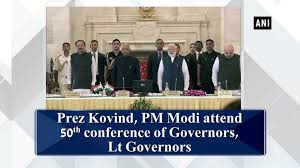
50th Conference of Governors Concludes at Rashtrapati Bhavan Today

The 50th Conference of Governors concluded at Rashtrapati Bhavan today (November 24, 2019) while laying emphasis on tribal welfare and issues related to water, agriculture, higher education and ease of living.

Five Groups of Governors submitted their reports on these issues, and deliberated and identified actionable points in which governors can play a facilitating role. The conference took keen interest in tribal welfare issue and pointed out that policies for tribal uplift had to be tailored in accordance with local requirements.

In his closing remarks, the President of India, Shri Ram Nath Kovind said that the discussions held by Governors and Lt. Governors proved to be a fruitful exercise. The participation of Ministries and NITI Aayog has helped in making these discussions focused and actionable. He was confident that many useful solutions would come out of the deliberations of this conference.

The President said that November 26 this year is the 70th anniversary of our Constitution. On that day a campaign will be launched to create awareness about fundamental duties among the citizens. He expressed hope that all Raj Bhavans will celebrate the Constitution Day in an effective manner and Governors will play a major role in creating awareness about fundamental duties among the people.

The President said that it is the fundamental duty of every citizen to protect the natural environment including water resources like forest, lake and river. It is also a constitutional duty to continuously strive for excellence in all areas for the progress of country. Individual and collective efforts for excellence in the areas of higher education, agriculture, inclusive growth and governance will give impetus to public welfare.

The President said that the post of Governor is the most important link in our federal system. Governors have a role in ensuring better coordination between centre and states. The President also made suggestions to governors to make their respective Raj Bhavans more interactive and accessible to ordinary people and representatives of different organs of the state.

While referring to gubernatorial post as having the colonial legacy of inaccessibility with common people, he urged governors to make conscious efforts to connect with people and dispel any such perception of Raj Bhavan being beyond the reach of the people.

The Vice President, the Prime Minister and the Minister for Home Affairs also addressed the concluding session.

****

Contesting Cribbing

If you\’re a person working to improve the educational system in a country like ours, here\’s something you\’ll recognize: whether it\’s journalists or academics, colleagues from NGOs or \’well-wishers\’ of children, everyone is pretty good at \’problem pointing\’. They\’re really good at telling us exactly how BAD things are. Numerous articles, speeches, social media entries, research pieces, presentations, and even protests, copiously crib about a range of ills affecting education : how the system is dysfunctional, teachers are absent, accountability is missing, children aren\’t learning, process is dated, children are oppressed, administration is rigid, policies are rich but unimplemented, how the disadvantaged continue to get a raw deal right through… Recognize it? I do, for some of this is what I do as well!

But here\’s the rub – all this elaboration on what is wrong (some of it is serious research that is credible as well), how far has it helped find exactly what to do. That is, what to do which would help us get rid of the problems being pointed out. Don\’t get me wrong, I\’m all for the growing numbers of those who are able to detail their dissatisfaction at the continued limitations of our education system. It\’s just that I\’m unable to learn enough from it to know what needs to be done.

Because when one gets down to the doing, a whole lot of other things unfold that you were not quite prepared for. Turns out dealing with diversity is not exactly easy, and most of the pat suggestions don\’t really hold in face of the actual ground realities. Turns out that poor (or even exploitative) governance is such an all-pervading reality that what we can do in / through education just pales in front of it (try sitting in a district education office for a day if you don\’t believe me). Turns out that our \’log frames\’, strategies, plans and spreadsheets capture something in our mind but all of it simply crumbles when the actual implementation takes place. It\’s often noticed that some of the best experts, especially those from the universities, are usually eager to help in the planning and the evaluation – but not the part that comes in between, i.e. the implementation!

So I\’ve come to the unfortunate conclusion that a great proportion of those involved tend to complain mainly because it is the easiest thing to do. Just like many newspaper sections talk of potholes on the roads, delayed or poor services, or lack of facilities (usually in a self-righteous tone that includes phrases such as \’even 60 years after independence\’ – you get the picture). All this in the hope that saying what is wrong will somehow make it go away. As if it really does! 

Where does all this leave us? To my mind, it leaves us with a lot of cribbing all around us. Every day we continue to read, hear, powerpoint and wordprocess an overdose of shortcomings. Such solutions as are offered are usually: 

  • trite (\’there should be accountability\’ – which is easy to say, of course) or 
  • platitudinous  (\’teachers should be dedicated to their vocation\’) or 
  • superficial (\’implement play way method!\’ – makes one\’s skin crawl) or 
  • autocratic (\’strictly monitor these damned teachers, don\’t let them get away\’ ) or 
  • misguided (\’pay teachers more / less if their students learn more / less\’ – you can see how this will favour the already advantaged, isn\’t it) or 
  • even desperate and daft (\’put a web cam in every class\’).


I\’m doing the same, of course, cribbing. But let me try to redeem myself by making a few (hopefully) concrete suggestions:

  • The first thing is to recognize the huge potential of all this cribbing. It represents an enormous and growing \’cognitive surplus\’ that can be put to better use to further what the \’cribber\’ is interested in – actual improvement.
  • Along the lines of wikipedia, bring out a collective, well-organised and evolving situational analysis to which people can keep contributing. This will help generate a more structured, well-rounded understanding that might increase the likelihood of finding effective strategies.This should include a critique of the kind of superficial solutions mentioned earlier, with case studies of the difficulties they landed in or the actual improvement they brought about. An analysis of serious efforts and the difficulties faced would help bring about a nuanced problematization.
  • Those involved in change efforts could find ways of identifying any \’cribber\’ who shows potential, and involve her/him in actual improvement processes – either the process would improve or the cribbing would be contained.
  • Publicize and set standards for the kind of writing that is deemed as being helpful. This is not easy at all – but the degree to which the social discourse on education is getting overwhelmed by this collective bemoaning (and the resultant diversion from / inability to actually address the issues) is now making it imperative that we find a way out. Any news channel / newspaper could initiate this by developing a policy paper on how to cover the social sector and then actually following it. Once an example is set, others would follow suit (simply because the initiating body would come out looking better, and therefore be likely to grab a bigger share of sensible eyeballs). 

You might feel that I\’ve totally mis-read the situation, that we need more people to actually be pointing out what is going wrong. Well, point away – but that\’s no guarantee it will make the problem go away!

How Do We Measure Change?

We repeatedly find ourselves saying that working on improving education implies change. That is because the very core of education – in terms of key relationships, processes and the critical outcomes desired – itself is expected to undergo a transformation. Some of the biggest differences expected are in terms of

  • undoing the existing hierarchy,
  • increasing accountability,
  • evolving the role of the key stakeholders such as children and community from passive to active,
  • in fact even a reversal of the notion of the \’beneficiary\’ (especially after the RTE, children and the community are the reasons why the education system exists; and teachers, educational officers and others in the system are the beneficiaries in that they get their salaries because children have a right to education)
  • preparing children for life rather than just for examinations.


Thus it is not just a case of revision in components such as curriculum or textbooks or training or assessment but bringing about much deeper changes that will then manifest themselves in the different components. Change, therefore, in the underpinnings or the foundations themselves, implies major shift in emphasis, ways of working, the means used, the technical and human / social capabilities required, and a myriad other things. All this adds up to one word: change.

Much has been said on the issue of what this change is and the different ways of bringing it about (and more will appear too). But the one unresolved question confronting us is: how will we know if real change is actually happening, and to what extent? Is there any way in which we can capture / describe and \’measure\’ such deep change? As of now, the question really has us stumped. Any suggestions? 

The Top Ten Confusions in Education

Trying to improve the quality of education – be it in a school or a cluster or an entire system – can be full of \’land-mines\’ exploding unexpectedly, leaving you with confusion all around you. Here are the top ten \’confusion\’ land-mines:

  • It is only when I teach that children will learn, isn\’t it?
  • Don\’t we have to guide children and show them the way?
  • I\’m not biased, am I?
  • Can all children really learn?
  • We can\’t teach different children different things in the same classroom, can we?
  • If only the teachers started working, wouldn\’t all problems of school education be solved?
  • If I turned out OK, how can there be much wrong with the education system?
  • If children start thinking by themselves and \’constructing\’ their own knowledge, what is the role of (and the need for) the teacher?
  • If we don\’t discipline children and correct their \’errors\’, won\’t they turn out bad?
  • Isn\’t the curriculum the same as the textbook that has to be \’covered\’?
  • In-service teacher training workshops can transform teachers, isn\’t it?
  • Testing is the best and the only way to find out if children have learnt anything, isn\’t it?
  • If one\’s education doesn\’t help one get a job, what good is it?
  • Researchers and academics know best about classroom processes, don\’t they?

Actually the list is longer than ten – pick out your own top ten! (You can include ones that are not here)

Also, who\’s the one confused? You, or the others? And is there anything that can be done?