Companies don\’t make investment decisions based on tax rates

If you cut tax rates, will companies invest more ? This is almost a religious belief in a certain party in a certain country in the world. Is it justified  ?
The answer, in my opinion, is mostly No.
Companies make investment decisions based on markets, sales projections, competitive advantage, margin potential, scalability and the like.  These are extremely complex business variables and occupy 90% of the time and effort that goes into a business decision.
The tax line is one of the last lines in the cash flows of an investment proposal. It is certainly important, but hardly a determiner of whether the investment goes ahead or not.
There are a few instances when the tax rate indeed becomes a determining variable in the decision. For example, in India, there have been many instances where the government, in an effort to stimulate an underdeveloped part of the country has allowed zero income tax rates for operations located in those areas. In such a case, the tax rate becomes a determiner of the location of the investment; not the investment per se. Nobody puts up a factory just because the tax rate is zero. They put up a factory because the business opportunity is compelling. Having decided to invest, they may choose to locate it in a low tax zone.
The other instance when a tax rate becomes a determiner of investment is if the tax rate is ridiculously high.  For example if the marginal tax rate is 90%, nobody will invest even if the business opportunity is compelling (M. Melenchon\’s supporters, are you listening ?). But if you cut the tax rate from 35% to 15% , it\’s a nice bonus, but it will not add one dollar of investment which otherwise would not have been made.
Further, companies make investments based on a 7 or 9 year time horizon. If one President cuts tax rates this year, what stops the next President from increasing it 3 years from now. So its almost inconceivable that a company which would otherwise have not made the investment, will rush to now make it because of the tax cut.
The argument that a major tax cut on companies, will spur investment growth is mostly flawed. It will however have the following consequences
It will improve corporate profits (for after all tax is a cost) and therefore both the investible surplus and/or dividends in the hands of shareholders. It will increase the wealth in the hands of those who are shareholders. They may spend it which will have a beneficial impact on the economy.
It will correspondingly increase the deficit that the government runs, and therefore the nation\’s borrowings. That will push the cost of borrowing and inflation.
But will it also increase tax revenues and therefore make the measure revenue neutral. Mostly No. But there is one big exception in the US, which will be the subject matter of the next post.

Companies don\’t make investment decisions based on tax rates

If you cut tax rates, will companies invest more ? This is almost a religious belief in a certain party in a certain country in the world. Is it justified  ?
The answer, in my opinion, is mostly No.
Companies make investment decisions based on markets, sales projections, competitive advantage, margin potential, scalability and the like.  These are extremely complex business variables and occupy 90% of the time and effort that goes into a business decision.
The tax line is one of the last lines in the cash flows of an investment proposal. It is certainly important, but hardly a determiner of whether the investment goes ahead or not.
There are a few instances when the tax rate indeed becomes a determining variable in the decision. For example, in India, there have been many instances where the government, in an effort to stimulate an underdeveloped part of the country has allowed zero income tax rates for operations located in those areas. In such a case, the tax rate becomes a determiner of the location of the investment; not the investment per se. Nobody puts up a factory just because the tax rate is zero. They put up a factory because the business opportunity is compelling. Having decided to invest, they may choose to locate it in a low tax zone.
The other instance when a tax rate becomes a determiner of investment is if the tax rate is ridiculously high.  For example if the marginal tax rate is 90%, nobody will invest even if the business opportunity is compelling (M. Melenchon\’s supporters, are you listening ?). But if you cut the tax rate from 35% to 15% , it\’s a nice bonus, but it will not add one dollar of investment which otherwise would not have been made.
Further, companies make investments based on a 7 or 9 year time horizon. If one President cuts tax rates this year, what stops the next President from increasing it 3 years from now. So its almost inconceivable that a company which would otherwise have not made the investment, will rush to now make it because of the tax cut.
The argument that a major tax cut on companies, will spur investment growth is mostly flawed. It will however have the following consequences
It will improve corporate profits (for after all tax is a cost) and therefore both the investible surplus and/or dividends in the hands of shareholders. It will increase the wealth in the hands of those who are shareholders. They may spend it which will have a beneficial impact on the economy.
It will correspondingly increase the deficit that the government runs, and therefore the nation\’s borrowings. That will push the cost of borrowing and inflation.
But will it also increase tax revenues and therefore make the measure revenue neutral. Mostly No. But there is one big exception in the US, which will be the subject matter of the next post.

Companies don\’t make investment decisions based on tax rates

If you cut tax rates, will companies invest more ? This is almost a religious belief in a certain party in a certain country in the world. Is it justified  ?
The answer, in my opinion, is mostly No.
Companies make investment decisions based on markets, sales projections, competitive advantage, margin potential, scalability and the like.  These are extremely complex business variables and occupy 90% of the time and effort that goes into a business decision.
The tax line is one of the last lines in the cash flows of an investment proposal. It is certainly important, but hardly a determiner of whether the investment goes ahead or not.
There are a few instances when the tax rate indeed becomes a determining variable in the decision. For example, in India, there have been many instances where the government, in an effort to stimulate an underdeveloped part of the country has allowed zero income tax rates for operations located in those areas. In such a case, the tax rate becomes a determiner of the location of the investment; not the investment per se. Nobody puts up a factory just because the tax rate is zero. They put up a factory because the business opportunity is compelling. Having decided to invest, they may choose to locate it in a low tax zone.
The other instance when a tax rate becomes a determiner of investment is if the tax rate is ridiculously high.  For example if the marginal tax rate is 90%, nobody will invest even if the business opportunity is compelling (M. Melenchon\’s supporters, are you listening ?). But if you cut the tax rate from 35% to 15% , it\’s a nice bonus, but it will not add one dollar of investment which otherwise would not have been made.
Further, companies make investments based on a 7 or 9 year time horizon. If one President cuts tax rates this year, what stops the next President from increasing it 3 years from now. So its almost inconceivable that a company which would otherwise have not made the investment, will rush to now make it because of the tax cut.
The argument that a major tax cut on companies, will spur investment growth is mostly flawed. It will however have the following consequences
It will improve corporate profits (for after all tax is a cost) and therefore both the investible surplus and/or dividends in the hands of shareholders. It will increase the wealth in the hands of those who are shareholders. They may spend it which will have a beneficial impact on the economy.
It will correspondingly increase the deficit that the government runs, and therefore the nation\’s borrowings. That will push the cost of borrowing and inflation.
But will it also increase tax revenues and therefore make the measure revenue neutral. Mostly No. But there is one big exception in the US, which will be the subject matter of the next post.

Companies don\’t make investment decisions based on tax rates

If you cut tax rates, will companies invest more ? This is almost a religious belief in a certain party in a certain country in the world. Is it justified  ?
The answer, in my opinion, is mostly No.
Companies make investment decisions based on markets, sales projections, competitive advantage, margin potential, scalability and the like.  These are extremely complex business variables and occupy 90% of the time and effort that goes into a business decision.
The tax line is one of the last lines in the cash flows of an investment proposal. It is certainly important, but hardly a determiner of whether the investment goes ahead or not.
There are a few instances when the tax rate indeed becomes a determining variable in the decision. For example, in India, there have been many instances where the government, in an effort to stimulate an underdeveloped part of the country has allowed zero income tax rates for operations located in those areas. In such a case, the tax rate becomes a determiner of the location of the investment; not the investment per se. Nobody puts up a factory just because the tax rate is zero. They put up a factory because the business opportunity is compelling. Having decided to invest, they may choose to locate it in a low tax zone.
The other instance when a tax rate becomes a determiner of investment is if the tax rate is ridiculously high.  For example if the marginal tax rate is 90%, nobody will invest even if the business opportunity is compelling (M. Melenchon\’s supporters, are you listening ?). But if you cut the tax rate from 35% to 15% , it\’s a nice bonus, but it will not add one dollar of investment which otherwise would not have been made.
Further, companies make investments based on a 7 or 9 year time horizon. If one President cuts tax rates this year, what stops the next President from increasing it 3 years from now. So its almost inconceivable that a company which would otherwise have not made the investment, will rush to now make it because of the tax cut.
The argument that a major tax cut on companies, will spur investment growth is mostly flawed. It will however have the following consequences
It will improve corporate profits (for after all tax is a cost) and therefore both the investible surplus and/or dividends in the hands of shareholders. It will increase the wealth in the hands of those who are shareholders. They may spend it which will have a beneficial impact on the economy.
It will correspondingly increase the deficit that the government runs, and therefore the nation\’s borrowings. That will push the cost of borrowing and inflation.
But will it also increase tax revenues and therefore make the measure revenue neutral. Mostly No. But there is one big exception in the US, which will be the subject matter of the next post.

Companies don\’t make investment decisions based on tax rates

If you cut tax rates, will companies invest more ? This is almost a religious belief in a certain party in a certain country in the world. Is it justified  ?
The answer, in my opinion, is mostly No.
Companies make investment decisions based on markets, sales projections, competitive advantage, margin potential, scalability and the like.  These are extremely complex business variables and occupy 90% of the time and effort that goes into a business decision.
The tax line is one of the last lines in the cash flows of an investment proposal. It is certainly important, but hardly a determiner of whether the investment goes ahead or not.
There are a few instances when the tax rate indeed becomes a determining variable in the decision. For example, in India, there have been many instances where the government, in an effort to stimulate an underdeveloped part of the country has allowed zero income tax rates for operations located in those areas. In such a case, the tax rate becomes a determiner of the location of the investment; not the investment per se. Nobody puts up a factory just because the tax rate is zero. They put up a factory because the business opportunity is compelling. Having decided to invest, they may choose to locate it in a low tax zone.
The other instance when a tax rate becomes a determiner of investment is if the tax rate is ridiculously high.  For example if the marginal tax rate is 90%, nobody will invest even if the business opportunity is compelling (M. Melenchon\’s supporters, are you listening ?). But if you cut the tax rate from 35% to 15% , it\’s a nice bonus, but it will not add one dollar of investment which otherwise would not have been made.
Further, companies make investments based on a 7 or 9 year time horizon. If one President cuts tax rates this year, what stops the next President from increasing it 3 years from now. So its almost inconceivable that a company which would otherwise have not made the investment, will rush to now make it because of the tax cut.
The argument that a major tax cut on companies, will spur investment growth is mostly flawed. It will however have the following consequences
It will improve corporate profits (for after all tax is a cost) and therefore both the investible surplus and/or dividends in the hands of shareholders. It will increase the wealth in the hands of those who are shareholders. They may spend it which will have a beneficial impact on the economy.
It will correspondingly increase the deficit that the government runs, and therefore the nation\’s borrowings. That will push the cost of borrowing and inflation.
But will it also increase tax revenues and therefore make the measure revenue neutral. Mostly No. But there is one big exception in the US, which will be the subject matter of the next post.

Companies don\’t make investment decisions based on tax rates

If you cut tax rates, will companies invest more ? This is almost a religious belief in a certain party in a certain country in the world. Is it justified  ?
The answer, in my opinion, is mostly No.
Companies make investment decisions based on markets, sales projections, competitive advantage, margin potential, scalability and the like.  These are extremely complex business variables and occupy 90% of the time and effort that goes into a business decision.
The tax line is one of the last lines in the cash flows of an investment proposal. It is certainly important, but hardly a determiner of whether the investment goes ahead or not.
There are a few instances when the tax rate indeed becomes a determining variable in the decision. For example, in India, there have been many instances where the government, in an effort to stimulate an underdeveloped part of the country has allowed zero income tax rates for operations located in those areas. In such a case, the tax rate becomes a determiner of the location of the investment; not the investment per se. Nobody puts up a factory just because the tax rate is zero. They put up a factory because the business opportunity is compelling. Having decided to invest, they may choose to locate it in a low tax zone.
The other instance when a tax rate becomes a determiner of investment is if the tax rate is ridiculously high.  For example if the marginal tax rate is 90%, nobody will invest even if the business opportunity is compelling (M. Melenchon\’s supporters, are you listening ?). But if you cut the tax rate from 35% to 15% , it\’s a nice bonus, but it will not add one dollar of investment which otherwise would not have been made.
Further, companies make investments based on a 7 or 9 year time horizon. If one President cuts tax rates this year, what stops the next President from increasing it 3 years from now. So its almost inconceivable that a company which would otherwise have not made the investment, will rush to now make it because of the tax cut.
The argument that a major tax cut on companies, will spur investment growth is mostly flawed. It will however have the following consequences
It will improve corporate profits (for after all tax is a cost) and therefore both the investible surplus and/or dividends in the hands of shareholders. It will increase the wealth in the hands of those who are shareholders. They may spend it which will have a beneficial impact on the economy.
It will correspondingly increase the deficit that the government runs, and therefore the nation\’s borrowings. That will push the cost of borrowing and inflation.
But will it also increase tax revenues and therefore make the measure revenue neutral. Mostly No. But there is one big exception in the US, which will be the subject matter of the next post.

Are teachers villains or victims?

At some point or the other in their lives, almost everyone has held the view: \’If only teachers did their work better, so many problems would be solved…\’  Schools would be so much better off, isn\’t it? Education would be great and our lives very different as a result; in fact, society itself would change, if only teachers did their work better.

People who think thus are, of course, only being \’nice\’. Because there are any number of others who have less \’nice\’ ways of putting it. \’Bloody teachers, curse them, they don\’t work at all. They\’re never there in school, and when they\’re there they don\’t teach. And if they teach, they don\’t teach properly, beat children, and don\’t even know themselves what they\’re supposed to teach. All they\’re interested in is their salaries, and making money from the grants that flow to the school.\’

In fact, this is unfortunately a very widely held view, especially among officials, supervisors, trainers and others who are in any way responsible for and towards teachers. Condemn them, point out all their flaws (exaggerate where it helps) and hold them accountable for all the ills of the education system. Teacher condemnation remains the starting point of many discussions related to improving education.

Anyone who spends time in school trying to implement what teachers are asked do on a daily basis soon finds that motivation has a way of evaporating rather rapidly. You\’re supposed to teach children of one class, but you find yourself teaching more than one class, of children at different ages, with huge variations among them.  Often, you don\’t know their language, and whatever you do, so many of them seem not to be getting it at all (partly also because they cannot attend regularly). Far from support, you get indifference (often derision) from those who are supposed to support you (head teachers, community representatives, supervisors, officials). Soon, if you happen to be from another area than your posting, you start trying to get yourself transferred.

Those \’above\’ them are not immune to exploiting teachers either – using their services to support their own administrative tasks, or even asking them to pay bribes for getting their travel allowance or even school grants (I came across a state where teachers used to be paid only Rs.400 as the TLM grant, with someone siphoning off Rs.100!).

But this doesn\’t mean teachers should absent themselves from school or beat children up, you would say. It\’s true, they shouldn\’t. It\’s just that it\’s so hard (and rare) to experience success as a teacher that it\’s not so surprising. Perhaps our system is victimizing teachers such that they\’re becoming villains? Or do you think they\’re only victims? Or are they really villains?

Turn the world vegetarian

Humans love eating meat. Vegetarians and vegans (this blogger is a vegetarian) don’t stand a chance. In quite a few countries in the world, you simply have to starve if you are a vegetarian.  In many others, your only ordering choice in a restaurant is likely to be an apology of a salad, that could more appropriately be fed to a cow !
Any chance that you can turn the human race into vegetarians ? Well, at least one company thinks so. The aptly named Impossible Foods based in California (where else)  would like to try. An interesting Q&A with the founder that I read in the Guardian, prompted this post.
The logic for turning the human race vegan is impeccable. The largest environmental impact that humans have created is from rearing animals for food – cows being the primary culprit. The resources utilised – water, land, etc – per pound of meat is also the largest. The absolutely atrocious conditions in which we rear and kill farm animals has to be a permanent blot on the human species (pig farmers in Iowa – are you listening ?) And if the population of farm animals decreases, there is a better chance of wildlife prospering,  as one of the chief causes of habitat loss is grazing. 
Of course, this is not going to happen. Go back to the first sentence of this post. 
I however have this feeling, totally unsubstantiated by data, that this might be a long term trend. Technology in food production is on the cusp of a revolution. After all humans don’t eat meat because they like to kill animals. They eat it because they love the taste. If, and when, plant based foods are engineered to taste like meat, there is every chance that people will start to switch. Especially if it is cheaper.  And then, slowly, the ethical side of it will start to play a part. If you can satisfy your nutrition and the craving for taste without killing, why wouldn’t you do it. After all, if many of the meat eaters actually saw how their meat was being produced, a good proportion will turn vegetarians immediately !
But this is not going to happen in a hurry. Impossible Foods is just a fad and, this being California, fads are always welcome. But good luck to them. I might even come out of retirement and open the India branch – at least it will get me into the good books of the awful gau rakshaks !
But one day, in the distant future, maybe 100 generations later, our descendants will look upon with horror at “prehistoric man” for killing and eating animals. And maybe somebody will read my post from the archeological archives and pronounce me as a prescient wise man !
By the way, the photo is that of a veggie burger .

What does ‘Education For Freedom’ mean to You?

Usually, it seems to mean: to become free from want. In the sense of being able to stand on one’s own feet, by being able to earn a livelihood or having a job (much more the last, in our case). But what education seems to be doing, in our context at least, is to create wants.
Just because a person has crossed, say, secondary education, ‘traditional’ work no longer seems to be enough for him, whether he has been prepared for any other career or not. And of course if a person does get a job, the desire to be more and more like the ‘educated’ and upwardly mobile – leads to more and more and more wants…
At the other end of the spectrum of views on this, freedom from want is seen as getting rid of the wants! When education is more religious and ‘environmental’, it helps a person realize that his wants are really few and that he is at his most free when helping others, and reducing from the earth the burden of bearing him. A nation of ascetics is an interesting idea but probably not a very desirable one!

So that leaves us the vast space in between the two extreme views (of ‘want more’ and ‘want nothing) on ‘education for freedom’. Where do you find yourself on this? Is this the lens from which to look at ‘education for freedom’? Is this even a worthwhile question in our times? What do you think?

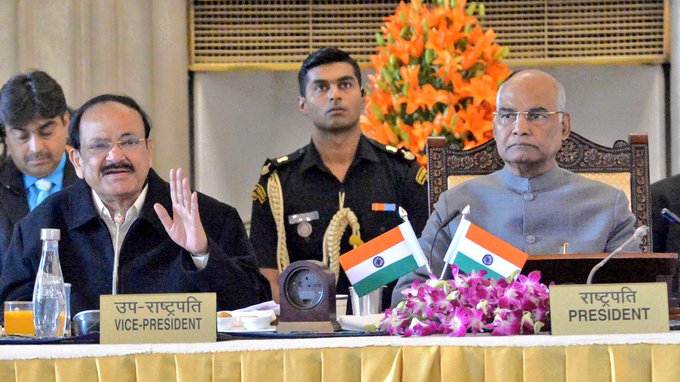
Ensure that the Government’s transformational programmes taken up are effectively implemented – Vice President

The Vice President, Shri M. Venkaiah Naidu said today that India is witnessing a rapid transformation in all spheres and that the Prime Minister’s clarion call of ‘reform, perform and transform’ has given a new sense of urgency and direction to the country, and the Governors should ensure that the momentum is maintained and tangible outcomes are achieved through collective and collaborative efforts.

Addressing the concluding session of 50th Governors’ Conference at Rashtrapati Bhawan today, Shri Naidu said that Governors, with their vast experience, can play an active role in shaping India’s development path.

Shri Naidu said that there cannot be a better time than now for us to make our “Ek Bharat” a “Shrestha Bharat”. The Vice President called upon the Governors to promote this spirit of ‘Bharatiyata’.

He drew their attention towards the rich cultural traditions and linguistic, literary heritage of each state, and stressed the need for its preservation.

“You must support efforts to preserve local culture, festivals and food varieties. You must encourage healthy foods and healthy lifestyle. You must encourage the preservation of local art forms and programmes that support local artisans and craftsmen”, he told the Governors.

He also asked them to ensure that local languages get their due place in administration and wherever public interfaces exist.

Calling the language as the repository of the culture of a region, Shri Naidu urged the Governors to actively encourage state governments to preserve and promote mother tongues and use them as a medium of instruction at least at the primary school level.

Shri Naidu also drew the Governors’ attention to certain colonial practices which need to be reviewed. For example, addressing high dignitaries as Excellency and adopting the cap and gown dress in the university convocations can be modified to bring in an essential Indian touch.

Expressing concern over the unsustainable water use, the Vice President called for urgent need for water conservation.

Lauding the Government’s aim to double farmers’ incomes and make agriculture remunerative and sustainable, he mentioned several structural reforms being introduced in farm sector.

Calling ‘agriculture as the basic culture’ of the country, he emphasised a greater need for effective ‘lab-to-land’ transmission of knowledge and promotion of diversification of crops, as well as supplementation of on-farm income through horticulture, dairy, poultry and pisciculture.

The Vice President further said that in the field of higher education, the focus will have to be on encouraging innovation and continuous quest for excellence. Research and teaching facilities have to be benchmarked against the best in the world, he added.

The two-day conference at Rashtrapati Bhavan was presided over by the Hon’ble President of India, Shri Ram Nath Kovind. Shri Amit Shah the Union Home Minister, Shri Ravi Shankar Prasad, Minister of IT & Communication, Law and Justice, Shri Gajendra singh Shekhawat, Minister of Jal Shakti, Shri Narendra Singh Tomar, Minister of Agriculture and Farmer Welfare , Shri Arjun Munda, Minister of Tribal affairs as well as the Governors of States and Lt. Governors and Administrators of UTs were among the dignitaries who attended the Conference.

*****

Pseudo Solutions for Real Educational Problems

Ask an intelligent question and get a ________ reply!
Here\’s an experiment. It seems to work well with functionaries from educational systems in India, Bangladesh and several other countries in South Asia and beyond.
Bring together a group of educational personnel such as academic supervisors, district and state / provincial educational officials. Pose a critical educational problem before them. Of the kind that they probably deal with on a daily basis, such as:
  • How to improve learning among children? Or
  • What action to take so that classroom processes become more interactive than they are at present? Or
  • How to enable children to enjoy learning mathematics (rather than being afraid of it)? Or
  • How to ensure and increase teacher attendance?

 Now, monitor the responses you get. They will usually include answers such as:
Teachers must be dedicated / devoted to the profession.
  • We must ensure that the system functions well.
  • We must increase monitoring and do it properly.
  • Teachers must be made aware of their responsibilities.

That didn\’t surprise you, did it? These are the typical answers one hears (you can probably increase the list greatly). But why should these answers worry us?
Because these answers are positively dangerous!
Either they reveal that our education system is in the hands of people who don\’t know what to do. Or, what is worse, it is in the hands of those who know what to do but are trying to hide behind these kinds of answers.
You can decide for yourself – after taking a look at the explanation below.
THE RICH VARIETY OF PSEUDO SOLUTIONS
The key issue is that instead of actions and concrete steps, those responsible come up with other things instead. From an educational planning point of view, a step or an action is something that you have to do, that you can set in a clear time-frame, that can be budgeted, broken down into clear parts to be implemented. It is not a vague statement of good intent.
And by coming up with statements that are not actions or steps, those making these statements are actually preventing solutions from really coming about. Here\’s how.
Give a quality instead of an action
A commonly offered \’solution\’ – \’teacher must be dedicated to his profession\’ – is not an action but a quality, the outcome of many other steps that we would have to take. Since those talking are often even responsible for recruiting teachers (and they did not take into account whether the potential teacher had a sense of \’dedication\’ or not), they need to discuss exactly how this dedication will now be ensured. E.g. by conveying to teacher that they matter, are valued, by visiting them, developing and disseminating performance standards (and using them to identify good performance, in an objective manner), or by setting role models in the form of the seniors themselves following a code of conduct, or a thousand other activities…. But instead of concrete action, we are presented sermons. Basically, offering a quality instead of a step merely looks like a ploy to avoid the necessary!
Defer the solution through \’action\’ that keeps on requiring further action
Do you remember those little \’Russian\’ dolls we used to get long ago – you lifted one and found another doll inside it, and another one inside, and so on. This variety of \’pseudo-solution\’ is just like those dolls. Here, the proposed solution is nothing but a guise to postpone committing oneself to actual action. For instance, you commonly hear suggestions such as \’Teachers must be trained properly\’, which begs the question: \’What should we do to ensure that teachers are trained properly?\’ Answer: \’We must have proper trainers.\’ But: \’How will we get proper trainers?\’ Answer: \’By recruiting them properly.\’ And so on. The solution is never really in your grasp; it keeps on evading you because it contains in itself yet another question, the answer to which contains another one…. Even Socrates with his Socratic Method would have had a tough time pinning down the actual action required. Lesser mortals like us just go mad and give up!
Show resolve, not necessarily solve!
Here, the answer to the critical problem is in the form of some very resolute-sounding statement. It gives the feeling that people are \’very serious\’ about doing something (never mind if scratching the surface shows that it can\’t really be converted into action). Pseudo-solutions of this category sound like this: \’We must ensure discipline.\’ Or \’We have to cover every single school.\’ Or \’The inputs must be made regularly.\’
Nothing wrong with these statements, except that they are only resolutions and not clear steps or concrete action. They don\’t take into account that the present action, which is so strongly being proposed to be improved, may itself not be the right action to start with. Or may not even have anything wrong to begin with. For instance, before concluding that inputs must be made regularly, we need to take into account that perhaps the inputs may be inappropriate, and making them regular will not help. Also, the feeling is that having said that they will be regular, what are the steps to make them regular? (E.g. use of scheduling software and training everyone it its use, or interactions to discuss the needs of the different components of our programme in terms of regularity as well as the nature of inputs needed, and exploring whether more than just regularity it is how well they are implemented that needs to be improved…)
Once again, the feeling is that having declared something solemnly, it will now happen. Unfortunately, it doesn\’t.
Everyone except us!
This is encapsulated in statements that exhort everyone to pull up their socks (or equivalent), except the people making these statements. Hence in a discussion on the kind of improvements required to increase the effectiveness of an educational system or a programme, it will be said that teachers must be devoted / dedicated, that supervisory staff must be capable, that managers must be professional and administrators sensitive and flexible apart from being committed. Such statements will be made about categories other than that of the solution givers, of course! And of course it is still not clear as to how the suggested change will be brought about.
The monitoring myth
For some reason as yet not very clear, a lot of proposed solutions have to do with monitoring – it is pointed out that monitoring is very poor, ineffective, irregular, and several other words that I\’m sure you can reel off. Well, excuse me, but monitoring is extremely limited as a solution. A commonly used example: I\’m monitoring the weight of a child regularly and it keeps on decreasing – all this regular monitoring does not help me if I don’t know what to do – the kind of nutrition to ensure, how to obtain / procure and prepare the required nutrients and enable the child to ingest these in an appropriate manner over the required period… I can keep monitoring without necessarily bringing about any improvement.
The dangerous part is the feeling that programmes and systems work only if they are monitored. Not necessarily – in order to work well, those involved need to feel that they are doing something worthwhile, that someone cares that they are there, that the task is challenging yet doable and enjoyable, that they are equipped to do it, enjoy doing it and are supported in their actions. Under these circumstances monitoring can indeed play a role to enhance effectiveness, but it is no substitute for the basics that need to be in place. It\’s a little bit like a car that has a very good speedometer and odometer (monitoring devices), but no engine (implementation requirement)! Good monitoring is not necessarily equal to good implementation.
An accompanying myth is that better planning is the solution. In fact, if you look at the kind of technical professionals brought in by donor agencies, multilaterals, development partners and even governments, there seems to a far greater concentration on the planning and the monitoring/evaluation parts, but very little on the stuff that comes in between the two – i.e., implementation! And that is why, when educational functionaries are asked to come up with solutions or steps that will lead to specific outcomes, they tend to suggest action related to better planning and monitoring, rather than improved implementation.
The thesis, and a question
So that\’s the thesis – that when asked to identify actions / steps / solutions to address critical educational issues, those responsible come up with things that might look like them but are not the real thing. And it is this that has kept us back, preventing the huge amounts of money and effort being invested from translating into reality.
But if this is actually the case, is it due to sheer incompetence, or is it a deliberate ploy to ensure that real change does not happen (because behind it all, people are very uncomfortable with an education system that actually works). If you\’re a conspiracy theorist too, let me know!


The Tsunami We Don\’t Always See

Our hearts go out to the sufferings of people in Japan. The pictures of the tsunami rushing in and engulfing everything in sight, wreaking havoc – will stay with us. Our sympathies and support should – and will – be available to help our fellow human beings in whatever way we can.
Our horror – and the desire to do something – would obviously be even more if we saw something similar happening all around us. And in a way something similar is happening all around us, only it is not as dramatic as a physical tsunami, making it a little difficult to be noticed by most people. It is what I would call the tsunami of poor quality of education that is hitting a million schools and tens of millions of children, its impact likely to be visible over the years rather than right now, instantly, in front of our eyes.
The Tsunami Around Us
No this is not alarmist, but an effort to put across a real picture and the urgency with which it needs to be recognized and acted upon. Every day, in hundreds of thousands of locations across the country, children make their way to the school. Around a quarter of them may find their teacher not there. This number alone is staggering, ranging as it would between one and two million teachers. MILLION! And if each teacher has 30 children in his class, you can estimate the number but not really conceive how enormous it is. And it is huge not just in terms of numbers, but for each child who loses a day of learning, and does so for many days every month, it is incalculable.
Had the facilities or the teachers not been available we could have cried over our fate in terms of being an underdeveloped country. But having the infrastructure (over 98% children have a school within a kilometre, and most buildings are not bad) and teachers actually in place (though the number of vacancies is still very large) – it is horrifying to watch or at least it should be, for there doesn\’t seem to be a sense of horror, or as much of it as would shake the country into action.
However the story doesn\’t end there. It is when \’teaching\’ takes place that the impact on children is often at its greatest. Decades ago, the Yashpal Committee\’s report on The Burden of the School Bag had detailed the \’burden of incomprehension\’ a majority of children bear. And it is difficult to see if things have changed dramatically, despite changed curricula, textbooks, the use of TLM, evolving assessment patterns, new training programmes… The number of children attending school – and their diversity – too has grown in leaps and bounds, while the approach to handling their needs has remained fairly static. Hence, survey after survey shows that – despite a degree of improvement – we continue to be far from the levels of learning desired (and possible).
But it is when it comes to the process that the greatest deadening effect takes place. Rote memorization, \’explanation\’ ina language not necessarily understood by children, a disregard for the needs of children who are too poor to be able to attend regularly, (an often active) discrimination in the classroom, are the lot of a majority of our children. If you doubt this, all you have to do is visit any 10 government schools in different locations, especially those away from \’headquarters\’.
This is not to say that all government schools are bad and that the \’bad\’ is restricted to government schools. It is to point out that even if only a third of schools are like the ones described above (and the number is surely more than that), it adds up to literally hundreds of thousands of schools and tens of millions of children – a slow tsunami of poor quality education that is surely wreaking havoc on the potential of our children, our country.
Dealing With It
So after all this panic, what do we do?
As in any disaster, stay calm! First recognize that there is a problem and accept that something must be done about it.
Second, realize that you are the right person to do something about it. Anyone is, everyone is. Every small action counts. Even if you smile at a child, say an encouraging word to a teacher, raise this issue with friends, relatives and colleagues, you are doing something.
Third, if you are willing to be more proactive or are already active, please do look at the urgency of the situation. Children cannot wait for us to learn or get our act together slowly. We need to quickly:
  • Establish the minimum conditions that must obtain. These are well laid out in the RTE (Right to Education) and its rules. Raise this issue wherever you can, and directly with the school or education authorities.
  • Encourage and support the community and the school management committees (SMCs) drawn from among the community to become more active. You can help in setting them up, in record keeping, in setting the agenda, in follow up, in helping ensure that teachers take them seriously and that they in turn don\’t take an adversarial position vis-à-vis teachers. You can use your position to ensure that the educational agenda is not hijacked by the money-making or power-gaining agenda.

If you are a Head Teacher, supervisor, CRC-BRC / district level teacher educator or officer:
  • Model the kind of behaviour you want from teachers
  • Share practical steps they can take in their classes, especially in terms of activity-based teaching (see the many entries in this blog for support)
  • Encourage teachers to be innovative, support them. If they ask questions, don\’t be dismissive (pass on the questions here if you can answer them!)

If you are a planner / policy-maker / decision- maker, please start by not dismissing what you have just read here. It is real, and it is happening – and it\’s on a gargantuan scale. On any given day, the number of children who are in school and not learning is more than the population of many countries – and it is a shame. What kind of performance standards can you set in place? What kind of outcomes can you insist on? How can you prepare the institutions and the system to deliver this, monitor them effectively and enable an ongoing improvement? Once again, the many entries in this blog would be helpful – and you could always share issues you would like others to provide suggestions / inputs on.
As surely as Japan will recover from the huge earthquake and the devastating tsunami, we can deal with this too. But first we have to see it as an emergency and address it. With all our might.

The Tsunami We Don\’t Always See

Our hearts go out to the sufferings of people in Japan. The pictures of the tsunami rushing in and engulfing everything in sight, wreaking havoc – will stay with us. Our sympathies and support should – and will – be available to help our fellow human beings in whatever way we can.
Our horror – and the desire to do something – would obviously be even more if we saw something similar happening all around us. And in a way something similar is happening all around us, only it is not as dramatic as a physical tsunami, making it a little difficult to be noticed by most people. It is what I would call the tsunami of poor quality of education that is hitting a million schools and tens of millions of children, its impact likely to be visible over the years rather than right now, instantly, in front of our eyes.
The Tsunami Around Us
No this is not alarmist, but an effort to put across a real picture and the urgency with which it needs to be recognized and acted upon. Every day, in hundreds of thousands of locations across the country, children make their way to the school. Around a quarter of them may find their teacher not there. This number alone is staggering, ranging as it would between one and two million teachers. MILLION! And if each teacher has 30 children in his class, you can estimate the number but not really conceive how enormous it is. And it is huge not just in terms of numbers, but for each child who loses a day of learning, and does so for many days every month, it is incalculable.
Had the facilities or the teachers not been available we could have cried over our fate in terms of being an underdeveloped country. But having the infrastructure (over 98% children have a school within a kilometre, and most buildings are not bad) and teachers actually in place (though the number of vacancies is still very large) – it is horrifying to watch or at least it should be, for there doesn\’t seem to be a sense of horror, or as much of it as would shake the country into action.
However the story doesn\’t end there. It is when \’teaching\’ takes place that the impact on children is often at its greatest. Decades ago, the Yashpal Committee\’s report on The Burden of the School Bag had detailed the \’burden of incomprehension\’ a majority of children bear. And it is difficult to see if things have changed dramatically, despite changed curricula, textbooks, the use of TLM, evolving assessment patterns, new training programmes… The number of children attending school – and their diversity – too has grown in leaps and bounds, while the approach to handling their needs has remained fairly static. Hence, survey after survey shows that – despite a degree of improvement – we continue to be far from the levels of learning desired (and possible).
But it is when it comes to the process that the greatest deadening effect takes place. Rote memorization, \’explanation\’ ina language not necessarily understood by children, a disregard for the needs of children who are too poor to be able to attend regularly, (an often active) discrimination in the classroom, are the lot of a majority of our children. If you doubt this, all you have to do is visit any 10 government schools in different locations, especially those away from \’headquarters\’.
This is not to say that all government schools are bad and that the \’bad\’ is restricted to government schools. It is to point out that even if only a third of schools are like the ones described above (and the number is surely more than that), it adds up to literally hundreds of thousands of schools and tens of millions of children – a slow tsunami of poor quality education that is surely wreaking havoc on the potential of our children, our country.
Dealing With It
So after all this panic, what do we do?
As in any disaster, stay calm! First recognize that there is a problem and accept that something must be done about it.
Second, realize that you are the right person to do something about it. Anyone is, everyone is. Every small action counts. Even if you smile at a child, say an encouraging word to a teacher, raise this issue with friends, relatives and colleagues, you are doing something.
Third, if you are willing to be more proactive or are already active, please do look at the urgency of the situation. Children cannot wait for us to learn or get our act together slowly. We need to quickly:
  • Establish the minimum conditions that must obtain. These are well laid out in the RTE (Right to Education) and its rules. Raise this issue wherever you can, and directly with the school or education authorities.
  • Encourage and support the community and the school management committees (SMCs) drawn from among the community to become more active. You can help in setting them up, in record keeping, in setting the agenda, in follow up, in helping ensure that teachers take them seriously and that they in turn don\’t take an adversarial position vis-à-vis teachers. You can use your position to ensure that the educational agenda is not hijacked by the money-making or power-gaining agenda.

If you are a Head Teacher, supervisor, CRC-BRC / district level teacher educator or officer:
  • Model the kind of behaviour you want from teachers
  • Share practical steps they can take in their classes, especially in terms of activity-based teaching (see the many entries in this blog for support)
  • Encourage teachers to be innovative, support them. If they ask questions, don\’t be dismissive (pass on the questions here if you can answer them!)

If you are a planner / policy-maker / decision- maker, please start by not dismissing what you have just read here. It is real, and it is happening – and it\’s on a gargantuan scale. On any given day, the number of children who are in school and not learning is more than the population of many countries – and it is a shame. What kind of performance standards can you set in place? What kind of outcomes can you insist on? How can you prepare the institutions and the system to deliver this, monitor them effectively and enable an ongoing improvement? Once again, the many entries in this blog would be helpful – and you could always share issues you would like others to provide suggestions / inputs on.
As surely as Japan will recover from the huge earthquake and the devastating tsunami, we can deal with this too. But first we have to see it as an emergency and address it. With all our might.

The Tsunami We Don\’t Always See

Our hearts go out to the sufferings of people in Japan. The pictures of the tsunami rushing in and engulfing everything in sight, wreaking havoc – will stay with us. Our sympathies and support should – and will – be available to help our fellow human beings in whatever way we can.
Our horror – and the desire to do something – would obviously be even more if we saw something similar happening all around us. And in a way something similar is happening all around us, only it is not as dramatic as a physical tsunami, making it a little difficult to be noticed by most people. It is what I would call the tsunami of poor quality of education that is hitting a million schools and tens of millions of children, its impact likely to be visible over the years rather than right now, instantly, in front of our eyes.
The Tsunami Around Us
No this is not alarmist, but an effort to put across a real picture and the urgency with which it needs to be recognized and acted upon. Every day, in hundreds of thousands of locations across the country, children make their way to the school. Around a quarter of them may find their teacher not there. This number alone is staggering, ranging as it would between one and two million teachers. MILLION! And if each teacher has 30 children in his class, you can estimate the number but not really conceive how enormous it is. And it is huge not just in terms of numbers, but for each child who loses a day of learning, and does so for many days every month, it is incalculable.
Had the facilities or the teachers not been available we could have cried over our fate in terms of being an underdeveloped country. But having the infrastructure (over 98% children have a school within a kilometre, and most buildings are not bad) and teachers actually in place (though the number of vacancies is still very large) – it is horrifying to watch or at least it should be, for there doesn\’t seem to be a sense of horror, or as much of it as would shake the country into action.
However the story doesn\’t end there. It is when \’teaching\’ takes place that the impact on children is often at its greatest. Decades ago, the Yashpal Committee\’s report on The Burden of the School Bag had detailed the \’burden of incomprehension\’ a majority of children bear. And it is difficult to see if things have changed dramatically, despite changed curricula, textbooks, the use of TLM, evolving assessment patterns, new training programmes… The number of children attending school – and their diversity – too has grown in leaps and bounds, while the approach to handling their needs has remained fairly static. Hence, survey after survey shows that – despite a degree of improvement – we continue to be far from the levels of learning desired (and possible).
But it is when it comes to the process that the greatest deadening effect takes place. Rote memorization, \’explanation\’ ina language not necessarily understood by children, a disregard for the needs of children who are too poor to be able to attend regularly, (an often active) discrimination in the classroom, are the lot of a majority of our children. If you doubt this, all you have to do is visit any 10 government schools in different locations, especially those away from \’headquarters\’.
This is not to say that all government schools are bad and that the \’bad\’ is restricted to government schools. It is to point out that even if only a third of schools are like the ones described above (and the number is surely more than that), it adds up to literally hundreds of thousands of schools and tens of millions of children – a slow tsunami of poor quality education that is surely wreaking havoc on the potential of our children, our country.
Dealing With It
So after all this panic, what do we do?
As in any disaster, stay calm! First recognize that there is a problem and accept that something must be done about it.
Second, realize that you are the right person to do something about it. Anyone is, everyone is. Every small action counts. Even if you smile at a child, say an encouraging word to a teacher, raise this issue with friends, relatives and colleagues, you are doing something.
Third, if you are willing to be more proactive or are already active, please do look at the urgency of the situation. Children cannot wait for us to learn or get our act together slowly. We need to quickly:
  • Establish the minimum conditions that must obtain. These are well laid out in the RTE (Right to Education) and its rules. Raise this issue wherever you can, and directly with the school or education authorities.
  • Encourage and support the community and the school management committees (SMCs) drawn from among the community to become more active. You can help in setting them up, in record keeping, in setting the agenda, in follow up, in helping ensure that teachers take them seriously and that they in turn don\’t take an adversarial position vis-à-vis teachers. You can use your position to ensure that the educational agenda is not hijacked by the money-making or power-gaining agenda.

If you are a Head Teacher, supervisor, CRC-BRC / district level teacher educator or officer:
  • Model the kind of behaviour you want from teachers
  • Share practical steps they can take in their classes, especially in terms of activity-based teaching (see the many entries in this blog for support)
  • Encourage teachers to be innovative, support them. If they ask questions, don\’t be dismissive (pass on the questions here if you can answer them!)

If you are a planner / policy-maker / decision- maker, please start by not dismissing what you have just read here. It is real, and it is happening – and it\’s on a gargantuan scale. On any given day, the number of children who are in school and not learning is more than the population of many countries – and it is a shame. What kind of performance standards can you set in place? What kind of outcomes can you insist on? How can you prepare the institutions and the system to deliver this, monitor them effectively and enable an ongoing improvement? Once again, the many entries in this blog would be helpful – and you could always share issues you would like others to provide suggestions / inputs on.
As surely as Japan will recover from the huge earthquake and the devastating tsunami, we can deal with this too. But first we have to see it as an emergency and address it. With all our might.

The Tsunami We Don\’t Always See

Our hearts go out to the sufferings of people in Japan. The pictures of the tsunami rushing in and engulfing everything in sight, wreaking havoc – will stay with us. Our sympathies and support should – and will – be available to help our fellow human beings in whatever way we can.
Our horror – and the desire to do something – would obviously be even more if we saw something similar happening all around us. And in a way something similar is happening all around us, only it is not as dramatic as a physical tsunami, making it a little difficult to be noticed by most people. It is what I would call the tsunami of poor quality of education that is hitting a million schools and tens of millions of children, its impact likely to be visible over the years rather than right now, instantly, in front of our eyes.
The Tsunami Around Us
No this is not alarmist, but an effort to put across a real picture and the urgency with which it needs to be recognized and acted upon. Every day, in hundreds of thousands of locations across the country, children make their way to the school. Around a quarter of them may find their teacher not there. This number alone is staggering, ranging as it would between one and two million teachers. MILLION! And if each teacher has 30 children in his class, you can estimate the number but not really conceive how enormous it is. And it is huge not just in terms of numbers, but for each child who loses a day of learning, and does so for many days every month, it is incalculable.
Had the facilities or the teachers not been available we could have cried over our fate in terms of being an underdeveloped country. But having the infrastructure (over 98% children have a school within a kilometre, and most buildings are not bad) and teachers actually in place (though the number of vacancies is still very large) – it is horrifying to watch or at least it should be, for there doesn\’t seem to be a sense of horror, or as much of it as would shake the country into action.
However the story doesn\’t end there. It is when \’teaching\’ takes place that the impact on children is often at its greatest. Decades ago, the Yashpal Committee\’s report on The Burden of the School Bag had detailed the \’burden of incomprehension\’ a majority of children bear. And it is difficult to see if things have changed dramatically, despite changed curricula, textbooks, the use of TLM, evolving assessment patterns, new training programmes… The number of children attending school – and their diversity – too has grown in leaps and bounds, while the approach to handling their needs has remained fairly static. Hence, survey after survey shows that – despite a degree of improvement – we continue to be far from the levels of learning desired (and possible).
But it is when it comes to the process that the greatest deadening effect takes place. Rote memorization, \’explanation\’ ina language not necessarily understood by children, a disregard for the needs of children who are too poor to be able to attend regularly, (an often active) discrimination in the classroom, are the lot of a majority of our children. If you doubt this, all you have to do is visit any 10 government schools in different locations, especially those away from \’headquarters\’.
This is not to say that all government schools are bad and that the \’bad\’ is restricted to government schools. It is to point out that even if only a third of schools are like the ones described above (and the number is surely more than that), it adds up to literally hundreds of thousands of schools and tens of millions of children – a slow tsunami of poor quality education that is surely wreaking havoc on the potential of our children, our country.
Dealing With It
So after all this panic, what do we do?
As in any disaster, stay calm! First recognize that there is a problem and accept that something must be done about it.
Second, realize that you are the right person to do something about it. Anyone is, everyone is. Every small action counts. Even if you smile at a child, say an encouraging word to a teacher, raise this issue with friends, relatives and colleagues, you are doing something.
Third, if you are willing to be more proactive or are already active, please do look at the urgency of the situation. Children cannot wait for us to learn or get our act together slowly. We need to quickly:
  • Establish the minimum conditions that must obtain. These are well laid out in the RTE (Right to Education) and its rules. Raise this issue wherever you can, and directly with the school or education authorities.
  • Encourage and support the community and the school management committees (SMCs) drawn from among the community to become more active. You can help in setting them up, in record keeping, in setting the agenda, in follow up, in helping ensure that teachers take them seriously and that they in turn don\’t take an adversarial position vis-à-vis teachers. You can use your position to ensure that the educational agenda is not hijacked by the money-making or power-gaining agenda.

If you are a Head Teacher, supervisor, CRC-BRC / district level teacher educator or officer:
  • Model the kind of behaviour you want from teachers
  • Share practical steps they can take in their classes, especially in terms of activity-based teaching (see the many entries in this blog for support)
  • Encourage teachers to be innovative, support them. If they ask questions, don\’t be dismissive (pass on the questions here if you can answer them!)

If you are a planner / policy-maker / decision- maker, please start by not dismissing what you have just read here. It is real, and it is happening – and it\’s on a gargantuan scale. On any given day, the number of children who are in school and not learning is more than the population of many countries – and it is a shame. What kind of performance standards can you set in place? What kind of outcomes can you insist on? How can you prepare the institutions and the system to deliver this, monitor them effectively and enable an ongoing improvement? Once again, the many entries in this blog would be helpful – and you could always share issues you would like others to provide suggestions / inputs on.
As surely as Japan will recover from the huge earthquake and the devastating tsunami, we can deal with this too. But first we have to see it as an emergency and address it. With all our might.