Vice President expresses confidence that the economy will rebound in the near future

The Vice President of India, Shri M Venkaiah Naidu today expressed confidence that the Indian economy would rebound in the near future saying that the current slowdown was cyclical.

Inaugurating the 102nd annual conference of the Indian Economic Association, he said it was true that the Indian economy was facing some challenges due to the decline in growth this fiscal. However, he said the country had faced similar slumps in the past in the wake of the East Asian financial crisis and global slowdown but bounced back with a higher growth rate every time.

Referring to the reforms initiated by the government including the introduction of the revolutionary GST to usher ‘ One Nation, One Tax, One Market’, the Insolvency and Bankruptcy Code and the steps taken to curb black money, Shri Naidu asserted that they were aimed at making the economy more robust and more resilient.

Pointing out that 66 lakh new taxpayers have been registered under the GST regime since its launch, the Vice President said that it indicated the rising trend of formalization of the economy. The Government has also taken measures to tackle the problem of NPAs and improve the health of the banking sector, he added.

Observing that agriculture was the mainstay of Indian economy, the Vice President cautioned that various waivers and subsidies would be unsustainable in the longer run. Stressing the need to diversify the rural economy, he said “rural non-farm activities are equally crucial for the growth of the rural economy”.

Stating that it was our national resolve to double the farmers’ income by 2022, Shri Naidu called for making rural economy sustainable and remunerative.

The Vice President also stressed the need for agricultural products to have access to larger markets, strengthening rural infrastructure, storage, and supply chains, apart from promoting village level in-situ food processing industry.

Referring to fiscal federalism as one of the themes of the conference, Shri Naidu said while most of the States have retained their fiscal deficit around permissible 3%, it has come at the cost of low capital expenditure. “There has been a rise in committed liabilities towards payment of interest and pensions, thereby leaving only a small part of their budget for capital expenditure on infrastructure development, he added.

The 102nd annual conference of the Indian Economic Association is being organised in Pt. RavishankarShukla University, Raipur.

Governor of Chhattisgarh, SushriAnusuiyaUikey, Chief Minister, ShriBhupeshBaghel, International Economic Association President, Prof. KaushikBasu, Indian Economic Association President, Prof.MahendraDev, Vice Chancellor of Pt. RavishnkarShukla University, Prof.KesariLalVerma and noted economists from across India and the world were present at the event.

Following is the full text of the speech –

प्यारे साथियो,

मुझे आज आपके बीच आकर बहुत खुशी हो रही है। आज Indian Economic Association के 102 वे वार्षिक सम्मेलन का उद्घाटन समारोह है और यहां बहुत से विद्वान, शोध करने वाले और उद्योग जगत के सम्मानित लोग मौजूद हैं। मैं आप सभी का सादर अभिभादन करता हूं।

जैसा कि सभी को ज्ञात है Indian Economic Association का उद्देश्य अर्थशास्त्र में अध्ययन, अध्यापन और शोध करना है। साथ ही आप लोग भारतीय अर्थव्यवस्था की समस्याओं और समाधान पर भी चिंतन और विमर्श करते हो।

I am pleased to be amongst this august gathering of scholars, researchers, business leaders and wealth creators to inaugurate the 102nd Annual conference of the Indian Economic Association being hosted by Pt. RavishankarShukla University, Raipur Chhattisgarh.

I am told that the main objective of Indian Economic Association is to promote the study, teaching and research in Economics and to study the problems of Indian economy.

It is expected of such independent research bodies to facilitate interface between Government, industry and wealth creators and other stakeholders to provide relevant broad-based policy inputs to the Government.

In ancient times, the Nagar Shresthi, the senior business man of the town, used be an integral part of royal court and used to provide counsel to the king. Kautiliya realised that wealth creation was essential for establishing a welfare state. He said that all programmes depended on treasury and advocated strategies for creation, protection and conservation of nation’s wealth.

Distinguished Friends,

As a Nation, we have taken a resolve to make our economy a US $ 5 Trillion economy by 2025, Double the income of Farmers by 2022, provide affordable Housing to all and connect every household with 24 hour power supply and piped drinking water by 2022, when we celebrate 75 years of our independence.

These are ambitious targets, but these services should have been delivered to our people in these 75 years since our independence. These targets will need resolute policy action, technology intervention and entrepreneurship and financial resources.

This conference is being organised in the backdrop of recent economic figures. There are media commentaries questioning India’s growth story. It is true that there are some challenges for the Indian economy as economic growth has declined in this fiscal year.

But it is not for the first time that India’s growth story has faced such sceptic comments. As renowned economist ShriAravindPanagarhiya has traced that ever since India’s reforms started in early 1990s, the country has faced slumps like in the wake of East Asian financial crisis towards the end of last century, or the global economic crisis towards the end of last decade.

Each time, we bounced back with higher growth rate.

Notwithstanding the GDP figures, India remains one the fastest growing bigger economies of the world. I must caution that a figure by itself may not always reveal the real story and strength of the economy unless it is placed in the context of recent policy initiatives, legislative architecture and institutional framework.

The reforms initiated by the government including introduction of the revolutionary GST to usher ‘ Óne Nation, One Tax, One Market’, the Insolvency and Bankruptcy Code as also the steps taken to curb black money are all aimed at making the economy more robust and more resilient.

The Government has also taken measures to tackle the problem of NPAs and improve the health of the banking sector.

I am told that 66 lakh new tax payers have been registered under new GST regime ever since its launch in July, 2017. This indicates the rising trend of formalisation of economy. The entire process of GST introduction and the decision-making mechanism in GST reflects the spirit of cooperative with every State and UT being represented on GST council.

Maintaining higher economic growth with fiscal prudence and monetary discipline requires resolute policy and legislative intervention. KaraurKarzkaanushasan arthvyavsthakeliyezaroorihai. Like in the previous times, this time also the global slowdown has affected us. It is being said that this slowdown of the Indian economy is cyclical. I am confident that things would look up and our economy would rebound in the near future.

As you all are aware, the government is working on the twin objectives of formalisation and modernisation of economy. The surge in the number of Income Tax and GST returns following the implementation of GST indicate the increasing formalisation of the economy. The process of formalization has been enabled by the use of technology in financial services, revenue administration and service delivery through Direct Benefit Transfer.

The need of the hour is to hasten the process of progress and ensure that every citizen is part of the growth story for an inclusive, forward-looking and prosperous India.

By creating conducive environment and adopting right policies and regulations, India is now making pioneering efforts to improve the infrastructure needed for development with a citizen-centric approach. This is quite visible from the fact that over the past few years, there has been huge growth in electronic citizen services delivery.

Dear friends,

India is digitally connected today. Undoubtedly, digitization is ensuring speedy delivery of services, apart from changing the banking and financial sectors. It is helping to achieve inclusive development.

The JAM trinity Jan dhan, AADHAAR and Mobile has enabled timely delivery of services, disbursal of benefits directly to the deserving and helped in plugging leakages.

As you all are aware, the twin processes of formalisation and modernization of the economy have made it transparent, inclusive and efficient.

  1. Insolvency and Bankruptcy Code has helped Banks to realise their loans. According to CRISIL during 2018-19, financial creditors could realise 42% of their Rs 2.53 Trillion amount involved in resolution. In percentage terms it is marked improvement over Pre-IBC era. As per one estimate the average time taken in resolution of insolvency cases has come down from more than 3 years to around one year. As a result of IBC and recapitalisation by the Government, many banks are now on the path of profit. Consolidation of Banks will further give them the benefits of economy of scales.

It must be realised that the dynamics of open economies will hit rough phases. It is a part of dynamic cyclical evolution. Corporate sector must accept temporary slow down as transient phase of an open economy so long as the economy is being run on transparent policy framework. I am happy that the Government has reacted to current situation to ease credit flow by recapitalising the Banks and persuading them to reach out to lend credit. It has asked the Departments and PSUs to release the outstanding dues of MSME suppliers to raise liquidity in economy.

I appreciate that the broad theme chosen for this conference will focus on “Economic Growth, Fiscal Federalism, Livelihoods and Environment”. Your discussions and deliberations will provide useful policy inputs to the Government.

मित्रो,

हमें समाज की अंतिम पंक्ति के लोगों तक पहुंचना है।  उन्हें विकास की मुख्यधारा में शामिल करना है। उन तक विकास और सुशासन के फल पहुंचने चाहिए। जब लंबे समय से समाज के हाशिये पर रह रहे लोगों का सशक्तीकरण होगा, तभी हमारा भारत सही मायनों में एक खुशहाल भारत बन पायेगा।

समावेशी विकास की ये संकल्पना हमारे सभी कार्यों – कार्यक्रमों में दिखनी चाहिए। भारत सरकार ने ऐसे अनेक कार्यक्रम शुरू किये हैं जो सदियों से वंचित समूहों, महिलाओं और गरीबों के उत्थान पर विशेष ध्यान देते हैं।

आयुष्मान भारत के जरिये सभी भारतीयों तक मेडिकल सेवाएं पहुंचाई जा रही हैं और यह दुनिया के सबसे बड़े स्वास्थ्य कार्यक्रमों में से एक है।

स्वच्छ भारत मिशन के तहत 10 करोड़ से अधिक टायलेट बनायी गयी हैं और 6 लाख के करीब गांव खुले में शौच से मुक्त हुए हैं। इससे हमारी उन माताओं-बहनों को बहुत आराम मिला है जिनको पहले सूरज छिपने का इंतजार करना पड़ता था। आप उनकी परेशानी महसूस करके देखिये एक बार।

इसी तरह उज्ज्वला योजना है। इसके तहत अब 8 करोड़ से अधिक LPG कनेक्शन बांटे गये हैं।

Accomplishing a faster economic growth is indispensable to unleash the latent potential of Indian economy and to create more employment opportunities for realising demographic dividend and long-term poverty removal. Some of the pro-growth reform measures like opening up more sectors for foreign investments and the initiatives such as Skill India, Start Up India, ‘Make in India’ and Digital India are all meant to spur the growth of the economy.

Various administrative measures have helped India to consistently improve global ranking in the Ease of Doing Business over the past five years—India is ranked 63rd in 2019. But the benefits of Ease of Doing Business must reach to our MSME enterprises in smaller cities. Our young professionals and students should be able to realise their business ideas.

You will also be discussing the rural economy and development. Often rural development is considered largely in terms of agricultural development. Agriculture is the mainstay of our economy and is called the Primary sector as it provides the foundation over which financial superstructure is built. It is our national resolve to double the farmers’ income by 2022.

Even as agriculture remains an important activity, rural non-farm activities are equally crucial for the growth of the rural economy. We must realise that various waivers and subsidies will be unsustainable in the longer run. We must diversify the rural economy.

While mechanisation and agro-research can enhance agricultural productivity, we must think to make rural economy sustainable and remunerative. Agricultural products must have access to larger markets. Apart from fully tapping digital tools like E- NAM, we need to strengthen rural infrastructure, storage and supply chains and also promote village level in-situ food processing industry. I am happy that the Government has decided to spend Rs 25 lakh crores on rural sector over next five years. I am sure that this investment will not only strengthen rural infrastructure but will also create demand in rural economy.

Fiscal federalism is the third theme of this conference. This is an important aspect of country’s financial administration. I am pleased to note that majority of States have been able to maintain the State GDP growth rate at the level of National Growth rate or even higher. While most of the States have retained their fiscal deficit around permissible 3%, it has come at the cost of low capital expenditure. There has been rise in committed liabilities towards payment of interest and pensions, thereby leaving only a small part of their budget for capital expenditure on infrastructure development. This Conference must discuss this issue and come up with solutions.

This Conference will also be discussing the issues pertaining Livelihood. Ensuring productive livelihoods and employment generation is one of the main objectives of development. It makes growth inclusive and equitable. India is a young country with 65% of population under 35 years of age. India’s demographic dividend is an opportunity and a challenge.

It is therefore necessary that we promote skill training and entrepreneurship among our young population. Our young students and professionals must not remain job seekers but rather become job providers. It was with this objective that the schemes like MUDRA were launched, which has so far disbursed Rs 1.5 lakh crores to 3.14 crore small and emerging entrepreneurs in 2019-20.

Today, India has emerged third in the number of Start ups. The country has unleashed the entrepreneurial spirit of our techno-professionals. We have set a target of 1 lakh Start Ups with 100 Unicorns each having a valuation of US $ 1 Billion, by 2025. Our Start Ups are venturing into newer domains like electric vehicles, bio-tech, agri-tech, retail tech, space and robotics. We must provide them skill infrastructure to prepare them for 4th industrial revolution. This process should start right from the school level where Atal Tinkering Labs have been set up to capture the imagination of young minds.

Angel investors from world over are reposing faith in Indian Start Ups. As per one estimate in the first half of the current year, around US $ 4 Billion were invested in around 300 domestic Start Ups. This is the promise our youngsters hold in global investment market.


Distinguished Delegate Friends,

I am happy that you will also be discussing environment issues in the context of overall economic development strategy. The beautiful State of Chhatisgarh has rich mineral deposits with huge potential for industrial development. A sizable population is traditionally dependent of Forests and we need to strike a fine balance between environment and development. Unsustainable production and consumption might result in an irreversible damage to our ecosystem.

This State is home for three Maharatna PSUs namely NTPC, Coal India and SAIL and one NavRatna PSU NMDC. These PSUs have provided the basis for rapid industrialization of the State, which was created by Atalji in year 2000, considering the special developmental requirements of local population.

A sizable part of this State has lagged behind due to naxal violence. While native communities have rightful claim over resources, they also require development and facilities. It must also be realised that peace is the pre-requisite for development. I believe that you will discuss this vital aspect during the Conference.

I hope that the discussions and deliberations of the three-day conference will provide valuable policy inputs. I thank you for giving me opportunity to share my impressions with such an august gathering.

Thank you!

Jai Hind!”


Finance Minister launches eBक्रय for online auction of assets attached by banks

Union Finance Minister Smt. Nirmala Sitharaman here today discussed banking issues with chiefs of Public Sector Banks (PSBs), chief executive of Indian Banks’ Association and representatives of leading private sector banks. Finance Secretary, Revenue Secretary, Economic Affairs Secretary, Electronics and Information Technology Secretary, CBI Director, RBI representative and the chief executive officer of NPCI were also present.

  1.  Steps  for enhancing digital transactions

In order to strengthen the digital payment eco-system and move towards less-cash economy, Hon’ble FM in her budget speech of 2019-20 had, inter alia, announced that business establishments with annual turnover of more than Rs. 50 crore shall offer low cost digital modes of payment ( such as BHIM UPI, UPI QR Code, Aadhaar Pay, Debit Cards, NEFT, RTGS etc.) to their customers, and no charge or Merchant discount rates (MDR) shall be imposed on customers as well as merchants. To facilitate implementation of this announcement, it was decided as under:

  • Department of Revenue (DoR) will notify RuPay and UPI as the prescribed mode of payment for undertaking digital transactions without any MDR.
  • Accordingly, all companies with a turnover of Rs. 50 crore or more shall be mandated by DoR to provide the facility of payment through RuPay Debit card and UPI QR code to their customers.
  • All banks will also start a campaign to popularise RuPay Debit card and UPI.

  1. Banks restored to health for lending
 

Extensive reforms carried out by the Government have restored banks to health, with the gross NPAs of PSBs declining from Rs. 8.96 lakh crore in March 2018 to Rs. 7.27 lakh crore in September 2019, their provision coverage ratio rising to their highest level in seven years, and banks returning to profitability, with as many as 13 banks reporting profits in H1FY20.


With the Essar resolution decision, banks have recovered Rs. 38,896 crore, in addition to Rs. 4.53 lakh crore recovered in the last 4½ years.


PSBs have attached assets worth over Rs. 2.3 lakh crore over the last three financial years and to enable online auction by banks of attached assets transparently and cleanly for improved realisation of value, eBक्रयa common e-auction platform was  launched today by the Finance Minister. The platform is equipped with property search features and navigational links to all PSB e-auction sites, provides single-window access to information on properties up for e-auction as well as facility for comparison of similar properties, and also contains photographs and videos of uploaded properties. As on 27.12.2019, a total of 35,000 properties had been uploaded on the platform by PSBs.

To strengthen banks, in addition to the recent infusion of Rs. 60,314 crore, additional infusion of Rs. 8,855 crore (Rs 4360 crore to Indian Overseas Bank, Rs 2153 crore to Allahabad Bank, Rs 2142 crore to UCO Bank and Rs 200 crore to Andhra Bank) has been approved and would be released shortly.

Having improved asset quality and internal resource generation, PSBs are now fully poised to support prudential credit growth towards a $ 5 trillion economy by 2025.

  1. Robust banks to lend without undue apprehensions


  • Bankers were assured that prudent commercial decision-making would be protected.
  • To allay any apprehensions in this regard and to take feedback, Director, CBI also attended the meeting. It was decided that—

(a)    CBI would develop a mechanism as recently introduced for income tax notices, so that CBI notices carry a registration number to avoid any scope for unauthorised communication and consequent harassment.

(b)   While pursuing criminal action against those responsible, the agency shall be sensitive to the distinction between genuine commercial failures and culpability. It was also noted that there is need for preserving the value of the business enterprise by treating it on a separate footing from culpability of individuals, if any.

(c)    PSBs may report instances of fraud through e-filing of FIRs on a designated email address of CBI so as to avoid scope of any arbitrage due to information asymmetry.

(d)   CBI would create a dedicated phone number on which any person could give information regarding any undue harassment by the investigative machinery.

  • Banks were also advised to ensure rigor and adherence to objective standards in selection of forensic auditors and devising objective SOPs for carrying out of forensic audit. To this end, the Indian Banks’ Association was requested to—

(a)      strengthen the forensic auditor empanelment process;

(b)     put in place robust arrangements for assessing adherence to standards by forensic auditors; and

(c)      tie up with CBI for training forensic auditors.

  1. Credit outreach by banks


  • PSBs have sanctioned over 11.68 lakh Repo-linked loans to retail borrowers for home/vehicle/education/personal loans and to micro and small enterprises, amounting to Rs. 1.32 lakh crore post Finance Minister’s announcements on 23.8.2019 on measures to boost the economy.
  • All PSBs have introduced checkbox-based OTS and have sanctioned settlements under OTS in over 5.26 lakh accounts amounting to Rs. 16,716 crore, post Finance Minister’s announcements on 23.8.2019.
  • In order to address the working capital needs of MSMEs on account of stress arising from delayed payments, PSBs are offering up to 25% enhancement in working capital limits for standard MSME accounts as a Standby Line of Credit and have launched a MSME Outreach Initiative for restructuring of stressed standard assets as needed on priority and in a timely manner, besides providing new term loans, payment solutions for delayed receivables, bill discounting and trade finance. A total of  5,38,440 MSME loan accounts have been restructured in terms of RBI’s circular dated 1.1.2019, out of which 1,65,104 accounts have been restructured since October, 2019.

  1. Support to NBFCs and HFCs by PSBs

  • On 11.12.2019, the Cabinet has approved the recently launched Partial Credit Guarantee Scheme (PCGS) that would now cover NBFCs/HFCs which may have slipped into SMA-0 (up to 30 days overdue) category during the one-year period prior to 1.8.2018, and asset pools rated BBB+ or higher. Under PCGS, Government has already approved issuance of guarantee for buy-outs of NBFC asset pools worth Rs. 4,294 crore from 10 NBFCs/HFCs covering a wide spectrum of entities.
  • Post IL&FS default, aided significantly by Government support, assets of NBFCs have grown by 12.83% from Rs 28.31 lakh crore to Rs 31.94 lakh crore, and assets of the 211 larger NBFCs with 81% of market share have grown at an even higher rate of 19.69%. Bank exposure to NBFCs has grown at a much higher rate of 17.46% as compared to market financing.
  • Similarly, 76 out of 101 HFCs with 82% of market share have shown a positive asset growth of 18% post IL&FS default from Rs 8.45 lakh crore to Rs 10 lakh crore. Exposure of banks and NHB to the 76 performing HFCs has grown by 38% post IL&FS default, as compared to 14% growth in market financing to these HFCs..
  • Thus, the NBFC/HFC sector post IL&FS default, is now stabilizing and good NBFCs/HFCs are able to raise funds from market even at times at rates less than the pre-IL&FS rates. The market is, however, distinguishing between good and not-so-good entities which is reflected in the better entities being able to obtain higher financing from both banks and the market.

Vice President calls for enlightened debate on larger issues

The Vice President of India, Shri M Venkaih Naidu today called for an enlightened debate on all larger issues and stressed that dissent has to be expressed in a democratic and non-violent manner.

“Constitutional methods and violence do not go together,” he said.

Shri Naidu paid rich tributes to Shri Arun Jaitley on his Birth Anniversary today and went down the memory lane recalling his long association with him.

Releasing a book titled, ‘The Renaissance Man-The Many Facets of Arun Jaitley,’ Shri Naidu said that even months after the passing away of his closest friend, he found it difficult to come to terms with the bitter fact that Shri Jaitley was no more.

He said “Whenever there is a need for enlightened debate, Jaitley will be missed.”

Describing Shri Jaitley as a thorough gentleman and a man of impeccable integrity, and said that he never compromised on principles and was a staunch opponent of corruption.

Stating that Shri Jaitley was a shining example of a leader with 4Cs – Character, Calibre, Capacity, and Conduct, VP expressed concerns that there was a worrisome trend in politics with people bringing in other 4Cs- Caste, Community, Criminality, and Cash.

Shri Naidu asked aspiring politicians to emulate these qualities of Shri Jaitley and serve the nation.

Recollecting his association with Shri Jaitley, the Vice President said that Jaitley Ji and he became fellow travelers in the “rough-and-tumble of Indian politics and developed a mutual admiration and respect for each other.

Describing Shri Jaitley as “a multi-faceted genius and a powerhouse of knowledge with a sharp analytical mind,” Shri Naidu recalled his ability to communicate effectively and explain even the most complex matters in a simple, lucid manner. “His frankness was another admirable quality and he never hesitated to call a spade a spade,” he added.

Stating that Jaitley Ji was his go to man for past many decades, the Vice President said that he used to seek Shri Jaitley’s sage counsel whenever needed.

Referring to Shri Jaitley’s deft handling of the economy at a critical time, the Vice President said that his persuasive skills and the spirit of camaraderie were in full display to evolve a consensus during the tough negotiations with states for GST.

Unmindful of his health, Jaitley Ji had to burn the midnight oil on many occasions to build consensus and for the successful roll-out of GST, he said.

The Vice President also referred to various measures taken by Shri Jaitley as Union Finance Minister to ensure that the banking sector did not slip into a deeper morass due to NPAs. The Insolvency and Bankruptcy Code introduced during his tenure proved to be a revolutionary step, he said.

VP said that the book was brought out by his son, Shri Muppavarapu Harshavardhan and daughter, Smt. Deepa Venkat as a token of love and affection for Shri Arun Jaitley. The book was released in the gracious presence of Mrs. Sangeeta Jaitley, wife of late Shri Arun Jaitley, his daughter, and son.

Speaker, Lok Sabha, Shri Om Birla, Deputy Chairman, Rajya Sabha, Shri Harivansh, Minister for Law & Justice, Shri Ravi Shankar Prasad, Minister of State for External Affairs and Parliamentary Affairs, Shri V. Muraleedharan, Minister of State for Parliamentary Affairs Minister, Shri Arjun Ram Meghwal, Chairman Prasar Bharati Board, Shri A Surya Prakash, several eminent editors, senior journalists were among the dignitaries present at the event.

Following is the full text of speech-

“I am overcome with emotion as I stand in front of you today to release the book titled ‘The Renaissance Man-The Many Facets of Arun Jaitley’. Even months after his passing away, I still find it difficult to come to terms with the bitter fact that he is no more.

Within a short span, I lost two of my closest friends—Shri Jaitley and Smt Sushma Swaraj. Both of them were like my family members to whom I used to look up to whenever I faced any dilemma or problem.

My association with Shri Jaitley goes a long way—back to our student days when I was the Students Union President at the Andhra University and he was at the helm of the Students Union at Delhi University.

We drew closer as we graduated into young politicians from student activists. Both of us were imprisoned during the dark days of Emergency when democracy was emasculated and every sane voice of reason was muzzled. Thus, we became fellow travelers in the rough-and-tumble of Indian politics and developed a mutual admiration and respect for each other.

From the moment I got acquainted with Jaitley Ji, I was simply struck by his warmth and cordiality. He was a thorough gentleman and a man of impeccable integrity. A staunch opponent of corruption and a committed democrat, he never compromised on the principles to which he was wedded.

Ever smiling and genial in nature, he was a multi-faceted genius and a powerhouse of knowledge with a sharp analytical mind.

Of course, his biggest asset was his ability to communicate effectively and explain even the most complex matters in a simple, lucid manner. Endowed with the gift of narration, his story-telling skills were legendary and his acquaintances used to relish every moment spent with this raconteur-par-excellence.

His deft handling of the economy at a critical time is all too well-known.  Jaitley Ji’s persuasive skills and the spirit of camaraderie were in full display to evolve a consensus and bring everyone on board during the tough negotiations for introducing one of the most awaited and revolutionary taxation measures—the GST.  Unmindful of his health, Jaitley Ji had to burn midnight oil on many occasions to build consensus and for the successful roll-out of GST. Today, we can see for ourselves how the country stood to benefit from his dedicated efforts.

Similarly, Jaitley Ji took measures to ensure that the banking sector did not slip into a deeper morass due to NPAs and prevented crony capitalists from exploiting the system. The Insolvency and Bankruptcy Code was another major reform introduced during his tenure which proved to be a revolutionary step in this direction.

Among other brilliant facets of his, Jaitley Ji was an excellent Parliamentarian. While in Opposition, instead of trying to score brownie points, he used to convincingly put across his viewpoint to the ruling party and make the government see reason in his argument. When in government, he would counter the opposition’s criticism with equal ferocity buttressing his arguments with facts and figures.

Jaitley Ji was my go-to-man for the past many decades. I used to seek his sage counsel whenever needed and I must confess that I was never disappointed with the advice given to me. His frankness was another admirable quality and he never hesitated to call  a spade a spade.

We had quite a few common interests. Both Shri Jaitley and I were fond of different cuisines and used to regularly visit various restaurants.

Of course, his geniality, warm and friendly disposition endeared him to one and all across the political spectrum. Irrespective of whether he was in the government or in the opposition, he used to maintain excellent personal relations and friendship with leaders across the political spectrum.

Jaitley Ji donned different roles with panache and aplomb—as a most distinguished lawyer, party spokesperson, cricket administrator, opposition leader and Union Minister. He left his indelible mark on the ministries he handled from Defence to Corporate Affairs to Finance.

He was known to be generous to a fault and was extremely considerate towards not only those in need of help and never hesitated to lend a helping hand to anybody in distress. Jaitley Ji was a politician who belonged to a rare breed and always placed the interests of the country above everything else.

This book containing the articles on Jaitley Ji was brought out by my son and daughter as a token of their love and affection for him. He was like a family member to all of us and has left us all with a world of memories.

Jai Hind!”


Union Home Minister Shri Amit Shah inaugurates Directorate General Building of CRPF in New Delhi

Union Home Minister Sh. Amit Shah today said that Central Reserve Police Force, CRPF had played an important role in wiping out terrorism from Punjab and Tripura in the decades of 1980 and 1990 and to restore complete peace in the border States. Speaking at the foundation laying ceremony of the CRPF Headquarters in New Delhi, he said that neighbouring countries tried to foment terrorism in the two States by misleading the youth to dismember the country but all their efforts were neutralised by CRPF.

Shri Shah said that whether it is a Naxal theatre or a riot situation, or for conduct of peaceful AmarnathYatra in Jammu and Kashmir or providing security ring to India’s Parliament, CRPF jawans always remain at the forefront.

Referring to Prime Minister Narendra Modi’s commitment for the welfare of paramilitary forces, the Home Minister said that by August-September, 2020, all such schemes will be given a final shape, the prominent among them would be a measure that all jawans should remain at least 100 days out of 365 days with their family members. A Committee is working on this and suggestions sought from DGs of paramilitary forces to implement this scheme soon. Shri Shah said, Ministry of Home Affairs is working with AIIMS to provide electronic Health Cards to family members of jawans for health check-up and facilities. Expansion of Air Carrier facilities for travel and transportation, creation of over 35,000 vacancies for faster promotion, announcement of new awards and more administrative and financial powers to DG, CRPF are steps in that direction, he added. Shri Shah said that it is the mantra of Modi Government that jawans should take care of India’s borders, the Central government will take care of their families.

Recalling the supreme sacrifices made by about 2184 CRPF personnel for internal security duties including at the war theatres with China in October,1959 and with Pakistan at Sardar Post, Kutch in Gujarat in 1965, Shri Shah said that he is more than happy to inaugurate the new headquarters of the World’s largest and the bravest force. He informed that in 2019 also CRPF bagged 75 bravery medals, which is the highest for any force.

Shri Shah said that new building at a cost of Rs 280 crore will have all modern facilities and green amenities, besides effective control and command system with modern training modules for 3.5 lakh strong force to enhance their operational capability.

The Home Minister also launched a new logo “Garud” for those engaged in providing security to the common man and VIPs and said that it would give them a new identity.

<><><><><>

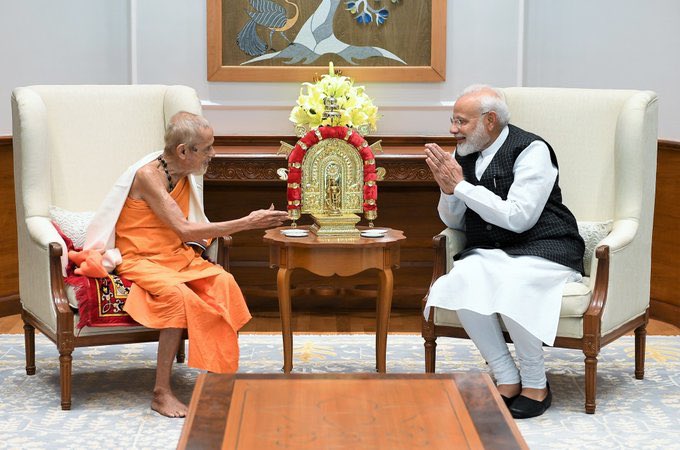
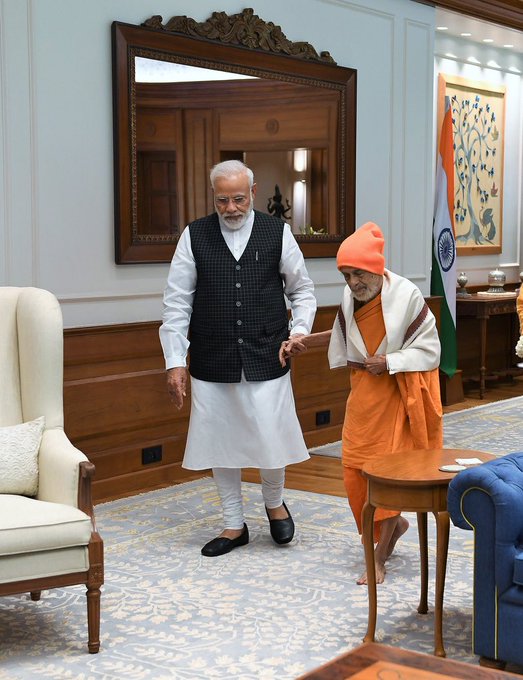
PM condoles passing away of Sri Vishvesha Teertha Swamiji of the Sri Pejawara Matha

The Prime Minister Shri Narendra Modi has condoled the passing away of Sri Vishvesha Teertha Swamiji of the Sri Pejawara Matha, Udupi.

“Sri Vishvesha Teertha Swamiji of the Sri Pejawara Matha, Udupi will remain in the hearts and minds of lakhs of people for whom he was always a guiding light. A powerhouse of service and spirituality, he continuously worked for a more just and compassionate society. Om Shanti.

I consider myself blessed to have got many opportunities to learn from Sri Vishvesha Teertha Swamiji. Our recent meeting, on the pious day of Guru Purnima was also a memorable one. His impeccable knowledge always stood out. My thoughts are with his countless followers”, the Prime Minister said.

Narendra Modi

@narendramodi

Sri Vishvesha Teertha Swamiji of the Sri Pejawara Matha, Udupi will remain in the hearts and minds of lakhs of people for whom he was always a guiding light. A powerhouse of service and spirituality, he continuously worked for a more just and compassionate society. Om Shanti.

View image on Twitter

Narendra Modi

@narendramodi

I consider myself blessed to have got many opportunities to learn from Sri Vishvesha Teertha Swamiji. Our recent meeting, on the pious day of Guru Purnima was also a memorable one. His impeccable knowledge always stood out. My thoughts are with his countless followers.

View image on Twitter
3,765 people are talking about this

****

Violence and democracy do not go together: VP

The Vice President of India, Shri M Venkaiah Naidu has called for an enlightened and constructive debate on issues such as CAA, NRC and NPR and urged the people to study in-depth and fully understand the background before reacting to any issue.

Inaugurating the Birth Centenary Celebrations of the late Chief Minister of united Andhra Pradesh, Dr. M. Channa Reddy in Hyderabad, the Vice President said that violence and democracy do not go together and cautioned the people to not get carried away in this age of fake news.

As regards CAA, NRC and NPR, the people of the country should have an enlightened, meaningful and constructive discussion and not jump to hasty conclusions. Ours is a mature democracy and there is no place for violence in it, the Vice President stressed.

Stating that dissent or disagreement has to be expressed in a constructive, democratic and peaceful manner, he recalled that Mahatma Gandhi had eschewed violence in all its forms even in the face of most daunting challenges. “While protesting against the British rule, he remained civil even to his adversary. He called off Non Cooperation Movement after Chauri Chaura incident which had turned violent”, he pointed out.

The Vice President stressed the need for maintaining the dignity of Parliament and Legislatures and raising the standards of the debates. He said that personal attacks should not be made, while policies could be criticized.

Referring to the governance system, the Vice President called for reforming it constantly in tune with people’s aspirations. He emphasized that transparency, accountability and people-centric policies were essential to provide good governance.

He said that eliminating corruption, decentralizing administration, cutting down red tape, promoting online interface between government departments and the public and promptly addressing the grievances were important features of a responsive administration.

Paying rich tributes to Dr. Channa Reddy, he said the late Chief Minister was a grass-roots politician and a mass leader, who relentlessly strove to uplift the conditions of the common people. The fact that he had occupied so many high offices is a testimony to his administrative acumen and leadership qualities, he added.

The Vice President said that Dr. Reddy’s tenure as Chief Minister was marked by many developmental initiatives as he steered the State on the path to industrialization. He toned up the administration by cutting on red tape and simplifying procedures.

Recalling that agriculture was close to Dr. Reddy’s heart, the Vice President said that he had accorded the highest priority to improving the lot of the farmers.

He also stated that the late Chief Minister was a relentless champion of social justice and had introduced reservations for BCs in government jobs and education in 1980. As a firm believer in strengthening democratic foundations, he reduced the voting age for local bodies from 21 years to 18 years, the Vice President added.

The Vice President also conferred Dr. M. Channa Reddy National Award for Sustainable Development posthumously on eminent irrigation expert Late Shri T Hanumantha Rao. The award is in recognition of his revolutionary innovation of Four Water Concept (FWC) for watershed development.

Shri Bandaru Dattatreya, Honorable Governor of Himachal Pradesh, Dr. K. Rosaiah, honorable former Governor of Tamil Nadu and others were present on the occasion.

The following is the full text of the speech:

I am pleased to be here to inaugurate the Centenary Celebrations of Dr. Marri Channa Reddy Garu, who had served the nation with distinction in various capacities. He was a visionary in the true sense and was gifted with remarkable administrative acumen.

Perhaps, he was one of the few leaders, who had served as Governor of four States, Chief Minister on two occasions and as a Union Minister. The fact that he had occupied so many high offices is a testimony to his administrative acumen and leadership qualities.

Indeed, Dr. Reddy was a grass-roots politician and a mass leader, who relentlessly strove to uplift the conditions of the common people. He was quick to grasp people’s problems and understand their aspirations. As a result, he used to give shape to policies that addressed their concerns.

Hailing from a farmer’s family, agriculture was close to his heart. He accorded the highest priority to improving the lot of the farmers and focused on agriculture in view of the primacy it deserves in our society.

He always had his finger on the pulse of the people and the fact that he served as Chief Minister of the erstwhile united Andhra Pradesh on two occasions in 1978 and 1989 showed how popular he was. A powerful orator in Telugu, Urdu, Hindi and English and a people’s man to the end, Dr. Reddy struck a special chord with the people of united Andhra Pradesh.

Dr. Channa Reddy began his journey in the service of the country in his early twenties after giving up his medical practice and plunging into the freedom struggle. To this day, he is remembered for his powerful writings in the Telugu weekly, “Hyderabad” which he ran from Vijayawada during the struggle against the Nizam’s rule in erstwhile Hyderabad.

At the age of 31, he became the youngest member of the Provisional Parliament in 1950. He was inducted as a minister in the Cabinet of Shri Boorgula Ramakrishna Rao.

His tenure as Chief Minister of the erstwhile united Andhra Pradesh was marked by many developmental initiatives as he steered the State on the path to industrialization, even as he ensured that the state’s development was not at the cost of agriculture. He toned up the administration by cutting on red tape and simplifying procedures.

He also took steps to improve land administration and set up Land Development Councils.

He was a relentless champion of social justice and had introduced reservations for BCs in government jobs and education in 1980. As a firm believer in strengthening democratic foundations, he reduced the voting age for local bodies from 21 years to 18 years.

For the benefit of farmers, he introduced a scheme to provide subsidies on fertilizers and seeds. He reduced interest on agricultural credit and accorded top priority for creating irrigation facilities.

He exempted land revenue for small farmers having holdings of 2.5 acres wet and 5 acres dry land and conferred right of land to about 75,000 people by distributing 1.33 lakh acres.

In a bid to address the problem of unemployed youth, the Society for Employment Promotion and Training in Twin Cities (SETWIN) was established when Dr. Reddy was the Chief Minister.

During his second stint as Chief Minister, Remote Area Development programme was launched in some of the naxalite-affected backward districts to wean away youth from the influence of the radicals. He will be always remembered for implementing the World Bank-assisted Cyclone Emergency Reconstruction Project and for taking up modernization of irrigation structures in Krishna and Godavari delta regions.

As Union Minister for Steel, he introduced reforms to improve steel production and brought about decontrol of distribution of steel and coal.

As a young MLA, I used to vehemently criticize his government’s decisions in the Assembly. One of his great qualities was that he never held anything against even his most bitter critic. Always a keen listener, he used to reply to every point raised by me or other opposition members.

I had the opportunity to interact with him on several occasions and what struck me was his concern to address the people’s problems. I also found him to be a man of strong convictions and principles.

Dr. Reddy was known as a firebrand leader and had championed the cause of a separate Telangana State in the late sixties. It led the government to provide key safeguards, mainly in terms employment and education, to the people of Telangana.

Dear sisters and brothers,

As we recall the excellent administrative qualities of Dr. Channa Reddy and pay tributes to him, we need to understand the importance of constantly reforming our governance system in tune with the needs and aspirations of the people. Transparency, accountability and people-centric policies are essential to provide good governance.

Eliminating corruption, decentralizing administration, cutting down red tape, promoting online interface between government departments and the public and promptly addressing the grievances are important features of a responsive administration.

Before concluding, let me stress the need for an enlightened debate on any issue before reacting to it. In this age of fake news, one should be all the more cautious before reacting. As a matter-of-fact, one should first understand and study the issue in-depth, know its background and try to know what will be its impact. We need to focus on the issue rather than diverting from the main issue.

As regards CAA, NRC and NPC, the people of the country should have an enlightened, meaningful and constructive discussion and not jump to hasty conclusions either way.

We are an independent country and a mature democracy. It should be remembered that violence and democracy will not go together. Any dissent or disagreement has to be expressed in a constructive, democratic and peaceful manner. Apprehensions need to be answered and addressed by the government at every level.

Please remember that the Father of the Nation, Mahatma Gandhi eschewed violence in all its forms even in the face of most daunting challenges. His methods of protest were scrupulously non-violent. While protesting against the British rule, he remained civil even to his adversary. He called off Non Cooperation Movement after Chauri Chaura incident which had turned violent.

Gandhi Ji continues to inspire the humanity with his eternal values, powerful ideas and thoughtful actions based on truth and non-violenceAs we are observing the 150th Jayanthi of Gandhi Ji, it is all the more important for us to remember that his views and the message of his life are eternal.

Finally, let me thank the organizers for inviting me to inaugurate the centenary celebrations of Dr. Channa Reddy Garu. He was a great son of this soil and left an indelible mark on the Indian political scene.


Jai Hind!


Five Questions to Ask Your Election Candidate (English Version)

This election may affect your children.  Especially if your would-be representative in legislative assembly keeps the following in mind.
·       Education – good / quality education – is everyone’s right. Especially after the RTE, education in every government school should be such that everyone finds it good. But even very poor parents are removing their children from government schools and making sacrifices to send their children to private schools.
Ask your would-be representative – Question 1: What will you do to ensure appropriate and quality education in government schools?
·       Teachers’ salaries have gone up. They now get training from time to time to enable good education for children. There is provision for mid-day-meals, school uniforms, play equipment, learning material – all free. But there is demotivation among teachers. They feel neglected. They feel as if they are not being respected.
Ask your would-be representative – Question 2: What will you do so that teachers take interest in their work and are committed to the good education of their children?
·       According to RTE the responsibility of running/managing the schools will now be with community and panchayats. But the community and the panchayats feel: how can we give any advice to the school? They do not find themselves capable of advising / supporting schools. And they feel this is not even their work.
Ask your would-be representative – Question 3: What will you do to enable the active involvement of community and panchayats in improving education in our schools?
·       Community and parents both expect that education will ensure children’s development as well as employment. But now people say: All this education is going to lead only to unemployment, so it is better that the child be engaged in some wage-earning work right away.
Ask your would-be representative – Question 4: What will you do so that every member of the community is aware and committed towards the education of their children?
·       If we look at the money spent on education, most of it is used for salries, infrastructure and maintenance. Crores of rupees are spent every year on this. Even then our schools and education offices look dirty and disorganized compared to private institutions. And the people responsible for improving education for children cannot even be heard talking about it.
Ask your would-be representative – Question 5: What will you do so that government schools and education offices look attractive? So that people in the system not only think of children’s improvement but also do what is needed?
Your views will have an impact, won’t they? But only if you raise these questions! Give your vote only if you get an answer! So go ahead, ask questions, get others to ask, and let us know!!

The flying car

I now petition Kitty Hawk that the best place in the world to launch it first would be in Bangalore. Everybody knows that a basic version of this already exists in the wonderful city’s roads , for after all, a two wheeler can come from all 360 degrees to dent your car even  today. But passing over that lightly, let’s examine how and why this would be a major hit in Bangalore

Everybody who works in the world famous Ecospace building would buy it immediately. Ecospace is the world’s first building where traffic jams are inside the building area and not outside. Average mean time currently for exiting from parking and coming to the gate is 45 mts. With a flying car, the coder will simply jump out of his office window in it and zoom away.  Similarly coders in cubby holes in every other monstrosity – Maanyata, ITPL, Bagmane in that order – are enough to ensure that Kitty Hawk’s order book for the next 10 years is filled up.

Two wheeler riders of Bangalore migrating to the flying car are likely to be confused initially as they are genetically programmed only to ride on the pavement or ride on the wrong side of the road. They will need some significant retraining to take to this new vehicle. Two wheeler riders are also currently used to taking the wife and both kids along with them. It is unclear from the prototype of the flying car as to where the two kids can be placed. Perhaps they can be made to hang from the wings. There is no safety worry –  in Bangalore, even babies are trained from birth on how to hang on while on a two wheeler

The world famous cab drivers of Bangalore will be the world’s best drivers on this car, as they have considerable practice in ducking and weaving and zooming. So the maneuvers required of a flying car come to them naturally. They will also be doing a massive public service. As they are used to constant honking, they will take this practice to the air and thereby drive off all the pigeons who currently infest every apartment building.

One of the greatest features of this car appears to be that it can instantly stop and hover in a particular spot. This will be very useful to BMTC drivers who like to stop in the middle of the road in an instant, if the fancy hits them.

There is one problem however. In Bangalore, every type of a cable – be it electricity, TV or internet cable dangles about 2 mtrs above every public space. Kitty Hawk will have to design the car such that it can take off and land passing through the 1 nanometer space available between the cables. In this they will be greatly aided by the dodging powers of the legendary cab driver of Bangalore.

We have one of the most proactive governments in the world in Bangalore. They will instantly build KR Puram, Silk Board and Graphite junctions in the air so that Bangaloreans on flying cars would not be deprived of the unique experiences to be had at the aforementioned places.  They will also ensure that enough airpockets are released into the atmosphere so that Bangaloreans will not get sick from a smooth ride – their bodies having being conditioned to the soothing effects of pot holes.

Another design suggestion for Kitty Hawk would be to provide a glass panel whereby owners can paint or affix stickers saying Bhuvaneswari , Parthiban and Rajasekhar (please note that these will be written in Kannada and therefore will require some additional lateral space)

Drivers will have to adjust their perception of tree branches. Today, the sight of a tree branch on the road means a vehicle has broken down and a twig and some leaves have been lodged in a crack to warn others of this fact. From the flying car, a branch and leaves may be safely taken to be on a living tree.

I am not sure of the impact these cars will have on the traffic cops of Bangalore. Perhaps they can climb trees and tow away the flying cars that have been parked on every branch – the ex two wheeler driver being an expert at parking his vehicle on any vacant area in any terrain.

What I am not clear is  how two drivers who have banged each other will fight. Current practice, which is almost a holy covenant is that you stop right there, get out and hurl the choicest abuse on the other guy.  You cannot move even 1 mtr from the spot (ie move to the side of the road) before fighting).  How this will be done mid air in the future scenario requires deep thought.

All in all, Kitty Hawk must simply relocate to Bangalore and start here. In any case the CEO is probably Arvindkatakshan Ramasubramaniam, who originally went from here. Welcome home, Sir !

    Dr Jitendra Singh interacts with participants on second day of ‘Destination North East’ festival in Varanasi

    The Union Minister of State (Independent Charge) Development of North Eastern Region (DoNER), MoS PMO, Personnel, Public Grievances, Pensions, Atomic Energy and Space, Dr Jitendra Singh said in Varanasi today that Northeast model of development and opportunity is now being replicated across India and this has been possible because of a concentrated effort to familiarize people, particularly youth, in different parts of the country about what all Northeast could offer to each one of them.

    Going around various stalls and interacting with participants and visitors, majority of them youth, on the second day of the 4-day  “Destination North East” festival at BHU campus in Varanasi, Dr Jitendra Singh said that the response to the event has been overwhelming and inspite of exams going on in some departments of University, students in huge numbers were seen visiting the stalls and intermingling with their counterparts from Northeast till almost midnight. He said, this is a vindication of the contention that he always held that as soon as the enormous potential and avenues of Northeast are made familiar to people living in other parts of India, there would virtually be a bee-line of explorers and aspirants heading for North East India.

    Making a particular mention of Bamboo, Dr Jitendra Singh pointed out that this is for the first time perhaps, that there was an extensive showcasing of the various aspects of bamboo use including a bamboo idol of Buddha and a bamboo-model depicting the holy Kamakhya temple. The positive outcome of this, he said, has been that youth and media persons in large numbers are visiting the venue to understand how best they could also take the benefit of bamboo in supplementing livelihood sources and bringing ease of living.  There are huge reserves of bamboo even outside Northeast, including in Central India, but there was little awareness and knowledge about it and therefore, it could not be put to optimum use. We have tried to educate the common citizens, particularly youth, about how best each one of them can introduce bamboo into his life routine, particularly after Prime Minister ShribNarendra Modi has amended the Indian Forest Act to exempt home-grown bamboo from it, he added.

    In addition to food outlets and traditional cultural performances, the B-2-B business meetings attracted a large number  of youngsters who seriously engaged themselves to explore and ascertain how best they could use the North Eastern pattern to further their entrepreneurship plans.

    *****

    The Case for Children\’s News Programmes

    Imagine regular news programmes for children
    While advertising and entertainment programmes have begun to cater to children\’s needs, for some reason news channels have ignored children altogether! Imagine a regular children\’s news programme, at a fixed time, presented in a lively way, as something for children to look forward to daily. It could be on radio and better still, on TV.

    What such programmes could contain
    While national and international events would figure in it, children\’s news would focus on the world as seen by children. Background information would make the news more accessible, along with activities that can be done at home or school. There might even be discussions and debates on issues that children have views and opinions on, along with scope to engage with the channel through phone calls / sms / email.

    Newspapers too
    And perhaps newspapers would follow with some space for children\’s news, based on what came on TV the previous night. This would not only enable greater understanding of the news itself, it would greatly boost higher order literacy (apart from newspaper circulation). This would also provide teachers with more current material for use in different classes across a range of subjects!

    Many benefits
    The immediate benefits for the channels themselves would be in terms of developing loyal viewers for the future (and perhaps an expanded revenue source through increased advertising range).

    However, the longer term implications for children themselves, for society and the country would be enormous.

    • Children who have had the opportunity to engage with a world beyond their immediate environment would develop cognitively and socially (well exceeding the abysmal levels attained at present!) 
    • Focusing the programming at special groups (e.g. girls, or children with disabilities or the rural poor or those who need help to learn the state language – such as tribal children – or English) would dramatically increase learning opportunities for the marginalized and the disadvantaged.
    • Wide spread use of such programmes would also help harness the demographic dividend India has at the present.

    If handled sensitively, this could help create a nation where plurality is cherished and the narrow confines of identity are not allowed to become a source of conflict.

    The Case for Children\’s News Programmes

    Imagine regular news programmes for children
    While advertising and entertainment programmes have begun to cater to children\’s needs, for some reason news channels have ignored children altogether! Imagine a regular children\’s news programme, at a fixed time, presented in a lively way, as something for children to look forward to daily. It could be on radio and better still, on TV.

    What such programmes could contain
    While national and international events would figure in it, children\’s news would focus on the world as seen by children. Background information would make the news more accessible, along with activities that can be done at home or school. There might even be discussions and debates on issues that children have views and opinions on, along with scope to engage with the channel through phone calls / sms / email.

    Newspapers too
    And perhaps newspapers would follow with some space for children\’s news, based on what came on TV the previous night. This would not only enable greater understanding of the news itself, it would greatly boost higher order literacy (apart from newspaper circulation). This would also provide teachers with more current material for use in different classes across a range of subjects!

    Many benefits
    The immediate benefits for the channels themselves would be in terms of developing loyal viewers for the future (and perhaps an expanded revenue source through increased advertising range).

    However, the longer term implications for children themselves, for society and the country would be enormous.

    • Children who have had the opportunity to engage with a world beyond their immediate environment would develop cognitively and socially (well exceeding the abysmal levels attained at present!) 
    • Focusing the programming at special groups (e.g. girls, or children with disabilities or the rural poor or those who need help to learn the state language – such as tribal children – or English) would dramatically increase learning opportunities for the marginalized and the disadvantaged.
    • Wide spread use of such programmes would also help harness the demographic dividend India has at the present.

    If handled sensitively, this could help create a nation where plurality is cherished and the narrow confines of identity are not allowed to become a source of conflict.

    The Case for Children\’s News Programmes

    Imagine regular news programmes for children
    While advertising and entertainment programmes have begun to cater to children\’s needs, for some reason news channels have ignored children altogether! Imagine a regular children\’s news programme, at a fixed time, presented in a lively way, as something for children to look forward to daily. It could be on radio and better still, on TV.

    What such programmes could contain
    While national and international events would figure in it, children\’s news would focus on the world as seen by children. Background information would make the news more accessible, along with activities that can be done at home or school. There might even be discussions and debates on issues that children have views and opinions on, along with scope to engage with the channel through phone calls / sms / email.

    Newspapers too
    And perhaps newspapers would follow with some space for children\’s news, based on what came on TV the previous night. This would not only enable greater understanding of the news itself, it would greatly boost higher order literacy (apart from newspaper circulation). This would also provide teachers with more current material for use in different classes across a range of subjects!

    Many benefits
    The immediate benefits for the channels themselves would be in terms of developing loyal viewers for the future (and perhaps an expanded revenue source through increased advertising range).

    However, the longer term implications for children themselves, for society and the country would be enormous.

    • Children who have had the opportunity to engage with a world beyond their immediate environment would develop cognitively and socially (well exceeding the abysmal levels attained at present!) 
    • Focusing the programming at special groups (e.g. girls, or children with disabilities or the rural poor or those who need help to learn the state language – such as tribal children – or English) would dramatically increase learning opportunities for the marginalized and the disadvantaged.
    • Wide spread use of such programmes would also help harness the demographic dividend India has at the present.

    If handled sensitively, this could help create a nation where plurality is cherished and the narrow confines of identity are not allowed to become a source of conflict.

    The Case for Children\’s News Programmes

    Imagine regular news programmes for children
    While advertising and entertainment programmes have begun to cater to children\’s needs, for some reason news channels have ignored children altogether! Imagine a regular children\’s news programme, at a fixed time, presented in a lively way, as something for children to look forward to daily. It could be on radio and better still, on TV.

    What such programmes could contain
    While national and international events would figure in it, children\’s news would focus on the world as seen by children. Background information would make the news more accessible, along with activities that can be done at home or school. There might even be discussions and debates on issues that children have views and opinions on, along with scope to engage with the channel through phone calls / sms / email.

    Newspapers too
    And perhaps newspapers would follow with some space for children\’s news, based on what came on TV the previous night. This would not only enable greater understanding of the news itself, it would greatly boost higher order literacy (apart from newspaper circulation). This would also provide teachers with more current material for use in different classes across a range of subjects!

    Many benefits
    The immediate benefits for the channels themselves would be in terms of developing loyal viewers for the future (and perhaps an expanded revenue source through increased advertising range).

    However, the longer term implications for children themselves, for society and the country would be enormous.

    • Children who have had the opportunity to engage with a world beyond their immediate environment would develop cognitively and socially (well exceeding the abysmal levels attained at present!) 
    • Focusing the programming at special groups (e.g. girls, or children with disabilities or the rural poor or those who need help to learn the state language – such as tribal children – or English) would dramatically increase learning opportunities for the marginalized and the disadvantaged.
    • Wide spread use of such programmes would also help harness the demographic dividend India has at the present.

    If handled sensitively, this could help create a nation where plurality is cherished and the narrow confines of identity are not allowed to become a source of conflict.

    The Case for Children\’s News Programmes

    Imagine regular news programmes for children
    While advertising and entertainment programmes have begun to cater to children\’s needs, for some reason news channels have ignored children altogether! Imagine a regular children\’s news programme, at a fixed time, presented in a lively way, as something for children to look forward to daily. It could be on radio and better still, on TV.

    What such programmes could contain
    While national and international events would figure in it, children\’s news would focus on the world as seen by children. Background information would make the news more accessible, along with activities that can be done at home or school. There might even be discussions and debates on issues that children have views and opinions on, along with scope to engage with the channel through phone calls / sms / email.

    Newspapers too
    And perhaps newspapers would follow with some space for children\’s news, based on what came on TV the previous night. This would not only enable greater understanding of the news itself, it would greatly boost higher order literacy (apart from newspaper circulation). This would also provide teachers with more current material for use in different classes across a range of subjects!

    Many benefits
    The immediate benefits for the channels themselves would be in terms of developing loyal viewers for the future (and perhaps an expanded revenue source through increased advertising range).

    However, the longer term implications for children themselves, for society and the country would be enormous.

    • Children who have had the opportunity to engage with a world beyond their immediate environment would develop cognitively and socially (well exceeding the abysmal levels attained at present!) 
    • Focusing the programming at special groups (e.g. girls, or children with disabilities or the rural poor or those who need help to learn the state language – such as tribal children – or English) would dramatically increase learning opportunities for the marginalized and the disadvantaged.
    • Wide spread use of such programmes would also help harness the demographic dividend India has at the present.

    If handled sensitively, this could help create a nation where plurality is cherished and the narrow confines of identity are not allowed to become a source of conflict.

    The Case for Children\’s News Programmes

    Imagine regular news programmes for children
    While advertising and entertainment programmes have begun to cater to children\’s needs, for some reason news channels have ignored children altogether! Imagine a regular children\’s news programme, at a fixed time, presented in a lively way, as something for children to look forward to daily. It could be on radio and better still, on TV.

    What such programmes could contain
    While national and international events would figure in it, children\’s news would focus on the world as seen by children. Background information would make the news more accessible, along with activities that can be done at home or school. There might even be discussions and debates on issues that children have views and opinions on, along with scope to engage with the channel through phone calls / sms / email.

    Newspapers too
    And perhaps newspapers would follow with some space for children\’s news, based on what came on TV the previous night. This would not only enable greater understanding of the news itself, it would greatly boost higher order literacy (apart from newspaper circulation). This would also provide teachers with more current material for use in different classes across a range of subjects!

    Many benefits
    The immediate benefits for the channels themselves would be in terms of developing loyal viewers for the future (and perhaps an expanded revenue source through increased advertising range).

    However, the longer term implications for children themselves, for society and the country would be enormous.

    • Children who have had the opportunity to engage with a world beyond their immediate environment would develop cognitively and socially (well exceeding the abysmal levels attained at present!) 
    • Focusing the programming at special groups (e.g. girls, or children with disabilities or the rural poor or those who need help to learn the state language – such as tribal children – or English) would dramatically increase learning opportunities for the marginalized and the disadvantaged.
    • Wide spread use of such programmes would also help harness the demographic dividend India has at the present.

    If handled sensitively, this could help create a nation where plurality is cherished and the narrow confines of identity are not allowed to become a source of conflict.