Why the Need of new Examination System in Pakistan

WHY THE NEED OF NEW EXAMINATION SYSTEM IN PAKISTAN

This study focused on evaluating the quality of the examination system of Pakistan. Pakistan education is going down day by day. The purpose of this study is to find the causes of this detracted process in Pakistan. The objectives are: to evaluate the examination system in Pakistan, to find the causes of this deteriorated examination system, to suggest some measure to improve the examination system in Pakistan.
The current examination system is obsolete; it did not fulfill the requirement of 21th century. This education and examination system was left for us by British after the independence of Pakistan in 1947. The purpose of this education system was to prepare clerical staff in the subcontinent to run the day to day activities of the offices. For which the British officers were not ready to do it. They wanted people who help them, e.g., to control the mass illiterate population, they want people with no brain; they need the people who can count and calculate. They need people who can write reports in English for their officers. Who can extend their stay in the subcontinent. For this purpose they design an education system that can produce brainless people, who can\’t think just act on the orders of their officers. They do not want leaders and thinkers in the occupied territory. They want people who obey order not to argue and raise the questions.
Unfortunately after the independence of Pakistan, no one gives serious thoughts to improve education system in Pakistan. Especially, after 1971 when democracy was restored in the country and the feudal and capitalist who took control of the country, they imposed the same colonial education system for common people. For elite class they established private schoolssystem which was very expensive. To prevent people from getting good education, they implemented education polices that hinders the efforts of people to get good education. Following are the major
Reasons / Hinders of public education system in Pakistan.
·        Medium of  instruction
·        Curriculum
·        Examination system
·        Bureaucracy of Pakistan
·        The policy makers
·        The elite class of Pakistan
In this article the focus will be on Examination system of Pakistan. However, to have good examination system we need to have a look at the Examination system of developed countries. The Examination system of the United States of America is a very good model.
In their examination system Students are marked on course they took in each subject studied from K to 12th class and the Grade Point Average (GPA) is calculated. Marks are dependent on their performance in different area, including student\’s performance in tests in the school, participation in class discussions, homework assignments, and school projects which they have selected.
Examination System in the US


High schools issue school ‘transcript\’ for each student showing their marks and grades, summarizing the courses taken. If a student wishes to go to college he can submit copies of his transcript to the college. College or university acceptance is also based upon personal recommendations from teachers and eligibility criteria. In some colleges and universities these school mark\’s sheet are not accepted. They only accept SAT and AST Test score for admission. For those institution\’s Students have to take national college aptitude tests during their last two years in high school, some colleges require Achievement (Ach) Tests. These Tests are based on multiple-choice general type test, but they are designed to measure students aptitude and verbal and mathematical skills.
The known and widely used tests are the American College Testing (ACT) programme and the Scholastic Aptitude Test (SAT), both of these tests are recognized by accredited universities for admission.
The total SAT score is 1,600 in which half is for mathematical and half for verbal skills, with the average score usually between 900 and 1,000. Students must score over 650 in each section or a combined total of over 1,300.
High school exit exam is a test that a student must pass to receive his high school diploma. Sometimes states have a series of standardized exams for this purpose. These tests are often called “end-of-course exams” at the end of completion high school courses in various core subjects. In some states they require students to pass end-of-course exams in addition to a comprehensive exit exam. California, recently suspended its administration of exit exams.
Texas requires students to pass two types of exit exams. One the Texas Assessment of Knowledge and Skills (TAKS), and the other is the State of Texas Assessments of Academic Readiness (STAAR), at end-of-course exams when a student finishes a course. The TAKS test, test language, arts, math, science and social studies. While STAAR includes subjects like: English; Algebra 1, Geometry, and Algebra; Biology, Chemistry, and Physics; World History, US History, and World Geography.
 “Not too long ago more than half of U.S. states required that students pass an exam to graduate from high school. That is changing, with a number of states dropping their exit exams — but a good number still require them, and that, this post explains, is a big and unnecessary problem for many students”
A national uprising has highlighted the misuse and overuse of standardized testing that hurts students. Now different state is looking for way to end high school exit testing. In the last few years, 10 states have repealed or delayed high school exit exams. South Carolina, Georgia, Arizona and California even decided to issue diplomas to thousands of those students who have been denied due to scores on discontinued tests. The reasons for this retreat is research, which researcher conducted on exit testing, which shows that exit tests hurt the students. They increase dropout rates from education.
The Gates-funded New America think tank 2014 study, “The Case against Exit Exams,” declared, “New evidence has reinforced the conclusion that exit exams disproportionately affect a subset of students, without producing positive outcomes for most.” The study further concluded that “have tended to add little value for most students, but have imposed costs on already at-risk ones.”
In the USA there is no federal mandate requiring high school exit testing. Since the law No Child Left Behind was passed in 2001, federal law has required testing once of the students during the grades 9–12 in math, English language arts, and science.
Pakistan examination system
The examination system of Pakistan is based on colonial era, the education system that British imposed on us. The purpose of this education system was to produce only clerical Staff in subcontinent. After independence of Pakistan, different governments design education polices, but all these polices were fruitless. The demand of these polices was the quality in education, but the Burdon was put on the student\’s shoulders. The policy makers adopted old British era examination system. However with time they make it harder for the students to pass the exams and they called it a step forward toward quality education. The restoration of democracy in Pakistan in after 1971, the feudal took control of the government and the sole purpose of their education polices was to prevent common man from geting education in government public schools. In these polices the examination system is made harder and harder to increase dropout rate. Multiple time medium of instruction was changed. Board exams were introduced in different stages of education due to which millions of students drop out from the school without completing matric education. One of the worst experiment was in examination system was the combine exam of 9th and 10th class. This experiment was continued for more than two decades. Always the result of this exam was 20 to 25 percent pass. While majority of the fail students were dropout of schools without completing their matric education. Later in 2000 this experiment was stopped and 9th and 10th separate exams were started which improve the passing rate of the students and decrease the dropout from the schools.
After 2018 election people were hoping that PTI government will change the education, and will give the nation a good education policy, but they are also fail to do so. In the process they make a huge mistake to change the requirement criteria for employment of teacher without holding B.Ed. degree to get jobs in the school. This was not a very thoughtful decision because millions of trained teacher are without jobs and they started employing untrained teachers. The reason was the arrogance of the minister who gives an interview to newspapers for changing employment criteria. After objections on his decision from educationist and teachers, the KPK government made it compulsory to keep the words of their minister on the cost of education. Now there is a rumor that government are going for combine 9th and 10th class board exam. It shows that politicians did not learn from their fast mistakes. They may be the puppet of feudal and elite class who do not wants educated voters. This system suits feudal that needs illiterate people to vote for them in the election, the voters who don\’t know their rights, and the voter who doesn\’t ask questions. These voter still votes for the corrupt politicians who had been proven guilty on international level, who have billions of dollars and property abroad in several countries. However, still these mass illiterate people think that they are innocent and they vote for them again and again. They create hurdles in every step to prevent people from education and board exams are their best weapon to do so. A Ph.D. research study conducted in Punjab on the Issue of out of School Children in BISE Gujranwala.
Table 1.1 Five Years Class 9th Annual Examination Result of BISE Gujranwala


Year
Applied
Appeared
Passed
Passed
Percentage
Failed Percentage
2012
225031
221023
88649
40.11
59.89
2013
 213547
207883
79200
38.09
61.91
2014
243128
240088
87334
36.38
63.62
2015
 252548
248537
100857
40.58
59.42
2016
244454
240105
129670
54.01
45.99
Source: BISE Gujranwala, 2016
“Table shows that 45.99 percent students in 2016, 59.42 percent in 2015 and 63.62
 Percent in 2014, 61.91 percent in 2013 and 59.89 percent in 2012 respectively, failed in class 9 annual examinations at BISE Gujranwala. This is an indication that most of class 9 pupils are not able to complete the secondary school certificate, and consequently drop out. (Mughal, 2018)”
While the overall enrollments in Pakistan Secondary/High Schools, in Class IX-X were 3.6 million students in 2016-17. The average pass rate was 40%, while failing rate was 60%. With this rate of failure 2.4 million (2400000) students dropped out of the school without complementing their matriculation certificate.
While in Higher Secondary Classes XI-XII the total number of 1.75 million students enrolled, with the average pass rate in Pakistan approximately half million students\’ and 1.25 million dropped out at this level. In 2018-19 approximately 1.84 million will appear in the examination in which 1342850 (1.3 million) will be dropped out.
 
Table 1.2 Enrollment in High and Secondary Vocational Institutes


Enrollment in High and Secondary

Table 1.2 shows that during 1981 and 2007 approximately 19077200 (190.77 million) passed the exam while approximately 28615800 (286.15 million) failed the examination and dropped out of school.
Table 1.3 enrollment in high and higher secondary schools
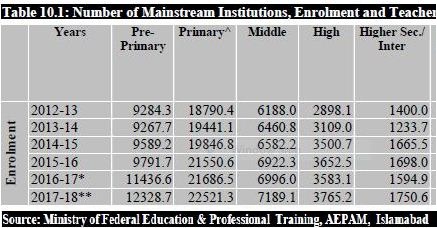
 

Table 1.3: Numbers are in thousands


Table 1.3 shows that from 2012 to 2018 the numbers of students enrolled were 20508600 (205.08 million). . Keeping in view average of fail students every year at this level, the number of fail students will be approximately 12305160 (123.05 million).
While in higher secondary/inter 9342700 (9.34 million) were enrolled and the number of failed rate at this level based on the average will be approximately 6673357 (6.67 million).
What is the purpose of examination system?
The purpose of examination is multi-fold; to evaluate the students learning achievements, to evaluate the teaching of teachers. Is it a right approach of examination system? A good approach of examination system is to give a comprehensive chance to students for learning. The purpose of education examination system is to improve the learning and reading skill of the students.
The second purpose is to evaluate the teaching skills of the teachers, for this purpose the country need such examination system which help to achieve  both objectives of the examination system. The current board exams are very old and outdated. It did not improve the quality of education, but it decrease the numbers of dropout students in the country. It is the major reason that we are still lacking behind in education from other countries.
·        The first purpose of education examination system is to improve the learning and reading skill of the students. A good collection of objective type questions from the textbook up to three hundred questions which cover every page of the book. To solve these objectives, he will learn to read, it will also help him to comprehend and learn the information that is provided in the textbook. This test must also include inductive and deductive type questions, so it develops the reasoning skills of the students. This objective type test should be given as home base test and they should be given enough time to read the textbook and found the answers. This home based objectives type assignment could be divided in two parts. One hundred and fifty questions in first semester and the rest one hundred and fifty questions in the second semester for every textbook.
·        The second purpose is to evaluate the teaching skills of the teachers. With objectives type examination we can evaluate the teaching skills of the teacher on the base of the performance ofstudents\’ achievements in the test. A good result will show that teacher was committed to his teaching and he used every possible way to develop the reading and comprehension skills of the students. When the teacher knows that he will be accountable for the bad result of his students, he will make it possible that every student understand what he is teaching. For this very purpose the country need such examination system, which help to achieveboth the objectives of the examination. The current examination system is outdated. It did not achieve the literacy rate what we are looking for. Despite it creates hinders in the improvement of literacy rate.
In most of the develop countries objective type test is implemented for the evaluation of students learning and teacher evaluation. In the area where reading and writing skills assessment is require there they use subjective type test, e.g., English, mathematics, etc.
Conclusion
From analysis it is crystal clear that what we are doing with the education on the name of quality and board examinations. It is very hard and time-consuming to calculate the accurate drop out for the last 40 years (1980-2020) for secondary (9th and 10th) and higher secondary (intermediate) level. For this purpose data was collected using internet and easily available books, research and other government documents. Majority data is easily available, but five years of data from 2008 to 2011 is not available. The data were calculated on the bases of average of available data for the missing years, the margin of error is five percent on both sides.
From the data and its analysis it is evident that in last forty years 47020000 (470.2 million) students were dropped out from schools without completing their secondary school education and 29000000 (290 million) students were from the higher/ inter level. It shows that we are dropping out millions of students every year at different stages of school on the name of quality and board examinations. Most develop country like the United States could not afford that kind of strict examination system where the literacy rate is very high. That why majority of states are ending school exit exams. The students who are weak in a particular subject are to attend summer school system. In summer school system both students and teachers have to attend school in summer vacation because both are responsible for bad result.
Suggestions and Recommendations
1.     We need to end board exams and any other drop out exams like United States; the majority of their states are ending school exit exams.
2.     We need to change the internal examination system, to a system where students learn and acquire knowledge from examination and evaluate teacher teaching on students achievements.
3.     Home objective type test is recommended for every subject. Three multiple choice questions from each page of textbook, all the questions should be arranged randomly. About every objective type question the page number of the respective question should be mentioned so the student read the page and find out the answer. The purpose of this drill is that student read every page of a textbook three times to build the reading habit of the students. Do not give a very easily discoverable objective type question.
4.     For improving writing ability in Urdu, English and local language internal subjective type exam is recommended after every three months. Written test in mathematics and Islamic studies.
5.     For improving writing skills of the students, dairy writing must be compulsory for students, at least five sentences in each language subjects.
6.     These home objective type test should  administered  by parts for each subject and at the end of the year a short objective  type test should administered from that home base test and in the subject where  reading and writing assessment is required  a subjective type  test  should be administered. The students who did not pass this test, they will attended classes in the summer vacations along their teachers. Afterward they should  be promoted to next class.
7.     For the purpose of admission in colleges or universities SAT type Test should be implemented during their last two years in higher secondary school, some colleges/ universities already require NTS Test. The score of this test could also be used for recruitment purposes.  These Tests should be based on multiple-choice type test in textbooks subjects which they are studying at this level, with additional papers to measure student’s aptitude, general, verbal and mathematical skills.
References
                                        
Burdett , N., & Everett, H. (n.d.). The impact of an examination board in Pakistan on student outcomes. Retrieved December 15, 2019, from https://www.riseprogramme.org/sites/www.riseprogramme.org/files/publications/24_Burdett_RISEconferencepaper.pdf.
Mughal, A. W. (2018). Investigating the Issue of Out of School Children in Rural Pakistan: Implications for Policymakers. Loughborough University.
Pakistan Bureau of Statistics. (n.d.). Retrieved December 15, 2019, from http://www.pbs.gov.pk/sites/default/files/50_years_statistics/vol1/12.pdf.
Pakistan Education Statistics. (2005). Retrieved December 15, 2019, from http://www.finance.gov.pk/survey/chapters/10-edu.pdf.
Pakistan Economic Survey . (2018). Retrieved December 15, 2019, from http://www.finance.gov.pk/survey/chapters_19/10-Education.pdf.


Educational Psychology

Concept of educational Psychology
What is psychology? The term \”psychology\” is derived from two Greek words – psyche (soul) and logos (science or study). Thus, literally it means study or science of soul. But now it is no more considered as science of soul. It has moved away from this focus and established itself as a scientific discipline which deals with the various processes and behavior of organism. Most of the contemporary psychologists agree on a definition of psychology as the scientific study of behavior and mental processes of organism.
There are three key terms in the above definition of psychology which have been clarified below: Scientific study means using techniques such as observation, description, and experimental investigation to collect information and then organizing this information. Mental processes refer to private and cognitive process such as attention, perception, remembering (memory), problem-solving, reasoning, decision-making, feelings, thinking, motives etc.
Definitions of Psychology • Psychology is the science of the activities of individual in relation to the environment (Woodworth). • Psychology is the positive science of behaviour (Watson). • Psychology is the science of human behavior and experience (Cruze). • Psychology is the science of mental activity of an organism (Guilford). • According to Charles E. Skinner, psychology deals with the responses to any and every kind of situation that life presents. By responses or behaviour is meant all forms of processes, adjustments, activities, and experiences of the organism.
Behaviour refers to all the actions or reactions of an organism (person or animal) in response to external or internal stimuli. The behavior of an individual, in a broad sense, refers to anything the individual does. According to Leagans (1961), behavior refers to what an individual knows (Knowledge), what s/he can do (skill – mental or physical), what s/he thinks (attitude), and what s/he actually does.
Behaviour may be simple or complex, short or enduring. Human behavior may be overt (expressed outside) or covert (expressed inside). While symbolic adoption is an example of covert behaviour, use adoption is an example of overt behavior. Both overt and covert behaviour can be measured. People who study psychological phenomena are not necessarily limited to the study of human beings only; they also study the behaviour of animals. They study the behavior and mental processes of individual not of group/community. Thus, when they are studying groups, the focus is generally on how individuals perform within the group rather than the study of the group as a whole.
EDUCATIONAL PSYCHOLOGY: MEANING AND DEFINITIONS
What is education? In order to know the educational psychology; we have to first understand what is education. The world education is derived from Latin word educare which means to bring-up. Education is also derived from another Latin world educere which means to lead out. Education as educere is more acceptable as it means leading an individual from ignorance to knowledge.
Education can be defined as the process of imparting or acquiring knowledge and habits through instruction or study. It can also be defined as a process in which human behaviour is modified so as to be in closer agreement with some model or ideal determined by the values of society. If education is to be effective, it should result in changes in all the behavioural components.
What is educational psychology?
Educational Psychology is a combination or overlapping of two separate fields of study; psychology and education. It is a distinct discipline with its own theories, research methods, problems and techniques. Educational psychology is distinct from other fields of psychology due to its focus on understanding the processes of teaching and learning that takes place in formal environments. Educational psychologists study what people think and do as they teach and learn a particular curriculum in a particular environment where education and training are intended to take place. They help in developing instructional methods and materials used to train people in both educational and work settings. They are also concerned with research on issues of relevance for education, counseling and learning problems.
Educational psychology deals with behavior of human beings in educational situation for definitions of educational psychology). This means that educational psychology is concerned with the study of human behavior or human personality, its growth, development, guidance under the social process of education. Education is possible in human beings; hence, human learning is the central core of educational psychology.
Definitions of Educational Psychology
• Educational psychology is that branch of psychology, which deals with teaching and learning. It takes its meaning from education, social process and from psychology, a behavioral science (Skinner).
• Educational Psychology is the discipline concerned with teaching and learning processes; applies the methods and theories of psychology and has its own as well (Woolfolk, 1995).
SCOPE OF EDUCATIONAL PSYCHOLOGY
Educational psychology deals with the behaviour of human beings in educational situations. Its main concerned is to identify various psychological factors affecting teaching and learning process. It describes and explains the learning according to scientifically determined principles and facts concerning human behaviour. Educational psychology addresses the questions – “why do some individual learn more than others\” and \”what can be done to improve that learning.\” Therefore, its subject matter is revolved around teaching and learning process and educational psychologists attempt to discover:
• The extent to which the factors of heredity and environment contribute to learning.
• The nature of the learning process.
• The educational significance of individual differences in rate and limit of learning.
• The inner change that occur during learning.
• The relation of teaching procedures to leaning outcomes.
• The most effective techniques for evaluating progress in learning.
• The relative effect upon an individual of formal learning as compared with incidental or informal learning experiences.
• To value the scientific attitude towards education.
• The psychological impact upon learner’s attitude of sociological conditions.
IMPORTANCE OF EDUCATIONAL PSYCHOLOGY
The importance of educational psychology in agricultural extension is immense as both disciplines deal with human behavior in educational environment. Following are the some of the reasons which explain the importance of educational psychology in agricultural extension.
• Educational psychology helps the extension agent to know the learner, his interest, attitudes, aptitude, level of aspiration, intelligence, interests, individual behavior in group, etc. which plays a major role in one\’s learning.
• Its main concern is on teaching and learning. This helps in formulating training programmes for improving the knowledge and skill of extension agent and farmers. It also helps in selection of teaching methods and aids for organizing effective learning situations and suggests technique of learning as well as teaching.
• It helps in imparting better education by organizing the subject matter of learning experience, preparation of different text books, development of assessment patterns, etc for heterogeneous learners.
• Educational psychology helps in acquainting learner with the mechanism of heredity and environment.
• It also deals with the problem-solving which is very important for extension agent to develop problem-solving skills amongst farmers.
• It helps extension agent to find causes of prejudices, the habit of sticking to old practices of farming and ways of doing things, the doubts and lack of confidence and factors affecting motivation.
• It also helps them to know the emotions and feelings of learner
Need and importance of the study of educational psychology for the teachers
1.    Understand the developmental characteristics of the children
2.    Understand the nature of class-room learning
3.    To be aware of individual differences
4.    Be aware with effective teaching methods
5.    Understand the learning problems of the children
6.    Know how to assess the learning outcomes of the students
7.    Understand the principles of curriculum constructions.
8.    Know the factors responsible for the mental ill-health and maladjustment.
9.    Predict the behaviour of students on the basis of research studies.
10. Organize educational activities for exceptional students.
11. Help students develop positive attitude.
12. Understand student’s dynamics.
13. Organize remedial instructional activities for children facing special difficulties.
14. Know the nature of motivation in learning.
15. Be aware of the possibilities and limitations of transfer of learning.
16. Be familiar with the conditions associated with juvenile delinquency.
17. Be aware of the causes of emotional disturbance in children.
18. Make use of innovations particularly relating to method.
19. Handle the problems of discipline in the classroom.
20. Keep psychological considerations in framing of time table.

Difference between group guidance and group counseling

Group counseling has become the preferred term to describe \”counseling with more than one individual simultaneously. 
The age groups for which this approach to group counseling has been directed include: preschool and early school (ages 5-9); preadolescent (ages 9-13); adolescent (ages 13-20); and adult. For each group the treatment conditions are set forth including preferred size of the group, group composition, setting and media utilized, and the nature of counselor intervention. The basic contention of the developmental approach to group counseling is that different age groups require significantly different treatment conditions. For example, the size of a counseling group of five-or six-year-olds would be about 3 or 4; nine-and ten-year-olds 5 or 6; fifteen-and sixteen-year-olds, 6 to 8; and adults, 8 to 10. The treatment setting for those five to nine years of age would be a playroom; for those approximately nine to thirteen years of age, an \”activity\” or game room, outdoor play areas, and a conference room; for adolescents and adults, a conference room would be preferred in most instances. The media would vary with the age level of the counselee with greater emphasis on toys and play materials for the young child, games and crafts for the preadolescent, and counselee talk for adolescents and adults.
1. Children
In the school setting, group counseling is often suggested for children who display behaviour problems, such as excessive fighting, chronic tiredness, violent outbursts, extreme withdrawal, inability to get along with peers, and a neglect of appearance.
In small groups, children have the opportunity to express their feelings about a wide range of personal problems. Children frequently experience learning difficulties in school as a result of inner turmoil. Some of these children suffer from anxiety over broken homes and disturbed family relationships. If the group is structured properly, these children can receive psychological assistance at an early age, and will stand a better chance of dealing effectively with the tasks they face later in life.
2. Adolescents
For most people, adolescence is a difficult period. It is characterized by paradoxes.
Adolescents strive for closeness, and yet fear intimacy and often avoid it. They rebel against control, and yet want direction and structure. While they push and test the limits imposed on them, they see limits as a sign of caring. They are not treated as mature adults, and yet are expected to act as though they had gained complete autonomy.
They are typically self-centered and pre-occupied with their own worlds, and yet are expected to deal with social demands and expand their horizons. They are asked to face and accept reality and, at the same time, many avenues of escape are available in the form of drugs and alcohol.
With adolescence come some of these conflicts: dependence/independence struggles, acceptance/rejection conflicts, identity crises, the search for security, pressure to conform, and the need for approval. Because of the stresses of the adolescent period, these years can be lonely, and it is not unusual for an adolescent to feel that there is no-one who can help.
Group counseling can be useful in dealing with these feelings of isolation, because it gives adolescents the means to express conflicting feelings, explore self-doubts, and realize that they share these concerns with their peers. A group allows adolescents to question openly their values, and talk freely about their deepest concerns. In the group, adolescents can learn to communicate with their peers, benefit from the modeling provided by the leader, and can safely experiment with reality and test their limits.
A unique value of a group is that it offers adolescents a chance to be instrumental for one another\’s growth and change. Because of the opportunities for interaction in groups, the members can express their concerns and be genuinely heard, and they can help one another gain increased self-acceptance.
3. Adults
A wide variety of special interest groups can be developed for adults of all ages. For example, groups can be formed for couples, single parents, parents who want to explore problems they have relating to their children, middle-aged people who return to college or change careers, and adults who want to explore developmental concerns, such as the search for identity.
On college campuses, groups have become increasingly popular as a way of meeting the diverse needs of students, who range from young adults to the elderly. Such groups can be created for relatively healthy students who experience a developmental crisis, or students who want to talk openly with others about their concerns. The purpose of these groups is to offer participants an opportunity to explore ways of changing certain aspects of their lives.
In group situations, college students of all ages deal with several different issues. They may include issues regarding career decisions, male/female relationships, the need for, and fear of, love, sex-role identity issues, educational plans, the meaning of life, challenging one\’s value system, and the meaning of work. There are also issues regarding feelings of loneliness and isolation, learning to form intimate relationships, exploring marital conflicts, and other concerns related to becoming a self-directed adult.
4. The Elderly
As people grow up, they face feelings of isolation, and may struggle with the problem of finding a meaning to life. Some of these older persons may resign themselves to a useless life, for they see little in their future. Like adolescents, the elderly often feel unproductive, unneeded, and unwanted by society. Another problem is that many older people have uncritically accepted myths about ageing.
Themes that are more common to the elderly than other age groups include loneliness, social isolation, losses, poverty, feelings of rejection, and the struggle to find a meaning to life, dependency, and feelings of uselessness, hopelessness and despair. There are also fears of death and dying, grief over another\’s death, sadness over physical and mental deterioration, depression, and regrets over past events. Acceptance can be through listening to their messages, and by not patronizing them. These individuals need support and encouragement, and the chance to talk openly about what they feel, and about the topics which concern them.
A counseling group can do a lot to help the elderly challenge the myths they may have that limit their lives. It can also help them to deal with the developmental tasks that they face. Like any other age-group, they must be able to face them in such a way that they retain their self-respect. Groups can assist the elderly to break out of their isolation, and encourage them to find a new meaning in life.
DEFINITIONS: GROUP GUIDANCE, GROUP COUNSELING, AND GROUP Psychotherapy
Group counseling lies on a continuum between group guidance and group psychotherapy. Group guidance is organized to prevent the development of problems. The content includes educational-vocational-personal -social information which is not otherwise systematically taught in academic courses. The typical setting is the classroom which ranges in size from approximately twenty to thirty-five. Providing accurate information for use in improved understanding of self and others is the direct emphasis in group guidance, whereas attitude change frequently is an indirect outcome or goal. The leadership is provided by a classroom teacher or a counselor who utilizes a variety of instructional media and group dynamics concepts in motivating students and in obtaining group interaction. Instructional media include unfinished stories, puppet plays, movies, films, filmstrips, guest speakers, audio-and video -taped interviews, student reports, and the like. Group dynamics concepts refer to the process employed in group guidance, such as social dramas, buzz groups, panels, and other related techniques.
The goal of group guidance is to provide students with accurate information which will help them make more appropriate plans and life decisions and, in this sense is prevention-oriented; group counseling is both prevention and remediation oriented. Group counseling is prevention oriented in the sense that the counselee or client is capable of functioning in society, but may be experiencing some \’rough spots\’ in his life. If counseling is successful, the rough spots may be resolved successfully with no serious personality defects incurred.
Group counseling is remedial for those individuals who have entered into a spiral of self-defeating behavior but who are, nevertheless, capable of reversing the spiral without counseling intervention. However with counseling intervention, the counselee is likely to recover more quickly and with fewer emotional scars.
Group counseling is defined as follows. Group counseling is a dynamic interpersonal process focusing on conscious thought and behavior and involving the therapy functions of permissiveness, orientation to reality, catharsis, and mutual trust, caring, understanding, acceptance, and support. The therapy functions are created and nurtured in a small group through the sharing of personal concerns with one\’s peers and the counselor(s). The group counselees are basically normal individuals with various concerns which are not debilitating to the extent requiring extensive personality change. The group counselees may utilize the group interaction to increase understanding and acceptance of values and goals and to learn and/or unlearn certain attitudes and behaviors.
Difference between group guidance and group counseling:
Although the content of group counseling is very similar to group guidance-including educational, vocational, personal, and social concerns-a number of other factors are quite different. First, group guidance is recommended for allschool students on a regularly scheduled basis: group counseling is recommended only for those who are experiencing continuing or temporary problems that information alone will not resolve. Secondly, group guidance makes an indirect attempt to change attitudes and behaviors through accurate information or an emphasis on cognitive or intellective functioning: group counseling make a direct attempt to modify attitudes and behaviors by emphasizing affective involvement. Finally, group guidance is applicable to classroom-size groups, whereas group counseling is dependent upon the development of strong group cohesiveness and the sharing of personal concerns which is most applicable to small, intimate groups.
Group psychotherapy
Group psychotherapy, the third part of the guidance, counseling, therapy continuum, was coined by J. L. Moreno in 1936 (Corsini, 1957). Moreno\’s definition is a general definition: \”Group psychotherapy means simply to treat people in groups (1962, p. 263).\” It is generally accepted that there is a difference in group counseling and group psychotherapy although there is overlap between them.
Brammer and Shostrom (1960) have characterized these differences by the following series of adjectives in which counseling is described as \”educational, supportive, situational, problem solving, conscious awareness, emphasis on \’normal’s\’, and short term. Psychotherapy is characterized by supportive (in a more particular sense), reconstructive, depth analysis, analytical, focus on the unconscious, emphasis on \’neurotics\’ or other severe emotional problems, and long-term. Although these differentiation\’s were applied to individual counseling and psychotherapy, they are equally applicable to group counseling and group psychotherapy.
PURPOSES OF GROUPS
The following are the goals and purposes of groups:
• To grow in self-acceptance and learn not to demand perfection.
• To learn how to trust oneself and others.
• To foster self-knowledge and the development of a unique self-identity.
• To lessen fears of intimacy, and learn to reach out to those one would like to be closer
To.
• To move away from meeting other\’s expectations, and decide for oneself the standards
By which to live.
• To increase self-awareness, and increase the possibilities for choosing and acting.
• To become aware of choices and to make choices wisely.
• To become more sensitive to the needs and feelings of others.
• To clarify values and decide whether, and how, to modify them.
• To find ways of understanding, and resolving, personal problems.

Educational Guidance

Guidance is as old as civilization.  In the primitive society, elders in the family offered guidance to the young and to persons in distress. It is true that a very minor percentage of our total population is capable of handling its problems independently without the cooperation and guidance of others.  We find that majority of the people do not have either confidence or insight to solve their problems.  There have always been people in the past who need occasional help from older or more experienced associates in meeting with their problems of daily life in the society.
Traditionally, in our society, the leader of the family or the local community was supposed to provide the necessary guidance and advice whenever any member of the family or the community needed it.  With the passage of time, revolutionary and evolutionary changes have taken place in all walks of life. The variety of jobs, high aspirations of the people and vocational specialization have made the work of guidance very difficult.  The head of the family or the leader of local community with the limited knowledge of changed conditions such as globalization, liberalization and consumerism is not capable of providing guidance to the youth of today. 
In the last two decades, guidance movement has spread like a wild-fire throughout the world and generated a great amount of enthusiasm and zeal among parents, teachers and social workers who have devoted time to explore its feasibility and the utility for general population including school going adolescents. All are convinced that proper provision of guidance services should be made for children at different age levels for the harmonious development of their personalities in the larger interest of the society and the individual.
Meaning of Guidance:
Guidance is an assistance made available by personally qualified and adequately trained men or women to an individual of any age to help them manage their own life activities, develop their own points of view, make their own decisions and carry out their own burden.
Ordinary Meaning:
Ordinary meaning of guidance is help, assistance and suggestions for progress and showing the way.  In that sense is a lifelong process.  Man needs guidance throughout his life. He needs it even from his infancy. When a child is born, the world for him is big, buzzing, blooming confusion and he knows nothing.  He learns everything from the society.  From the mother, he learns how to stand on his feet, from the father, he learns to walk and from the teacher he learns to seek knowledge and education, all learning takes place through guidance.  The society guides the individual to learn, to adjust oneself to the physical and social environment.
To sum up we may say that guidance is a personal help rendered by the society to the individual so as to enable him to adjust to the physical and social environment and to solve the problem of life.
Specific Meaning:
Guidance in our society, is comparatively a new field within the larger and more inclusive field of education, and is used as a technical term as the specific meaning. It covers the whole spectrum of education, which starts from the birth of the child and continued till his death. This is a wide meaning of the term, which includes all types of education such as formal, non-formal, informal and vocational etc., which aims to adjust the individual in his environment in an effective way.
In the context    of dynamic inter-personal relationships, Carter V. Good has said in dictionary of education (1959), while defining guidance:
“Guidance is a process of dynamic inter-personal    relationships designed to influence the attitudes and subsequent behavior of person”.
Guidance is a help to the students in making the best possible adjustment to the situations in the educational institutions and in the home and at the same time facilitates the development of all aspects of the personality.  According to Skinner:
“Guidance is a process of helping young person learns to adjust to self, to others and to circumstances”.
Aims of Guidance:
The aims of guidance are the same as those of education in a democratic society like ours.  Just like education, guidance services are also based on the principle that the individual is a crucial importance in an educational institution.  The aims of guidance lend emphasis and strength to the educational program and make it more dynamic, specifically the aims of guidance may be laid as follows from the individual’s point of view:
1)    To help the individual, by his own efforts as far as possible to realize his potentialities and to make his maximum contribution to the society.
2)    To help the individual to meet and solve his own problems and make proper choice and adjustment.
3)    To help the individual to live a well balanced life in all aspects i.e., physical, mental, emotional and social.
4)    To help the individual to lay a permanent foundation for sound and mature adjustment.
From the point of view of the institution t he aims of guidance can be stated as follows:
1)    The guidance program should encourage and stimulate teachers towards better teaching.
2)    The program should aim at providing assistance to teachers in their efforts to understand t heir students.
3)    It should provide teachers with systematic technical assistance and in-service training activities.
4)    It should contribute to the mutual adjustment of children and school.
5)    It should provide for referral of students by teachers.
Types of Guidance:
Guidance is the help given by one person to another in making choices and adjustments and in solving problems. Guidance functions in all sorts of problem situations may be in educational, vocational, or personal.  Thus, there are different types of guidance programs depending upon the nature of a problem.  It is an interesting phenomenon that educationists and guidance workers have been describing types of guidance in diversified ways.  Many of them do not agree on the number and types of guidance.
W.M. Prestor described six types of guidance:
            (a)       Educational Guidance
            (b)       Vocational Guidance
            (c)       Guidance in Social and Civic activities
            (d)       Guidance in Health and Physical activities
(e)       Guidance in worthy use of leisure time
            (f)        Guidance in character building
Paterson has grouped them into five types:
1.     Educational Guidance
2.     Vocational Guidance
3.     Personal Guidance
4.     Health Guidance
5.     Economic Guidance
If we examine the classification of all the psychologists a common thread passes through mainly three types of guidance, these are:
(i)                Educational Guidance
(ii)              Vocational Guidance
(iii)             Personal Guidance
Educational Guidance:
According to Arthur J. Jones, “Educational Guidance is concerned with assistance given to pupils in their choices and adjustment with relation to schools, curriculum, courses, and school life.”It means that educational guidance is mainly concerned with such problems of education as are faced by students engaged in the study of different subjects for their vocational preparation.  There are various problems of educational guidance, which have been discussed by Brewer in his book “Educational Guidance”.  Brewer is of the view that educational guidance concerned strictly with the pupil’s success in his educational career. Keeping this in view, he stated a number of problems pertaining to educational guidance.  In educational guidance, one of the main problems is o help the individual to make desirable progress in his educational career.  Educational career obviously “the path of learning which has been to be followed by a pupil”.
In order to explain educational guidance activities, Ruth Strong says that it must include the following:
1.     Helping a student to adjust academic load to his ability.
2.     Substituting a more suitable course for one in which the student has failed, instead of requiring him to repeat the subject.
3.     Adopting methods of teaching to the individual in a class.
4.     Scheduling opportunities for counseling students as an intrinsic part of their curriculum.
5.     Placing the responsibility for learning with the students.
6.     Re-organizing student’s real interest and providing opportunities for each student’s participation in the student activities, which unless carried to access seem to have a benefit effect on scholarship.
Vocational Guidance:
            It was for the first time that the term “Guidance” came into prominence along with adjective Vocational.  All have not universally described the term.  In the same way, different scholars have visualized them in different modes. Some have considered it as “getting a job for the child” while others visualized it as “keeping the individual happy at his work,” while still others considered it as “fitting the occupation to the individual”.  The National Vocational Guidance’ Association of USA in 1924 defined it: “The process of assisting the individual to choose an occupation, prepare for  it, enter upon it and make a progress in it,”  In accordance with this definition, the vocational guidance counselor or the vocational guidance officer is to do everything for the pupil.  This is all against the spirit of Guidance service as in this process the pupil is to be assisted to decide for himself and someone else is not to decide for him.  Keeping all this in view the Association revised the definition in 1937 and said, “Vocational Guidance is the process of assisting the individual to choose an occupation, prepare for it, enters upon it and progress in it.”  It is concerned primarily with helping individual to make decisions and choice involved in planning a future and building career decisions and choices necessarily in affecting satisfactory vocational adjustment.
Personal Guidance:
            Personal guidance is meant to provide assistance to all problems, which do not come within the purview of educational and vocational guidance.  This type of guidance starts from early childhood and continues throughout the life of an individual.  Personal social guidance has become relevant under existing problem conditions.  These day individuals are facing emotional problems, mental ill-health, attitudes towards social evils, changing values towards social system and superstition.  Such problems necessitate the importance of personal guidance.
            Personal guidance may be defined as the assistance offered to the individual to solve his emotional, social, ethical, and moral as well as health problems.  Thus, in the nature of personal guidance we find a concern for individual and social problems, which are not generally dealt with under educational and vocational guidance.
            The purpose of personal guidance is to help the individual in his physical, emotional, social, moral, and spiritual development and adjustment.  As regards physical development; play activities of the children have to be properly organized likewise for emotional development; children have to be provided with opportunities for self-expression.  In matters of social development, children have to plan to get along with others.    
Counseling
Counseling is a process of helping individuals or group of people to gain self-understanding in order to be themselves.  Counseling is a process designed to help clients understand and clarify personal views of their life space, and to learn to reach their self-determined goals through meaningful, well informed choices and a resolution of problems to an emotional or inter-personal nature.  It believes that every human individual has the potential for self-growth, self development and self-actualization.
Aims of Counseling:
Counseling aims at helping the clients understand and accept themselves “as they are”, and Counseling is to help the client to himself.  The main aim of Counseling is to bring about a voluntary change in the client.  For this purpose the Counselor provides facilities to help achieve the desired change or make the suitable choice.
According to Dunsmoor and Miller, the aims of student counseling are:
1)    To give the student information on matters important to success.
2)    To get information about student which will be of help in solving his problems?
3)     To establish a feeling of mutual understanding between student and teacher.
4)    To help the student work out a plan for addressing his difficulties.
5)    To help the student know himself better his interests, abilities, aptitudes and opportunities.
6)    To encourage and develop special abilities and right attitudes.
7)     To inspire successful endeavor toward attainment.
8)    To assist the student in planning for educational and vocational choices.
  
Types of Counseling:
There are five types of counseling as under:
(1)         Directive Counseling:
This type of counseling is directive in its nature.  The counselor plays an important role in it. He / She is the authority which states a judgment over any problem.  In this type of counseling student has not any important role but counselor has problem in his/her main focus.  Student has to cooperate to his/her counselor.  Since it is an authoritative type of counseling so students communicate a little and counselor does most of talking.  In it we cannot see democratic environment.  Student has to work under the counselor not with him.  We can give counseling regarding intellectual aspects in it.
(2)         Non directive Counseling:
In this type of counseling, student is provided a great opportunity for free expression in which he/she could give information to counselor completely. In this type of counseling student works with counselor not under him/her. It is democratic in behavior where counseling develops further insight, a more complete and accurate understanding of the problem.  Since student plays a central role in it so we can also say it client centered counseling.
(3)   Eclectic Counseling:
In this type of counseling, counselor offers many alternative solutions of a problem from which student could select the most appropriate one.
Counselor has the need of individual in his/her vie at the time of counseling.  Counselor has the effect of counseling on student in his/her mind.
A teacher should use this type of counseling according to need and nature of students as well as problems.
(4)         Individual Counseling:
This is referred to as one to one counseling.  It occurs between the professionally trained counselor (Therapist) and his client (Counselee).  The goal of this is to help the client to understand himself, clarify and direct his thought, in order to make a worthwhile decision.  Through this, client’s problems are alleviated. 
(5)         Group Counseling:
This is a counseling session that takes place between the professionally trained counselor and a group of people. Number of this group should not be more than seven, or at least ten, in order to have a cohesive group and an effective well controlled counseling session.  Members of the group are clients/counselees whose tasks or problems that are meant for resolution are similar.
Difference between Guidance and Counseling
Writers in most cases find it difficult to distinguish between the two words. According to Shertzer and Stone (1976), the attempt to differentiate between guidance and counseling has not met with any measure of success because it is difficult to make distinctions between the two terms. On this basis of similarities, the terms could be interpreted to mean the same thing because in terms of people’s welfare the two words are out to achieve the same goals. Although they are both educational services but contextually, they can be differentiated.  The table below shows some differences between the two terms:
S.No.
Guidance
Counseling
1.
Counselor directed. Locus of
Control remains with the Tutor (Counselor).
Student (client) directed. Locus of control moves towards student (client). This means the client is more involved at every stage in counseling.
2.
The Tutor (Counselor) is information/advice giver.
The Tutor (Counselor) is a facilitator/enabler. He is not the decision maker.
3.
Counselor determines objectives and methods.
Client and Counselor jointly negotiate a contract about agenda and methodology.
4.
Assessment/diagnosis and evaluation is in the domain of the counselor.
Client participates in assessing needs and evaluating progress.
5.
Concern is with decision (decision seen at product). The way it is reached is not regarded as especially significant.
Concern is with the process of decision making. Understanding how decision is reached is as important as the content of the decision.
6.
Learning is seen as specific to the problem in question.
Learning is seen as transferable.  What is learnt in one context is seen utilizable in another e.g., the learning of a skill such as breaking down problem into its component parts.
7.
Feelings are not regarded as important in learning.
Learning is seen as an emotional as well as a cognitive process.  This means the behavior and the thinking are important.
8.
Learning about a subject is not seen as involving self-discovery.
Learning about a subject is seen as involving a process of learning about self.
Problems of Secondary School Students
·        The main problem to cope is the poor passion for the job demonstrated by the students involved in initial vocational training, which is caused by their lack of motivation when they had to choose the training career, mostly because of guiding mistakes.  Sometime the pupils receive a wrong guidance.  The causes appeared to be linked with the criteria of evaluation of the possibilities of the students, which are mainly based on the progress at school of the students.  When the students finish the lower secondary school, they usually know in which school they should go, but they do not know which profession they can do.
·        It is difficult to interact with the students for the guidance operators of the upper secondary schools because it is difficult to find and develop specific tools for guidance settled for each target of students.  With the students with special needs the guidance plays an important role as they are moving towards the transition to the vocational education.  The guidance at comprehensive school gets often continuation in form of the preparatory education lasting from one year to even two years. Otherwise, it is difficult to organize individual meetings with students.  There is not school time scheduled for this purpose.
·        It is hard to organize guidance in the classrooms because the expressed needs vary from student to student.  For this reason, it is not easy to involve each student in the guidance activities.  Every partner expressed a common problem concerning the different level of participation and motivation of the students of each class.  While some students participate to the proposed activities, another part of the class is not interested.  Furthermore, the pedagogical approach, used in the individual meetings, cannot be used in the classroom.
·        The students do not have enough information about: the training profiles, the risks of the professions and the criteria of selection of the job.  They have a wrong perception of some job because many professions are subject to stereotypes and prejudices.  The trainers do not guide girls and boys in the same way.  They do not encourage them when they would like to choose a job which is made traditionally by the other sex.  The students reject guidance because it is difficult to understand the offer and the channels of guidance.  There is a difficulty to know the services of guidance of the territory and in some area of the partnership there is a poor diffusion of them.
·        The students find difficult to imagine what they want to do in their future because they do not know their personal wishes/attitudes, having a poor attitude to analyze themselves.  They do not will to play the game because the tools/instruments used in the guidance activities are not very effective.  The guidance with special needs students faces similar challenges.  More intensive, personalized and holistic approach to guidance and assistance in the second transition would carry the student to the next level i.e., to vocational studies.  The risk in the transition phase is that students (mainstream or special needs students) drop out entirely from school.
·        The families do not stimulate their pupils and sometimes they are not interested in the school progress of their sons. The problems analyzed in the guidance sector have a strong influence also in the didactic field, analyzed by the partners but not included in the partnership activities which focus mainly in guidance.  The poor passion for the job makes more difficult to involve the students in the classroom and laboratories activities, improving the difficulties to make classes for the trainers. In order to understand who and how many people might benefit directly and indirectly form the results of the project, we can consider them divided by countries.
Behavioral Problems of Secondary School Students
Most human problems arise from life situations and significantly affect the development of individuals.  There are various reasons of behavior problems among the students. There may be hereditary, environmental factors which include home environment, defective discipline, unwanted home atmosphere, school environment, etc. Other factors are physical abnormalities, adolescent period, and poverty of parents and lack of suitable recreational facilities.
 The following are the some common behavioral problems of Secondary School Students:
1-    The student is attracted towards anti-social elements.
2-    He fails in the examination.
3-    He shows frequent nervousness.
4-    He does not show interest in his studies.
5-    The students make false excuses in the school.
6-    The student remains absent in the school.
7-    He is shy by nature.
8-    He is cut off from the group.
9-    The pupil may project emotional disturbances through nail biting, head scratching, thumb sucking, etc.
10-                       Truancy
11-                       Stealing
12-                       Cheating
13-                       Bullying
14             Lying

Definition Staff of Counseling and Aims of Staff Counseling

Staff counseling is a psychological health care intervention which can take many forms. Its aim is to assist both the employer and employee by intervening with an active problem-solving approach to tackling the problems at hand.
Employee counseling can do much to prevent the negative effects of stress at an individual level and ultimately at an organizational level.
Aims of Staff Counseling:
The specific aims of staff counseling are to:
·         Explore and find the key sources of difficulty.
·         Review the individual’s current strategies and styles of coping.
·         Implement methods of dealing with the perceived problem, thereby alleviating the issue. Often, this step may involve also improving interpersonal relations at work and/or improving personal performance.
·         Evaluate the effectiveness of the chosen strategies.
Staff Assignments
While the program must be defined and organized to meet the identified needs of students and the established goals of the program, the assignments of the program staff also must be appropriately defined and organized. Although school counselors have the primary responsibility for delivery of the Texas Comprehensive, Developmental Guidance and Counseling Program, full program implementation calls for employing a wide range of categories of staff and distinguishing between their roles. Organizing the staffing patterns and defining their organizational relationships are also required.
Staff categories: The personnel resources available to a campus or district guidance program vary with the size of the district and the school / district’s commitment to the guidance program. Professional, paraprofessional, and volunteers from the school guidance department, the school staff, and the district and community are used.
School Staff:
                   Administrators’ responsibilities may relate to the guidance program: provision of responsive services to students who are having behavior or other problems; referral of students for counseling; provision of system support to the program and the counseling staff; administration of functions which link to guidance activities (e.g., scheduling, testing program coordination).
                   Teachers may perform such guidance functions as the teaching guidance curriculum, advising in the individual planning system, and referring students for counseling.
District staff:
                   Guidance department administrators and supervisors lead and assist in developmental guidance and counseling program planning, design, implementation, and evaluation. They provide staff development activities through supervision, evaluation, and in-service training of campus guidance staff. They are responsible for materials and resources.
                   Psychological services personnel coordinate and collaborate with counselors to ensure continuity of services for students with special, psychological needs.
                   Social Workers and other related mental health specialists augment the guidance program staff. In general, their services are extensions of Responsive Services.
Competence. The responsibilities that various people carry out in comprehensive, developmental guidance and counseling program implementation must be specifically defined. Responsibilities should be appropriate to the individuals’ background, training, and competence; for example, guidance department heads should be trained in supervision of school counselors.
Personnel without school counselor certification should be trained to carry out their responsibilities in the guidance and counseling program, e.g., teachers trained to be advisors, community representatives trained to be school speakers, and parent volunteers trained in tasks and parameters of their jobs. They should also be schooled regarding the needs of students.
Personnel without school counselor certification cannot legally be used in place of certified professional school counselors, but rather to augment the program. All personnel assisting in the delivery of the guidance program should adhere to the ethical and legal standards of the counseling profession. Key standards are those regarding students’ and parents’ rights and confidentiality.
Staffing patterns. Staff load and/or special program assignments for individual staff members need to be:
                   supported by a rationale appropriate to student and community needs, and to campus guidance program goals and objectives;
                   appropriate to each counselor’s or staff member’s program responsibilities;
                   Appropriate to each counselor’s or staff member’s training, background, and area of specialization.
Organizational relationships. The guidance department has primary responsibility to implement the Texas Comprehensive, Developmental Guidance and Counseling Program the local board of education adopts as policy. Personnel without school counselor certification who are active in the program should be supervised by the professional school counselors.
Within the professional school counseling staff, organizational relationships should be clearly defined. Those counselors with special responsibilities should be clearly identified. The guidance department head should be delegated the authority needed to supervise the counseling and guidance department staff.
Mechanisms which facilitate communications between the various members of the guidance program staff need to be employed; for example, regular staff meetings should be held.
Guidance Department:
                   Counselors may be assigned to conduct their responsibilities comprehensively (i.e., to fulfill all responsibilities for the counselees in their group assignments). Specialist counselors may be assigned to carry out special program assignments or to serve special student groups. Special program assignments include guidance department leadership, crisis team, and building test coordination. Special group assignments include students in compensatory education, special education, career and technology education, and substance abuse/prevention programs.
                   Paraprofessional support personnel are needed to fully implement the Texas Comprehensive, Developmental Guidance and Counseling Program and include secretaries, registrars, career center technicians, and scheduling clerks. 
Counselors’ Responsibilities
When a fully certified school counselor is employed, the administration, faculty, parents, and community should expect the counselor to carry out eight basic responsibilities competently and in a professional and accountable manner. The eight responsibilities are:
                   Program Management
                   Guidance
                   Counseling
                   Consultation
                   Coordination
                   Student Assessment
                   Professional Behavior
                   Professional Standards

when is a community not a community?

In response to mark\’s suggestion that we contribute to a discussion about why we are in this community has stimulated a question for the group – when is a community not a community?

If you all think about any communities/groups you may belong to – they all have one thing in common.

Faces by Fazen 

There is always a core group who seem to do everything, are always involved no matter what, and others who remain quietly on the periphery…sometimes popping up when the need arises and disappearing again. People come and go, and in some instances people are a captive audience at some time or other. I am captivated with this community, and thoroughly enjoying our progress through the course activities. For me a community is about having a common purpose or reason to meet.

The common reason for this community being formed is that we are part of a course with common goals, in terms of assessment, but also in the need to find out more about online communities. Although we all have differing reasons for participating and different expectations and because of this we will each take away different things from this experience.

Because we are an online community, we are using a range of online tools and methods to interact, and a range of activities to give us a reason to use them. We could have set up just a Blackboard discussion Board with 93 forums as they did in one iteration of this course, but we have chosen to give the class the opportunity to see how a variety of tools and strategies work – that way you can experience them and choose what will work for you in your teaching.

So I don\’t expect we will all feel comfortable, or warm and cozy in this community because it is challenging. But I hope that the strength of the community will be in helping each other overcome the challenges. For myself, it is a challenge because I have never used such a wide variety of tools and methods to teach an online course, and this is my first time teaching this course. I am loving it, and I don\’t particularly feel like I am teaching, rather I am feeling like a participant. There are so many interesting viewpoints and discussions going on. I was here because I was one of the facilitators, now I am here because I am finding it fascinating – Although I am spending far too much time participating.

I have also found out a lot about different online communities and some of the theoretical underpinnings by listening to the guest speakers. I am learning so much. I now know that online communities are not just about Gilly Salmon\’s five-step emoderating model or about asynchronous or synchronous discussions. They are so much more. You will see what I mean if you look at the list we compiled last night in the wiki – onlinecommunities. The new page we invite you all to contribute to along with your own discipline-specific page.

The overall aim of this course is to get everyone to the facilitator phase (development – stage five – relates to Gilly Salmon\’s five-stage model) of being in an online community and to get there there are other phases to pass through e.g. access to the tools and strategies (access – stage one) getting to know the community (socialisation – stage two), sharing knowledge and information (information sharing – stage three), creating knowledge and resources (knowledge building – stage four) .

Auf wiedersehen

When writing to the email group to thank them for participating in the course, I realised that the community was really only beginning. Although the course is now officially finished, we will be keeping the email group open so the community can share ideas, tips and stories about their experiences facilitating online. I also invited everyone to help develop the online communities pages on WikiEducator. I hope some will continue to engage in the group.

As a first time facilitator and co-facilitator in the course I found the experience a very challenging and rewarding experience. It has not been easy and it was never boring. Overall, it was extremely interesting to interact online with such a diverse and highly skilled group of educators; everyone in the group had very different needs and expectations. Sometimes I found it frustrating and sometimes I found it confusing – the reactions of the group were not always logical and rarely predictable.

For example, I believed the instructions for the first part of the course were clear and straightforward but that relied on people working systematically through the Blackboard activities and resources. People did not seem to get it. Then we confused people by throwing other technologies into the mix – email group, blog, wiki – as problems came up we offered a range of solutions. There was choice introduced, not just step-by-step and work through the activities and resources on Blackboard….post a discussion in Blackboard. The options threw a lot of people into the pirana pool. People\’s preference for options other than Blackboard meant the platform became redundant as we thought it would in a networked community.

Was it too much too soon?

For the next class, I feel that the Blackboard option will not be an option. Sure we could have shown people a couple of nice to know web 2.0 technologies and left them safely sitting in the learning Management System AND that could have been a community of sorts. Perhaps a subsistence community and a community with very limited means but a gated community – safe but how I hate the idea.

Instead we took the class out into the scary cyber world of uncertainty and unpredictability. Choice was the flavour of the day – ask a question and there were several options to choose from. Good or bad! We took people on a constructionist, constructivist and scaffolded/facilitated pathway with many forks and turns. People were not comfortable and they complained or disappeared from view. The true blue online facilitators did reappear though and they were stronger than when they started and more innovative – yes there were a few bruises and damaged egos – but they made the effort to ride the bull.

I learned a great deal from the experience and am impressed by the tenacity of the community to try out new challenges and experiences. Facilitating the class with Leigh opened new communities I had hitherto tried but avoided eg Second Life, gaming, FaceBook. I really liked the 10 minute lecture series – how fortunate we were to have so many people willing to contribute their know how to the community. My only regret is not having enough time to reflect on my blog about all the events. I can still do this of course because they are all recorded.

I asked the class to forgive us for discombobulating them. I was impressed with the high level of critical thinking and there was significant diversification of the communities\’ online facilitation abilities as we moved through the course. It is clear there is no one magic bullet for success. Each group will be different. Hopefully the group has established some guidelines for themselves and the groups they will go on to facilitate. I hope they can now recognise the need to allow their students room to evolve as a community. I firmly believe that only by providing loosely-structured problems will students be assisted to think critically and really learn how to learn.

I have never forgotten the words of a visiting lecturer years ago who ran a workshop on critical thinking. \”If you want to get your students to think critically, you have to put them in a place where they do not feel comfortable and where they feel challenged, they will not go there on their own.\”

I particularly like the explanation on the uses of critical thinking on Wikipedia. To get this class to think critically about good and bad methods for facilitating online communities it was necessary to present them with experiential real world problems in an online community and not just one or two but a wide range. Just transmitting information to them abut how to facilitate online would not have cut it; they had to experience it warts and all. What was bad to some was good to others and vice versa. Each experience would have beenunique although the community was exposed to the same things.

\”Critical thinking is also critical inquiry, so such critical thinkers investigate problems, ask questions, pose new answers that challenge the status quo, discover new information that can be used for good or ill, question authorities and traditional beliefs, challenge received dogmas and doctrines, and often end up possessing power in society greater than their numbers.\” \”The intellectual skills of critical thinking–analysis, synthesis, reflection, etc.–must be learned by actually performing them.\” (AN INTRODUCTION TO CRITICAL THINKING by Steven D. Schafersman, 1991). 
Facilitating this course has helped me to become better at critical thinking. It is not an easy thing to get the balance right in a course like this and my big question is – should we cater to the lowest common denominator in terms of skill and comfort or should we make the challenge higher and hope for the best. I believe for this class we did the right thing going with the latter – uncomfortable as it was at times for all of us.

Evaluation of eLearning for Best Practice course is starting

Well it has been a mission getting the course material ready. The picture of Kaihaihai beach from the zigzag track near the Heaphy track is a reminder I was on holiday this year.
I decided to transfer everything to WikiEducator for ease of updating and currency. Also it is a great opportunity to put some of the facilitation ideas and tools we used in Facilitating eLearning Communities course into practice.

How did I get interested in evaluation?
My interest in evaluation comes from spending a number of years teaching and learning online and designing and developing online courses. I have also used a number of multimedia resources, and the quality of them has been rather variable. I studied evaluation for interactive learning systems with Professor John Hedberg when he was lecturing at the University of Wollongong. Yes I was a distance student, and that is the best place to sit if you want to critique best practice.

Thomas Reeves and John Hedberg felt so strongly about the need for better evaluation practices that they wrote a textbook about the subject. The reference is – Reeves, T. & Hedberg, J. (2003). Interactive learning systems evaluation . Educational Technology Publications: Englewood Cliffs, New Jersey.

I was able to put evaluation into practice when I was part of a two year collaborative project (eLearning Collaobrative Development Fund – eCDF) to develop online information literacy modules. My experience as Chair of the Analysis and Evaluation committee was invaluable – I led several evaluation projects as part of the development and learned a heap about evaluation in action. There are several reports in the Research and Evaluation section on the project website at: http://oil.otago.ac.nz

I also build in evaluation in all the flexible development projects I manage and I am always intrigued by the lack of awareness for the process of evaluation. I am really looking forward to working with a new group in the class and to help them complete an evaluation project relevant to their work.

Research evaluation has good news for blogging

It was great to discover some research with good things to say about using blogging for learning. This is also a great example of how evaluation can provide evidence for teaching and learning innovation.

\”This article received an Outstanding Paper Award at ascilite Singapore 2007 Conference, gaining the additional recognition of publication of an expanded version in AJET. \” (Farmer, Yue & Brooks, (2008)

Reference: Farmer, B., Yue, A. & Brooks, C. (2008). Using blogging for higher order learning in large cohort university teaching: A case study. Australasian Journal of Educational Technology, 24(2), 123-136. 

The evaluation is still being carried out and preliminary results indicate there is potential in using blogging to enhance learning. 

Overview: The blogging trial was conducted and evaluated with 200+ first year students being team taught in a \”Cultural Studies Program at the University of Melbourne\”(p125). To ensure security and because the blogs were being assessed, a purpose-built platform called \”CultureBlogging\” was created, and the authors also mention it aided compatibility with a proprietary learning system. 

It appears the exercise was overall well supported by students though grades were a little lower than those obtained through traditional assessment methods. Student feedback indicated that more scaffolding in the way of guidelines on how to write on a blog and how to write reflectively about themselves was needed. 

\”Although most students were generally media savvy in their uptake of new technologies and some were already familiar with the tools of blogging, most however were not necessarily familiar with the nature and possibilities of blogging as a self reflexive practice. More guidance on the pedagogical aims of blogging would possibly have helped make the exercise more user friendly and critically transformative\”(Farmer et al., p8). 

Only 56/200 responded to the questionnaire about the use of blogging in the course, but the researchers also have the blogs to examine and content analysis of these is continuing. There was positive and negative feedback about the blogging exercise but overall the researchers report on the use of blogging in a large group of students as worthwhile. They did pick up a conflict between students\’ perceptions of blogging and educational use and this is an area where they recommend some strategies will need to be applied. 

\”We would hope that by supporting, guiding and modelling use of modest Web 2.0 tools such as blogs we will be enablingstudents to take on ‘prosumer’ identities that are more significant and self aware than the simple phatic discourse of online sociability and the prosaic ‘daily diary’ experience that many students seem to associate with blogging\” (Farmer et al., p12). 

My reflections on a presentation of an evaluation project – DVD resources in Nursing

It was great to catch up with Bonnie Schroyen and Suzy Poppe from the Nursing Department at NorthTec again and I was very appreciative that they agreed to give a presentation to the 2008 class in the class I am teaching/facilitating, Evaluation of eLearning for best practice. It was especially valuabel because they were alumni from the course. The presentation only can be accessed by clicking: Evaluating the effectiveness of a DVD in the flexible mode of delivery in nursing and I have loaded the presentation with synced audio on to a web-based facility called MyPlick. The full web-conference session can be found by clicking here.

So what happened?I introduced Bonnie and Suzy to the class, eight of whom attended the session on Elluminate, and then encouraged the class to introduce themselves to the presenters. Half the class had microphones so the rest were asked to introduce themselves on the chat facility. However this was probably unnecessary as I had also initiated introductions on the Whiteboard, and most people had written their name and area of work there for everyone to see. I felt this worked quite well and next time, I will do the same with the Whiteboard introductions and only introduce the presenters using voice.

The class will get their chance to ask questions after the presentation, or during it if the presenters prefer this, and I will need to ensure that everyone gets a chance to speak. Anyone who asked a question on chat, was either responded to by the presenters or I asked the question on their behalf.

Bonnie and Suzy had a short PowerPoint presentation describing the evaluation project which was easy to follow. They explained how they used a mixed methods approach (survey and online discussion) in a formative evaluation to investigate a new DVD resource which had been designed to enhance an \”online nursing module in the Bachelor of Nursing (BN)\”.

They investigated the \”student’s feelings and opinions about the design and ease of use of this resource\”, so they could make recommendations about improvements which could be made to the design. My understanding is that the DVD provided students with guest speaker presentations. This was trialled as a way to reduce costs and travel for guest speakers.

The sample size for their evaluation was quite good with 20 respondents. They used likert scales in the survey and collected quantitative data which was analysed using a tool in the Moodle Learning Management system. It would have been good to see some of the graphs they produced – I may be able to obtain them from the presenters. Qualitative data was collected from the discussion forum, and the comments were very positive. Overall, the presenters found that the students believed the DVD was effective.


Bonnie and Suzy had not found the task of conducting the evaluation project an onerous one, and enjoyed doing it. That was great to hear, and they thought it only took them around 20 hours. Participants in the course have an allocation of 50 hours for the project, and providing they do not make their project too big, they should be able to remain within the time frame.

I did not ask them what their \”big picture\” questions were, but this might have made the main thrust of the project more understandable. Some graphics on the slides would have been good but the design was clear and simple and their explanations good so pics might have deflected our focus. Some graphs of the results would have been good.

Discussion timeFollowing the presentation we had some very good discussion about the usefulness of DVD resources in a flexible course, ongoing use and currency of the resource and modifications. For example, the nursing course is now primarily online and short video clips are being used rather than the longer versions previously presented on DVD. People were interested in the idea of version control being added to the DVD, which would save having to collect them all in at the end of the course. This was necessary to prevent people using outdated material which might contain techniques which were no longer safe. I am having trouble uploading the discussion to the web and will add this later.

I missed Suzy\’s statement about the examples of video clips so did not get them to show an example of what they are doing now. That was a pity – perhaps a link to one or two would still be useful, so people can see they type of resource they are using and the quality.

My feeling was that the session\’s focus was on the resource rather than the aspects of the evaluation project itself, but I believe it was still useful in getting across the message about how important it is to evaluate eLearning resources. I will be interested now to read about others\’ thoughts about the session, and will run a poll to find out how useful, the class have found the presentation in helping them get going on their own evaluation projects.

There has been one positive comment about the presentation so far and someone is actually excited about the next one. At least it is pleasing one person, and it was great to see eight people there on the night. Right on!
Bronwyn

Teams are they more innovative and fun

Thank goodness for Leigh and his ability to keep us updated with the latest developments. The BBC interview where Peter Day talks to Professor Lynda Gratton of the London Business School was very interesting. Prof Gratton believes that good teamwork is what will make companies successful in the 21st century.

I like the ideas they were discussing e.g ignite teams with \”big questions\” to explore and solve – innovative teams are where there is a small core of people and \”volunteers\” come in because they are passionate about the project. Hence a team leader\’s role becomes not so much to direct and choose and but to inspire. The ability to cooperate is the most important characteristic for people to have in modern times so they can work collaboratively in teams. The focus is on the good of the team not on the individual\’s needs. Also the ability to be able to make connections with others, locally and globally. Graduates with these attributes are highly sought after in big companies.

People in a business if left to their own devices will sign up to project teams which excite and inspire them. eg. Google. Innovation is created when people who are very different share their ideas and they often do not agree with each other but they can cooperate.

So perhaps the idea of the teams and committees we have in the poly may not be the best for cohesion and for spreading the passion eg. the quality in teaching team was chosen – perhaps if people were invited to join and did so because of their passion about quality in teaching and learning, a very different mix would have been created, perhaps a more innovative (no offence meant here) combination may have been achieved. Having \”experts\” or higher levels of staff on a team is not necessarily more productive and effective – you need people to challenge because they have a different perspective.

Big teams can be very productive and everyone has the chance to shine. Gender and ethnicity mixed teams are much more productive. Some of the examples discussed were interesting such as Google, Nokia, BP and a Scottish bank. If they can do it surely we can as well.

One of the things which made my job in eLearning more exciting in the early days was the collaborative projects and networks I was involved in. Being able to have the freedom and autonomy to choose projects means I can be part of several teams, and I have learned so much from working collaboratively. The networked learning team is an excellent example of a collaborative association where ideas are discussed and shared, and people join because they are passionate about the area and want to develop resources to share with students and staff alike.

Now we have the Digital Information Literacy project and collaboration across Otago Polytechnic, Manukau Institute of Technology, University of Otago and Massey University. Watch this space for the project wiki page – it will be appearing soon.

So what sort of help is there to help learners access flexible learning equitably?

Thank you Pam for a very interesting presentation last week about the Disabilities Service. There was a small but very interested group at the Elluminate session and the discussion which followed covered a range of things about flexible learning. The disabilities Service supports people with a range of health issues as well as people who are visually impaired, deaf, or have physical immobility.

It turns out there is lots of support students can obtain to help them access learning opportunities. As well as note-takers, peer tutoring and arrangements for taking exams, students may also need support to access online materials and use computers.

For example, Dragon Voice Recognition software is useful for people to use to create electronic documents, if they are unable type on a computer for long periods, or even if they want to work more efficiently. It does take a while to train yourself to use this software but there are some very skilled trainers offering this service e.g. Brian Treanor at otago Polytechnic.

JAWS (Job Access With Speech) is a screen reader software which people who are visually impaired can use to have an online page read to them (Wikipedia, 2008.) I know my father-in-law uses something like this for his emails and searching on the Net. He does a lot of work on his computer and is for official purposes rated as blind. Being a Veteran in the USA means he gets lots and lots of government support, and special training to use the products he is supplied with…..off the track here, but I do wonder if there is a similar service in NZ which is just as comprehensive – special Veteran hospitals etc. Anyway the support he has had for computing means he has been able to record the family history and write books.

There is a raft of products available to help people who are visually impaired with their computing needs. You might like to take a look at some of them on the Freedom Scientific website.

Training can be organised in different types of software by the Disabilities Service. One thing Pam has asked is that lecturers provide easier access to documents for people who are visually impaired. For example, make sure documents are in Word-like formats (we prefer Rich Text Format) as well as pdf because the font can more easily be increased for printing.

Staff at the Disabilities Service are available to give advice to teachers as well so they can find out how to better support their students. One thing I think that lecturers at the polytechnic do quite well is providing extensions for assignments for students with or without health problems – sometimes life just gets too busy. However, the Disabilities Service is available to negotiate extensions on behalf of students.

This leads me to the idea of flexibility for assessments – how important is it that students have to submit assignments under strict deadlines? My belief is that due dates should be a guide only, and throughout my years of study I have been very lucky to have flexibility with my studies. I would never have been able to complete anything otherwise. Due to flexibility and being treated as an autonomous learner, I have completed a Diploma of Teaching (Tertiary), a Certificate in Clinical Teaching, and nine Doctoral courses and a pilot research study. No flexibility, no completion. 😦

Is inflexibility in assessment conducive to learning? 

I think we need to design assessments that enable learners to document what they are learning rather than encourage rote learning. Exams have long been a thorn in my side and yet there are people who believe that some subjects can only be tested through exams. For example, bioscience which is very fact-based. However, I have used \”open book\” formative quizzes and learning portfolios very successfully for this subject. The students preferred these types of assessment to exams because it took the stress off them, and they were really able to think about how the bioscience facts they were learning could be applied in real, clinical situations. Their learning was more holistic, and the formative self-tests enabled them to work through facts step-by-step as well.

However some NZQA assessments for unit standards encourage the use of Mastery learning – I am not a fan of this method as you may have guessed. Repetitive practice for certain skills is necessary for safety, e.g driving and flying, but critical thinking skills are much more important in the long term. When the crunch comes and you have to decide for example, how to land the plane which has gone out of control or has been hijacked.

Do you agree with me? And I ask the following questions as well and hope some of you can continue this discussion on here.

Open educational resources

 The importance of our relationship with WikiEducator and the significance of open educational resources (OER) is really beginning to sink in. We are part of a vision and it rocks!

I attended a DEANZ web-conference (Elluminate) presentation by Wayne MacKintosh from the Commonwealth of Learning today – WikiEducator: DE reincarnated or new innovation? I realised after Wayne mentioned how Otago Polytechnic was a leader in OER in NZ, how far behind other organisations actually are in this area. The whole thing has taken on a life of its own since we started developing courses on WikiEd.

I agree with Wayne the structure of WikiEd does enhance asynchronous interaction. For one thing in the Designing for Flexible Learning course, participants can study self-paced using the course schedule as a guide, and they can leave each other messages in the Discussion (Talk) area. So far I haven\’t experienced many students using the wiki collaboratively though some participants in the Facilitating Online Communities did create pages for an assignment though I am not sure what will happen in the next iteration.

Wayne mentioned that social phenomenon of our time – Wikipedia – and how well it does in providing free access to the sum of our human knowledge – well it is the largest encyclopedia in the history of human kind. Well it is looking like WikiEd might be getting even bigger. Their strategy of access to free education for all countries by 2015 is phenomenal and worthy of our attention. He explained how community is pivotal – and involves content, capacity, connections;
sustainability is important for the OER project or they will fail.

Some stats
More than half of the registered users on WikiEd are over 50 yrs, and the majority are educators. Wayne\’s slide show has all the detail. A very interesting statistic – 12% of Wikied users are actively editing whereas in Wikipedia only 3% of the users are active editors – probably because more people access it than develop the articles. WikiEd is the first wiki platform to enable generation of pdf from wiki pages. There is also a facility to generate content cartridges of wiki pages for importation into LMS. And last but not least – Learning4content – is the largest wiki training initiative in the world.

WikiEd team
graphic designer
learning designer
critical reader
editor
subject matter expert

A return to tradition 
There are several levels of certification available following training:
wikiapprentice
wikibuddy
wikiartisan
wikitrainer
wikimaster

It is possible to get certification loaded on your user page after having done the training; maybe I will work harder on getting this. One thing I do need to do is create a decent profile page. Leigh has been nagging me for ages to do this.

In the future, WikiEd is looking at developing the extra capability of exporting an IMS package. It enables direct import of content to LMS without creation of a cartridge. Not sure why this is necessary but I guess it will satisfy people who are unwilling to share and feel cheated if others use their content.

A school initiative is racking up the action: http://wikieducator.org/Handouts4Teachers. Another school example – http://wikieducator.org/Biology_in_elementary_schools. There is a big opportunity for us to work with schools in helping them develop content on wikiEd. I wonder if the push is still there to do this? Not being on Academic Board any more I don\’t hear about these things and the info is not filtering to us.

Utah state is going to create an open school – an OER handbook is being developed to help educators create OERs. Perhaps they could use some of the stuff we have developed on digital information literacy on the WikiEd platform and which we are using in the Digital Information Literacy project also located on WikiEd. ….so much to do and so little time.

It was a good presentation and although discussion was slow and had that halted factor due to the \”push to talk\” feature of Elluminate, I was glad I made the time to attend. It has motivated, mortified and made me petrified….will I ever get my thesis written?

HERDSA conference – Rotorua

Traveling to Rotorua for the Herdsa 2008 conference was a smooth hop to Christchurch and Rotorua. The first day we spent in the eLearning Guidelines workshop sharing our project experiences with the other project leaders. I was pretty proud of the poster created by Sunshine – spot the one with the arrow below. The vertical brochures looked great as well. NorthTec\’s poster was pretty good as well – very little text, eye-catching and with a separate handout, an A4 brochure with all the info about the project. More on this later…

The highlights at HERDSA 2008 were the key note speakers – Dr Pita Sharples, Dr Barbara Holland, Judith Ramaley, Dr Stuart Middleton and Dr Etienne Wenger – and the Inquiry-based research workshop. I will concentrate on the key note presenters in this post and do another post around the IBL presentation.
  1. Dr Pita Sharples spoke at the Powhiri and shared his perspectives on Maori learners and participation – it is okay to take a long time to get your education – he did. His talk was enjoyable and set the scene for the conference about disadvantaged learners such as Maori, however, only the keynotes addressed this area with regard to engagement, and I only attended one presentation which dealt with this – Selena Chan (given by Nick) and the use of mobile technologies so that bakery students had access to resources. A lot of speakers spoke about engagement and communities of practice, but not about access and equity and diversity. Dr Sharples spoke about the importance of “language nests” for Maori children and also schools where they could carry on the learning. Taking children from Te Kohanga Reo and putting them in mainstream schools did not work. Te Wananga were another advance for improving the participation of Maori students.
  2. Dr Barbara Holland – spoke about communities of engagement. She mentioned how contemporary students crave active and experiential learning eg mobile learning and social networking – I was curious and want to investigate the research on this. She suggested a conference – International Service-Learning conference – Hong Kong 2009. There are different perspectives on what engagement with the community means. For example, an exchange of ideas and information is heading towards engagement, whereas Incubators, continuing education, internships and clinical work which are work-integrated and which promote networking are examples of community engagement. In other words engagement is connected learning and discovery. Dr Holland framed this as community-based learning which enables participants to explore their interests leading to greater self-esteem, motivation, engagement, empowerment. I liked the ideas Dr Holland put forward, as the theoretical basis of a practical framework which Judith Ramaley explained later on. However in vocational education community-based learning is not new. Certainly in nursing and other health professions there is a strong connection with professional communities which is linked to learning objectives and reflection. The development of academic/clinical positions in the School of Nursing at Otago Polytechnic has been dually beneficial. I wonder if they still exist?

  3. Judith Ramaley – was charming and funny as she spoke about how a framework of engagement in an organisation can lead to transformative change where “adaptive expertise” is foremost. That is proponents have the capacity to “learn on the job” and solve problems creatively as they arise. Anyone and everyone can lead change as people work together collaboratively using inquiry and emotional learning to form communities of practice. I particularly liked her analogy to social networking where “institutions become equivalent to a social network or open source model in which anyone may offer suggestions, contribute to advancing the institution and feel an integral part of the enterprise as a whole” – a “transformational change dynamic”. It is not a top down model and I believe OP has the beginnings of this capacity although our managers are immersed in a model of strategic change. The work we are doing with the Commonwealth of Learning through WikiEducator is an example of community-based learning and this is being led from the “coal-face”. It is disruptive, complex and collaborative and transformative for anyone who becomes involved and capacity is building around the nexus of open educational resources (Holland & Ramaley, 2008, p45). References: Holland B. & Ramaley, J. (2008). Creating a Supportive Environment for Community- University Engagement: Conceptual Frameworks. HERDSA Annual Conference 2008 Proceedings, p33-47.

  4. Dr Stuart Middleton – was also funny and it was obvious he was not very impressed by politicians and the impact of government policies on access to education. We now have a situation where education has become more academic and has lost flexibility – the one size fits all approach means there is no longer a differentiated curriculum. The result is that disengagement is now occurring, and even though there is growth in education a large number of people turning are turning their backs on education and there are serious skills shortages. He likened the educational system to a nut which was resistant to change (the nut cracker), with disengagement showing up as one of the cracks as the arms of the nut cracker (changing demographics and economies) squeezed the nut. As Dr Middleton said, “Given the filters of failure that currently operate within education up to the point of entry into further and higher education, the group that presents itself for postsecondary education has become such a distorted reflection of the community that even the most carefully attentive and sensitive selection procedures would simply not achieve equity nor provide access for a majority of students.” We have a “leaky education system” with large numbers dropping out of secondary school, truant and leaving with no qualifications. Maori participation has increased thanks to the Te Wanangas, however, participation and completion rates in mainstream universities continue to be low. The diagram below depicts equity and access, and shows where some of the cracks lie in the transition from secondary to higher education. I will link to the paper once the proceedings are online. In the not too distant future, white Europeans will be in the minority so those groups of learners who have traditionally been under-represented are increasing, meaning HE needs to work differently. For example, the Pacific Island population is predicted to increase to make up 51% of the population in Auckland in the next five years. He also referred to examples in the literature around student retention and success stating, “Supporting students is critical to their success”.
Dr Middleton’s presentation was very powerful and I particularly liked the following quotes: “Simply by sailing in a new direction, you could change the world” (Curnow). “We have to be careful not to cross a crevasse in two steps” (Middleton), this was regarding the new funding regime – which he believes is a good move as we have moved away from the previous system but it is happening too quickly. For example, the Adult Community Education funding should never have been dismantled as 40% of people participating in Community Learning Centres in Auckland go on to HE. And the best quote, “Resources have to be distributed unevenly when the need is uneven” (Middleton).
5. Dr Etienne Wenger – rearranged the main venue and put us in circles facing each other. This was tricky for some who were unable to nod off, though believe it or not, they tried. Etienne tried to engage the audience in reflection on some of the presentations about Communities of Practice which worked a little but people had come to hear his wisdom and they were tired from the conference dinner and dancing so not particularly responsive and there was no real discussion. Personally I would have liked to hear more about his new theories and frameworks for COPs, but apparently this would have repeated his workshop. There were a couple of good diagrams about the social discipline of learning, an approach also
covered in his latest book, so I hope the diagrams will appear on the conference web site
soon. 
The conference was closed by Rotorua\’s Deputy Mayor and his closing speech and prayer sent us on our way after he led a rendition of pokare kare ana.

Online communities – what are they? Who makes them – A mouse or a (wo)man?

The topic of the next two weeks is one I am intrigued to follow as I want to see what everyone\’s take on an online community actually is. Two questions up front and you can read about how I reached them further on:

What do others think?

  • Can an online community thrive through commensurate (equal) facilitation and and symbiotic (feed off each other) relationships, or do you need one person or several people to take on leadership roles to make it work well?
  • How important is the platform chosen for the online community?

So how did I get to these questions? To start with on the email forum, I found that I agreed with Bronwyn Stuckey\’s example about learning.

\”For me a worrying area is when people call a class of learners a CoP and say that learning is the practice. That is really too large and amorphous to be one practice. A class of students learning accounting by engaging in scenarios as practitioners, possibly with real practitioners in the class as mentors is beginning to take on a CoP approach. According to what you state this course is not a community of practice of online facilitators. We\’re going there. \”

Already the email forum discussion has helped us to see the differences between online communities and CoPs and some belive there is not actually a difference.

I believe there is a difference. However surely an online community is \”what you make it\”. Certainly it can turn into a CoP if it is not already one. Sylvia Currie mentions, \”often communities evolve from interest — to learning — to practice. is it developmental\”. Perhaps it is but is it as simple as it seems?

The model of Virtual Community brought to us by Greg Barcelon via Violeta mentions that a Virtual Community exhibits – Responsibility, sharing, celebration – in other words members take the initiative, and they have enjoyment while sharing their ideas and knowledge. As Russ says, \”we need to understand the way the community functions\”. Plus a virtual community can be comprised of groups and is usually interwoven by networks (Bee). This is quite nice but is it too simplistic?

Isn\’t an online community not just about the participants in it, but also about the ways in which participants interact, and the platforms they use to interact?

For example, as many of you already know, and others will find out as you progress through the course there is a multitude of online community platforms – Second Life, FaceBook, MySpace, Google Groups, wikis, blogs, online games etc, etc, etc. Additionally, some platforms can kill a community as mentioned in Sheryl Nussbaum-Beach\’s blog post – The Art of Building Virtual Communities – if they are not right for the community.

Therefore if a platform is chosen which does not work for the community, then does this mean that the participants and/or facilitators do not have an adequate understanding of the community or that the platform is at fault? Sheryl also appears to make no distinction between online communities and CoPs.

There is some interesting stuff on Sheryl\’s post about Member Roles, What makes a healthy community and Derek Wenmouth\’s The 4 Cs of Participation in Online Communities for blogs. It is an extension and new take on Gilly Salmon\’s Five-step Model for e-moderation.

According to Greg Barcelon\’s take on virtual communities everyone is in it together and leadership is not important but is it? Is he just referring to active participation and not leadership? According to the writing by Sheryl Nussbaum-Beach, both her and Etienne Wenger believe that leadership is essential.

Bronwyn Stuckey in her post refers to opportunities for leadership as important:
\”the opportunity to step up and step into roles – that this event provided. And ..the shared sense of the value of being together – that evolved through the activity\” 
So maybe we need to do what the fellow in the pic is doing, and take charge of the situation and go for it if we are to create an online community around the subject of this course – online facilitation. I am looking forward to reading more people\’s opinions about online communities.