Visualizing The National Parks – Celebrating 100 Years Of America\’s Wonder

Source: National Geographic


On August 25, 2016, the National Park Service (NPS) turns 100. After a century of shepherding America\’s splendor, the Park Service and its personnel will rightfully be feted as dedicated, humble stewards of our country\’s most precious landscapes.

Personally, we have been lucky enough to visit many of the nation\’s 59 parks on all points of the compass. Each site has never failed to live up to its consecration as a place of American rarity, pride, and beauty. From the unspoiled trails to the popular overlooks, every curated destination within the wilderness is a testament to the work and vision of the Parks Service.

Source: National Park Service


This august anniversary introduces many opportunities to weave the Parks into authentic classroom lessons. For example, the \”Every Kid In A Park\” initiative seeks to connect our nation\’s youth to its most treasured spaces. Additionally, a wide range of visualizations now provide easy ways to incorporate the centennial into state standards and skill-based curricula. At their least, these videos and graphics offer terrific kick-offs to a morning\’s discussion. At their best, these charts and illustrations support critical student proficiencies. They also bring to life the gorgeous panoply of natural wonder that would make any Disney confection blush.

To start, the \”Find Your Park\” website gathers videos and social media interactions of everyday first-person testimonials about the grandeur of America\’s vistas. As a companion, the NPS has opened its Geographic Information Systems (GIS) data to the public, for educators and graphic artists to tap in building models of terrains and visitations.

Some of the best renderings of the National Parks come from the Works Project Administration during the 1930s New Deal. These art deco posters from the Federal Arts Project capture the majesty of the otherworldly settings in colorful and appealing travel enticements. National Geographic has assembled a nice collection of these posters from the Library Of Congress.
Source: National Park Service


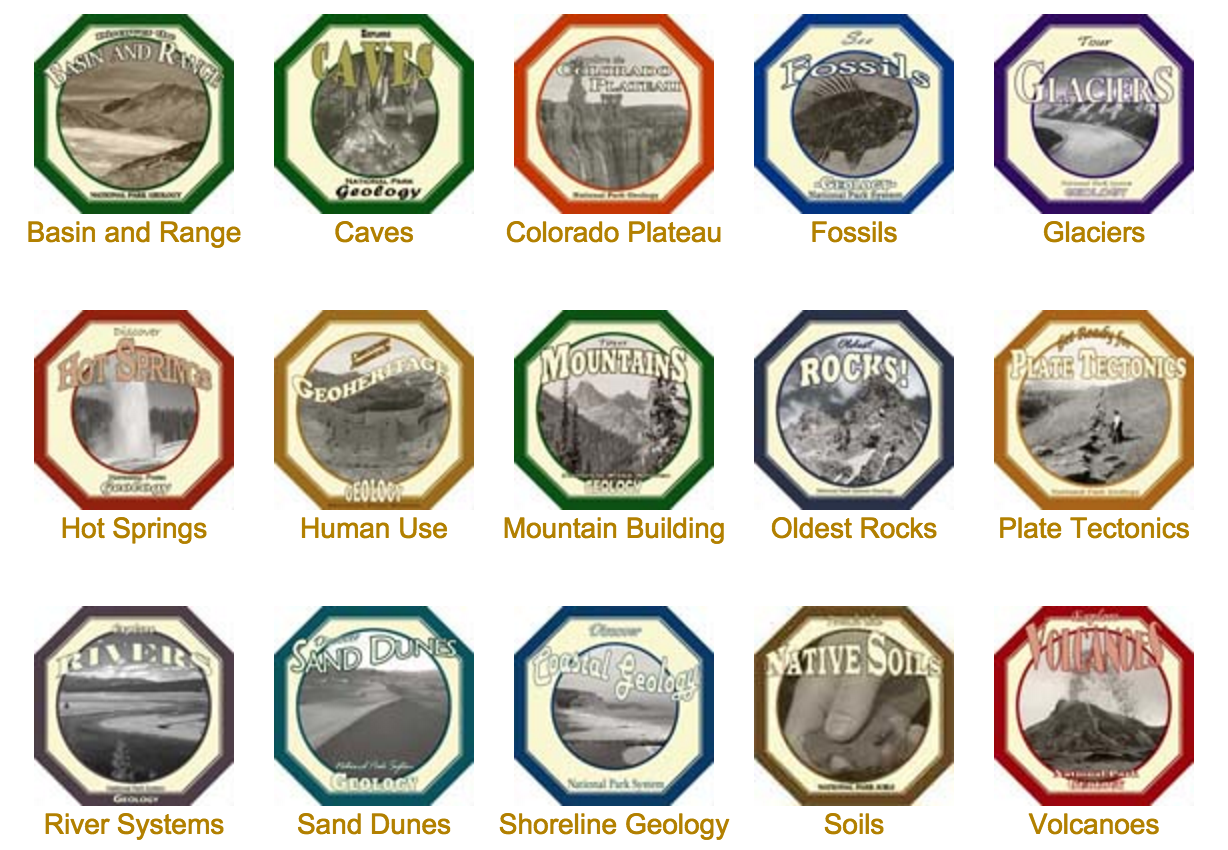
In a video homage, the outdoor outfitter O.A.R.S. has put together a stunning tribute to the Parks, told through the stirring words of Theodore Roosevelt. As befitting its founder, the NPS takes seriously its safeguarding of America\’s geology. It invites students of energy, minerals, and paleontology to explore the singular contours and cliffs through open online access and badging of restoration and geoscience. These resources are terrific for earth science and environmentally minded teachers to investigate with their students.
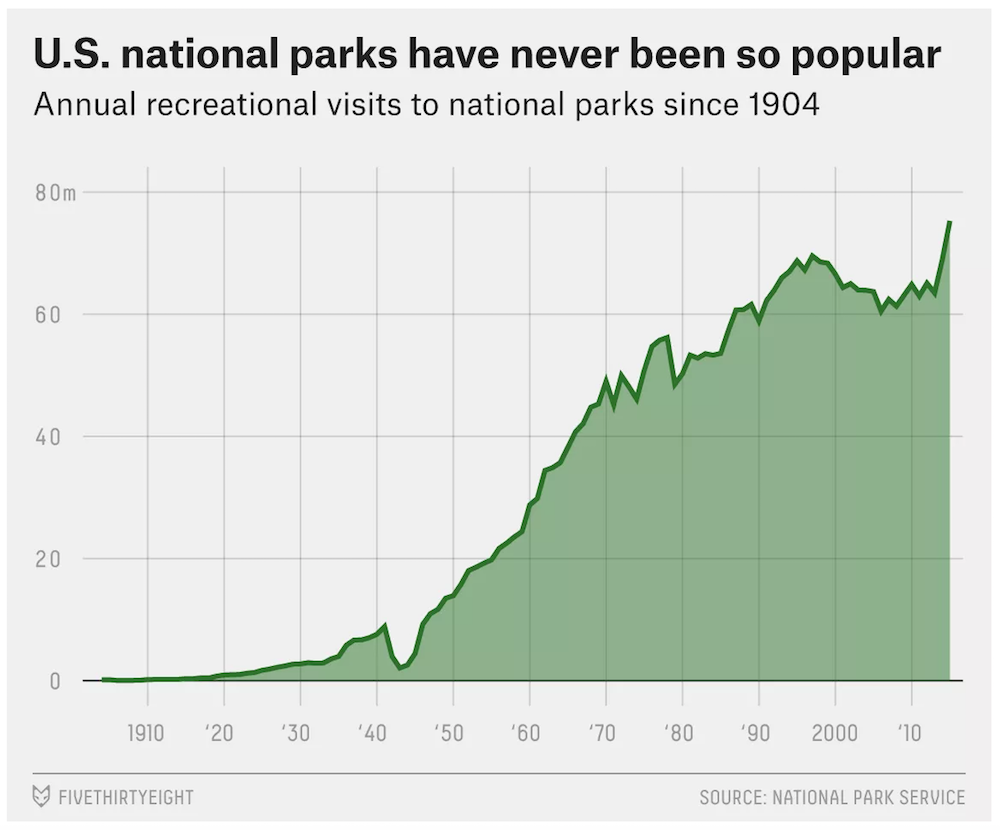
Source: FiveThirtyEight


In math and statistics, the minds at FiveThirtyEight (who usually spend their time worrying about political polls and baseball ERAs) have analyzed the popularity of each park. They crafted crisp graphs and charts for STEM educators to draw from in ranking the visitors to each venerated location. As they note, \”the U.S. national parks have never been so popular,\” and the Great Smoky Mountains continues its reign as the most-visited National Park, due to its location and exquisiteness.
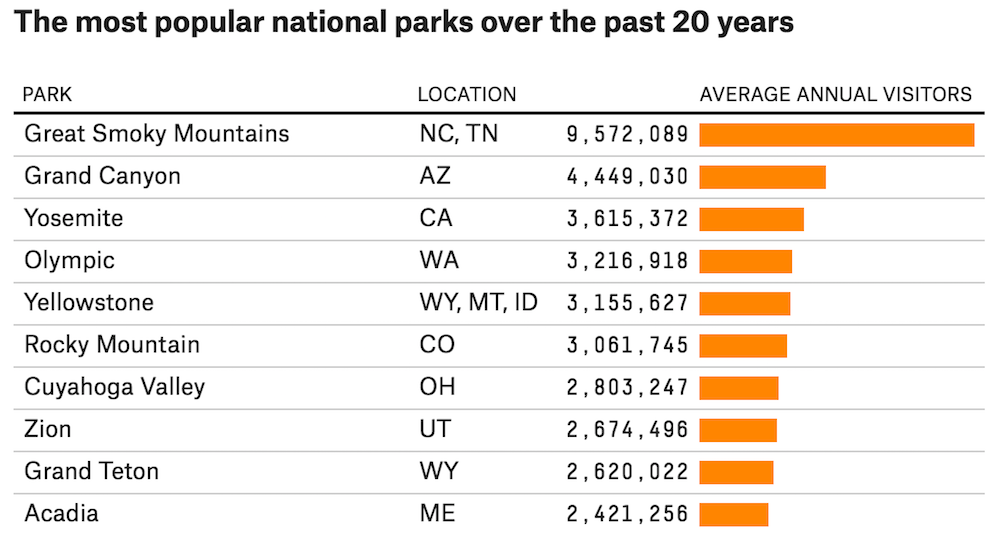
Source: FiveThirtyEight


In probing the specifics beneath the Great Smoky Mountains\’ charm, researcher John Farrell raked the Instagram API to determine where in the Park photographs were most frequently snapped. His visualization layers social media atop traditional coordinate geography to present a new picture of the Park\’s usage. He includes similar map mash-ups for other coast-to-coast sites.
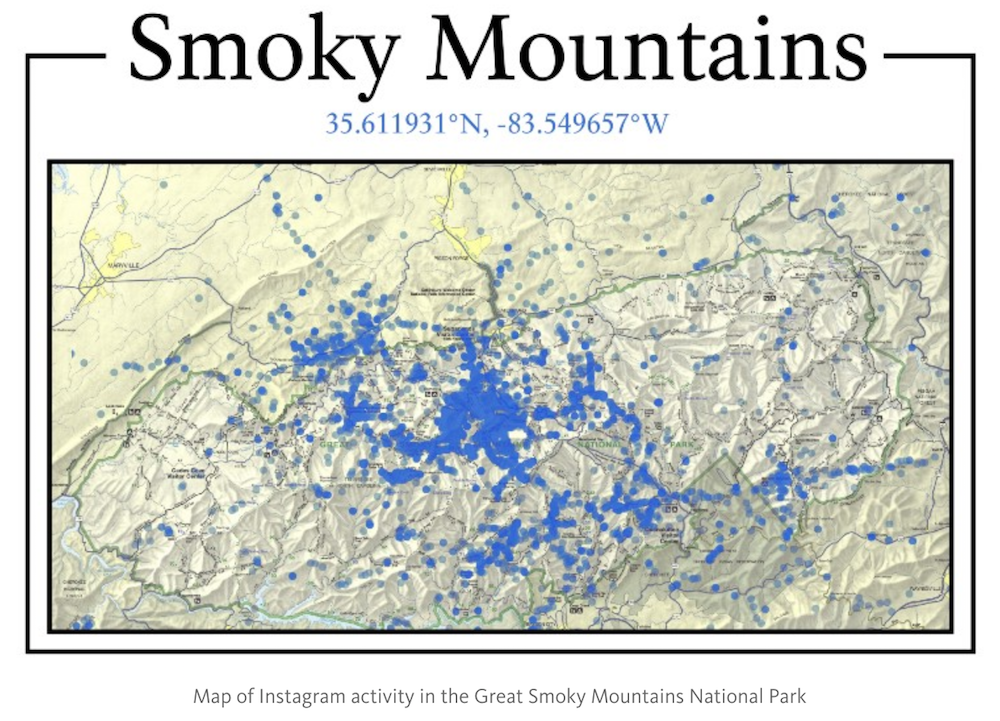
Source: John Farrell


For its part, the NPS has put together its own retro advertisement, in the classic style of antique movie reels or 1950s television ads. This wry film is a perfect nod to the 100-year heritage of the organization. It also displays a warm embrace of every citizen who passes through the Parks\’ gates.


Digging deeper into the soil and flora, Luke Easterwood, Michael Gelon, Hadar Scharff, and Matt Soave have analyzed the Parks\’ Vegetation Inventory. They built a visualization series to \”encourage insightful discoveries\” through the Tableau interface. These charts and graphs drill down to specific physiognomic classes and leaf phenology details.
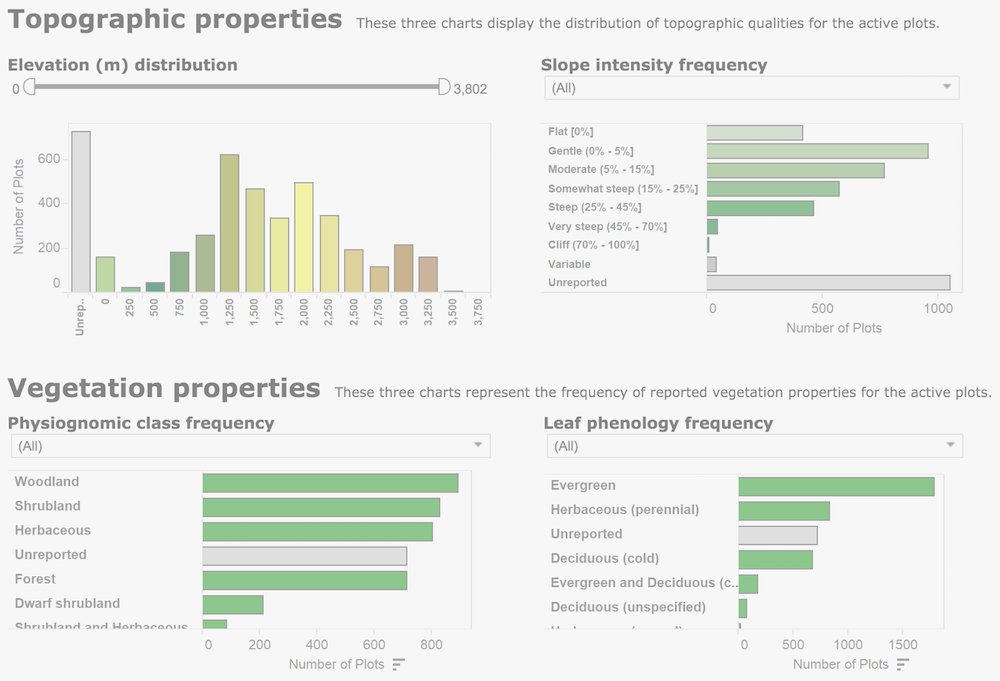
Source: mattsoave.com


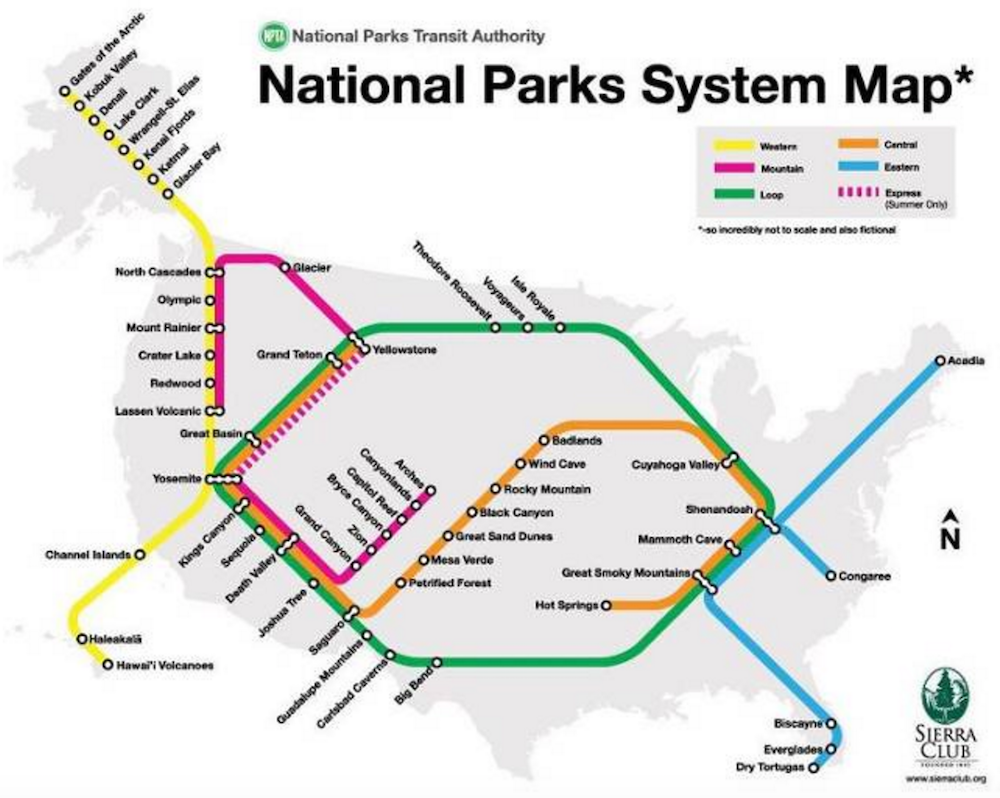
In order to help navigate the Parks, the Sierra Club has designed a System Map based on the urban subway template. This seemingly humorous rendering actually gives travelers a valuable guide in planning their vacations and in connecting the dots between regional marvels.
Source: Fast Company


Source: David Hockney

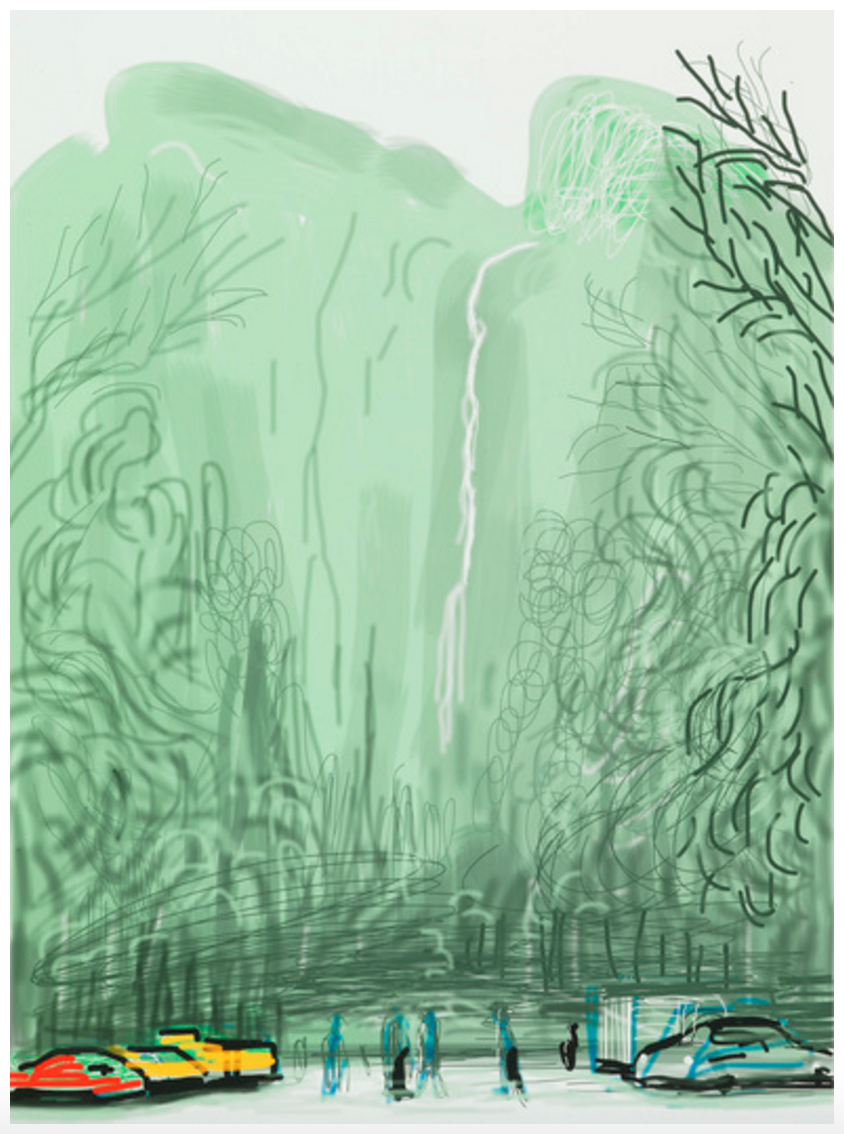
Finally, the purest representations of America\’s National Parks have always come from the minds of the country\’s painters. Beginning with the light portraits of Thomas Moran, many artists have sought to capture the glory of glaciers and geysers. Most recently, David Hockney scratched a series of brilliant sweeps on his iPad in his \”Yosemite Suite.\” These personal, stylized views prove to any viewer that the nation\’s Parks are love letters to its wilderness. They are the last vestige against urbanity and a hallmark of global distinction.
Visualizing The National Parks – Celebrating 100 Years Of America\’s Wonder

Source: National Geographic


On August 25, 2016, the National Park Service (NPS) turns 100. After a century of shepherding America\’s splendor, the Park Service and its personnel will rightfully be feted as dedicated, humble stewards of our country\’s most precious landscapes.

Personally, we have been lucky enough to visit many of the nation\’s 59 parks on all points of the compass. Each site has never failed to live up to its consecration as a place of American rarity, pride, and beauty. From the unspoiled trails to the popular overlooks, every curated destination within the wilderness is a testament to the work and vision of the Parks Service.

Source: National Park Service


This august anniversary introduces many opportunities to weave the Parks into authentic classroom lessons. For example, the \”Every Kid In A Park\” initiative seeks to connect our nation\’s youth to its most treasured spaces. Additionally, a wide range of visualizations now provide easy ways to incorporate the centennial into state standards and skill-based curricula. At their least, these videos and graphics offer terrific kick-offs to a morning\’s discussion. At their best, these charts and illustrations support critical student proficiencies. They also bring to life the gorgeous panoply of natural wonder that would make any Disney confection blush.

To start, the \”Find Your Park\” website gathers videos and social media interactions of everyday first-person testimonials about the grandeur of America\’s vistas. As a companion, the NPS has opened its Geographic Information Systems (GIS) data to the public, for educators and graphic artists to tap in building models of terrains and visitations.

Some of the best renderings of the National Parks come from the Works Project Administration during the 1930s New Deal. These art deco posters from the Federal Arts Project capture the majesty of the otherworldly settings in colorful and appealing travel enticements. National Geographic has assembled a nice collection of these posters from the Library Of Congress.

Source: National Park Service


In a video homage, the outdoor outfitter O.A.R.S. has put together a stunning tribute to the Parks, told through the stirring words of Theodore Roosevelt. As befitting its founder, the NPS takes seriously its safeguarding of America\’s geology. It invites students of energy, minerals, and paleontology to explore the singular contours and cliffs through open online access and badging of restoration and geoscience. These resources are terrific for earth science and environmentally minded teachers to investigate with their students.

Source: FiveThirtyEight


In math and statistics, the minds at FiveThirtyEight (who usually spend their time worrying about political polls and baseball ERAs) have analyzed the popularity of each park. They crafted crisp graphs and charts for STEM educators to draw from in ranking the visitors to each venerated location. As they note, \”the U.S. national parks have never been so popular,\” and the Great Smoky Mountains continues its reign as the most-visited National Park, due to its location and exquisiteness.

Source: FiveThirtyEight


In probing the specifics beneath the Great Smoky Mountains\’ charm, researcher John Farrell raked the Instagram API to determine where in the Park photographs were most frequently snapped. His visualization layers social media atop traditional coordinate geography to present a new picture of the Park\’s usage. He includes similar map mash-ups for other coast-to-coast sites.

Source: John Farrell


For its part, the NPS has put together its own retro advertisement, in the classic style of antique movie reels or 1950s television ads. This wry film is a perfect nod to the 100-year heritage of the organization. It also displays a warm embrace of every citizen who passes through the Parks\’ gates.


Digging deeper into the soil and flora, Luke Easterwood, Michael Gelon, Hadar Scharff, and Matt Soave have analyzed the Parks\’ Vegetation Inventory. They built a visualization series to \”encourage insightful discoveries\” through the Tableau interface. These charts and graphs drill down to specific physiognomic classes and leaf phenology details.

Source: mattsoave.com


In order to help navigate the Parks, the Sierra Club has designed a System Map based on the urban subway template. This seemingly humorous rendering actually gives travelers a valuable guide in planning their vacations and in connecting the dots between regional marvels.

Source: Fast Company


Source: David Hockney

Finally, the purest representations of America\’s National Parks have always come from the minds of the country\’s painters. Beginning with the light portraits of Thomas Moran, many artists have sought to capture the glory of glaciers and geysers. Most recently, David Hockney scratched a series of brilliant sweeps on his iPad in his \”Yosemite Suite.\” These personal, stylized views prove to any viewer that the nation\’s Parks are love letters to its wilderness. They are the last vestige against urbanity and a hallmark of global distinction.

Short Biography of ‘Dr. Martin Luther King, Jr.’ (107 Words)

‘Dr. Martin Luther King, Jr.’ was born on 15th January, 1929 in Atlanta, Georgia. He was born Michael King, but his father changed his name in honor of German reformer Martin Luther.

Dr. Martin Luther King, Jr. was a legendary activist and leader in the African-American civil rights movement (1955-1968). He received the Nobel Peace Prize in 1964 for combating racial inequality through nonviolence. He was assassinated on April 4, 1968. Dr. Martin Luther King, Jr. is best known for being an iconic figure in the advancement of civil rights in the United States and around the world, using non-violent methods following the teachings of Mahatma Gandhi.

Short Biography of ‘Paul Laurence Dunbar’ (116 Words)

‘Paul Laurence Dunbar’ was born on June 27, 1872 in Dayton, Ohio. He was the son of ex-slaves. His father’s name was Joshua and his mother’s name was Matilda.

Paul Laurence Dunbar wrote his first poem at age 6 and gave his first public recital at age 9. At an early age he edited and published many newspapers.

Paul Laurence Dunbar wrote many short stories, novels, plays, songs, essays and poetry. Due to racial discrimination, he could only find work as an elevator operator. He wrote most of his works while taking people up and down the elevator. Paul Laurence Dunbar was among the first African-American poets to gain national prominence. He passed away on February 9, 1906.

Short Biography of ‘Harry Houdini’ (141 Words)

‘Harry Houdini’ was born on March 24, 1874 in Hungary. His real name was ‘Eric Weisz’. His parents were Rabbi Mayer Samuel Weisz and Cecília Weisz. When Harry was still a baby, his parents decided to go and live in the U.S.A.

Harry Houdini was a great escape-artist. When he was nine years old he gave his first public performance. Houdini was so very interested in magic, that he practiced many tricks until they were perfect.

Houdini’s most famous trick was to escape. On stage he would be tied up or locked up with chains and in a few minutes he would get free. He performed many other famous tricks. Some of his tricks were very dangerous.

Harry Houdini died on October 31, 1926 at the age of 52. He had shown in his life that he was ready to meet any challenge.

Short Biography of ‘Louis Braille’ (97 Words)

‘Louis Braille’ was born on 4th January 1809 in France. Due to an accident in early life he was completely blind in both eyes.

Louis Braille himself was a blind and worked in a blind school in Paris. He perfected a system of reading and writing especially for the blind. This writing is called Braille. The system that he developed in 1834 was not used much until about the time of his death.

Louis Braille died on 6th January, 1852 at the age of 43. He will always be remembered for his system remains known worldwide simply as braille.

Short Biography of ‘Siegfried Sassoon’ (117 Words)

‘Siegfried Sassoon’ was born on 8th September, 1886 in England. His full name was Siegfried Loraine Sassoon. His father Alfred Ezra Sassoon was a member of the wealthy Baghdadi Jewish Sassoon merchant family. Siegfried Sassoon was an eminent English poet and writer.

Siegfried Sassoon served during the first world war as a captain. At first he was very excited and felt honoured to be in the war and fighting for his country; but then, when he saw the horrors of the war at first hand, he began to speak out against it. He wrote some moving poetry about the hardships and tragedy felt in war. Siegfried Sassoon died on 1st September 1967 at the age of 80.

Short Biography of ‘Jagdish Chandra Bose’ (176 Words)

‘Jagdish Chandra Bose’ was born on 30 November 1858 in Bengal, India (Now in Bangla Desh). His father, Bhagawan Chandra Bose was a leader of the Brahmo Samaj. Jagdish Chandra Bose was raised in a home committed to pure Indian traditions and culture.

Jagdish Chandra Bose attended Cambridge University after studying physics at Calcutta University. He returned to India in 1884 after completing a B.Sc. degree from Cambridge University. He made many discoveries in biology and physics. He showed that plants have feelings. He found that metals get ‘tired’ after some time. He invented a machine to measure the growth of plants.

Jagadish Chandra Bose is one of the most prominent first Indian scientists who proved by experimentation that both animals and plants share much in common. He authored two illustrious books, ‘Response in the Living and Non-living’ and ‘The Nervous Mechanism of Plants’. He set up the Bose Institute at Calcutta. He was honoured with many notable awards for his great work.

Jagdish Chandra Bose passed away on 23 November 1937 at the age of 78.

Short Article on ‘Uses of Domestic Animals’ (160 Words)

The ‘Domestic Animals’ are the animals that have been tamed and kept by humans as a work animal, food source or pet. There are different kinds of domestic animals. Cow, buffalo, sheep, goat, dog, cat, elephant, horse, camel, cock, hen, parrot, pigeon are some example of domestic animals.

Domestic Animals are very useful to man. Cow gives us milk. bullocks help the farmers in farming. Furs of sheep are very soft and long. These furs are sheared and made into wool. We get milk from the she-goats. Dogs are very faithful animals and they watch our houses. Elephants are used to carry heavy logs of wood. Horses are used to ride. Camels are used in deserts. The parrot is a talking bird. Most of the domestic animals are greatly devoted to their masters. Our domestic animals are quite friendly to us. They do very useful jobs for our benefit. Hence, we should treat them with all kindness.  

‘Care to be taken while completing Life Insurance Proposal Forms’ (150 Words

A contract of life insurance is a contract of utmost good faith technically known as uberrima fides. The principle of disclosing all material facts is embodied in this important concept which applies to all form of life insurance. It becomes the duty of the proposer to inform the insurer of everything likely to affect the judgement of the insurer, however unimportant it may seem to him/ her (the proposer).

Hence, the proposer should ensure that all questions in the proposal form are correctly answered. Any misrepresentation, non- disclosure of facts/ information which is material to acceptance of risk, or fraudulent information in any document leading to the acceptance of the risk will render the insurance contract null and void.

Hence, it is quite important that the policyholders and his dependants provide the correct and full information to secure the precious benefits of the insurance policy for his near and dear ones. 

Short Biography of ‘A.J. Cronin’ (74 Words)

Full name of ‘A.J. Cronin’ was Archibald Joseph Cronin. A.J. Cronin was born on 19 July 1896 in Cardross, Scotland. He was a great physician and a writer from scotland.

A.J. Cronin wrote several novels and short stories. His works are renowned for their memorable characters and powerful portrayal of the injustices in the society. His best-known novel was ‘The Citadel’. A.J. Cronin was passed away on 6 January 1981 at the age of 84. 

Short Biography of ‘Salim Ali’ (122 Words)

Full name of ‘Salim Ali’ was Salim Moizuddin Abdul Ali. He was born on 12 November 1896 in Mumbai, India. His father’s name was Moizuddin and his mother’s name was Zeenat-un-nissa. His parents died in the very early age of Salim Ali.

Salim Ali was a famous ornithologist and naturalist of India. He is known as the ‘Bird Man of India’ because he was an expert on Indian Birds. He studied the habits and lifestyles of Indian birds all his life. Salim Ali has written books on the birds of India. For his great work he was awarded the Padm Bhushan and Padma Vibhushan by the Government of India.

Salim Ali was passed away on 20 June 1987 at the age of 90. 

Short Biography of ‘Lala Lajpat Rai’ (132 Words)

‘Lala Lajpat Rai’ was born on 28 January 1865 in Punjab state of India. His father’s name was Radha Krishan, who was a was an Urdu teacher.

Lala Lajpat Rai was a large believer in the idea of Hinduism. He joined Indian National Congress and took active part in the freedom struggle of India. He was a great Indian freedom fighter and for this he was deported to Burma. Lala Lajpat Rai was elected President of the Congress party in the Calcutta Special Session of 1920.

Lala Lajpat Rai worked with great Energy and enthusiasm to improve education and social conditions in India. He was popularly known as ‘Punjab Kesari’ meaning the lion of Punjab also known as ‘Sher-e- Punjab’. He was died on 17 November 1928 at the age of 63. 


Indian Economic Service / Indian Statistical Service Examination, 2019

Based  on  the  results  of  the  written  examination of the Indian Economic Service / Indian Statistical Service Examination, 2019 held  by  the Union Public Service Commission from 28th to 30th June, 2019 followed by interviews  for  Personality  Test  in December, 2019 and January, 2020,  the  lists,  in  order  of  merit, of  the  candidates who have been recommended for  appointment  to  the  posts in Indian Economic Service and Indian Statistical Service are appended.

            The number of vacancies reported by the Government for posts to be filled is as under:-

Service GEN EWS OBC SC ST Total
Indian Economic Service 14 03 08 05 02 32

[Incl. 01 PwBD-1]

Indian Statistical Service 14 03 09 05 02 33

[Incl. 01 PwBD-1, 01 PwBD-3,

01 PwBD-4 & 5]

     The number of candidates recommended for appointment to the posts in Indian Economic Service and Indian Statistical Service is as under:

Service GEN EWS OBC SC ST Total
Indian Economic Service 14

[incl. 01 PwBD-1]

03 08 05 02 32

[incl. 01 PwBD-1]

Indian Statistical Service 10

[incl. 01 PwBD-3]

05 10

[incl. 01 PwBD-1]

05 02 32

[incl. 01 PwBD-1  & 01 PwBD-3

            Appointments shall be made strictly in accordance with the extant rules and the number of vacancies available.

            The Result of following Roll Nos. of recommended  candidates  are provisional :

Indian  Economic  Service (06 Nos. )

0470285 0870008 0870471 0870579 0870998
0871425        

Indian Statistical Service (11 Nos.)

0880344 0880973 0881551 0881725 0881762
0882260 1080073 1080493 1180510 2680088
2680798        

      The offer of appointment to the candidates whose result has been kept provisional will not be issued till the Commission verifies the original documents awaited from such candidates and till clarifies the provisional status of these candidates. The provisionality of these candidates will remain valid only for a period of three months from the date of declaration of Final result. In case the candidate fails to submit the requisite documents as required by the Commission within this period, their candidature will be cancelled and no further correspondence would be entertained in this regard.

           UPSC  has  a ‘Facilitation Counter’  near Examination Hall in its campus. Candidates  can obtain any information/clarification regarding their examination/ recruitment on the working day  between 10.00 hrs. to 17.00 hrs in person  or over telephone nos.  011-23385271 / 23381125.  Result  will  also  be  available  on  the  UPSC  web  site  i.e. www.upsc.gov.in Marks  of  the  candidates  shall  be  made  available  on the  website  within  fifteen  days  from  the  date  of  publciation  of  the  result.

Results – IES

Results – ISS

********

RCJ/PK

IEA Launches First In-depth Review of India’s Energy Policies

In partnership with NITI Aayog, International Energy Agency (IEA) today released the first in-depth review of India’s energy policies.

The report highlights the achievements of India’s energy policies and provides recommendations to support the government’s goals of promoting well-functioning energy markets and boosting deployment of renewables.

Dr Fatih Birol (Executive Director of the IEA) presented the key findings of the review in New Delhi in the presence of Shri Pralhad Joshi (Minister of Coal), Shri Dharmendra Pradhan (Minister of Petroleum and Natural Gas and Minister of Steel), Shri R K Singh (Minister for Power and Renewable Energy), Dr Rajiv Kumar (Vice Chairman, NITI Aayog), Shri Amitabh Kant (CEO of NITI Aayog), key energy secretaries, ambassadors and think tanks.

IEA regularly conducts in-depth reviews of energy policies for its member and association countries.This is the first review carried out for India, which has been an IEA-association country since March 2017.

Introducing the report, NITI Aayog Special Secretary Shri RP Gupta welcomed and commended the hard work of the IEA. He said, ‘As India builds on the remarkable growth and development of its energy sector, this in-depth review will help the Government in meeting its energy objectives by setting out a range of recommendations in each energy policy area.’

NITI Aayog CEO Amitabh Kant, who had brought up the idea with IEA to conduct the review, said: ‘With clear goals in place, the country is making great strides towards affordable, secure and cleaner energy for all its citizens. India is working hard to move towards its aspirations of transforming the energy sector.’

‘IEA has the privilege of enjoying a close relationship with India. This first in-depth review of the country’s energy policies illustrates the value of our growing collaboration,’ said Dr Birol.

‘The energy choices that India makes will be critical for Indian citizens as well as the future of the planet. This was demonstrated at IEA’s 2019 ministerial meeting, which mandated the Agency to start consultations with India for a strategic partnership that could serve as a path to eventual membership, a game-changer for international energy governance.’

The IEA report congratulates the Indian government on its outstanding achievements in extending citizens’ access to electricity, affordable efficient lighting and clean cooking in record time through historic schemes like SAUBHAGYA, UJALA and UJJWALA,while pursuing energy market reforms and the swift deployment of renewable technologies. The report highlights the strong growth of renewables in India, which now accounts for almost 23% of the country’s total installed capacity. The review also found that energy efficiency improvements in India avoided 15% of additional energy demand, oil and gas imports, and air pollution as well as 300 million tonnes of CO2 emissions between 2000 and 2018.

India is becoming increasingly influential in global energy trends. The country’s demand for energy is set to double by 2040, and its electricity demand may triple, according to the IEA report. Indian oil consumption is expected to grow faster than that of any other major economy. This makes further improving energy security a key priority for India’s economy, says the IEA.

IEA welcomes Indian government policies designed to conduct large-scale renewable energy auctions, open up coal mining to private companies, and promote access to oil and gas markets for foreign investors. The report offers a wide range of recommendations for reforms in support of India’s goal of promoting open and well-functioning energy markets in sectors such as coal, gas and electricity. These include building strong regulators to ensure non-discriminatory access, moving from state allocation to market pricing, and further rationalizing energy subsidies.

In India’s renewables-rich states, the share of variable renewables in electricity generation is already above 15%, a level that calls for dedicated policies to ensure they integrate smoothly into the power system. NITI Aayog can play a strong role in working with the states to implement power sector reforms, advance grid integration, improve flexibility and coordinate energy policy decisions.

The review also strongly encourages India to institutionalise energy policy coordination across government with a national energy policy framework.

Power and Renewable Energy Minister R K Singh congratulated IEA and NITI Aayog for the launch of the report: ‘India’s energy policy is a global story. India has the largest unified power grid that operates in a single frequency. India has moved from scarcity to surplus electricity over the past few years, while implementing the largest and the fastest energy access improvement and energy efficiency programmes in the world.’

Coal Minister Joshi said,‘With the support of Amitabh Kant and Dr Rajiv Kumar, India recently launched commercial mining operations. IEA’s report will be very helpful for designing our future course of action in the energy sector.’

Petroleum and Natural Gas Minister Pradhan said:‘NITI Aayog has already started preparing a National Energy Strategy, and I would like to propose an annual event where NITI and IEA can bring together global energy stakeholders to have a structured energy dialogue. We look forward to engaging with IEA on oil security and on helping India move towards a natural gas-based economy.’

NITI Aayog Vice Chairman Dr Kumar emphasised that India’s energy goals cannot be achieved without a strong coordination of policies and targets between Central and state governments, notably on electricity market design and renewable targets, and that a stronger cooperation is therefore needed on these fronts.

The report will help India to design implementation strategies to achieve secure and sustainable energy access for its citizens.

***