

“Presently students are likely to face much bigger challenges than their predecessors. Hence, educators must equip students with knowledge that will help them face challenges squarely.” —Professor M.S. Rao
Vision 2030: One Million Global Leaders


Overall, I think it went well. Lots of discussion and questions and people were keen to make contact at the end of the class….always a good sign.
It appears that the title and the content offered were timely. There was a big contingent from one school who have a push on to put courses online. This was excellent. They did have concerns, however, about how to get their content online. They were advised to work with the programme developers, and offered assistance to have people work alongside them, but not do it for them. The mentality is still there to get stuff on Blackboard, rather than thinking how they would like to present content and activities, and what technologies could assist.
There was some discussion about models where content is handed over to a team to create resources. Leigh made a good point about models he had seen which didn\’t work and had cost lots of money. He believes it is best to start with finding resources which already exist and can be re-used…if possible. This makes a lot lof sense.
The total number who enrolled was 13 but 3 people didn\’t turn up. The group were very interested and gave positive evaluations.
I started the workshop off with an overview of facilitating online learning…well I sort of took charge of it really…we did brainstorm how we would approach it earlier in the week, but the actual content we presented was up to us individually. At the 11th hour, I felt the need to slap together some slides…too many bullet points..but for next time I will develop some concept maps.Hey I can try out CMAP.
I will try and get them done before this group finishes their online discussion. This will continue on until the end of the second week in May. Easter in the middle sort of interrupts the flow. The timing for the next workshop will be better. And hey next time we will try out Elluminate for the initial session.
People liked the different cases we presented. Merrolee had lots of practical advice and talked about how she managed the online discussion. It is good for people to hear the nitty gritty stuff from someone so experienced…well I am too. I talked about how assessment was linked in strongly to the discussions. We gave tips for managing prolific postings and motivating people to go online. I really have to do something about the amount of content in the evaluating eLearning for best practice course though…I will definitely be going with the learner-generated model for next year. hopefully i will still be teaching it then.
Leigh gave a very insightful overview of alternatives such as egroups, and how they are very useful platforms for handing over ownership of material to students….giving them something they can take away with them when they leave their 3 yr programmes…when they are locked out of the institutional platforms. Some of the OTs were very intrigued with the idea of having a community of practitioners able to remain in contact about professional issues.
It will take time but the ideas are filtering through. All we need are enthusiastic staff who act as \”hotpoints\” in their schools and talk about what they are doing to others. I do love running workshops with staff, and seeing the lightbulbs come on.
The next offerings will need to be a practical show and tell with staff demonstrating what they are doing. Oh when to schedule all these? We have two visiting speakers coming in May and June, Peter Mellow (AUT) on the Study Txt mobile learning project – article. Also John Milne (Massey) who is coming to work with us on the TEC eLearning guidelines an ECDF project. Exciting stuff.
Considerations to include in your plan – remember you do not have to create them for this course just make a plan for how to create them and why you have chosen the approach and what you need to do to make it happen.
Also think about how the use of videos in your teaching and learning environment will address:
* access & equity – format of the videos and where they will be stored, who will access them and how etc,
* cultural sensitivity/diversity – learning preferences of your students, universal design etc;
* sustainability – cost of producing – resourcing, time, equipment (departmental capex can be used for development to pay a design student for example who can help with production and editing), your time – also think about the place they will be stored and how easy this is to do, ease of linking to them.
Storage
Should the videos be stored on an open website such as Youtube, Blip.tv or on a passworded site such as Unitube or Moodle where they are not as accessible but more secure. However they may get \”locked away causing problems later on when people try and find them to reuse them. They may even end up re-creating them again. Is this sustainable in the long term?
This is just the tip of the iceberg cos there are other options as well such as vodcasting/podcasting – broadcasting video clips to which students can subscribe. They can do this if you put them on a blog or on blip.tv or Youtube by subscribing to your vids. You could also create video clips on your mobile and send them directly to a web site.
The bonus is that if using video and uploading them to blip.tv or Youtube, students could subscribe to your videos and download them directly from there to an ipod or other portable player for viewing in the field. How cool is that!?
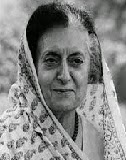

 |
| Source: ASIDE 2016 – 2nd Grade Infographics |
Since we began working with students to create infographics several years ago, we’ve witness tremendous growth in their ability to give context to their content. They’ve become accustomed to keeping font choices simple, careful about not typing in all caps for easier readability, and selective with color and images.
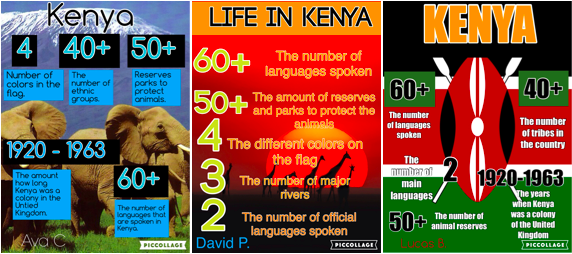 |
| Source: ASIDE 2016 – 3rd Grade Infographics |
They think about placement of text, simplify the information, and see the connections that each part plays in the overall design. It’s no longer a battle to compile the content and type the copy first, and then make it POP! There is no doubt in our minds that our continued integration of design as a method to transform information so that it can be easily understood at a glance is becoming second nature for our students. We spend less and less time instructing them to go back to rework problem areas.
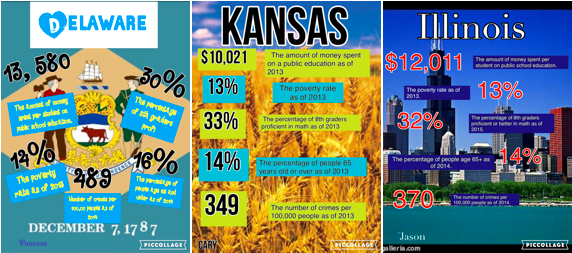 |
| Source: ASIDE 2016 – 4th Grade Infographics |
Their mastery of the elements and principles of design show a natural progression with each advance in grade level. We’ve built a vocabulary of terms and expressions such as “1 + 1 = 3” that roll off their tongues as they help others around them. They understand that it’s not about the math, but the spatial adjacency of items that are side by side; they get that the middle counts. They love putting the infographic side-by-side with their research notes. The visual vs. linear comparison really hits home, and the sense of pride in their work is huge.
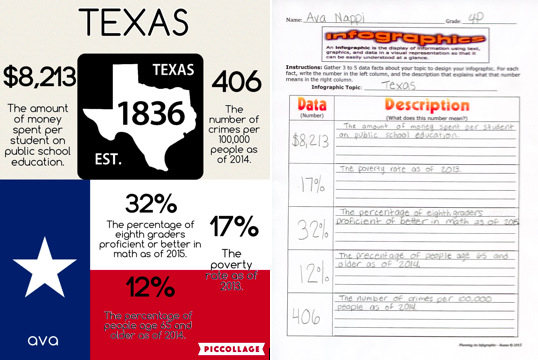 |
| Source: ASIDE 2016 – 4th Grade Infographic |
We firmly believe in the benefits of pushing the design of information within the curricula as a way of helping students internalize their research as well as create a context for it. With each year that we do this, the process becomes easier.
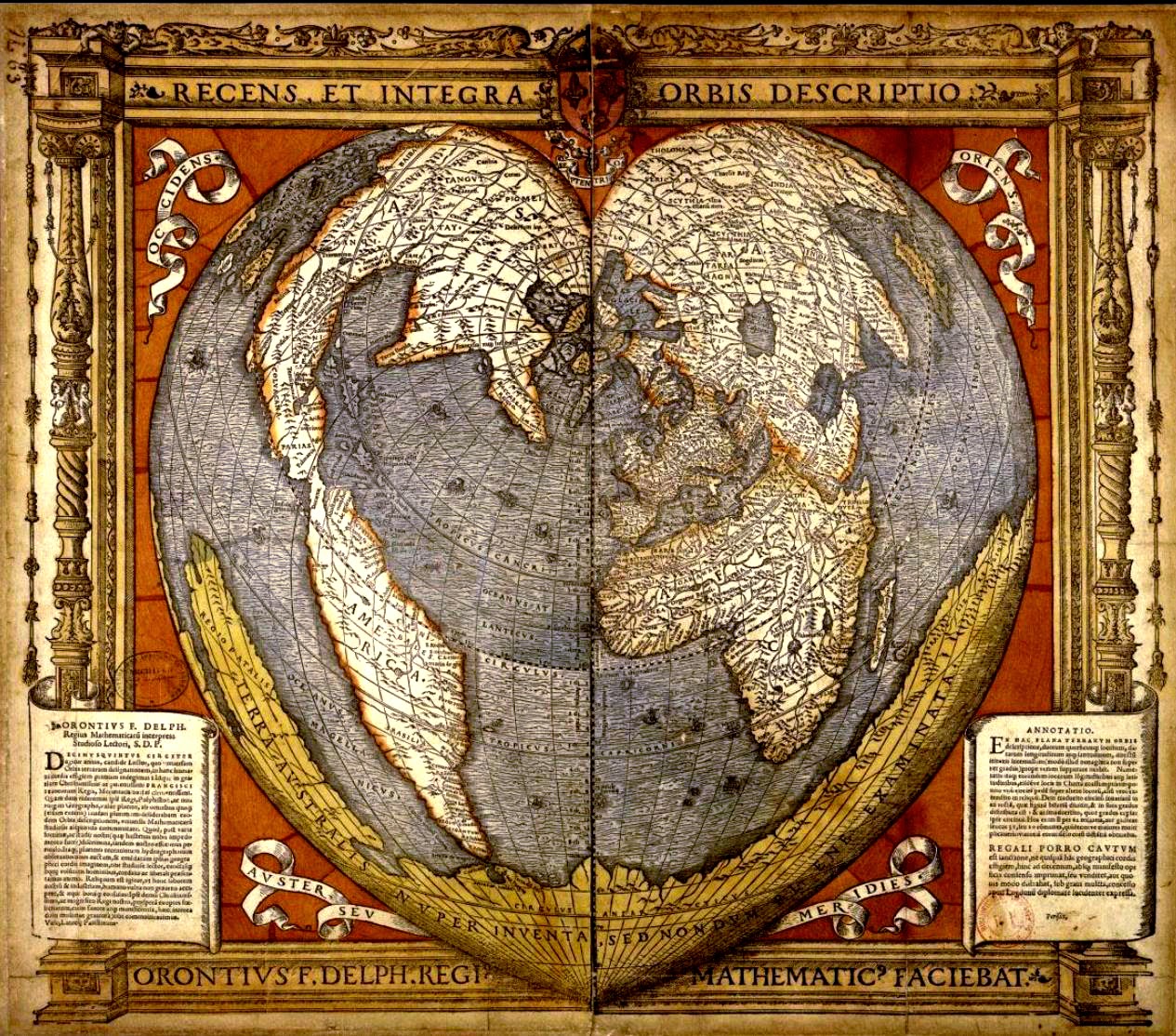 |
| Source: Wikipedia – Oronce Fine, 1531 |
It wasn’t until our students started making heart-shaped worlds as part of a way to promote peace that we wondered if there were any historical references. To our surprise, there were plenty. One of the earliest heart-shaped (cordiform) map projections by Oronce Fine, a French mathematician and cartographer, was created in the sixteenth century. According to Wikipedia, this might have been his most famous illustration and one that influenced other cartographers, such as Peter Apian and Gerardus Mercator.
We love when something our learners do triggers a curiosity in us. Instead of showing our students the many infographics we’ve collected about Valentine’s Day that tabulate the amount of money spent by men and women on items such as flowers, chocolate, and jewelry, we chose to show these beautiful heart-shaped maps that so wholly connected to their designs. As expected, our students delighted in seeing the connection to their creations, especially since they had no idea of their connections to history.
We uncovered other examples of cordiform map projections that obviously take their influence from Oronce Fine’s beautiful cartographic design. The maps below, illustrated by Giovanni Cimerlino and Pierre Moulart Sanson, were done more than a century apart.
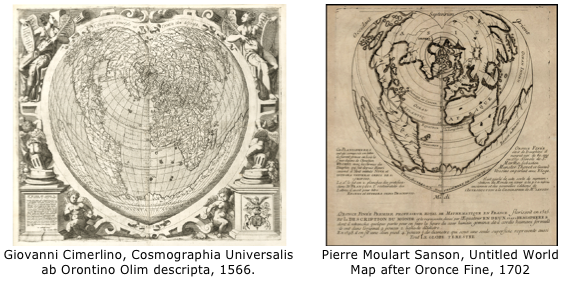 |
| Source: Rare Maps (Left) and Britain (Right) |
Two more recent uses of the heart-shaped map appeared on stamps issued in the United States (1991) and Venezuela (1972). We wonder if the graphic artists knew of Oronce Fine’s hand-drawn map of 1531.
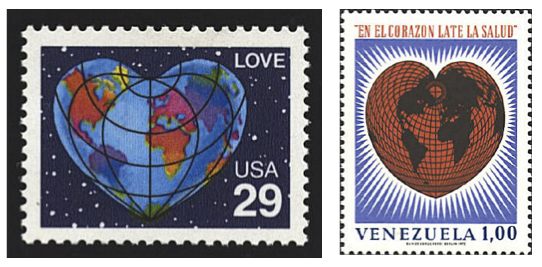 |
| Source: Dan’s Topical Stamps |
The “Love” stamp from the United States does not necessarily represent a cordiform projection, whereas the stamp from Venezuela celebrating World Health Day more closely resembles the heart-shaped designs from the fifteenth century.
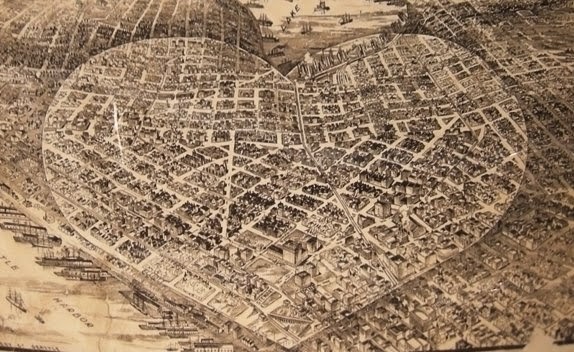 |
| Source: Biographile |
As we probed the Internet for other examples, we discovered a heart-shaped map of Seattle from 1905 and one of the New York City subway system from 2008.
These maps clearly illustrate the change in design from one era to another. The map of Seattle represents a more typical illustration at the turn of the twentieth century, whereas the subway map, completed more than a century later, closely follows the style of a modern visual illustration or infographic.
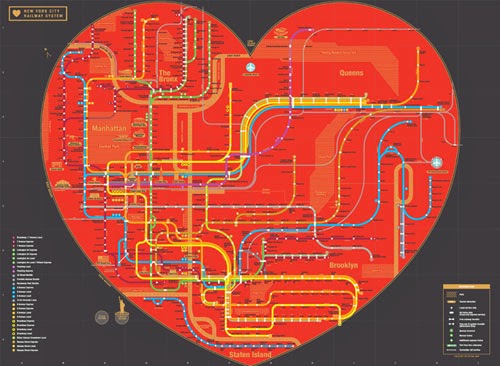 |
| Source: Zero Per Zero |
Sometimes it’s the innocence of children that triggers inquiry in adults. We attribute our curiosity to them. Finding other models based on their creativity led to the discovery of historical references. Connecting history through primary sources reinforced their global view of the world.
With the continued onslaught of violence and terrorism in the news, we could all use a little more heart.

The Life Insurance Corporation of India settles a large number of Death Claims every year. Only in case of fraudulent suppression of material information is the liability repudiated. This is to ensure that claims are not paid to fraudulent persons at the cost of honest policyholders.
The number of Death Claims repudiated is, however, very small. Even in these cases, an opportunity is given to the claimant to make a representation for consideration by the Review Committees of the Zonal office and the Central Office. As a result of such review, depending on the merits of each case, appropriate decisions are taken.
The Claims Review Committees of the Central and Zonal Offices have among their Members, a retired High Court/ District Court Judge. This has helped providing transparency and confidence in Corporation operations and has resulted in greater satisfaction among claimants, policyholders and public.

 Eduindex
You must be logged in to post a comment.