Day: January 30, 2020
“An average individual prefers hiking, an above-average individual prefers trekking, and an extraordinary individual prefers mountaineering.” —Professor M.S. Rao
work meanderings
Source:
A lot has been happening at work. For a start we are lucky enough to have visits from a couple of people involved in flexible learning – Cathy Gunn (University of Auckland) and John Clayton (WINTEC – Hamilton, NZ)….more about this later.
FLUG meets Blackboard head on
I have been busy with the formation of the new and improved FLUG – a group of enthusiasts involved in flexible learning and support. With our organisational strategy of flexible teaching and learning, it was timely to change the name of the Blackboard User Group to FLUG (Flexible Learning Users Group).
We also needed to extend the group – so a bigger cross section of people involved in flexible options here could muck in and get their hands dirty.
This way the small core of enthusiasts and people involved with the Learning Management System will have more of \”a voice\” in some of the changes which are happening here in our organisation. So the Bb User Group has re-birthed as FLUG.
So…what does this mean? FLUG will hopefully provide information to the newly formed Flexible …committee about operational matters and stuff from the coal face. We also hope to assist in developing some sort of flexible learning and teaching strategy which is meaningful for our learners and staff in the organisation.
So who do we think we are…why should we have a say?
Because FLUG hopefully will represent the \”real users\” because it is made up mainly of people who get it. But do we?
We all know that flexible learning is a very important strategy for quality education.What gets me though is that every organisation seems to be busying themselves with the development of strategies for eLearning or flexible learning and teaching…..but what are these strategies based on?? What everyone else has been doing..or on the unique culture within an organisation? The former I believe because it is easier.
It is also easier to follow like sheep and stay with an LMS like Bb – the same as the others. It is also easier to stay with an imposition model – a model where the learners are told what they\’re getting rather than being asked how they want to approach teaching and learning.
The best model for a flexible learning and teaching strategy which I have seen is the one QUT (Queensland University of Technology) developed called the QUT Teaching Capabilities Framework. See overview at:
QUT surveyed staff and students who were using the LMS (Blackboard), to find out what was important to them as both teachers and learners. The project team took their findings and using a process of wide consultation, they developed a framework. This framework now underpins how teaching and learning is offered at the university, and has informed the professional development of staff.
Unfortunately, we have not gone down this track, but have taken the route followed by many. Additionally, we have also developed a teaching qualification without developing a teaching and learning strategy first. Now staff will be indoctrinated into \”a way\” of teaching which may not be right for our learners…or for our environment.
We have broken the first golden rule! We didn\’t find out what our learners actually wanted first!
As a result, our flexible learning and teaching strategy may also not be based on actualities but on assumptions. I believe we do have time to find out what our teachers and learners actually want, what their experience is to date and what they would like to see happening.
Wont this save time in the end! We are in a good position to really do something different and lead flexible learning in a new direction.
I would really like to see us get out from behind the herd, stop the baaing and mooing and get to the green grass first…for a change.
Watch this space to find out how the flexible strategy and the teaching qual evolve.
Learning preferences – Part one
Second half of the Learning preference workshop
The second part of the workshop is on Wednesday 17 September, 1205 to 1250 in H311 when we will have more discussion about learning preferences and look more in-depth at the different models for learning styles. I hope you get a chance before then to try out one of the learning styles questionnaires, with which you are not familiar. Some of the questionnaires are listed on the 50 ways website. Remember the VARK is a homegrown version of VAK. Don Clark’s webite – Learning Styles & Preferences – has a good overview of most of the learning styles.
I will continue the discussion around learning preferences on here so it will be good to get your feedback.
Short Essay on \’Rani Lakshmibai\’ (220 Words)
Rani Lakshmibai was married to Gangadhar Rao in 1842. Gangadhar Rao was the king of Jhansi. In 1851, the Rani had a son; he unfortunately died when he was barely four months old. Raja Gangadhar Rao could not bear the shock and after a long illness, he died on November 21, 1853.
Jhansi became a major center of the revolt of 1857. Rani Lakshmibai of Jhansi, began to strengthen security and started a volunteer army. Ordinary people also contributed to the revolt. In 1857, the kings of the neighboring state of Jhansi, Orchha and Datia attacked. Rani Lakshmibai defeated them successfully. In March 1858 the British army besieged the city of Jhansi. But Rani, with her adopted son Damodar Rao was able to escape. Rani died on June 18, 1858.
Rani Lakshmibai was the great heroine of the First War of Indian Freedom. She was the embodiment of patriotism, self-respect and heroism. Her life is a thrilling story of womanliness, courage, adventure, deathless patriotism and martyrdom. Rani Lakshmibai was the real meaning of the ideal heroine. She was proud of not just India but the world\’s women.
Short Essay on \’Rani Lakshmibai\’ (220 Words)
Rani Lakshmibai was married to Gangadhar Rao in 1842. Gangadhar Rao was the king of Jhansi. In 1851, the Rani had a son; he unfortunately died when he was barely four months old. Raja Gangadhar Rao could not bear the shock and after a long illness, he died on November 21, 1853.
Jhansi became a major center of the revolt of 1857. Rani Lakshmibai of Jhansi, began to strengthen security and started a volunteer army. Ordinary people also contributed to the revolt. In 1857, the kings of the neighboring state of Jhansi, Orchha and Datia attacked. Rani Lakshmibai defeated them successfully. In March 1858 the British army besieged the city of Jhansi. But Rani, with her adopted son Damodar Rao was able to escape. Rani died on June 18, 1858.
Rani Lakshmibai was the great heroine of the First War of Indian Freedom. She was the embodiment of patriotism, self-respect and heroism. Her life is a thrilling story of womanliness, courage, adventure, deathless patriotism and martyrdom. Rani Lakshmibai was the real meaning of the ideal heroine. She was proud of not just India but the world\’s women.
Short Essay on \’Rani Lakshmibai\’ (220 Words)
Rani Lakshmibai was married to Gangadhar Rao in 1842. Gangadhar Rao was the king of Jhansi. In 1851, the Rani had a son; he unfortunately died when he was barely four months old. Raja Gangadhar Rao could not bear the shock and after a long illness, he died on November 21, 1853.
Jhansi became a major center of the revolt of 1857. Rani Lakshmibai of Jhansi, began to strengthen security and started a volunteer army. Ordinary people also contributed to the revolt. In 1857, the kings of the neighboring state of Jhansi, Orchha and Datia attacked. Rani Lakshmibai defeated them successfully. In March 1858 the British army besieged the city of Jhansi. But Rani, with her adopted son Damodar Rao was able to escape. Rani died on June 18, 1858.
Rani Lakshmibai was the great heroine of the First War of Indian Freedom. She was the embodiment of patriotism, self-respect and heroism. Her life is a thrilling story of womanliness, courage, adventure, deathless patriotism and martyrdom. Rani Lakshmibai was the real meaning of the ideal heroine. She was proud of not just India but the world\’s women.
\’Present Status of LIC of India\’ (491 Words)
Life Insurance Corporation of India was created on 1st September, 1956, with the objective of spreading life insurance much more widely and in particular to the rural areas with a view to reach all insurable persons in the country, providing them adequate financial cover at a reasonable cost.
LIC had 5 zonal offices, 33 divisional offices and 212 branch offices, apart from its corporate office in the year 1956. Since life insurance contracts are long term contracts and during the currency of the policy it requires a variety of services need was felt in the later years to expand the operations and place a branch office at each district headquarter. Re-organization of LIC took place and large numbers of new branch offices were opened. As a result of re-organisation servicing functions were transferred to the branches, and branches were made accounting units. It worked wonders with the performance of the corporation. It may be seen that from about 200.00 crores of New Business in 1957 the corporation crossed 1000.00 crores only in the year 1969-70, and it took another 10 years for LIC to cross 2000.00 crore mark of new business. But with re-organisation happening in the early eighties, by 1985-86 LIC had already crossed 7000.00 crore Sum Assured on new policies.
Today LIC functions with 2048 fully computerized branch offices, 109 divisional offices, 8 zonal offices, 992 satallite offices and the Corporate office. LIC’s Wide Area Network covers 109 divisional offices and connects all the branches through a Metro Area Network. LIC has tied up with some Banks and Service providers to offer on-line premium collection facility in selected cities. LIC’s ECS and ATM premium payment facility is an addition to customer convenience. Apart from on-line Kiosks and IVRS, Info Centres have been commissioned at Mumbai, Ahmedabad, Bangalore, Chennai, Hyderabad, Kolkata, New Delhi, Pune and many other cities. With a vision of providing easy access to its policyholders, LIC has launched its SATELLITE SAMPARK offices. The satellite offices are smaller, leaner and closer to the customer. The digitalized records of the satellite offices will facilitate anywhere servicing and many other conveniences in the future.
LIC continues to be the dominant life insurer even in the liberalized scenario of Indian insurance and is moving fast on a new growth trajectory surpassing its own past records. LIC has issued over one crore policies during the current year. It has crossed the milestone of issuing 1,01,32,955 new policies by 15th Oct, 2005, posting a healthy growth rate of 16.67% over the corresponding period of the previous year.
From then to now, LIC has crossed many milestones and has set unprecedented performance records in various aspects of life insurance business. The same motives which inspired our forefathers to bring insurance into existence in this country inspire us at LIC to take this message of protection to light the lamps of security in as many homes as possible and to help the people in providing security to their families.
\’Present Status of LIC of India\’ (491 Words)
Life Insurance Corporation of India was created on 1st September, 1956, with the objective of spreading life insurance much more widely and in particular to the rural areas with a view to reach all insurable persons in the country, providing them adequate financial cover at a reasonable cost.
LIC had 5 zonal offices, 33 divisional offices and 212 branch offices, apart from its corporate office in the year 1956. Since life insurance contracts are long term contracts and during the currency of the policy it requires a variety of services need was felt in the later years to expand the operations and place a branch office at each district headquarter. Re-organization of LIC took place and large numbers of new branch offices were opened. As a result of re-organisation servicing functions were transferred to the branches, and branches were made accounting units. It worked wonders with the performance of the corporation. It may be seen that from about 200.00 crores of New Business in 1957 the corporation crossed 1000.00 crores only in the year 1969-70, and it took another 10 years for LIC to cross 2000.00 crore mark of new business. But with re-organisation happening in the early eighties, by 1985-86 LIC had already crossed 7000.00 crore Sum Assured on new policies.
Today LIC functions with 2048 fully computerized branch offices, 109 divisional offices, 8 zonal offices, 992 satallite offices and the Corporate office. LIC’s Wide Area Network covers 109 divisional offices and connects all the branches through a Metro Area Network. LIC has tied up with some Banks and Service providers to offer on-line premium collection facility in selected cities. LIC’s ECS and ATM premium payment facility is an addition to customer convenience. Apart from on-line Kiosks and IVRS, Info Centres have been commissioned at Mumbai, Ahmedabad, Bangalore, Chennai, Hyderabad, Kolkata, New Delhi, Pune and many other cities. With a vision of providing easy access to its policyholders, LIC has launched its SATELLITE SAMPARK offices. The satellite offices are smaller, leaner and closer to the customer. The digitalized records of the satellite offices will facilitate anywhere servicing and many other conveniences in the future.
LIC continues to be the dominant life insurer even in the liberalized scenario of Indian insurance and is moving fast on a new growth trajectory surpassing its own past records. LIC has issued over one crore policies during the current year. It has crossed the milestone of issuing 1,01,32,955 new policies by 15th Oct, 2005, posting a healthy growth rate of 16.67% over the corresponding period of the previous year.
From then to now, LIC has crossed many milestones and has set unprecedented performance records in various aspects of life insurance business. The same motives which inspired our forefathers to bring insurance into existence in this country inspire us at LIC to take this message of protection to light the lamps of security in as many homes as possible and to help the people in providing security to their families.
\’Present Status of LIC of India\’ (491 Words)
Life Insurance Corporation of India was created on 1st September, 1956, with the objective of spreading life insurance much more widely and in particular to the rural areas with a view to reach all insurable persons in the country, providing them adequate financial cover at a reasonable cost.
LIC had 5 zonal offices, 33 divisional offices and 212 branch offices, apart from its corporate office in the year 1956. Since life insurance contracts are long term contracts and during the currency of the policy it requires a variety of services need was felt in the later years to expand the operations and place a branch office at each district headquarter. Re-organization of LIC took place and large numbers of new branch offices were opened. As a result of re-organisation servicing functions were transferred to the branches, and branches were made accounting units. It worked wonders with the performance of the corporation. It may be seen that from about 200.00 crores of New Business in 1957 the corporation crossed 1000.00 crores only in the year 1969-70, and it took another 10 years for LIC to cross 2000.00 crore mark of new business. But with re-organisation happening in the early eighties, by 1985-86 LIC had already crossed 7000.00 crore Sum Assured on new policies.
Today LIC functions with 2048 fully computerized branch offices, 109 divisional offices, 8 zonal offices, 992 satallite offices and the Corporate office. LIC’s Wide Area Network covers 109 divisional offices and connects all the branches through a Metro Area Network. LIC has tied up with some Banks and Service providers to offer on-line premium collection facility in selected cities. LIC’s ECS and ATM premium payment facility is an addition to customer convenience. Apart from on-line Kiosks and IVRS, Info Centres have been commissioned at Mumbai, Ahmedabad, Bangalore, Chennai, Hyderabad, Kolkata, New Delhi, Pune and many other cities. With a vision of providing easy access to its policyholders, LIC has launched its SATELLITE SAMPARK offices. The satellite offices are smaller, leaner and closer to the customer. The digitalized records of the satellite offices will facilitate anywhere servicing and many other conveniences in the future.
LIC continues to be the dominant life insurer even in the liberalized scenario of Indian insurance and is moving fast on a new growth trajectory surpassing its own past records. LIC has issued over one crore policies during the current year. It has crossed the milestone of issuing 1,01,32,955 new policies by 15th Oct, 2005, posting a healthy growth rate of 16.67% over the corresponding period of the previous year.
From then to now, LIC has crossed many milestones and has set unprecedented performance records in various aspects of life insurance business. The same motives which inspired our forefathers to bring insurance into existence in this country inspire us at LIC to take this message of protection to light the lamps of security in as many homes as possible and to help the people in providing security to their families.
The Power Of Visual Rhetoric – Using Kinetic Typography To Learn About Black History & Civil Rights
![]() |
| Source: Versa |
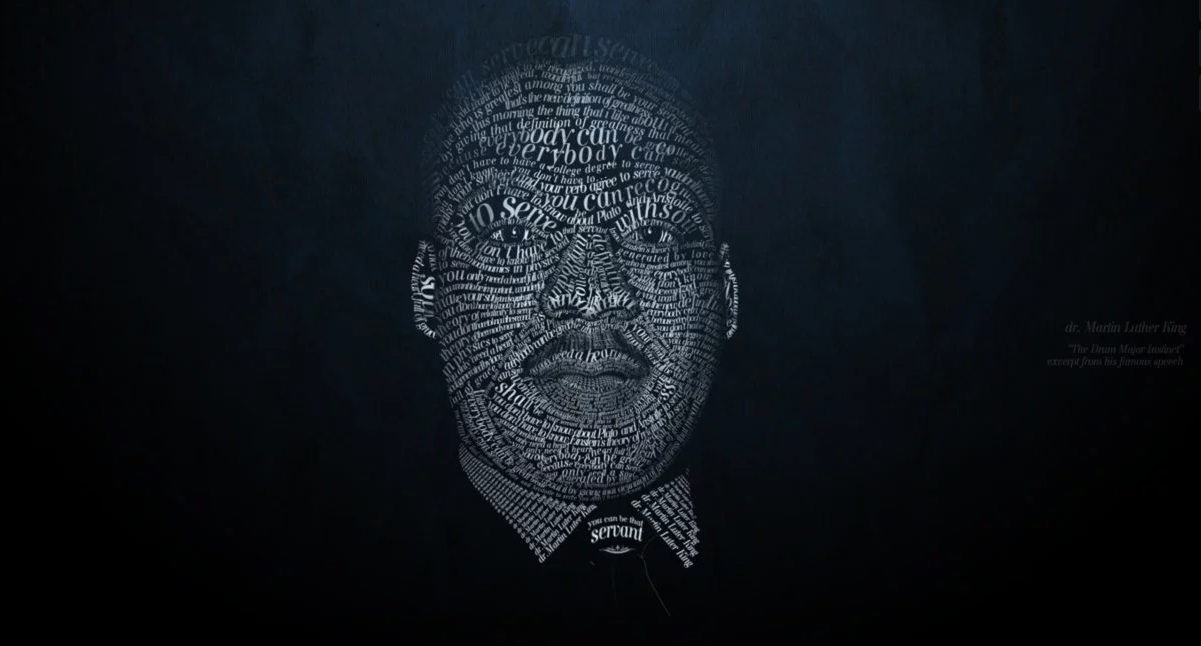
Kinetic typography and motion graphics are bringing to life the soaring oratory of the Civil Rights Era like never before. During the 1950s and 60s, many landmark speeches stood out in their power to persuade the conscience of a generation. The Reverend Dr. Martin Luther King, Jr., in particular, crafted brilliant language to inspire a burgeoning movement and to convince an at-time reluctant populace. During February’s African American History Month, the words of Dr. King are widely studied. Yet rarely before has the rhetoric of his writings emerged in such vivid portrayal as in the motion graphics below.
Kinetic typography is the combination of motion and text. Via animation, fonts take on lives of their own, scaffolding or cascading across canvases with the addition of music and/or narration. The zoom of calligraphy and the staccato of letters become at once mesmerizing and educational.
Dr. King’s addresses, when read quietly for homework, do feature his eloquent use of classical references and repetition. In silence, however, they do not achieve their most compelling effect. Like Shakespeare, his verses are meant to be heard, to be experienced, to be savored.
![]() |
| Source: Ryan Blackwell |
When Dr. King’s words appear in the dynamic interplay of typefaces on the screen, the music and color and locomotion all elevate his passages to new heights. They take on an urgency, a potency of expressiveness, and a linguistic might. They crystalize the commitment of the freedom fighters pushing for fair housing, fair employment, fair public service. They honor the ardor of those who sacrificed much for so many.
The three videos in this post contain engrossing representations of Dr. King’s most moving rhetoric. In each case, he builds phrases and arguments in a powerful crescendo about human dignity and natural rights. His “I Have A Dream” speech may be his most famous, yet his final speech, “I’ve Been To The Mountaintop,” and his final sermon, “The Drum Major Instinct,” may together feature his most masterful craftsmanship with verbiage and values, rights and reason. By adding motion, the designers of these videos bring Dr. King’s messages to life.
The Drum Major Instinct (visualization by Versa)
Martin Luther King (kinetic typography) from versa on Vimeo.
I\’ve Been To The Mountaintop (visualization by Ryan Blackwell)
I Have A Dream (visualization by Deco, EMAV 2012)
For more resources and ideas about lessons for African American History Month, check out \”Let\’s Talk About Race.\”
Collaborative Hearts And Minds Help Kids Cope
![]() |
| Source: ASIDE 2015 |
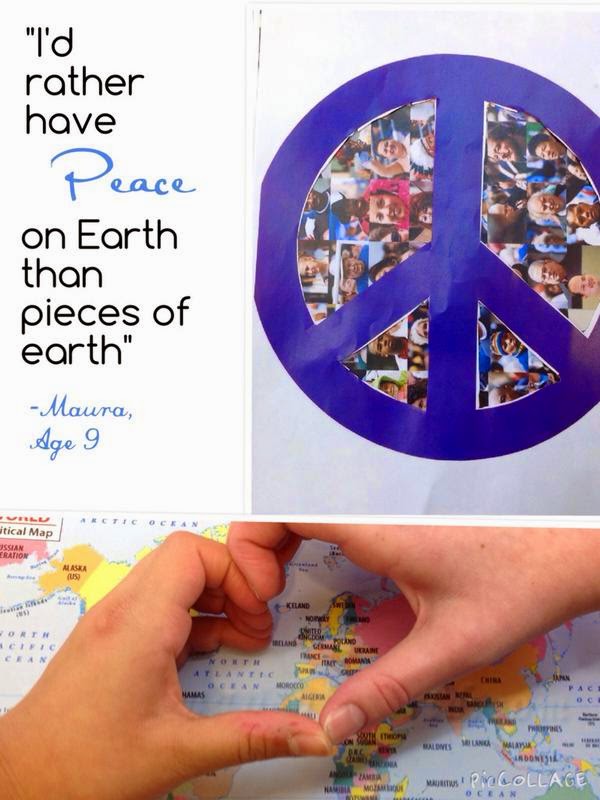
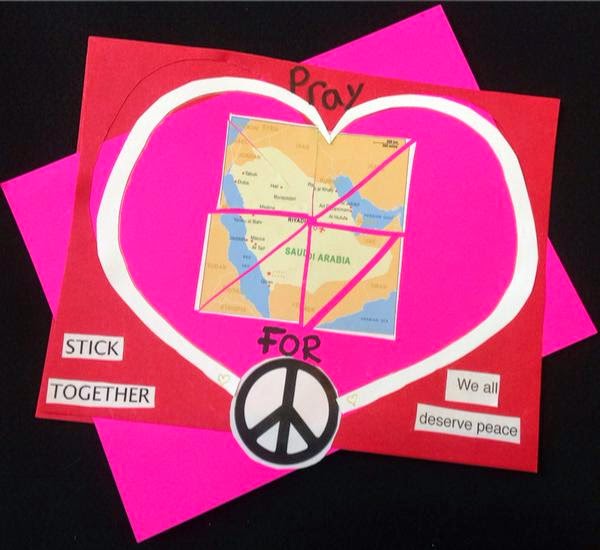
With the increasing questions we received from our sixth graders about the abhorrent news this past week, we realized they needed to do something to make them feel they were sending a positive message to help the world be a more peaceful place. Eleven- and twelve-year-olds hear the news, and most have far more access to content than their parents realize. Their questions abound and need an outlet. As middle school educators, we know this.
![]() |
| Source: ASIDE 2015 |
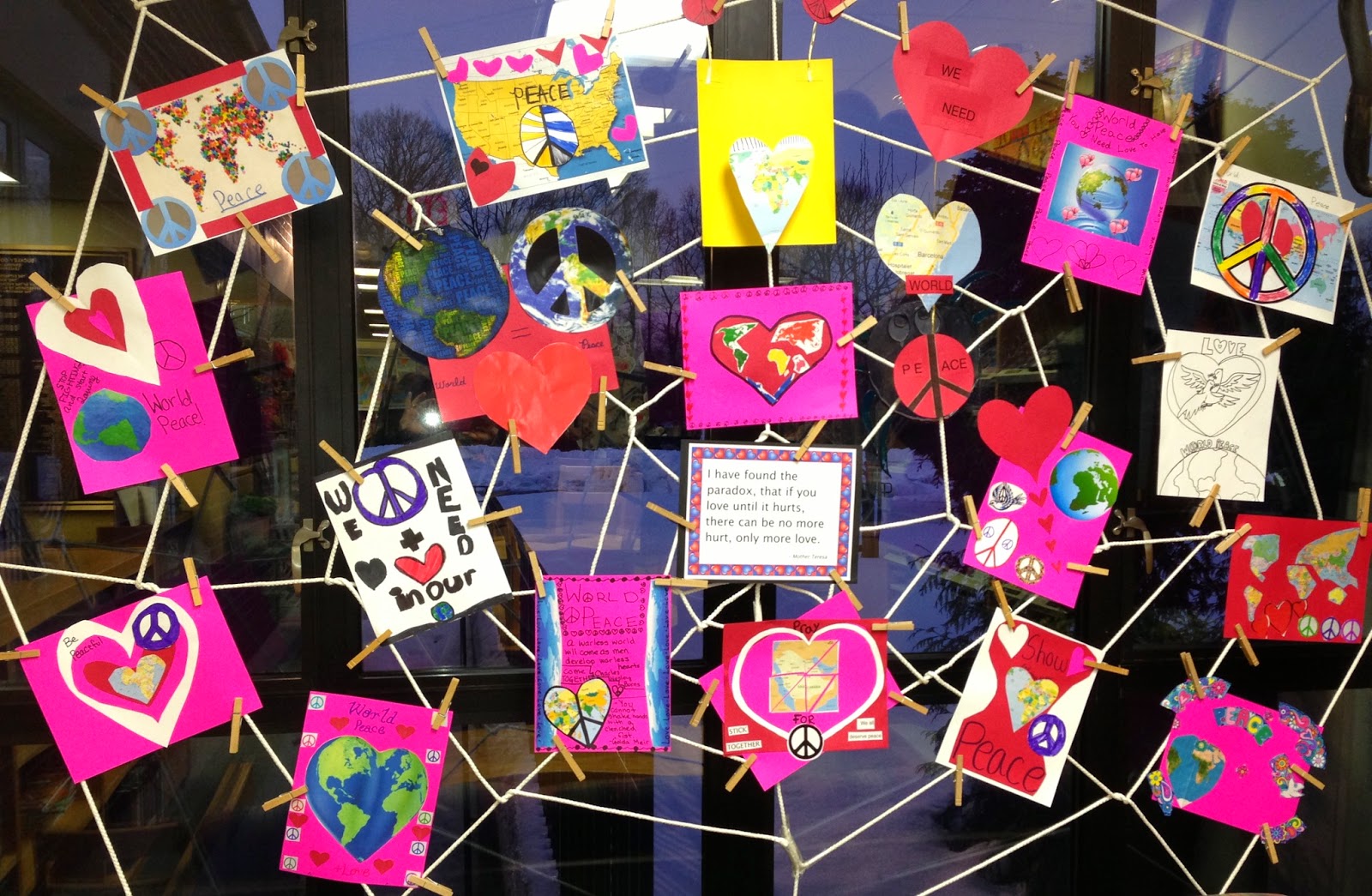
So with our friend and colleague, Francine Wisnewski (@fwisnewski), we decided to bring hearts and minds together to let the kids create a message to share on social media and with the school community. We asked them that each finished design somehow include a heart, map, and peace sign. That’s it. How they incorporated the criteria and with whom they worked, or not, was up to them.
We cherish the flexibility in our curricula that allows us to stop everything to promote mindfulness with our learners. It does not matter that the schedule listed math and history; we pulled the kids together to address their concerns about world conflict and violence.
![]() |
| Source: ASIDE 2015 |
We continually try to build the hearts and minds of our young learners to be peace builders, peacemakers, and peacekeepers. As adults, we understand the turmoil in the world, and sometimes we just have to stop to help them cope. It’s worth every minute. If we don’t, we lose the power of positive thinking that the world so much needs.
For other resources, please see:
Short Biography of ‘Dr. Sarvepalli Radhakrishnan (S. Radhakrishnan)’ (150 Words)
Short Essay on ‘Festival I Like Most’ (188 Words)
Many festivals are celebrated all over the year in India but I like Holi festival the most. Holi is one of the greatest festival of Hindus. It is a festival of colours. This festival falls on a full moon day in Phalgun Month of Hindu Calender. I like it most because this festival brings lot of joy and happiness.The story behind the Holi festival is that there was a king named Hiranya kashyap, he had a son, Prahlad, a holy spirit and highly devoted to God but Prahlad’s devotion enraged Hiranya kashyap and he planned to kill his own son. He asked her sister Holika, who was immune to fire, to sit in fire taking Prahlad in her lap. Fortunately Prahlad, who was blessed by Lord, was saved and Holika was burnt to ashes.
Holi is also a festival of love and unity and celebrates the triumph of good over evil. The festival is celebrated with lot of pomp in north India. After a fun filled and exciting day, the evenings are spent in sobriety when people meet friends and relatives and exchange sweets and festive greetings.
Short Essay on \’Chhath Puja\’ (250 Words)
\’Chhath Puja\’ is a famous festival of Hindus. It is celebrated in Bihar and Uttar Pradesh and many other parts of India. It is also followed in some parts of West Bengal, Jharkhand, Odisha, Assam and also Mauritius and Nepal. It is celebrated mainly among the Bhojpuri and Maithali speaking people. Chhath Puja takes place during 6th day (Shasthi) lunar fortnight (Shukla Paksha) of Karthik month according to Hindu Calendar. It generally falls in the month of October-November. The festival lasts for four days.Chhath Puja is also known as Dala Chhath. In this important festival setting Sun (dawn) is worshiped. The festival is observed with the faith that the Sun God fulfills wishes if \’araghya\’ is offered with complete dedication and devotion. It is a festival connected with purity, devotion to the Sun God who is considered as the source of life on this earth and is regarded as the deity who fulfills all our wishes. The festival is with an aim to express thanks to Sun God for offering energy to earth continuously enabling the environment suitable for the people to live. Along with the Sun God people worship \’Chhathi Maiya\’ on this day.
On this festival devotees assemble at the ghats at rivers and ponds and take a holy dip before preparing offerings (Prasad). The main constituent of the offerings are Thekua, which is a wheat based cake. Offerings are preferably cooked on earthen Chulha (oven). During the offerings, offerings are contained in small, semicircular pans woven out of bamboo strips called soop.


You must be logged in to post a comment.