bronwynhegarty doctorate meanderings

I have been reading this work by Hope Hartman:

Hartman, H.J. (2001). Developing students’ metacognitive knowledge and skills. In H.J. Hartman (ed.), Metacognition in learning and instruction. Kluwer, 33-68. Academic Publishers: the Netherlands.

I like the models she proposes:
Executive management metacognition – plan, monitor and evaluate progress.
Strategic metacognitive knowledge – what (facts), when and why (context) and how (procedures).

These models would enable participants to use metacognitive strategies for the three tasks in their course. This would help them develop metacognitive control and knowledge and also reflect.

For each task participants will be asked to plan, monitor and evaluate their progress using self-questioning techniques and reflect using a blog.

Why do I like the models she proposes:
1. Discipline diverse – these models can be used in a number of disciplines as they relate to any type of learning. The examples in the chapter relate to reading, maths, science social studies, writing.

2. Self-questioning is used and this can be modelled to encourage learners to create their own questions. The answers of course are generated by the learner.

3. Critical thinking – the models encourage this and by scaffolding the learning, critical thinking questions can be developed by the students themselves.

I also like the components of the BACEIS model and the internal and external supersystems.B = behaviour
A = affect
C = cognition
E = environment
I = interacting
S = systems

The cognitive system includes metacognition plus critical thinking, creativity and learning strategies. It would make it too big a project I guess to also look at motivation, affective self-regulation and attitudes (affective system) which are also part of the internal supersystem.

The external supersystem includes culture and instructional techniques as well as teacher characteristics etc as influences on thinking but they are not really relevant for this project.

Integrating Technology for active lifelong learning – Seminars

This weekend I have been attending some of the presentations at the Integrating Technology for Active Life-long Learning Connecting Online 2010
Feb 5-7
.

It is an annual live online conference of interest to educators, administrators, students, and community members who value the importance of integrating technology into the curriculum to improve instruction and learning. The Conference was conducted on the IT4ALL Moodle site and using WiZiQ.

First of all I attended the excellent presentation Sarah Stewart gave about: Working out the difference between online teaching and facilitation. This provoked a lot of thoughtful discussion.

For example an excerpt from a post I made on the Discussion Forum: \”You cannot come in and assess at the end of the course as a so-called objective independent marker unless there are strict and standardised criteria. This then means that professional judgement cannot be used. This is not ideal in any situation. Why should a student\’s understanding and assessment be weighted on one final piece of work? Exams work like this and they do not encourage holistic learning.

The idea of developing a partnership is great but if the teacher steps back and takes time to learn from the students and listens and gets to know them and interacts without always having to be the expert – the same thing can be achieved without separating facilitation/teaching/assessment. What do people think?\”

Helen Barrett spoke about: Social networks and interactive portfolios: Blurring the boundaries. (recording to come soon.) The idea of integrating social networking into the eportfolio was presented and is based on Helen\’s most recent article: Online Personal Learning Environments: Structuring Electronic Portfolios for Lifelong and Life Wide Learning

Also the idea of what motivates us. Dan Pink\’s book – Drive – covers motivation – autonomy, mastery and purpose. I will be interested to see if values are mentioned as an important part of intrinsic motivation. It is fun to master something you are curious about and have passion about it and this will be more of a driver than anything. More on this topic later…off to track down the book. There was a question about how the big picture purpose of portfolios could motivate. What are the mastery elements in social networking – mastering skills, showcasing achievements, flow of learning, increasing self-awareness and self-understanding. Apparently the key is that all of us want to be part of something bigger than ourselves? So if the portfolio can be seen to have a lifelong purpose it could motivate.

What got me all excited is the concept that \”reflection is the heart and soul of a portfolio\” – my sentiments exactly. And the comment that most documents start their life in electronic format so my question is why print them off and bind them in a hard copy portfolio?

Short Essay on \’Influence of Advertisement in Our Lives\’ (160 Words)

Advertisements are essential for starting a new business. Promoting sales is the main motive of a large enterprise. Advertisements rule every aspect of our lives and provide a link between an individual and the world.

Advertising, by the definition, is a paid form of non-personal communication to promote the goods and services. It simplifies the choice of consumers by creating an awareness among people about several brands and products available in the market. As advertisements help in business expansion, the companies spend crores or millions on them.

Advertisements are contained in various means of communication such as magazines, newspapers, television, radio, bill boards etc. Attractive pictures, slogans, taglines etc shown in the advertisements lure customers, thereby pushing up sales.

Advertisements are popularized by the government for betterment of the society in the field of education, providing better facilities, housing facilities for poor, medical facilities like polio drops and other vaccines etc. So, we can conclude by saying that advertisements greatly influence our lives. 

Short Essay on \’Influence of Advertisement in Our Lives\’ (160 Words)

Advertisements are essential for starting a new business. Promoting sales is the main motive of a large enterprise. Advertisements rule every aspect of our lives and provide a link between an individual and the world.

Advertising, by the definition, is a paid form of non-personal communication to promote the goods and services. It simplifies the choice of consumers by creating an awareness among people about several brands and products available in the market. As advertisements help in business expansion, the companies spend crores or millions on them.

Advertisements are contained in various means of communication such as magazines, newspapers, television, radio, bill boards etc. Attractive pictures, slogans, taglines etc shown in the advertisements lure customers, thereby pushing up sales.

Advertisements are popularized by the government for betterment of the society in the field of education, providing better facilities, housing facilities for poor, medical facilities like polio drops and other vaccines etc. So, we can conclude by saying that advertisements greatly influence our lives. 

Short Essay on \’Influence of Advertisement in Our Lives\’ (160 Words)

Advertisements are essential for starting a new business. Promoting sales is the main motive of a large enterprise. Advertisements rule every aspect of our lives and provide a link between an individual and the world.

Advertising, by the definition, is a paid form of non-personal communication to promote the goods and services. It simplifies the choice of consumers by creating an awareness among people about several brands and products available in the market. As advertisements help in business expansion, the companies spend crores or millions on them.

Advertisements are contained in various means of communication such as magazines, newspapers, television, radio, bill boards etc. Attractive pictures, slogans, taglines etc shown in the advertisements lure customers, thereby pushing up sales.

Advertisements are popularized by the government for betterment of the society in the field of education, providing better facilities, housing facilities for poor, medical facilities like polio drops and other vaccines etc. So, we can conclude by saying that advertisements greatly influence our lives. 

\’Letter for Change of Fund Type in LIC Unit Linked Insurance Plan (ULIP)\’

To.
The Sr. Branch Manager.
City –Branch Office,
L.I.C. of India,
Lucknow

Sir,

Sub.: Change of Fund Type – From Growth to Bond Fund
Ref.: Policy Number –XXXXXXXXX

The applicant is the policyholder of above numbered policy of your branch.

The applicant wants to change the type of fund of above policy from Growth Fund to Bond Fund.

Therefore it is requested that the fund type of above policy be changed from Growth to Bond Fund.

Thanks.

Lucknow                                                                                                  Yours’ Sincerely,
Dt.: 12.02.2014                                                                                                 XXX

\’Letter for Change of Fund Type in LIC Unit Linked Insurance Plan (ULIP)\’

To.
The Sr. Branch Manager.
City –Branch Office,
L.I.C. of India,
Lucknow

Sir,

Sub.: Change of Fund Type – From Growth to Bond Fund
Ref.: Policy Number –XXXXXXXXX

The applicant is the policyholder of above numbered policy of your branch.

The applicant wants to change the type of fund of above policy from Growth Fund to Bond Fund.

Therefore it is requested that the fund type of above policy be changed from Growth to Bond Fund.

Thanks.

Lucknow                                                                                                  Yours’ Sincerely,
Dt.: 12.02.2014                                                                                                 XXX

\’Letter for Change of Fund Type in LIC Unit Linked Insurance Plan (ULIP)\’

To.
The Sr. Branch Manager.
City –Branch Office,
L.I.C. of India,
Lucknow

Sir,

Sub.: Change of Fund Type – From Growth to Bond Fund
Ref.: Policy Number –XXXXXXXXX

The applicant is the policyholder of above numbered policy of your branch.

The applicant wants to change the type of fund of above policy from Growth Fund to Bond Fund.

Therefore it is requested that the fund type of above policy be changed from Growth to Bond Fund.

Thanks.

Lucknow                                                                                                  Yours’ Sincerely,
Dt.: 12.02.2014                                                                                                 XXX

Why Design Matters For Educators And Learners

Source: ASIDE 2016

We just finished attending the New York College Learning Skills Association (NYCLSA) Symposium in Saratoga. We met impressive educators who shared their expertise and resources, and we presented “Design Gives Context To Content To Engage Learners.” The following is an excerpt of why we feel so passionate about this topic.

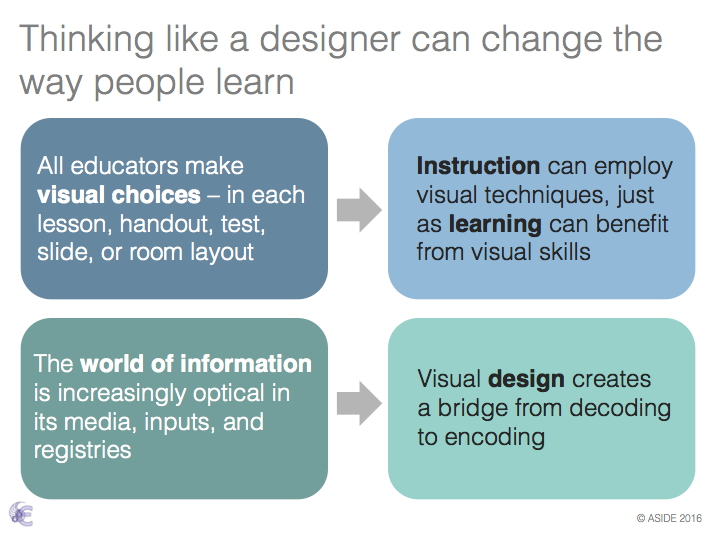
The harmony between form and function not only applies to design, but it also relates to the synergy between educator and learner. It supports both. Good design of information guides the attention of our students, creating a relationship between context and content. It allows for engagement without distraction.

Design Matters, because it can:

  • Steer the eye of the viewer
  • Remove the noise and congestion
  • Separate ideas into succinct areas
  • Create a consistency across materials
  • Align information for clarity
  • Establish a hierarchy of content
  • Make information easier to navigate


Design plays an integral part in the skills of graphicacyvisual literacy, and visual thinking. If companies spend billions of dollars on advertising to grab our attention, it would make sense for educators to think about information design as well. With the growing industry of online learning, how we incorporate visual information makes a difference not only in the way a student engages with the content, but also how he or she comprehends the information over the long run.

Source: ASIDE 2016

Attention, comprehension, and retention, or “ARC,” are inextricably linked when the visual information is included in the overall design of content. It’s why people and kids remember commercial, jingles, logos, and brands. The connection increases engagement with the material, making it memorable. The more we incorporate these aspects into our teacher toolkit, as well as in the options that students have to deliver content, the deeper the link to the material.

Source: ASIDE 2016


Design can influence the perception of information, the visual communication, and the engagement with text. It enables learners to make associations, and it provides opportunities for greater understanding.

Design Principles For Students As They Create Visual Projects And Digital Stories

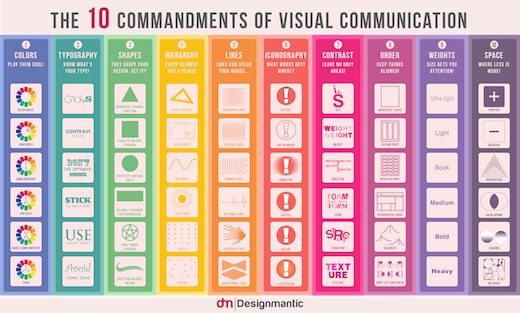
Source: DesignMantic (click for full-size image)


Students are producing more projects than ever before. The proliferation of visual apps and the access to easy tech tools have allowed learners to create all sorts of digital stories and custom graphics. Yet, as Marvel Comics teaches us, with great power comes great responsibility.

It is tempting to assume that because children are growing up in a visual world, they automatically know how to decode and encode optical inputs. This proficiency is known as graphicacy, which is the key to visual thinking in a differentiated classroom. If educators are going to ask students to design posters and slideshows, then they also need to guide young learners in the skills of effective design. Any teacher who has seen children layer neon pink fonts on top of vertiginous purple backgrounds knows that kids don’t innately grasp the keys to clean layouts.

Source: DesignMantic (click for full-size image)


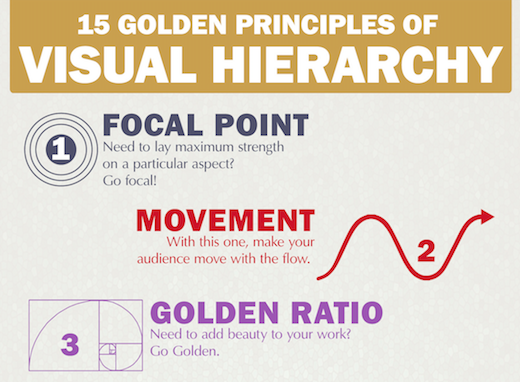
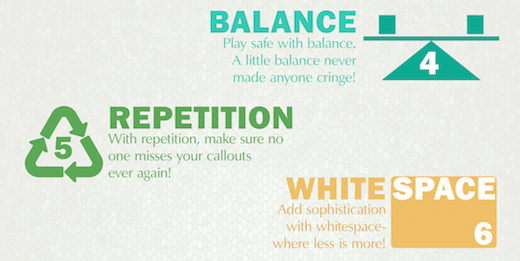
The logo design firm DesignMantic has published a series of extremely helpful infographics to help budding artists generate successful visuals. Even though these placards are intended for marketing and business purposes, they perfectly suit the needs of teachers looking for classroom resources.

DesignMantic‘s graphic of the “15 Golden Principles Of Visual Hierarchy” marches through a framework for art and imagination. As the firm notes:

“Visual hierarchy … offers to your eyes visual assistance, suggesting to them, what information to linger on to, as your vision glides through it. It lays down a path for the data to flow in, to get absorbed into the brain smoothly. It guides the human eye from one element of the data to the next, like an invisible pointer moving through the data, to keep the reader free of any visual fatigue.”

Source: DesignMantic (click for full-size image)

The company also offers a primer in “The 10 Commandments Of Visual Communication.” Much like its tenets for quality logos, these guidelines range from line and font choices to arrangement and sizing tips. In essence, it provides “a layperson’s handbook of visual communication.” It reminds us of similar advice from “The Design Of Project-Based Learning – Color Theory For Web 3.0.”

Short Biography of ‘Bhaichung Bhutia’ (200 Words)

‘Bhaichung Bhutia’ was born on 15 December 1976, at Tinkitan, Sikkim. He picked up football very early, since that was the only game which everybody played in his village. At the early age of eleven, Bhaichung’s skill in football earned him in SAI (Sports Authority of India) scholarship at the Tashi Namgyal Academy, Gangtok.

In 1992, for the first time he played for India at the under-16 Sub-Junior Tournament at Dacca. His mastery with football has earned him nicknames such as ‘Wiz Kid’, ‘Crises Man’, ‘Man with the Golden Boot’, ‘Wonder Kid’, ‘Boy Wonder’, and many others. During this period he played for many clubs and leagues. He was voted the ‘Asian Player of the Month’ in May, 1999. Bhaichung won Sikkim State Award and national Arjun Award. In September 1999, at the age of 25, he joined the Second Division English Club, Burry F.C., in Manchester, England.

Bhaichung Bhutia is Indian football’s pride and joy. The fact that he is the first Indian to play in European Club as a professional makes him a special footballer of our country. Bhaichung good nature is matched with hard work and a great determination to succeed. Bhaichung Bhutia is a household name in India and it every young player’s dream to be like this wonderful footballer.

General Duty Medical Officers of The Central Health Services Attending 4th Foundation Training Programme Call on The President Posted On: 23 JAN 2020 6:38PM by PIB Delhi

General Duty Medical Officers (GDMOs) of the Central Health Services attending the 4th Foundation Training Programme at the National Institute of Health and Family Welfare, called on the President of India, Shri Ram Nath Kovind, today (January 23, 2020) at Rashtrapati Bhavan.

Addressing the young doctors, the President said that our country has made great strides in providing healthcare to our people. Diseases such as polio and smallpox, which once claimed so many lives, have been defeated. Our immunisation programme is gaining strength. We have brought down the Maternal Mortality Rate and Infant Mortality Rate. Yet, we still face many challenges and have a long way to go in evolving a holistic healthcare system, one which is uniformly affordable and accessible to our citizens both in rural and urban areas. In this regard, it is a matter of satisfaction that the government has made Universal health coverage a priority. The rollout and success of the Ayushman Bharat Yojana is a critical step in this direction. We have to keep building on this great momentum and doctors will play an important role in doing so.

The President said that the disease burden in our country is undergoing an evolution. We have to tackle widespread diseases such as TB, malaria and dengue, and at the same time deal with the rising incidence of lifestyle diseases like diabetes, obesity, hypertension, depression etc.  He urged doctors to work towards a multidisciplinary approach to health – from prevention, wellness, cure, community empowerment to research and innovation.

The President said that as doctors, they can play a major role in encouraging healthy lifestyles. We can address the increasing stress in our lives with regular exercises and physical activity, practicing Yoga and Meditation. Doctors can be a major influencer in promoting such lifestyles and bringing about a culture of wellness.

Click here to see the President’s speech 


***

Cabinet approves signing of MoU between Brazil and India for bilateral cooperation in the field of early childhood

The Union Cabinet, chaired by the Prime Minister Shri Narendra Modi, has given its approval for signing of Memorandum of Understanding (MoU) on Cooperation between the Ministry of Citizenship of the Federative Republic of Brazil and the Ministry of Women & Child Development of the Republic of India for bilateral cooperation in the field of early childhoods.

Benefits

It will strengthen the bonds of friendship between the two countries and increase bilateral cooperation on the issues of early childhood care.  Both countries will benefit from exchange of best practices of the respective countries in the field of early childhood.

*******

Shri Dharmendra Pradhan launches SERVICE -a scheme of SAIL to promote Voluntary Philanthropist Activities by its employees;

Minister of Petroleum and Natural Gas & Steel Shri Dharmendra Pradhan today launched a scheme of SAIL to promote Voluntary Philanthropist Activities (VPA) by its employees.    The scheme called “SAIL Employee Rendering Voluntarism and Initiatives for
Community Engagement (SERVICE)” will promote and facilitate philanthropist activities by the employees in a structured manner.

The Minister also launched a portal for the employees to register for the scheme. The dedicated interactive “SAIL SERVICE” portal for implementation of this Scheme shall act as a platform for enabling faster interaction and communication amongst the various stakeholders.  It shall eventually be developed as a repository of knowledge management in this regard.

Speaking on the occasion, ShriDharmendraPradhan said that it is a great initiative of SAIL to encourage its employees and their families to give back to society in a positive manner.  He said “This year marks 70 years of our Constitution coming into effect. Honorable President of India ShriRamnathKovindji has said that while being alert about their rights, citizens should also be conscious of their duties. Through SERVICE, employees of SAIL will come forward to perform their social duties voluntarily and contribute towards social welfare and nation building.”

ShriPradhan called for mass scale mobilisation of employees towards achieving social good through voluntary activities, based on their interest areas. He said that the SAIL employees and their families can contribute in nation building and community development.  He called upon the SAIL employees to participate in this Scheme whole-heartedly andmake the habit of helping others an integral part of their lives.He also called for incentivising initiatives taken by employees aimed towards social welfare.

There are about 70,000 regular employees of SAIL and 60,000 contractual employees in various plants of SAIL.  All these employees and their families will be encouraged to come forward and undertake such VPA for community development.  They will be encouraged to undertake Voluntary Philanthropist Activities preferably under the identified thrust areas under the Corporate Social Responsibility (CSR).  These include education and health, women empowerment, sustainable income generation, assistance to Divyangjan, access to water and sanitation, village development, environment sustenance, sports coaching, and traditional arts and culture.  The Scheme may also promote other related VPAs by employees which should not be related to any other organisation or receiving any funding from any organisation.

SAIL will undertake mass mobilisation programmes in its plants and units to spread awareness about this scheme and to encourage employees to participate in VPS.  A pledge shall be administered at all plants and units of SAIL on the SAIL Foundation Day i.e. 24th January for VPS towards community development.

SAIL shall provide logistic support to such employees or groups for undertaking the VPAs, subject to evaluation and assessment.   Due recognition will also be given for the employees or groups under the scheme, based on their contribution.

On this occasion, Shri Anil Kumar Chaudhary, Chairman, SAIL, also apprised the media about the SERVICE scheme.


——

Cabinet approves Extension, of tenure of the Commission constituted under Article 340 of the constitution to examine the issue of sub-categorization within Other Backward Classes in the Central List

ment in Central Government posts & for admission in Central Government Educational Institutions are expected to be benefitted upon implementation of the recommendations of the Commission. The Commission is likely to make recommendations for benefit of such marginalized communities in the Central List of OBCs.


Financial Implications:

The expenditure involved are related to the establishment and administration costs of the Commission, which would continue to be borne by the Department of Social Justice and Empowerment.


Benefits:

All persons belonging to the castes/communities which are included in the Central List of SEBCs but which have not been able to get any major benefit of the existing scheme of reservation for OBCs in Central Government posts & for admission in Central Government Educational Institutions would be benefitted.


Implementation strategy and targets:

Orders for extension of the term of the Commission and addition in its Terms of Reference will be notified in the Gazette ‘in the form of an Order made by the President, after receipt of the approval of the Hon’ble President to the same.


Background:

The Commission was constituted under article 340 of the Constitution with the approval of President on 2nd  October, 2017. The Commission, headed by Justice (Retd.) Smt. G. Rohini commenced functioning on 11th October, 2017 and has since interacted with all the Stats/UTs which have subcategorized OBCs, and the State Backward Classes Commissions. The Commission has come to the view that it would require some more time to submit, its report since the repetitions, ambiguities, inconsistencies and errors of spelling or transcription etc appearing in the existing Central List of OBCs need to be cleared. Hence the Commission has sought extension of its term by six, that is upto 31st July 2020 and also addition in its existing Terms of Reference.


**********