\’High Court of Gujarat\’ was established on 1st May, 1960 as a result of bifurcation of the former State of Bombay into two States of Maharastra and Gujarat. The Gujarat High Court is the High Court of the State of Gujarat, India. The seat of the High Court is at Ahmedabad.
The High Court of Gujarat started functioning near Akashwani, Navrangpura, Ahmedabad, Gujarat, India. Later the High Court has shifted to the new building at Sola, Ahmedabad, Gujarat, India from 16 January, 1999. The High Court has a sanctioned strength of 42. Hon\’ble Mr. Justice Sunderlal Trikamlal Desai was the first Chief Justice of High Court of Gujarat.
Month: January 2020
\’Gujarat High Court\’ | \’High Court of Gujarat\’ (100 Words)
\’High Court of Gujarat\’ was established on 1st May, 1960 as a result of bifurcation of the former State of Bombay into two States of Maharastra and Gujarat. The Gujarat High Court is the High Court of the State of Gujarat, India. The seat of the High Court is at Ahmedabad.
The High Court of Gujarat started functioning near Akashwani, Navrangpura, Ahmedabad, Gujarat, India. Later the High Court has shifted to the new building at Sola, Ahmedabad, Gujarat, India from 16 January, 1999. The High Court has a sanctioned strength of 42. Hon\’ble Mr. Justice Sunderlal Trikamlal Desai was the first Chief Justice of High Court of Gujarat.
\’Gujarat High Court\’ | \’High Court of Gujarat\’ (100 Words)
\’High Court of Gujarat\’ was established on 1st May, 1960 as a result of bifurcation of the former State of Bombay into two States of Maharastra and Gujarat. The Gujarat High Court is the High Court of the State of Gujarat, India. The seat of the High Court is at Ahmedabad.
The High Court of Gujarat started functioning near Akashwani, Navrangpura, Ahmedabad, Gujarat, India. Later the High Court has shifted to the new building at Sola, Ahmedabad, Gujarat, India from 16 January, 1999. The High Court has a sanctioned strength of 42. Hon\’ble Mr. Justice Sunderlal Trikamlal Desai was the first Chief Justice of High Court of Gujarat.
Why am I interested in sustainable living?
I presently work as an Educational Developer in the Educational Development Centre. I have been interested in environmental issues since the 70s when I lived in London for five years and Switzerland for six months – they were recycling everywhere, in the community and in the hospital I nursed in. You could pick up free furniture every month off the street when it was put out for collection. The reason for the activity – their country is too small to fill it up with junk. There is more about how I got to this space on my blog and I would feel privileged if you took the time to read about my background in sustainability.
While in London i rode a bicycle constantly, and used public transport because it wasn\’t practical to use a car even on long journeys. There was too much traffic; it was exhilarating to weave in and out of the cars and buses, and the fastest way to get around. I ate organic food which was very easy to get. Every time I washed my hair the water was black with soot. It was a very polluted city, and the water we were expected to drink had been recycled eight times by the municipal council.
Living there made me very aware of the issues facing the planet. I recall asking a chemistry lecturer about global warming, and the idea was poohooed as pollycock. I also recall asking questions about the safety of nuclear energy in a meeting with nuclear energy official representatives. They were adamant that alternative energy sources would never see the light of day and that nuclear power plants were 100% safe. The most fascinating trip I ever made was to Macynlleth in mid Wales where alternative energy centre was being set up – Centre for Alternative Technology – they had created a fully sustainable house and community from a bare quarry. Today it is a thriving magnet for all sorts of people wanting to learn about alternative energies and sustainable ways of living.
I joined a group of protesters one time and our efforts to get to to Greenham Common via train and bicycle were blocked by the authorities. we were protesting the nuclear weapons held there by the US. I was also closely involved with an urban regeneration group and we replanted wastelands and areas near abandoned railway tracks. My interest in the environment and sustainable ways of living has always been from a scientific angle as well as from a sociological stance. I just want to see people and the earth treated justly.
I would like to see Otago Polytechnic modelling sustainabiity in everything we do. Not just the everyday practical things which relate to energy use and recycling but also that we ensure we purchase good only from reputable sustainable companies, and that we provide sustainable educational choices for the community.
You may be interested in the following local organisations:
1. Sustainable Dunedin Network at: http://www.dect.org.nz/
2. Sustainable Dunedin City Society at: http://www.sustainabledunedincity.org.nz/
Here is a video clip on the Channel 9 website of an interview about the Dunedin City Council Annual Plan with members of Sustainable Dunedin City Society
\”The newly-formed Sustainable Dunedin City Society are arguing that the DCC\’s annual plan shows no sign of dealing with issues concerning climate change.They\’re concerned if the council doesn\’t rethink their current plan, Dunedin can kiss goodbye to a sustainable city and environment.\”
First of all we need to communicate openly and discuss the ideas around the Key Performance Indicators for the Sustainability plan. We would also benefit from having information added to a Wiki so it can be dynamic and readily updated by all interested staff at OP. That way people will feel involved and will be more likely to contribute and collaborate as well as cooperate. otherwise we may get into the same ole ways of working where we are being told what we have to do, rather than taking responsibility for doing what is right because we feel passionate about being a sustainable organisation.
Professional learning and development
Peace Through Understanding – GPI 2015
![]() |
| Source: ASIDE, 2015 |
Last week, the Institute for Economics and Peace (IEP) released the 2015 Global Peace Index (GPI) on its Vision of Humanity website. As with our earlier posts on the topic of peace, and in particular the release of the 2013 and 2014 GPI, we believe that sharing these findings each year helps to establish a deeper understanding of the effects of peace on society. The resources available on the site provide educators with a variety of learning materials, including an interactive map, infographic highlights, and a short motion graphic explaining this year’s report.
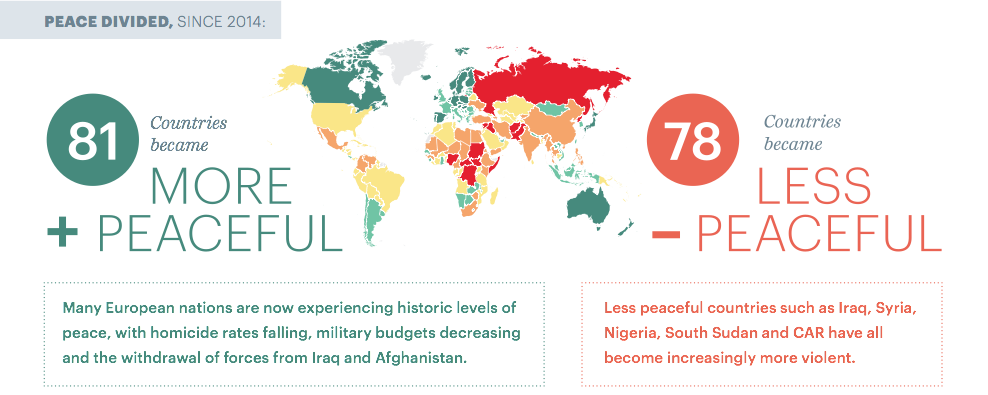
Unfortunately, while peace did not necessarily decline a great deal in 2015, the GPI for this year does reveal an increasingly more divided world. The motion graphic below helps to explain how the most peaceful countries are enjoying increasing levels of peace and prosperity, while the least peaceful countries spiral into violence and conflict.
In our classrooms, we receive countless questions from young learners regarding current events with reference to violence both in the United States and abroad. We suppose, too, that so much of what we teach in our history classes involves conflict, conquest, and seizure. It’s no wonder that we get this question every year, “Do you think there will ever be a time without war?” We can only reply with, “We hope so.” The strife and conflict in the news does not bode well for a better answer, and if history is any indication, the prospect looks grim.
![]() |
| Source: Vision of Humanity |
![]() |
| Source: IDP |
Nevertheless, we will do our part to educate young learners to be peacemakers, builders, and keepers. We need young people to believe in social justice, human rights, and peace. The more mindful we are about our actions, the greater the chance for change. This includes talking about divisive issues of racism, immigration, and sexual orientation. We don’t want to think about the ramifications if we don’t make peace part of the daily conversation. The more voices, the better. Make them heard by preparing now for the International Day Of Peace on September 21, 2015.
For other resources, please see:
Short Essay on \’Siegfried Sassoon\’ (117 Words)
Siegfried Sassoon served during the first world war as a captain. At first he was very excited and felt honoured to be in the war and fighting for his country; but then, when he saw the horrors of the war at first hand, he began to speak out against it. He wrote some moving poetry about the hardships and tragedy felt in war. Siegfried Sassoon died on 1st September 1967 at the age of 80.
Short Essay on \’Siegfried Sassoon\’ (117 Words)
Siegfried Sassoon served during the first world war as a captain. At first he was very excited and felt honoured to be in the war and fighting for his country; but then, when he saw the horrors of the war at first hand, he began to speak out against it. He wrote some moving poetry about the hardships and tragedy felt in war. Siegfried Sassoon died on 1st September 1967 at the age of 80.
Short Essay on \’Siegfried Sassoon\’ (117 Words)
Siegfried Sassoon served during the first world war as a captain. At first he was very excited and felt honoured to be in the war and fighting for his country; but then, when he saw the horrors of the war at first hand, he began to speak out against it. He wrote some moving poetry about the hardships and tragedy felt in war. Siegfried Sassoon died on 1st September 1967 at the age of 80.
Short Essay on \’Siegfried Sassoon\’ (117 Words)
Siegfried Sassoon served during the first world war as a captain. At first he was very excited and felt honoured to be in the war and fighting for his country; but then, when he saw the horrors of the war at first hand, he began to speak out against it. He wrote some moving poetry about the hardships and tragedy felt in war. Siegfried Sassoon died on 1st September 1967 at the age of 80.
Short Essay on \’Siegfried Sassoon\’ (117 Words)
Siegfried Sassoon served during the first world war as a captain. At first he was very excited and felt honoured to be in the war and fighting for his country; but then, when he saw the horrors of the war at first hand, he began to speak out against it. He wrote some moving poetry about the hardships and tragedy felt in war. Siegfried Sassoon died on 1st September 1967 at the age of 80.
Short Essay on \’Siegfried Sassoon\’ (117 Words)
Siegfried Sassoon served during the first world war as a captain. At first he was very excited and felt honoured to be in the war and fighting for his country; but then, when he saw the horrors of the war at first hand, he began to speak out against it. He wrote some moving poetry about the hardships and tragedy felt in war. Siegfried Sassoon died on 1st September 1967 at the age of 80.
Short Biography of \’Maulana Abul Kalam Azad\’ (148 Words)
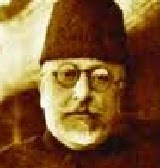
\’Maulana Abul Kalam Azad\’ was born on 11th November, 1888. His real name was Abul Kalam Ghulam Muhiyuddin. His father\’s name was Maulana Khairuddin, who lived in Bengal. His mother\’s name was Alia, who was an Arabian. He was married to Juleikha at the age of thirteen.Maulana Azad was a journalist, author, poet and philospher. He started to publish the newspaper \’Al-Hilal\’ in the year 1912. Al-Hilal played an important role in forging Hindu-Muslim unity. He wrote many works, reinterpreting the holy Quran. He played an active role in the freedom movement of India. He became the first Education Minister of independent India.
Maulana Azad died on 22nd February, 1958. For his invaluable contribution to the nation, Maulana Abul Kalam Azad was posthumously awarded India\’s highest civilian honour, Bharat Ratna in 1992. His birth anniversary 11th November is declared as National Education Day by the Government of India.
Short Biography of \’Maulana Abul Kalam Azad\’ (148 Words)
\’Maulana Abul Kalam Azad\’ was born on 11th November, 1888. His real name was Abul Kalam Ghulam Muhiyuddin. His father\’s name was Maulana Khairuddin, who lived in Bengal. His mother\’s name was Alia, who was an Arabian. He was married to Juleikha at the age of thirteen.Maulana Azad was a journalist, author, poet and philospher. He started to publish the newspaper \’Al-Hilal\’ in the year 1912. Al-Hilal played an important role in forging Hindu-Muslim unity. He wrote many works, reinterpreting the holy Quran. He played an active role in the freedom movement of India. He became the first Education Minister of independent India.
Maulana Azad died on 22nd February, 1958. For his invaluable contribution to the nation, Maulana Abul Kalam Azad was posthumously awarded India\’s highest civilian honour, Bharat Ratna in 1992. His birth anniversary 11th November is declared as National Education Day by the Government of India.
Short Biography of \’Maulana Abul Kalam Azad\’ (148 Words)
\’Maulana Abul Kalam Azad\’ was born on 11th November, 1888. His real name was Abul Kalam Ghulam Muhiyuddin. His father\’s name was Maulana Khairuddin, who lived in Bengal. His mother\’s name was Alia, who was an Arabian. He was married to Juleikha at the age of thirteen.Maulana Azad was a journalist, author, poet and philospher. He started to publish the newspaper \’Al-Hilal\’ in the year 1912. Al-Hilal played an important role in forging Hindu-Muslim unity. He wrote many works, reinterpreting the holy Quran. He played an active role in the freedom movement of India. He became the first Education Minister of independent India.
Maulana Azad died on 22nd February, 1958. For his invaluable contribution to the nation, Maulana Abul Kalam Azad was posthumously awarded India\’s highest civilian honour, Bharat Ratna in 1992. His birth anniversary 11th November is declared as National Education Day by the Government of India.


You must be logged in to post a comment.