The process of Astronaut selection for the Gaganyaan mission is completed :ISRO Chairman

The Chairman Indian Space Research Organisation (ISRO) Dr K Sivan briefed media at a Press Meet organised at ISRO Headquarters, Bengaluru today. During the Press Meet, Dr Sivan outlined ISRO’s achievements during the last one year and also the plans to be accomplished during the current year.

During 2019, six launch vehicle and seven satellite missions were realised by ISRO. The year also marked the 50th launch of the Polar Satellite Launch Vehicle (PSLV). Dr Sivan said that two new variants of the PSLV were introduced. For the first time, the spent fourth stage of the PSLV was successfully demonstrated as an experimental orbital platform. Indigenously developed Vikram processor by Semi-Conductor Laboratory was flight tested during the year. International mobile standards body 3rd Generation Partnership Project (3GPP) approved India’s regional navigation satellite system NavIC which would facilitate NavIC’s use in mobile phones.

On the capacity building front, a second launch port, exclusively for the Small Satellite Launch Vehicle (SSLV), is planned to be established in Thoothukudi district, Tamil Nadu. “Land acquisition activities are presently in progress”, said Dr. Sivan. A second Vehicle Assembly Building in SDSC SHAR Sriharikota was dedicated to the nation during the year for increasing the launch frequency. As part of the enhanced outreach activity, a launch viewing gallery was operationalised in Sriharikota to facilitate viewing of launches live by the public.

In an effort towards horizontal expansion of ISRO, Space Technology Cells, Space Technology Incubation Centres andRegional Academic Centres for Space were established during the year and many more such centres are planned in the future. A special programme for school children called “YuvaVIgyaniKAryakram (YUVIKA)”aimed at imparting basic knowledge on Space Technology, Space Science and Space Applications was also introduced during the last year.

To carry forward the industry production of space systems, ISRO incorporated New Space India Limited (NSIL), under the Department of Space and efforts in realising PSLVs from industry initiated.

Pertaining to future programmes, Dr Sivan said Chandrayaan-3 mission to the moon, comprising a lander and a rover is approved by the Government and activities for its realisation are in progress.

Talking about India’s first human space flight mission Gaganyaan, Dr. Sivan said “We’ve made good progress in the mission. The process of Astronaut selection for the mission is completed”. He further added that four astronauts have been selected, who will undergo extensive training.

Other projects during the year include SSLV, GSLV with 4m ogive payload fairing, GSAT-20 satellite, NavIC with indigenous atomic clocks, Indian Data Relay Satellite System, Aditya-L1 and XPOSAT.

*****

PM greets the nation on New Year

The Prime Minister Shri Narendra Modi has extended his New Year greetings to the nation.

“Have a wonderful 2020! May this year be filled with joy and prosperity. May everyone be healthy and may everyone’s aspirations be fulfilled. आप सभी को साल 2020 की हार्दिक शुभकामनाएं। ”, the Prime Minister said.


Narendra Modi

@narendramodi

Have a wonderful 2020!

May this year be filled with joy and prosperity. May everyone be healthy and may everyone’s aspirations be fulfilled.

आप सभी को साल 2020 की हार्दिक शुभकामनाएं।

37.5K people are talking about this

****

PM congratulates General Bipin Rawat on taking charge as India’s first Chief of Defence Staff

The Prime Minister Shri Narendra Modi has congratulated General Bipin Rawat on taking charge as India’s first Chief of Defence Staff.

“I am delighted that as we begin the new year and new decade, India gets its first Chief of Defence Staff in General Bipin Rawat. I congratulate him and wish him the very best for this responsibility. He is an outstanding officer who has served India with great zeal.

As the first CDS takes charge, I pay homage to all those who have served and laid down their lives for our nation. I recall the valiant personnel who fought in Kargil, after which many discussions on reforming our military began, leading to today’s historic development.

On 15th August 2019, from the ramparts of the Red Fort, I announced that India will have a Chief of Defence Staff. This institution carries tremendous responsibility of modernizing our military forces. It would also reflect the hopes and aspirations of 1.3 billion Indians.

Creation of the Department of Military Affairs with requisite military expertise and institutionalisation of the post of CDS is a momentous and comprehensive reform that will help our country face the ever-changing challenges of modern warfare”, the Prime Minister said.


Narendra Modi

@narendramodi

I am delighted that as we begin the new year and new decade, India gets its first Chief of Defence Staff in General Bipin Rawat. I congratulate him and wish him the very best for this responsibility. He is an outstanding officer who has served India with great zeal.

11.7K people are talking about this

Narendra Modi

@narendramodi

As the first CDS takes charge, I pay homage to all those who have served and laid down their lives for our nation. I recall the valiant personnel who fought in Kargil, after which many discussions on reforming our military began, leading to today’s historic development.

6,099 people are talking about this

Narendra Modi

@narendramodi

On 15th August 2019, from the ramparts of the Red Fort, I announced that India will have a Chief of Defence Staff. This institution carries tremendous responsibility of modernizing our military forces. It would also reflect the hopes and aspirations of 1.3 billion Indians.

5,102 people are talking about this

Narendra Modi

@narendramodi

Creation of the Department of Military Affairs with requisite military expertise and institutionalisation of the post of CDS is a momentous and comprehensive reform that will help our country face the ever-changing challenges of modern warfare.

6,266 people are talking about this

****

Telephone Calls by Prime Minister on New Year

On the occasion of the New Year, Prime Minister Shri Narendra Modi today had telephone conversation with  H.M. Jigme Khesar Namgyel Wangchuck, The Druk Gyalpo of Kingdom of Bhutan and  Lyonchhen (Dr.) Lotay Tshering, Prime Minister of Bhutan, Mr. Gotabaya Rajapaksa, President and Mr. Mahinda Rajapaksa, Prime Minister of Sri Lanka, Mr. Ibrahim Mohamed Solih, President of the Maldives, Ms. Sheikh Hasina, Prime Minister of Bangladesh and Mr. K.P. Sharma Oli, Prime Minister of Nepal.

Prime Minister conveyed to the leaders his New Year greetings and good wishes on behalf of the people of India and on his own behalf. He emphasized India’s commitment to ‘Neighbourhood First’ policy and the vision of shared peace, security, prosperity and progress for all of India’s friends and partners in the region.

In his conversation with the King of Bhutan, the Prime Minister highlighted important achievements of the last year which have led to further consolidation of special ties between India and Bhutan. Prime Minister fondly recalled his last visit to Bhutan and the love and affection he received from the people there. He also emphasized the need to enhance youth exchanges between the two countries. Prime Minister also mentioned that he was looking forward to forthcoming visit of the King to India.

President of Sri Lanka Mr.Gotabaya Rajapaksa warmly reciprocated the wishes of Prime Minister and expressed confidence that India and Sri Lanka would further enhance their friendly ties in the year 2020. The two leaders reiterated their commitment to closely work together towards this end.

Speaking to the Prime Minister of Sri Lanka Mr. Mahinda Rajapaksa, Prime Minister reiterated India’s commitment to further expand the close and extensive cooperation with Sri Lanka. Prime Minister Rajapaksa reciprocated the wishes warmly and expressed keen desire to further enhance relations between the two countries.

Prime Minister Shri Modi wished the President of the Maldives and the people of the Maldives success in all their endeavours for development. President Solih warmly reciprocated Prime Minister’s wishes and expressed his keen desire to further deepen and strengthen the ties with India by enhancing the existing bilateral cooperation and exploring newer areas for working together.

Speaking with Prime Minister Sheikh Hasina, the Prime Minister, inter alia, congratulated her on being re-elected as the President of the Awami League for the next three years. Prime Minister also expressed his condolence on the untimely demise of former High Commissioner of Bangladesh to India Syed Muazzem Ali. Prime Minister noted the progress achieved in India-Bangladesh relations in 2019. He also stated that the upcoming birth-centenary of Bangbandhu and 50 years of the Liberation of Bangladesh and establishment of bilateral diplomatic ties provided important milestones to further progress of the close India-Bangladesh ties, which is a priority of his Government.

In his conversation with Prime Minister Oli, the Prime Minister expressed his satisfaction at the progress of India-Nepal relations in 2019, with the completion of several projects. He specifically noted the completion of Motihari (India)- Amlekhgunj (Nepal) petroleum products pipeline in a record time. Both the leaders also agreed for an early inauguration of the Integrated Check Post in Biratnagar and the housing reconstruction project in Nepal through video conference.

******

PM to visit Karnataka on 2nd and 3rd January 2020

The Prime Minister, Shri Narendra Modi, will visit Karnataka on 2nd and 3rd January 2020.

At Tumkur, He will visit the Sree Siddaganga Mutt, where he will unveil a plaque to mark the laying of Foundation Stone for a memorial museum of Shri Shri Shivakumar Swamiji.

The Prime Minister will offer prayers and also plant a sapling at the Mutt. The Chief Minister of Karnataka Shri B. S. Yediyurappa  and other dignitaries including Sh. Siddalingeshwara Swamy will be present on the occasion.

Prime Minister will address the gathering.


*****

PM to distribute Krishi Karman Awards

The Prime Minister Shri Narendra Modi will distribute Krishi Karman Awards and Commendation Awards to states at a public meeting in Tumkur Karnataka on Thursday, 2.1.2020. He will also give away Agriculture Minister’s Krishi Karman Awards for Progressive Farmers.

The event will also witness the release of the 3rd installment of PM Kisan (Pradhan Mantri Kisan Samman Nidhi) of Rs 2000 for the period December 2019-March 2020. This will benefit approximately 6 crore beneficiaries.  Prime Minister will also hand over Certificates to beneficiaries under PM Kisan from 8 States/UTs.

At the same event, Prime Minister will also handover the Keys of Deep Sea fishing Vessels and Fishing Vessel Transponders to select farmers of Tamil Nadu.

He will also distribute Kisan Credit Cards (KCC) to select farmers of Karnataka.

The Prime Minister will visit an Exhibition at the venue, and address the gathering.


***

PM to dedicate Five DRDO Young Scientists Laboratories to the nation

In a boost to indigenous research capabilities in the defence sector, Prime Minister Shri Narendra Modi will dedicate Five DRDO Young Scientists Laboratories to the nation on Thursday January 2, 2020.

The event shall be organised at the Aeronautical Development Establishment, DRDO at Bengaluru. Prime Minister shall unveil a plaque to mark the dedication, and address the Scientists.

DRDO will also showcase some of its innovative products to the Prime Minister at an Exhibition on the occasion.

Chief Minister B. S. Yediyurappa  and DRDO Chairman Dr. G Satheesh Reddy will be present on the occasion.

It may be recalled that in 2014, addressing a distinguished gathering of senior and eminent defence scientists, and senior officers of the armed forces, after giving away the Defence Research and Development Organization (DRDO) awards, the Prime Minister had suggested that at least five DRDO labs should be identified exclusively for innovation from young scientists upto the age of 35 years.

On that occasion, the Prime Minister had also called for involving youth in defence research related activities in a big way, to ensure that India remained abreast of global technological advancements in the field.


*****

facilitate or teach or learn

In response to Leigh\’s posting as you prepare to facilitate try not to teach. To teach or not to teach. to facilitate or not to facilitate. To moderate or not to moderate! Is there really a debate to be had I wonder?

I believe that all this angst has come about because \”a teacher\” decided some way back that he or she would replace the word \”teach online\” with \”facilitate online\”. It means the same!

Because we have all been encouraged to step back a bit and stop pushing information at students and encourage them to do more thinking for themselves and more self-directed learning, teaching is now facilitating. But is it?

Learner-centred is the new buzz word along with facilitated learning – it is still about teaching. The teachers, you and I, leigh, are still seen as the experts in the discipline we are teaching otherwise we would not be asked to \”teach\” the course.

So why have we been asked to teach the course and not the local butcher who is equally able to facilitate a jolly good discussion?

Because we have some expertise – like it or not, we have to teach our class something so they can teach themselves. Teach or model, facilitate or model – otherwise they will not just be feeling frustrated or confused – too much to learn – they will be really, really angry and p…ed off. Why didn\’t we just send out the handbook with the instructions for the course and the assessments with a few readings and tell them to get on with it?

Because we have to teach them something. that involves not just facilitating a good ole discussion, it involves giving information, brokering information, helping/facilitating them to find information, setting up systems and facilitating ways for them to develop as a community, directing them towards the things they need to complete to pass the course or not. Is that not teaching in one sense?

Making it interesting and challenging and scary enough to make them come back for more – fear as in the kind you get on a rollercoaster. Fear can be a great stimulant!

In my mind, good teaching is about good facilitating and treating the learners as individuals and as competent intelligent people who can think for themselves and who are encouraged to think critically.

In response to some of leigh\’s questions –

  • Why is this course called facilitate online learning communities and not teach online learning communities? To be absolutely pedantic here it is Facilitating eLearning communities. So just as Leigh has replaced eLearning with online – have we not replaced teaching with facilitating?
  • Is teaching and facilitation really interchangeable?
  • Yes mostly it is because good teaching should strike a balance and the teacher should step back when necessary and step forward and teach when needed – sometimes we need to be more proactive to facilitate scaffolded learning and not just assume people will enjoy struggling to find out everything themselves. The level of support needed, I believe, depends on each person\’s zone of proximal development(Wikipedia, 2007), for each situation and each topic. As you will see a person can be assisted to develop not only by the teacher but also by their peers – so does the peer then become a teacher too?
  • Is facilitation simply one of many techniques that a teacher employs in their work? Or is teaching just one of many 3rd party services that a facilitator might call on in their work?
  • Is it possible to be both a teacher and a facilitator within the same group of people?
  • In response to these questions, I believe the answer is yes in both cases. Why? Because firstly, I see the terms as interchangeable where someone really knows how to support learners albeit called teacher or facilitator. Secondly, a balance is crucial in contemporary society .
  • What are the differences in the roles and what are the social dynamics in play when they function?
  • It depends on our definitions for teacher and facilitator and these depend on our philosophies as this discussion is demonstrating.

Examples: If facilitating a meeting – we might approach it in different ways. We can talk and dominate the session for the bulk of the time and answer questions, or present a slide show and demonstrate what we have been doing and/or would like to see being done and answer Qs. we can set an agenda and call for contributions, and chair the meeting to keep discussion on track and comments relevant. we can dominate the meeting by always bringing up points of discussion. a meeting can be facilitated by all members and all members contribute equally thus teaching others by telling them new things or bringing up points they may not have thought of. 

I guess it depends on whether you believe that learning occurs all the time and whether when we learn we have taught ourselves or learned from others. Does that then make them teachers? 

Oh boy – is it not all about letting others speak, and about people having an equal chance to contribute, and valuing each person\’s contribution and unique style?

To me that is much more important than debating the difference between teaching and facilitating. even someone standing up in front of a class and delivering a lecture for an hour, has facilitated learning in some way. what they may not have done is facilitated group discussion or critical thinking but they could have and I always tried to operate this way in large lectures.

So lecture is not synonymous with monologue or transfer of information – it depends on the style of the lecturer – just as tutorial or discussion is not synonymous with interaction. as we know people can just sit there and wait to be told and not contribute no matter how excellent the facilitator might be. Intrinsic motivation can play a huge part in how actively people engage and contribute.
You facilitate an exam perhaps not teach in it. That is the only example I can think of where there might be a difference BUT you actually supervise an exam or invigilate not really facilitate it. You facilitate a discussion or a meeting but you may not do it well just as you may not teach well. And for me good teaching is about being a good facilitator of knowledge, of interaction, of information, of learning and of people. Are there other examples you can think of where you facilitate not teach?
Bron

5 Teaching Strategies to Transform Your Lesson Plans

Today on TeacHHUB.com, we look at some teaching strategies that are designed to transform your lesson plans.
The article, penned by frequent contributing writer (and seasoned elementary school educator) Janelle Cox, lays out five ways that teachers can positively alter their lesson plans for the better.
Janelle’s ideas include:
  • Use the Goldilocks Approach for Planning Objectives
  • Use Visual Learning Strategies
  • Give Students a Choice
  • And More!

Janelle sums up her article like this: “If your goal is to create transformational lessons, then they should focus on enriching the lives of your students. You can do this by carefully crafting your objectives so they are not too broad or too specific, but just right. In addition to that, they should be engaging and go beyond the textbook, incorporate visuals, and give students the opportunity of choice. When you do this, along with planning your assessment first, then you have ultimately transformed your lessons so that your students will be engaged and motivated to learn.”
How do you transform your lessons? Do you have any specific teaching strategies that you like to do? Please feel free to share your thoughts and ideas in the comment section, we would love to hear what you have to say.

Ideas for Dunedin International Computer Mediated Social Networking Conference

I am really interested in contributing to a paper for the Dunedin International Computer Mediated Social Networking Conference in June with Leigh Blackall and Sarah Stewart. It is a great idea to base it on the Facilitating eLearning Communities course. 

I have read Leigh and Sarah\’s posts and ideas and have come up with some thoughts for a paper for this conference. Looking at the list of people in the conference programme committee, and the place where papers will be published – this looks like a very computer science-focussed conference. For example, papers will be published in the \”Springer-Verlag in the LNCS/LNAI series\” – I found this for the Springer LNCS series.
So what will this audience be interested in? In the introductory blurb they mention Social Network Systems (SNS) and have provided a list of questions they want answered. I have added them to the wiki for consideration and discussion as well.

I believe we could answer the following Q from an educational point of view: The other Qs don not seem relevant to the online communities course experience – correct me if I am wrong.

  • How can various Web 2.0 tools be integrated to satisfy the needs of electronic communities in a holistic manner?

Are we preparing a case study as an example of what happened? This could be done from the perspective of whoever in the Facilitating elearning community collaborates to write the paper – that way permission will not be a problem – their were insufficient evaluations and we were not asking the right Qs to get any useful info for the paper.

Perhaps if we describe how we tried to integrate the various web 2.0 tools with the aim of developing an online community and modelling different communities – we can also include the issues which cropped up. Our perspective of how the community developed and what facilitation was needed to assist this. we do not have enough data or time to do a proper evaluation of participants to get it from their perspective unless they contribute to the paper.

This would enable a discussion of how we used blogs and wikis and email, SL etc to communicate and present the course content – The set up and maintenance of the Facilitating Online Learning Communities course. we can also bring in the class experiences (Experiences of the participants and examples of how their new learning is being used in their work – if they are contributors) and include the different types of web 2.0 communities to which we exposed them and discuss how the sense of community developed in the course. (Outstanding issues and considerations arising from the course.)

I do not think we will have time to include teacher/facilitator issues or the rest of the items suggested by Leigh (italicised above) – these might have to be addressed in another paper.

  1. Further work we will do in developing education generally at Otago Polytechnic using socially networked media and communications.
  2. Frank and honest discussion on the probable and existing issues with this vision and Otago Polytechnic

Re the presentation on the day, I think it would be of more value to beam in or play some course participant comments about how they thought the web 2.0 integration thing went, rather than comments from the 10 min lecture series presenters as this should really be about the experiences of the course facilitators and participants if this is a case study that is.
Bron

The Attention Dimension

Ever wonder what to do with kids in your classes that have ADHD? They can be frustrating, for you and the other kids in your class. Often, they can derail an entire class for an entire hour – or for an entire year.
Also, it’s important to note that approximately three kids is each class have been diagnosed with ADHD, and only half get treatment – if they are identified at all.
Today on TeachHUB.com, new contributing writer James Paterson looks at some teaching strategies educators can use to help them get ADHD-afflicted kids to coexist and even flourish in your class.
James offers up 12 tips today, including:
Report your concerns
Collect data
Consider seating
And more!
In a paragraph devoted to seating arrangements, James writes: “CHADD (Children and Adults with ADHD)recommends seating these students away from distractions and not paired with another student who is distractible. The organization also suggests seating near the teacher or a responsible classmate, and other arrangements that may help in a class where attention issues arise.”
James’ last paragraph reads lime this: “Teachable moments. Find time to teach these students basic organizational skills that they have never had an opportunity to try or practice. Using a planner is key. DuPaul says new research shows such times spent by teachers on these skills can pay off dramatically for students with attention issues, especially those in high school and middle school.”

Teaching Strategies to Deal with a Poorly Designed Textbook

We’ve all been there: The school district or school administration saddles us with a clunker of a textbook that we must utilize. Maybe it’s poorly written, maybe it’s outdated, maybe its ancillary materials like quizzes or websites are sub-par.
Whatever the case, you’re stuck with it. Today on TeachHUB.com, frequent contributing writer Janelle Cox looks at some teaching strategies designed to help you through that terrible tome.
Janelle, who is a seasoned elementary school educator based in Upstate New York, includes the following helpful teaching strategiesfor overcoming bad textbooks:
  • Have Students Do a Walk-Through of the Textbook
  • Look for Additional Online Resources
  • Use the Textbook Only as a Resource
  • Develop Students’ Ability to Analyze and Critique the Book
  • And More!

Janelle sums up her article like this: “Poorly designed textbooks or ones that are out of date can be utilized as long as you think of them as just one of the many resources you are using to have students gain knowledge about a topic. With a little forethought and creativity, these “Awful” textbooks can actually provide a useful guide for learning.”

Why the Need of new Examination System in Pakistan

WHY THE NEED OF NEW EXAMINATION SYSTEM IN PAKISTAN

This study focused on evaluating the quality of the examination system of Pakistan. Pakistan education is going down day by day. The purpose of this study is to find the causes of this detracted process in Pakistan. The objectives are: to evaluate the examination system in Pakistan, to find the causes of this deteriorated examination system, to suggest some measure to improve the examination system in Pakistan.
The current examination system is obsolete; it did not fulfill the requirement of 21th century. This education and examination system was left for us by British after the independence of Pakistan in 1947. The purpose of this education system was to prepare clerical staff in the subcontinent to run the day to day activities of the offices. For which the British officers were not ready to do it. They wanted people who help them, e.g., to control the mass illiterate population, they want people with no brain; they need the people who can count and calculate. They need people who can write reports in English for their officers. Who can extend their stay in the subcontinent. For this purpose they design an education system that can produce brainless people, who can\’t think just act on the orders of their officers. They do not want leaders and thinkers in the occupied territory. They want people who obey order not to argue and raise the questions.
Unfortunately after the independence of Pakistan, no one gives serious thoughts to improve education system in Pakistan. Especially, after 1971 when democracy was restored in the country and the feudal and capitalist who took control of the country, they imposed the same colonial education system for common people. For elite class they established private schoolssystem which was very expensive. To prevent people from getting good education, they implemented education polices that hinders the efforts of people to get good education. Following are the major
Reasons / Hinders of public education system in Pakistan.
·        Medium of  instruction
·        Curriculum
·        Examination system
·        Bureaucracy of Pakistan
·        The policy makers
·        The elite class of Pakistan
In this article the focus will be on Examination system of Pakistan. However, to have good examination system we need to have a look at the Examination system of developed countries. The Examination system of the United States of America is a very good model.
In their examination system Students are marked on course they took in each subject studied from K to 12th class and the Grade Point Average (GPA) is calculated. Marks are dependent on their performance in different area, including student\’s performance in tests in the school, participation in class discussions, homework assignments, and school projects which they have selected.
Examination System in the US


High schools issue school ‘transcript\’ for each student showing their marks and grades, summarizing the courses taken. If a student wishes to go to college he can submit copies of his transcript to the college. College or university acceptance is also based upon personal recommendations from teachers and eligibility criteria. In some colleges and universities these school mark\’s sheet are not accepted. They only accept SAT and AST Test score for admission. For those institution\’s Students have to take national college aptitude tests during their last two years in high school, some colleges require Achievement (Ach) Tests. These Tests are based on multiple-choice general type test, but they are designed to measure students aptitude and verbal and mathematical skills.
The known and widely used tests are the American College Testing (ACT) programme and the Scholastic Aptitude Test (SAT), both of these tests are recognized by accredited universities for admission.
The total SAT score is 1,600 in which half is for mathematical and half for verbal skills, with the average score usually between 900 and 1,000. Students must score over 650 in each section or a combined total of over 1,300.
High school exit exam is a test that a student must pass to receive his high school diploma. Sometimes states have a series of standardized exams for this purpose. These tests are often called “end-of-course exams” at the end of completion high school courses in various core subjects. In some states they require students to pass end-of-course exams in addition to a comprehensive exit exam. California, recently suspended its administration of exit exams.
Texas requires students to pass two types of exit exams. One the Texas Assessment of Knowledge and Skills (TAKS), and the other is the State of Texas Assessments of Academic Readiness (STAAR), at end-of-course exams when a student finishes a course. The TAKS test, test language, arts, math, science and social studies. While STAAR includes subjects like: English; Algebra 1, Geometry, and Algebra; Biology, Chemistry, and Physics; World History, US History, and World Geography.
 “Not too long ago more than half of U.S. states required that students pass an exam to graduate from high school. That is changing, with a number of states dropping their exit exams — but a good number still require them, and that, this post explains, is a big and unnecessary problem for many students”
A national uprising has highlighted the misuse and overuse of standardized testing that hurts students. Now different state is looking for way to end high school exit testing. In the last few years, 10 states have repealed or delayed high school exit exams. South Carolina, Georgia, Arizona and California even decided to issue diplomas to thousands of those students who have been denied due to scores on discontinued tests. The reasons for this retreat is research, which researcher conducted on exit testing, which shows that exit tests hurt the students. They increase dropout rates from education.
The Gates-funded New America think tank 2014 study, “The Case against Exit Exams,” declared, “New evidence has reinforced the conclusion that exit exams disproportionately affect a subset of students, without producing positive outcomes for most.” The study further concluded that “have tended to add little value for most students, but have imposed costs on already at-risk ones.”
In the USA there is no federal mandate requiring high school exit testing. Since the law No Child Left Behind was passed in 2001, federal law has required testing once of the students during the grades 9–12 in math, English language arts, and science.
Pakistan examination system
The examination system of Pakistan is based on colonial era, the education system that British imposed on us. The purpose of this education system was to produce only clerical Staff in subcontinent. After independence of Pakistan, different governments design education polices, but all these polices were fruitless. The demand of these polices was the quality in education, but the Burdon was put on the student\’s shoulders. The policy makers adopted old British era examination system. However with time they make it harder for the students to pass the exams and they called it a step forward toward quality education. The restoration of democracy in Pakistan in after 1971, the feudal took control of the government and the sole purpose of their education polices was to prevent common man from geting education in government public schools. In these polices the examination system is made harder and harder to increase dropout rate. Multiple time medium of instruction was changed. Board exams were introduced in different stages of education due to which millions of students drop out from the school without completing matric education. One of the worst experiment was in examination system was the combine exam of 9th and 10th class. This experiment was continued for more than two decades. Always the result of this exam was 20 to 25 percent pass. While majority of the fail students were dropout of schools without completing their matric education. Later in 2000 this experiment was stopped and 9th and 10th separate exams were started which improve the passing rate of the students and decrease the dropout from the schools.
After 2018 election people were hoping that PTI government will change the education, and will give the nation a good education policy, but they are also fail to do so. In the process they make a huge mistake to change the requirement criteria for employment of teacher without holding B.Ed. degree to get jobs in the school. This was not a very thoughtful decision because millions of trained teacher are without jobs and they started employing untrained teachers. The reason was the arrogance of the minister who gives an interview to newspapers for changing employment criteria. After objections on his decision from educationist and teachers, the KPK government made it compulsory to keep the words of their minister on the cost of education. Now there is a rumor that government are going for combine 9th and 10th class board exam. It shows that politicians did not learn from their fast mistakes. They may be the puppet of feudal and elite class who do not wants educated voters. This system suits feudal that needs illiterate people to vote for them in the election, the voters who don\’t know their rights, and the voter who doesn\’t ask questions. These voter still votes for the corrupt politicians who had been proven guilty on international level, who have billions of dollars and property abroad in several countries. However, still these mass illiterate people think that they are innocent and they vote for them again and again. They create hurdles in every step to prevent people from education and board exams are their best weapon to do so. A Ph.D. research study conducted in Punjab on the Issue of out of School Children in BISE Gujranwala.
Table 1.1 Five Years Class 9th Annual Examination Result of BISE Gujranwala


Year
Applied
Appeared
Passed
Passed
Percentage
Failed Percentage
2012
225031
221023
88649
40.11
59.89
2013
 213547
207883
79200
38.09
61.91
2014
243128
240088
87334
36.38
63.62
2015
 252548
248537
100857
40.58
59.42
2016
244454
240105
129670
54.01
45.99
Source: BISE Gujranwala, 2016
“Table shows that 45.99 percent students in 2016, 59.42 percent in 2015 and 63.62
 Percent in 2014, 61.91 percent in 2013 and 59.89 percent in 2012 respectively, failed in class 9 annual examinations at BISE Gujranwala. This is an indication that most of class 9 pupils are not able to complete the secondary school certificate, and consequently drop out. (Mughal, 2018)”
While the overall enrollments in Pakistan Secondary/High Schools, in Class IX-X were 3.6 million students in 2016-17. The average pass rate was 40%, while failing rate was 60%. With this rate of failure 2.4 million (2400000) students dropped out of the school without complementing their matriculation certificate.
While in Higher Secondary Classes XI-XII the total number of 1.75 million students enrolled, with the average pass rate in Pakistan approximately half million students\’ and 1.25 million dropped out at this level. In 2018-19 approximately 1.84 million will appear in the examination in which 1342850 (1.3 million) will be dropped out.
 
Table 1.2 Enrollment in High and Secondary Vocational Institutes
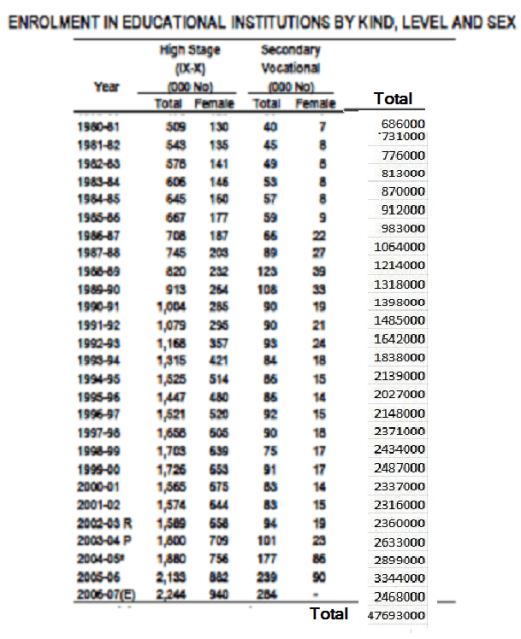

Enrollment in High and Secondary

Table 1.2 shows that during 1981 and 2007 approximately 19077200 (190.77 million) passed the exam while approximately 28615800 (286.15 million) failed the examination and dropped out of school.
Table 1.3 enrollment in high and higher secondary schools
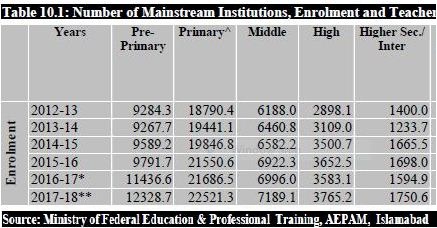
 

Table 1.3: Numbers are in thousands


Table 1.3 shows that from 2012 to 2018 the numbers of students enrolled were 20508600 (205.08 million). . Keeping in view average of fail students every year at this level, the number of fail students will be approximately 12305160 (123.05 million).
While in higher secondary/inter 9342700 (9.34 million) were enrolled and the number of failed rate at this level based on the average will be approximately 6673357 (6.67 million).
What is the purpose of examination system?
The purpose of examination is multi-fold; to evaluate the students learning achievements, to evaluate the teaching of teachers. Is it a right approach of examination system? A good approach of examination system is to give a comprehensive chance to students for learning. The purpose of education examination system is to improve the learning and reading skill of the students.
The second purpose is to evaluate the teaching skills of the teachers, for this purpose the country need such examination system which help to achieve  both objectives of the examination system. The current board exams are very old and outdated. It did not improve the quality of education, but it decrease the numbers of dropout students in the country. It is the major reason that we are still lacking behind in education from other countries.
·        The first purpose of education examination system is to improve the learning and reading skill of the students. A good collection of objective type questions from the textbook up to three hundred questions which cover every page of the book. To solve these objectives, he will learn to read, it will also help him to comprehend and learn the information that is provided in the textbook. This test must also include inductive and deductive type questions, so it develops the reasoning skills of the students. This objective type test should be given as home base test and they should be given enough time to read the textbook and found the answers. This home based objectives type assignment could be divided in two parts. One hundred and fifty questions in first semester and the rest one hundred and fifty questions in the second semester for every textbook.
·        The second purpose is to evaluate the teaching skills of the teachers. With objectives type examination we can evaluate the teaching skills of the teacher on the base of the performance ofstudents\’ achievements in the test. A good result will show that teacher was committed to his teaching and he used every possible way to develop the reading and comprehension skills of the students. When the teacher knows that he will be accountable for the bad result of his students, he will make it possible that every student understand what he is teaching. For this very purpose the country need such examination system, which help to achieveboth the objectives of the examination. The current examination system is outdated. It did not achieve the literacy rate what we are looking for. Despite it creates hinders in the improvement of literacy rate.
In most of the develop countries objective type test is implemented for the evaluation of students learning and teacher evaluation. In the area where reading and writing skills assessment is require there they use subjective type test, e.g., English, mathematics, etc.
Conclusion
From analysis it is crystal clear that what we are doing with the education on the name of quality and board examinations. It is very hard and time-consuming to calculate the accurate drop out for the last 40 years (1980-2020) for secondary (9th and 10th) and higher secondary (intermediate) level. For this purpose data was collected using internet and easily available books, research and other government documents. Majority data is easily available, but five years of data from 2008 to 2011 is not available. The data were calculated on the bases of average of available data for the missing years, the margin of error is five percent on both sides.
From the data and its analysis it is evident that in last forty years 47020000 (470.2 million) students were dropped out from schools without completing their secondary school education and 29000000 (290 million) students were from the higher/ inter level. It shows that we are dropping out millions of students every year at different stages of school on the name of quality and board examinations. Most develop country like the United States could not afford that kind of strict examination system where the literacy rate is very high. That why majority of states are ending school exit exams. The students who are weak in a particular subject are to attend summer school system. In summer school system both students and teachers have to attend school in summer vacation because both are responsible for bad result.
Suggestions and Recommendations
1.     We need to end board exams and any other drop out exams like United States; the majority of their states are ending school exit exams.
2.     We need to change the internal examination system, to a system where students learn and acquire knowledge from examination and evaluate teacher teaching on students achievements.
3.     Home objective type test is recommended for every subject. Three multiple choice questions from each page of textbook, all the questions should be arranged randomly. About every objective type question the page number of the respective question should be mentioned so the student read the page and find out the answer. The purpose of this drill is that student read every page of a textbook three times to build the reading habit of the students. Do not give a very easily discoverable objective type question.
4.     For improving writing ability in Urdu, English and local language internal subjective type exam is recommended after every three months. Written test in mathematics and Islamic studies.
5.     For improving writing skills of the students, dairy writing must be compulsory for students, at least five sentences in each language subjects.
6.     These home objective type test should  administered  by parts for each subject and at the end of the year a short objective  type test should administered from that home base test and in the subject where  reading and writing assessment is required  a subjective type  test  should be administered. The students who did not pass this test, they will attended classes in the summer vacations along their teachers. Afterward they should  be promoted to next class.
7.     For the purpose of admission in colleges or universities SAT type Test should be implemented during their last two years in higher secondary school, some colleges/ universities already require NTS Test. The score of this test could also be used for recruitment purposes.  These Tests should be based on multiple-choice type test in textbooks subjects which they are studying at this level, with additional papers to measure student’s aptitude, general, verbal and mathematical skills.
References
                                        
Burdett , N., & Everett, H. (n.d.). The impact of an examination board in Pakistan on student outcomes. Retrieved December 15, 2019, from https://www.riseprogramme.org/sites/www.riseprogramme.org/files/publications/24_Burdett_RISEconferencepaper.pdf.
Mughal, A. W. (2018). Investigating the Issue of Out of School Children in Rural Pakistan: Implications for Policymakers. Loughborough University.
Pakistan Bureau of Statistics. (n.d.). Retrieved December 15, 2019, from http://www.pbs.gov.pk/sites/default/files/50_years_statistics/vol1/12.pdf.
Pakistan Education Statistics. (2005). Retrieved December 15, 2019, from http://www.finance.gov.pk/survey/chapters/10-edu.pdf.
Pakistan Economic Survey . (2018). Retrieved December 15, 2019, from http://www.finance.gov.pk/survey/chapters_19/10-Education.pdf.


Educational Psychology

Concept of educational Psychology
What is psychology? The term \”psychology\” is derived from two Greek words – psyche (soul) and logos (science or study). Thus, literally it means study or science of soul. But now it is no more considered as science of soul. It has moved away from this focus and established itself as a scientific discipline which deals with the various processes and behavior of organism. Most of the contemporary psychologists agree on a definition of psychology as the scientific study of behavior and mental processes of organism.
There are three key terms in the above definition of psychology which have been clarified below: Scientific study means using techniques such as observation, description, and experimental investigation to collect information and then organizing this information. Mental processes refer to private and cognitive process such as attention, perception, remembering (memory), problem-solving, reasoning, decision-making, feelings, thinking, motives etc.
Definitions of Psychology • Psychology is the science of the activities of individual in relation to the environment (Woodworth). • Psychology is the positive science of behaviour (Watson). • Psychology is the science of human behavior and experience (Cruze). • Psychology is the science of mental activity of an organism (Guilford). • According to Charles E. Skinner, psychology deals with the responses to any and every kind of situation that life presents. By responses or behaviour is meant all forms of processes, adjustments, activities, and experiences of the organism.
Behaviour refers to all the actions or reactions of an organism (person or animal) in response to external or internal stimuli. The behavior of an individual, in a broad sense, refers to anything the individual does. According to Leagans (1961), behavior refers to what an individual knows (Knowledge), what s/he can do (skill – mental or physical), what s/he thinks (attitude), and what s/he actually does.
Behaviour may be simple or complex, short or enduring. Human behavior may be overt (expressed outside) or covert (expressed inside). While symbolic adoption is an example of covert behaviour, use adoption is an example of overt behavior. Both overt and covert behaviour can be measured. People who study psychological phenomena are not necessarily limited to the study of human beings only; they also study the behaviour of animals. They study the behavior and mental processes of individual not of group/community. Thus, when they are studying groups, the focus is generally on how individuals perform within the group rather than the study of the group as a whole.
EDUCATIONAL PSYCHOLOGY: MEANING AND DEFINITIONS
What is education? In order to know the educational psychology; we have to first understand what is education. The world education is derived from Latin word educare which means to bring-up. Education is also derived from another Latin world educere which means to lead out. Education as educere is more acceptable as it means leading an individual from ignorance to knowledge.
Education can be defined as the process of imparting or acquiring knowledge and habits through instruction or study. It can also be defined as a process in which human behaviour is modified so as to be in closer agreement with some model or ideal determined by the values of society. If education is to be effective, it should result in changes in all the behavioural components.
What is educational psychology?
Educational Psychology is a combination or overlapping of two separate fields of study; psychology and education. It is a distinct discipline with its own theories, research methods, problems and techniques. Educational psychology is distinct from other fields of psychology due to its focus on understanding the processes of teaching and learning that takes place in formal environments. Educational psychologists study what people think and do as they teach and learn a particular curriculum in a particular environment where education and training are intended to take place. They help in developing instructional methods and materials used to train people in both educational and work settings. They are also concerned with research on issues of relevance for education, counseling and learning problems.
Educational psychology deals with behavior of human beings in educational situation for definitions of educational psychology). This means that educational psychology is concerned with the study of human behavior or human personality, its growth, development, guidance under the social process of education. Education is possible in human beings; hence, human learning is the central core of educational psychology.
Definitions of Educational Psychology
• Educational psychology is that branch of psychology, which deals with teaching and learning. It takes its meaning from education, social process and from psychology, a behavioral science (Skinner).
• Educational Psychology is the discipline concerned with teaching and learning processes; applies the methods and theories of psychology and has its own as well (Woolfolk, 1995).
SCOPE OF EDUCATIONAL PSYCHOLOGY
Educational psychology deals with the behaviour of human beings in educational situations. Its main concerned is to identify various psychological factors affecting teaching and learning process. It describes and explains the learning according to scientifically determined principles and facts concerning human behaviour. Educational psychology addresses the questions – “why do some individual learn more than others\” and \”what can be done to improve that learning.\” Therefore, its subject matter is revolved around teaching and learning process and educational psychologists attempt to discover:
• The extent to which the factors of heredity and environment contribute to learning.
• The nature of the learning process.
• The educational significance of individual differences in rate and limit of learning.
• The inner change that occur during learning.
• The relation of teaching procedures to leaning outcomes.
• The most effective techniques for evaluating progress in learning.
• The relative effect upon an individual of formal learning as compared with incidental or informal learning experiences.
• To value the scientific attitude towards education.
• The psychological impact upon learner’s attitude of sociological conditions.
IMPORTANCE OF EDUCATIONAL PSYCHOLOGY
The importance of educational psychology in agricultural extension is immense as both disciplines deal with human behavior in educational environment. Following are the some of the reasons which explain the importance of educational psychology in agricultural extension.
• Educational psychology helps the extension agent to know the learner, his interest, attitudes, aptitude, level of aspiration, intelligence, interests, individual behavior in group, etc. which plays a major role in one\’s learning.
• Its main concern is on teaching and learning. This helps in formulating training programmes for improving the knowledge and skill of extension agent and farmers. It also helps in selection of teaching methods and aids for organizing effective learning situations and suggests technique of learning as well as teaching.
• It helps in imparting better education by organizing the subject matter of learning experience, preparation of different text books, development of assessment patterns, etc for heterogeneous learners.
• Educational psychology helps in acquainting learner with the mechanism of heredity and environment.
• It also deals with the problem-solving which is very important for extension agent to develop problem-solving skills amongst farmers.
• It helps extension agent to find causes of prejudices, the habit of sticking to old practices of farming and ways of doing things, the doubts and lack of confidence and factors affecting motivation.
• It also helps them to know the emotions and feelings of learner
Need and importance of the study of educational psychology for the teachers
1.    Understand the developmental characteristics of the children
2.    Understand the nature of class-room learning
3.    To be aware of individual differences
4.    Be aware with effective teaching methods
5.    Understand the learning problems of the children
6.    Know how to assess the learning outcomes of the students
7.    Understand the principles of curriculum constructions.
8.    Know the factors responsible for the mental ill-health and maladjustment.
9.    Predict the behaviour of students on the basis of research studies.
10. Organize educational activities for exceptional students.
11. Help students develop positive attitude.
12. Understand student’s dynamics.
13. Organize remedial instructional activities for children facing special difficulties.
14. Know the nature of motivation in learning.
15. Be aware of the possibilities and limitations of transfer of learning.
16. Be familiar with the conditions associated with juvenile delinquency.
17. Be aware of the causes of emotional disturbance in children.
18. Make use of innovations particularly relating to method.
19. Handle the problems of discipline in the classroom.
20. Keep psychological considerations in framing of time table.

Difference between group guidance and group counseling

Group counseling has become the preferred term to describe \”counseling with more than one individual simultaneously. 
The age groups for which this approach to group counseling has been directed include: preschool and early school (ages 5-9); preadolescent (ages 9-13); adolescent (ages 13-20); and adult. For each group the treatment conditions are set forth including preferred size of the group, group composition, setting and media utilized, and the nature of counselor intervention. The basic contention of the developmental approach to group counseling is that different age groups require significantly different treatment conditions. For example, the size of a counseling group of five-or six-year-olds would be about 3 or 4; nine-and ten-year-olds 5 or 6; fifteen-and sixteen-year-olds, 6 to 8; and adults, 8 to 10. The treatment setting for those five to nine years of age would be a playroom; for those approximately nine to thirteen years of age, an \”activity\” or game room, outdoor play areas, and a conference room; for adolescents and adults, a conference room would be preferred in most instances. The media would vary with the age level of the counselee with greater emphasis on toys and play materials for the young child, games and crafts for the preadolescent, and counselee talk for adolescents and adults.
1. Children
In the school setting, group counseling is often suggested for children who display behaviour problems, such as excessive fighting, chronic tiredness, violent outbursts, extreme withdrawal, inability to get along with peers, and a neglect of appearance.
In small groups, children have the opportunity to express their feelings about a wide range of personal problems. Children frequently experience learning difficulties in school as a result of inner turmoil. Some of these children suffer from anxiety over broken homes and disturbed family relationships. If the group is structured properly, these children can receive psychological assistance at an early age, and will stand a better chance of dealing effectively with the tasks they face later in life.
2. Adolescents
For most people, adolescence is a difficult period. It is characterized by paradoxes.
Adolescents strive for closeness, and yet fear intimacy and often avoid it. They rebel against control, and yet want direction and structure. While they push and test the limits imposed on them, they see limits as a sign of caring. They are not treated as mature adults, and yet are expected to act as though they had gained complete autonomy.
They are typically self-centered and pre-occupied with their own worlds, and yet are expected to deal with social demands and expand their horizons. They are asked to face and accept reality and, at the same time, many avenues of escape are available in the form of drugs and alcohol.
With adolescence come some of these conflicts: dependence/independence struggles, acceptance/rejection conflicts, identity crises, the search for security, pressure to conform, and the need for approval. Because of the stresses of the adolescent period, these years can be lonely, and it is not unusual for an adolescent to feel that there is no-one who can help.
Group counseling can be useful in dealing with these feelings of isolation, because it gives adolescents the means to express conflicting feelings, explore self-doubts, and realize that they share these concerns with their peers. A group allows adolescents to question openly their values, and talk freely about their deepest concerns. In the group, adolescents can learn to communicate with their peers, benefit from the modeling provided by the leader, and can safely experiment with reality and test their limits.
A unique value of a group is that it offers adolescents a chance to be instrumental for one another\’s growth and change. Because of the opportunities for interaction in groups, the members can express their concerns and be genuinely heard, and they can help one another gain increased self-acceptance.
3. Adults
A wide variety of special interest groups can be developed for adults of all ages. For example, groups can be formed for couples, single parents, parents who want to explore problems they have relating to their children, middle-aged people who return to college or change careers, and adults who want to explore developmental concerns, such as the search for identity.
On college campuses, groups have become increasingly popular as a way of meeting the diverse needs of students, who range from young adults to the elderly. Such groups can be created for relatively healthy students who experience a developmental crisis, or students who want to talk openly with others about their concerns. The purpose of these groups is to offer participants an opportunity to explore ways of changing certain aspects of their lives.
In group situations, college students of all ages deal with several different issues. They may include issues regarding career decisions, male/female relationships, the need for, and fear of, love, sex-role identity issues, educational plans, the meaning of life, challenging one\’s value system, and the meaning of work. There are also issues regarding feelings of loneliness and isolation, learning to form intimate relationships, exploring marital conflicts, and other concerns related to becoming a self-directed adult.
4. The Elderly
As people grow up, they face feelings of isolation, and may struggle with the problem of finding a meaning to life. Some of these older persons may resign themselves to a useless life, for they see little in their future. Like adolescents, the elderly often feel unproductive, unneeded, and unwanted by society. Another problem is that many older people have uncritically accepted myths about ageing.
Themes that are more common to the elderly than other age groups include loneliness, social isolation, losses, poverty, feelings of rejection, and the struggle to find a meaning to life, dependency, and feelings of uselessness, hopelessness and despair. There are also fears of death and dying, grief over another\’s death, sadness over physical and mental deterioration, depression, and regrets over past events. Acceptance can be through listening to their messages, and by not patronizing them. These individuals need support and encouragement, and the chance to talk openly about what they feel, and about the topics which concern them.
A counseling group can do a lot to help the elderly challenge the myths they may have that limit their lives. It can also help them to deal with the developmental tasks that they face. Like any other age-group, they must be able to face them in such a way that they retain their self-respect. Groups can assist the elderly to break out of their isolation, and encourage them to find a new meaning in life.
DEFINITIONS: GROUP GUIDANCE, GROUP COUNSELING, AND GROUP Psychotherapy
Group counseling lies on a continuum between group guidance and group psychotherapy. Group guidance is organized to prevent the development of problems. The content includes educational-vocational-personal -social information which is not otherwise systematically taught in academic courses. The typical setting is the classroom which ranges in size from approximately twenty to thirty-five. Providing accurate information for use in improved understanding of self and others is the direct emphasis in group guidance, whereas attitude change frequently is an indirect outcome or goal. The leadership is provided by a classroom teacher or a counselor who utilizes a variety of instructional media and group dynamics concepts in motivating students and in obtaining group interaction. Instructional media include unfinished stories, puppet plays, movies, films, filmstrips, guest speakers, audio-and video -taped interviews, student reports, and the like. Group dynamics concepts refer to the process employed in group guidance, such as social dramas, buzz groups, panels, and other related techniques.
The goal of group guidance is to provide students with accurate information which will help them make more appropriate plans and life decisions and, in this sense is prevention-oriented; group counseling is both prevention and remediation oriented. Group counseling is prevention oriented in the sense that the counselee or client is capable of functioning in society, but may be experiencing some \’rough spots\’ in his life. If counseling is successful, the rough spots may be resolved successfully with no serious personality defects incurred.
Group counseling is remedial for those individuals who have entered into a spiral of self-defeating behavior but who are, nevertheless, capable of reversing the spiral without counseling intervention. However with counseling intervention, the counselee is likely to recover more quickly and with fewer emotional scars.
Group counseling is defined as follows. Group counseling is a dynamic interpersonal process focusing on conscious thought and behavior and involving the therapy functions of permissiveness, orientation to reality, catharsis, and mutual trust, caring, understanding, acceptance, and support. The therapy functions are created and nurtured in a small group through the sharing of personal concerns with one\’s peers and the counselor(s). The group counselees are basically normal individuals with various concerns which are not debilitating to the extent requiring extensive personality change. The group counselees may utilize the group interaction to increase understanding and acceptance of values and goals and to learn and/or unlearn certain attitudes and behaviors.
Difference between group guidance and group counseling:
Although the content of group counseling is very similar to group guidance-including educational, vocational, personal, and social concerns-a number of other factors are quite different. First, group guidance is recommended for allschool students on a regularly scheduled basis: group counseling is recommended only for those who are experiencing continuing or temporary problems that information alone will not resolve. Secondly, group guidance makes an indirect attempt to change attitudes and behaviors through accurate information or an emphasis on cognitive or intellective functioning: group counseling make a direct attempt to modify attitudes and behaviors by emphasizing affective involvement. Finally, group guidance is applicable to classroom-size groups, whereas group counseling is dependent upon the development of strong group cohesiveness and the sharing of personal concerns which is most applicable to small, intimate groups.
Group psychotherapy
Group psychotherapy, the third part of the guidance, counseling, therapy continuum, was coined by J. L. Moreno in 1936 (Corsini, 1957). Moreno\’s definition is a general definition: \”Group psychotherapy means simply to treat people in groups (1962, p. 263).\” It is generally accepted that there is a difference in group counseling and group psychotherapy although there is overlap between them.
Brammer and Shostrom (1960) have characterized these differences by the following series of adjectives in which counseling is described as \”educational, supportive, situational, problem solving, conscious awareness, emphasis on \’normal’s\’, and short term. Psychotherapy is characterized by supportive (in a more particular sense), reconstructive, depth analysis, analytical, focus on the unconscious, emphasis on \’neurotics\’ or other severe emotional problems, and long-term. Although these differentiation\’s were applied to individual counseling and psychotherapy, they are equally applicable to group counseling and group psychotherapy.
PURPOSES OF GROUPS
The following are the goals and purposes of groups:
• To grow in self-acceptance and learn not to demand perfection.
• To learn how to trust oneself and others.
• To foster self-knowledge and the development of a unique self-identity.
• To lessen fears of intimacy, and learn to reach out to those one would like to be closer
To.
• To move away from meeting other\’s expectations, and decide for oneself the standards
By which to live.
• To increase self-awareness, and increase the possibilities for choosing and acting.
• To become aware of choices and to make choices wisely.
• To become more sensitive to the needs and feelings of others.
• To clarify values and decide whether, and how, to modify them.
• To find ways of understanding, and resolving, personal problems.