The 5 C’s of Credit

By Chemeketa SBDC

Businesses require capital to start, run and grow. Where does it come from? Isn’t that a large piece of the successful business puzzle? Many small businesses must save for years or invest inheritance or retirement funds, while others borrow from friends and family.
While these are successful venues to pursue in raising funds for business, they are not always available. Who is always available? The bank.
Visiting a bank is not a guarantee that you will receive needed funds; typically, about one in four businesses will be successful in getting a loan. Why is that number so low? Banks want to lend in a manner that brings the greatest return for the least risk. In other words, they want to know they’ll get their money back.
So your job as a potential borrower is to demonstrate that you are capable of repaying what was borrowed and that you are a minimal risk to the bank. Banks look at potential borrowers and assess their 5 C’s: character, credit score, capacity, capital and collateral. Bankers often use this term to describe the considerations given to the borrowing ability of a small business.
A bank is going to assess your character. This is often picked up during the interview process and throughout your work with the loan officers. Do you have a history of paying on time? How do you treat your managers, employees, vendors and customers? This is a subjective judgment but is one of the 5 C’s, a piece of the decision-making process.
On the flip side, the next test is not so subjective. Credit score is often a make-or-break consideration. A credit score demonstrates your commitment to meeting your financial obligations. There is not a concrete minimum score; each institution sets its own policy regarding credit scores. Having a high score increases your chances of borrowing money.
Free reports are available, and you should review your score at least annually. This will help you identify ways to clean up your credit. It also provides a basis for comparing yourself to other borrowers, as most reports tell you where you rank nationwide. You can work on your credit score for months and even years in advance of applying for a loan to position yourself to be lendable.
Capacity is where your projections are used. What is your ability to repay the loan? A banker will look for sufficient cash flows to cover your debt repayments, not just to this bank but to all the sources from which you have borrowed funds.
Debt-to-income ratios are used in making these determinations. Most homebuyers are familiar with this computation. When looking at your total debt payments as a percentage of your total income, it must be below certain thresholds determined by the bank to keep its risks at moderate levels.
Next comes the skin-in-the-game test. A lender wants you to invest, not just your time and efforts, but your money into the business as well. Capital. This is often a deal breaker as many people expect to be 100 percent financed. Typically you will need to contribute 20 to 30 percent of the capital. These funds are often raised from friends, family or retirement withdrawals.
The last of the 5 C’s is collateral. Your lender wants to know how it can get its money back if you default and don’t repay. If you pledge real estate or capital equipment as collateral, then you can be forced to sell the assets and the proceeds used to repay your creditor. Remember, banks are risk averse, and having sufficient collateral allows them the best opportunity to recover their funds, but such a drastic measure is typically a worst-case scenario.
Banks are great to work with. They want to lend money. But will they lend to you? Are you bankable? That is for the bank to determine, but if you strive to improve your 5 C’s, you are giving yourself the best chance at raising the funds necessary to start, run and grow your small business.

Considering a Gig Job? Here’s What You Should Know.

Gig jobs are those where workers earn money based on the task, or “gig” they complete. Gig workers are typically independent contractors or free-lancers who work part-time, without benefits, sometimes for multiple companies. There has been a lot of buzz in the press lately about the rise of the gig economy. Is this the new wave of the future?
According to Colorado Department of Labor statistics, the number of Colorado part-time workers actually decreased from 23.9% in 2006 to 22.5% in 2016. Interestingly, the number of part-time workers seeking full-time employment rose during the same period, from 13.7% in 2006 to 16.7% in 2016. So what does this mean? Despite all the press, the gig economy isn’t significantly changing the way we work. People work part-time for a number of reasons and some of those prefer full-time work.
What has changed is the number of opportunities. The rise of Uber, Lyft, Airbnb, Rover and similar companies has resulted in an increasing number of easily accessible gig jobs. If you are considering testing the gig economy, here are some considerations:
  1. Is the gig economy a good fit? If you’re trying to earn some extra cash, try out a new business or field, or plan for a future career change, a gig job may be what you’re looking for. If you crave stability, benefits or a traditional structure, you will likely wind up frustrated.
  2. Do you like flexibility? The hours and schedules for gig jobs can flex to fit your lifestyle. Do you have to work around another job or family obligations? Do you prefer to work from home? As your own boss, you decide when and where to work.
  3. Can you manage yourself? You won’t have a set schedule so you have to stay on task. If you don’t work, you don’t get paid. And don’t forget to plan for taxes as a self-employed worker.
  4. Do you offer a needed skill? As in most types of work, the more in-demand your skill, the higher the pay. If anyone can do the gig job, you may be putting in a lot of hours for minimal return. Working the most needed hours or providing something that is more niche should increase your income.
  5. Are you entrepreneurial? If being your own boss is appealing, gig jobs may be a great option. Working for larger companies as an independent contractor can allow you to focus on the work you love.
If you’re interested in learning more about the gig economy, join the DU Young Professionals on October 17 to hear about the benefits and challenges of working gig jobs. Register here.

Take Advantage of the Just in Time Career & Internship Fair

Careers with a Cause

All Majors “Just In Time” Career & Internship Fair

Whether you’re at the career fair to gather information about possible careers, or to network with employers and alumni, it’s important to be prepared and professional.
If it’s your first time working the room, we have some tips that will help you get the information you need and make a good first impression.

PREPARING FOR THE CAREER FAIR

  • Look over the list of attending employers and target those that interest you most.
  • Research your target employers ahead of time and carefully review their company websites and job listings.
  • Make a list of questions you want to ask your target employers.
  • Update your resume, making sure it’s relevant to your target employers.
  • As a rule of thumb, bring at least 10 more copies of your resume than you think you’ll need. It’s better to have too many than too few.
  • Bring a notebook or portfolio with room to collect business cards and brochures.
  • Prepare a short, professional introduction, including focused information about your experience, strengths, accomplishments, career interests and goals.
  • Dress professionally.
  • Arrive early, and plan extra time for parking and locating your target employers.

NETWORKING WITH EMPLOYERS AND ALUMNI

  • Always shake hands, make eye contact and smile when you meet someone for the first time. Demonstrate enthusiasm, confidence and interest.
  • Introduce yourself using your prepared professional introduction and don’t forget to ask the questions you’ve prepared.
  • Answer any questions directly, politely and concisely.
  • Listen attentively, take notes if you need them, and ask for business cards and brochures from your target employers.
  • Network with other students and alumni as you go; they may know of other relevant opportunities.
  • If you’re feeling overwhelmed, take a break. Give yourself time to get organized and return to the fair with renewed energy.
  • Always thank employer representatives for their time.

GATHERING INFORMATION

If you haven’t yet declared a major or chosen a career path, career fairs can be a great place to do a little research.
Before the fair, make a list of careers and fields you’re considering. Then, during the fair, approach the relevant employers, introduce yourself, and tell them you’re currently researching careers, and would love to know more about their company and industry.

GETTING CREATIVE—WHEN YOUR FIELD ISN’T REPRESENTED AT THE FAIR

If you’re interested in one career, but an employer is recruiting for another, don’t let that stop you from saying hello.
Pick employers who might use your skill set, introduce yourself and ask about opportunities in your field. Ask if the representative can give you a name and contact information for someone in the relevant department.
Even if the recruiter takes a copy of your resume to pass along, make sure to follow up with the relevant department after the fair.

AFTER THE CAREER FAIR

  • Send thank you notes to representatives at your target companies. Thank them for the information, remind them how you met, and reiterate your qualifications and interest in the company.
  • Follow up on interesting employment opportunities; send your resume and cover letter to the potential employer, complete an online application, request a job description or application packet, or call or email the relevant person/department to ask if someone has had a chance to review the resume you submitted at the fair.

RELAX; IT’S NOT A TEST.

Don’t forget to relax and have fun. Choosing a career and finding a job can be daunting, but it can also be exciting—learning more about your options, taking advantage of free employer giveaways and meeting new people.
So, while you’re doing your research and making your connections, don’t forget to smile and enjoy the process.
Need some help brainstorming your introduction, preparing your resume or coming up with employer questions? Contact our team.

3 Lies You Tell Yourself When You Can’t Seem to Get Any Interviews

3 Lies You Tell Yourself When You Can’t Seem to Get Any Interviews was originally published on The Muse, a great place to research companies and careers. Click here to search for great jobs and companies near you.
At one point during my last job search, I lost count of how many days went by without an interview. And as much as I wanted to say I was doing just peachy, the truth was that having nothing on my calendar was taking a toll on me. I get a lot of energy from being around people, so the fact that I had nowhere to be but the little desk in our living room made me feel like a complete failure.
Fast-forward to today and that experience makes me confident enough to say two things. For starters, people in a similar situation are absolutely not failures. But even more importantly, there are some pretty common lies that are easy to believe when you’re constantly striking out.
Since you’re reading this right now, here are a few things I have a feeling you’re thinking right this second.

1. I Need to Apply to More Jobs to Increase My Odds

Sometimes, job openings can seem like lottery tickets. When you need to find something ASAP, it’s even easier to look at the number of positions you’ve applied for and say, “I need to double that number to increase my chances of landing one of them.” And when that happens, you end up spending an entire day sending out typo-ridden resumes and badly-tailored cover letters just for the sake of being able to say you did “everything you could” to find your next gig.

What to Do Instead

Instead of applying for more jobs, take a closer look at the positions you’ve applied for recently. You might find that some of them aren’t actually aligned with your career goals. In other cases, you’ll discover that you made a critical error on your application that cost you the interview. No matter what you find, do a little homework on your past applications before you start blasting out more to out to any company that happens to be hiring.

2. I Have it Pretty Good at My Current Job

When all you’re getting is radio silence, it’s easy to look at your current role with rose-colored glasses and assume that it’s a sign that you should stay put. I’ve been there myself. Ask any one of my closest friends, and they’ll tell you about a time when I said that even though my job at the time kept me up all night, that at least I was able to make my rent. And when nobody’s reaching out to schedule any interviews, it’s easy to take this lie as proof that it’s time to pump the brakes on trying to find something new.

What to Do Instead

A friend of mine forced me at one point to write down everything I disliked about my position. Not just hypothetically, and not just during a general brainstorming session. I mean I got a pen and pad out of my desk, gave myself 30 minutes to think about my job, and write down what I couldn’t stand about it.
At the end of the exercise, I realized that it was time to start pursuing new opportunities ASAP. This might sound silly, but seeing your biggest grievances written down in ink is a pretty good motivator to keep grinding during a long hunt.

STILL HAVEN’T FOUND THE RIGHT JOB FOR YOU?

Good thing we have 80,000+ openings listed just one click away.
Hint: This is the one click
\'jobs\'

3. There’s Nothing I Can Do to Change This

When things aren’t going your way, simply getting an interview on the calendar can seem impossible. And as the days (sometimes, weeks) go by with nothing but radio silence, it’s natural to assume that you’re not hearing back from employers because you’re just the worst candidate on the face of the earth. Of course, that couldn’t be further from the truth—but when you have nothing to look forward to, it’s hard to believe otherwise.

What to Do Instead

This might sound counterintuitive, but I found that it was incredibly helpful at these junctures to take a break from my hunt. I had a really hard time being productive (let alone find openings I actually wanted) when I was so down on myself. If you’re currently employed, take a day to focus 100% on your current role, even if you hate what you’re doing.
Or, if you’re unemployed, take an afternoon to catch up on something you enjoy doing. This might sound like a step in the wrong direction, but you’ll be more inspired to get back on the grind after you take a second to catch your breath.
But in the event that you still need a little kick in the pants to shake the feeling that you can’t change your situation, consider hiring a career coach to help you understand why you’re not getting any responses.
No matter where you are in your job search, it’s hard to look at your calendar and see absolutely nothing on the docket. Of course, there are a few things about your approach you could consider adjusting.
But no matter how many (or how few) interviews you have lined up, don’t let yourself believe that things will be like this forever. Find the help you need, take a few beats to collect your thoughts, and attack the search like you and I both know you can attack it.

How To Get That Interview And Land The Job

Get That Interview And Land The Job
Do you feel as though you’re great on paper, but you’re not able to get past the application stage of the job search process? It’s not about your experience, but the approaches you’re taking when looking for work. Here’s how you can optimize your job seeking process and get that interview.

Take advantage of applicant tracking systems

Many companies now use applicant tracking systems to whittle down the applicants for interview automatically. These systems use keywords and look for them in your application. If they can’t find enough instances of them, your application is instantly rejected. Determine what they keywords may be, and make sure you use them.

Don’t be too picky

Students who have just graduated, or people looking to switch career, are often stuck in the trap of looking for the perfect job. The problem is, it doesn’t exist. The roles you’re applying for will never be able to meet every single thing you require of them. If you understand that when you’re applying, you’re much more likely to be able to adapt to the roles at hand.

Take your time

Don’t rush an application. Take your time and research the company you’re applying to. Take care in the writing of your CV and covering letter. If you plan in advance, you can put a lot more care and attention into what you write.

Don’t ignore temporary jobs

Temp jobs may feel like a step back when you’re job hunting, but in fact, you’re much better off in a temp job than unemployed. If you have large gaps in your CV, then you’ll have to explain them to any recruiter who asks. If you’ve been temping though, you can show that you’ve been active in working, even if it’s just temping, while you’ve been looking for a better role. Some companies will hire their temps on permanently if they’re good, so it’s worth making a good impression while you’re there.

Get your foot in the door

Before getting that perfect role, you need to get your foot in the door. Don’t focus too much on the role itself, if it’s with the right industry or company. Instead, just get in here and then focus on working your way up the ladder. You have the opportunity to really show what you’re made of, so use it.

Tools to help you get that job

– Resumention: These writers will happily work with you in order to get your CV looking perfect.
– 5 Ways To Create A Truly Memorable Resume: This guide has some highly useful technical tips to help you put your CV together before you apply.
– PaperFellows: If you struggle with grammar, this is a writing community to turn to. Users can suggest you how to correct the grammar in an existing CV, or help you with writing a new one.
– 10 Resume Building Tools And Services: These tools can be very helpful in the CV writing and application process, and so are worth checking out.
– Resume Genius: This website has a whole host of resume templates to choose from, so you have a good base to start writing from.
– EasyWordCount: If you’re struggling to proofread, or you don’t have time to get it done, use this online tool. It will highlight the misspells in your CV.
To get that interview, it just takes a slight readjustment of expectations and a different approach to what you’re doing. Take this advice and you’ll soon be getting the interviews you need. You’ll get that job in no time.

What Actually Happened When I Transferred to a Different Team at My Company

What Actually Happened When I Transferred to a Different Team at My Company was originally published on The Muse, a great place to research companies and careers. Click here to search for great jobs and companies near you.
If you told me a year ago that I’d wind up changing jobs, there’s no way I would’ve believed you. I felt really lucky that my first role out of college was at a company with a mission I believed in—and I had no complaints.
Fast forward and I’m working in a completely different field as an HR Coordinator. I love my current role, even though I hadn’t always been planning on it.
So, what happened in between? I transferred internally from the profiles team at The Muse to a role in human resources, and the process was nowhere near as scary as I imagined it would be.
That said, there were three steps that helped make the transition go smoothly that I’d recommend to anyone contemplating a similar move.

1. I Tried the Sort of Work I’d Be Doing First

My first hint that I was interested in another field came out of a project I worked on for fun in which I helped organize a way to formally celebrate employee anniversaries. (Yes, this was something I thought was fun!)
After testing it out and seeing the success, I kept going—despite the fact it was in no way a part of my role.
The fact I looked forward to this was a big sign to me that I wanted to be a part of helping people feel recognized and appreciated for their time at work.

Here’s How You Can Do the Same

If you’re drawn to opportunities outside of your job description, take them on. Yes, it can mean more work in the short run, but it’s a great way to find out how much you enjoy it—before you set things in motion to change roles.
Not to mention, when something opens up in that other department and you want to apply, you’ll have concrete examples of how you can contribute.
\'\'
Hanging out with my first team at The Muse in the office

2. I Talked to My Boss

After I read the job description for the HR Coordinator role, I decided I’d like to pursue it. So, my next step was to have a long talk with my manager about what it would mean if I applied—whether or not I ended up getting the job.
I was torn between wanting to apply, and not wanting to leave the team that I’d grown so close to. It was hard for me to wrap my head around the right decision since I wasn’t unhappy. My manager was extremely supportive and let me know that my current position would still be there for me if I didn’t end up getting this new job.

Here’s How to Have That Conversation

Before you sit down with your boss, be prepared to discuss why you want to apply. Assuming you’re on good terms with your manager and he or she cares about your growth, it’ll be a positive exchange (albeit a little awkward).
Think of this discussion as a good time to talk about what you like and dislike about your current position. If you end up staying, you’ve started a dialogue about the work you’re most passionate about, and if someone else needs to take your place, your manager has the information they need to help the team move forward. Since you’ll remain working in the same vicinity, it’s incredibly important to keep this conversation positive (so no burning bridges or turning this into a venting session).
That said, I know not everyone has a good relationship with their boss. So, if you think they may start excluding you from good projects if you share your desire to change roles—and then stay put—that’s something to think about before moving forward.
\'\'
Hanging out with my second team at The Muse on our ski retreat

3. I Stayed Considerate of My Old Team

When I found out that I got the position, I was thrilled for this new chapter to start, but also anxious. I knew why I wanted it, but since I hadn’t been unhappy or actively looking for a job before applying, how would I explain it to my co-workers? Would I have to explain my move to people one by one as I ran into them at the Keurig machine?
I informed the people I worked closest with first and worked with my team to make sure all of my daily responsibilities would be covered before I moved. The week before I started, my new manager sent out an email to the whole team announcing my new role (and saving me from having to explain why I was suddenly sitting at a different table).

Here’s How to Leave on Good Terms

If you get the offer: Congrats! Once everything’s official, have a conversation with your manager letting them know you’ve accepted and offer up any details about the timeline.
Fortunately for your team, your transition away from the role will be a little less scary since you’ll still be around for any questions. Be sure you speak personally with anyone who reports to you or who relies on you to get their own job done before any wider announcements are made.
If you don’t get the job, spend some time thinking about what motivated you to apply and focus on ways you can grow your current role—or if that’s not possible, ways you stretch outside of work.
At most (reasonable) organizations, applying for a job internally will not affect your current role. Though, if you find yourself incredibly bummed that you didn’t get it—or you do feel repercussions—it might be a sign that it’s time to explore other similar opportunities outside of your current company.

WANT TO SEE WHAT IT WOULD BE LIKE TO WORK IN HR?

…You know, just like, take a quick peek at what the roles look like?
Yes? Check Out HR Openings Here
\'Human
Once everyone knew, my inbox flooded with supportive and congratulatory messages from my co-workers. I learned that if you take the initiative to explore what you’re really passionate about, it’s hard for people not to be excited for you.
So, if you find yourself being drawn to a new opportunity, see it through. And when you’re happy at your current company already, an internal transfer is really the best of both worlds.

Mentoring in the Workplace


Looking for a way to enhance your professional and personal skills in the workplace?  Finding a mentor is a great way to do just that!  Mentoring programs are becoming a standard in many organizations.  According to Chronus Corporation, over 71 % of Fortune 500 companies now offer mentoring or sponsorship programs.
A few benefits to having a mentor are learning:
  • valuable business and life skills
  • best practices for your industry
  • appropriate behaviors and protocols.
Having a mentor gives you the opportunity to discuss your ideas and opinions with an interested listener in a safe and confidential environment.  You can also benefit from hearing the lessons that your mentor has learned along the way – both their successes and failures.  Having a mentor sets a great training ground to enable you to develop good mentoring behaviors to become a good mentor for others in the future.
Here are a few tips on how to find a mentor:
  1. Ask yourself what you want in a mentor. Is it an expert who can help with a specific business challenge?  Are you looking for someone inside your workplace who has the inside track to be an advocate for you?  Mentoring doesn’t have to be a “business” relationship, you can find mentors outside the workplace from organizations you belong to or neighbors and relatives as well.
  2. Check with your employer’s human resources department to see if they have a mentoring program. Many big corporations offer sponsorship or mentoring programs.  You can also tap into industry associations.
  3. College ties do bind. Find a mentor from your alma mater by utilizing Pioneer Connect and LinkedIn.
  4. Try to find a mentor who will challenge your thinking and show you there might be a different way to approach a problem, or an additional potential, one you never knew existed.
  5. Make it fun! When asking for a meeting with a potential mentor, avoid making it seem as though you will only add to their workload.
Mentorship is an exciting opportunity for both of you and often turns into a mutually beneficial relationship.
Author: Kelli Sessions is the Career Services Coordinator in the Taylor Family Undergraduate Career Center in Daniels College of Business.
Editor: Maria Kuntz, Assistant Director, Advancement Marketing at University of Denver

3 Things Recruiters Always Look for on Your LinkedIn Profile

3 Things Recruiters Always Look for on Your LinkedIn Profile was originally published on The Muse, a great place to research companies and careers. Click here to search for great jobs and companies near you.
Let’s cut to the chase: If your profile isn’t telling hiring managers who you are, what you’re about, and how well you’ll do the job–you could be missing out on your next opportunity (and not even know it).
As an HR professional and career coach, I work with recruiters every single day, so I can give you an inside look at what needs to be on your LinkedIn profile if you want to get noticed.
Although there’s no hard and fast rule that’ll guarantee you’ll get hired, there are at least three things your profile must have in order to up the odds you’ll get noticed.

1. Your Qualifications Match the Open Role

The number one mandate every recruiter has is to match competent and qualified individuals to open positions. One of the easiest ways for them to do this via LinkedIn is to search for keywords that relate to the position they’re trying to fill.
For example, if a particular role requires extensive project management skills, one of the key things they’ll be searching for is: extensive project management experience.
Your job is to make it easier for them to understand your specific expertise as well as your core skills and accomplishments. In the time it takes to scroll down the page, they’ll need to see concrete examples of your experience relevant to the role being filled. You can demonstrate this by doing some research on the one or two skills people who do well in the jobs you’re applying for have and making sure to clearly describe them in key places on your profile (i.e., in the headlinesummary, and job description sections).
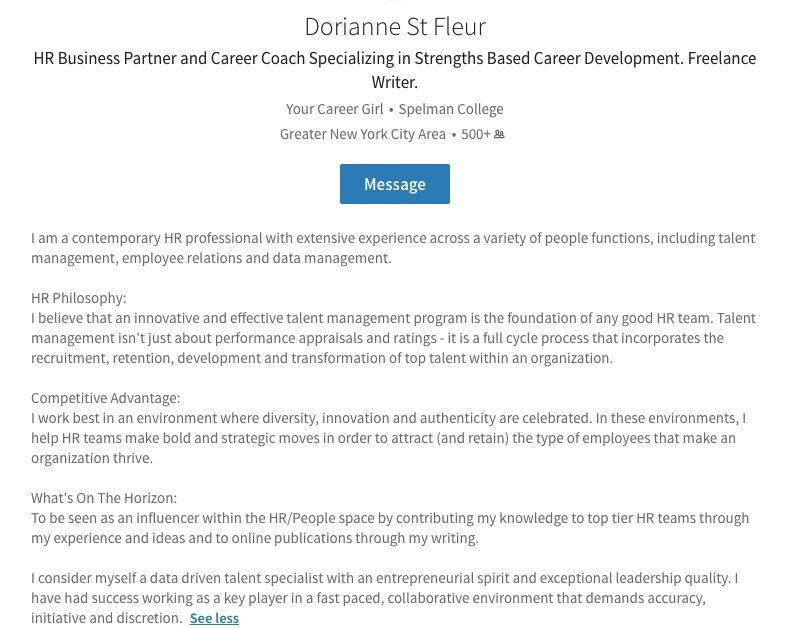
For example, if I were to apply for openings in human resources, a recruiter would take one look at my profile and see how I stand up to the competition and what I’ve accomplished:
\'\'

2. You’re Accomplished

It may seem counterintuitive, but including buzzwords like “team player” and “subject matter expert” on your profile can actually work against you since recruiters are more interested in learning about what you’ve actually achieved throughout your career, instead of how many adjectives you can use to describe yourself.
It’s important that you identify key professional accomplishments (at least two or three) and infuse them into the narrative on your profile. Explaining that you’ve led a team that was able to exceed target revenue for the past three quarters, for example, is a good way to highlight your leadership skills—rather than simply describing yourself as an “experienced leader.”
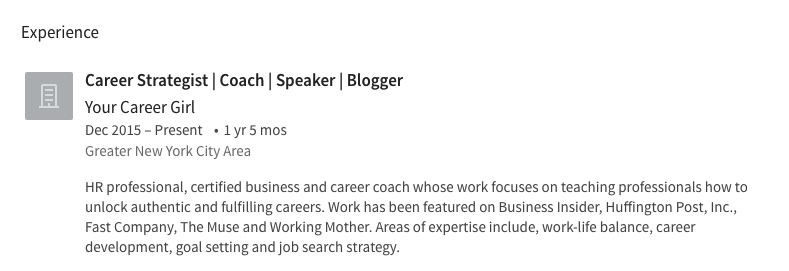
You’ll see in one of my job experience description featured below, I avoid buzzwords that fail to demonstrate my achievments. Instead, I clearly show where I’ve been featured and the many roles I’ve held within a particular company:
\'\'

3. You Have Zero Red Flags

Part of a recruiter’s responsibilities is to sort through the hundreds of candidates searching for roles to find individuals with the skills and experience needed for the open positions. One of the filters they use to get through the high volume is to eliminate anyone with glaring red flags.
Some common one include:
• Inflated Job Titles: It’s hard to become the VP of your department with only two years of work experience. Exaggerating about your title can make you seem disingenuous and untrustworthy—two things you don’t want recruiters to associate with you.
• Excessive Job Hopping: While there could very likely be a good reason for one short stint (maybe even two) on your resume, candidates who switch jobs every year can seem like they tap out quickly or have trouble meshing well with new co-workers.
• Inappropriate Language: It’s never OK to use profanity or suggestive language on LinkedIn (this includes articles you share and statuses you “like”). It can make you come off as unprofessional, which is the opposite of what you want a recruiter to think about you.
Things like these are warning signs to recruiters and can take you out of the running immediately. In order to position yourself as a good match for what a company is looking for, you’ve got to keep an eye out for anything on your profile that could be perceived in a negative light.

IS YOUR LINKEDIN PROFILE IN GREAT SHAPE?

Then start job searching with the confidence that you’ll stand out.
Just click here
\'jobs\'
If you’re looking for your next job and your profile could use some work, my advice to you is to take a break from your search until you’ve had a chance to make the necessary updates. A well put-together LinkedIn page will dramatically improve the likelihood you’ll pique recruiters’ interests—which could, in turn, help you land your next gig.

The Underrated Career Lesson I Learned After I Crashed and Burned at Work

The Underrated Career Lesson I Learned After I Crashed and Burned at Work was originally published on The Muse, a great place to research companies and careers. Click here to search for great jobs and companies near you.
I nailed every word of the presentation. I articulated my points, my visual aids were clear, and my data outlined every reason my peers should get on board with my new big project: launching a peer-coaching program. This initiative was sure to make me shine in my role as a leadership coach.
But as I looked up from my slides, I could see that the audience was unmoved. Several said they simply didn’t have time for it. Others sat silently, but the look on their faces told me all I needed to know: They weren’t into it and wouldn’t support it—or me.
I walked out of the room defeated. Without the critical backing of this group, my project was doomed to fail.
Afterward, I sought out my boss for feedback, but her candid response left me even more stunned. “You should take the time to get to know each of your co-workers personally; they all have really interesting stories to tell.”
Huh? What did getting to know my colleagues have anything to do with working together professionally? How is knowing what position Greg’s kid plays in little league going to help me to get my work done? Or where Jane is getting married?
I considered myself a caring person. I used to be a social worker! But, as I thought more about my boss’ advice, it dawned on me that perhaps there was a disconnect between how my new co-workers expected me to act and how I was behaving. I’d completely failed to recognize the culture of my new workplace—not to mention the fact that building relationships with co-workers beyond spreadsheet data had been increasing in importance for a while.
When team members came into my office and wanted to chat about their weekends, I half-listened before hastily wrapping up the conversation with a “glad to hear, gotta go back to work.” When people asked me to lunch, I told them I had a big deadline (which most of the time I did), and replied, “maybe next time.” But there never was a next time.
Heeding my manager’s advice (I had nothing to lose, after all), I began investing time, energy, and effort into getting to know my colleagues—and not because I was pushing an agenda.
I asked my teammate Rebecca how she was spending the holiday weekend. I stopped by Dan’s cubicle and invited him to join me for a coffee break. I stopped walking past Mary’s desk in a big hurry in the morning and instead paused to say hello and ask who was pictured in the frame next to her computer.
And I listened with my full attention.
It took some time for them trust that I was being sincere. In fact, some of them even directly asked me what I needed or wanted, referencing my by now, long-forgotten project. Opting to be candid, I explained that I’d made a mistake when I first came on board: I’d not taken the time to get to know the most important part of my new company, the people. It took time to build relationships and form friendships.
But, you know what happened? Being genuinely interested in others and building relationships eased the stress of deadlines and the strain of long projects. Being a true people-person felt good!
I quickly learned that work relationships are instrumental in helping you succeed. People respond well to those they know and those who treat them right.
Once I realized this, three notable things happened:
  • I got picked for better projects
  • My ideas were heard (and very often approved)
  • I received additional support
When you have strong relationships with your colleagues, you’re far more likely to be respected. And when you’re respected, you can speak and expect people to listen to what you’re saying. Even if your co-workers don’t 100% agree with your ideas, they’re likely to take a chance and offer approval if they value you as a person and professional.
Having colleagues on your side means that if you make the infrequent last-minute request, ask for a favor, or even miss a deadline, you’re not going to be punished for it. You’ll be forgiven quickly and everyone will move on.
I’ve come a long way from that crash and burn, and now my days are spent guiding others to career success and fulfillment. The guiding principle on which my practice rests is that the more effort and genuine care you put into building strong work relationships, the more successful you’ll be.

Real World Advice: Transitioning from College to the Workforce

Are you preparing to complete your degree and start working full time? Would you appreciate a few words of wisdom from people who have been in your shoes? The United States Patent and Trademark Office helps inventors and entrepreneurs introduce their innovations and products to the world. We employ over 12,000 professionals with degrees ranging from electrical and mechanical engineering to finance, IT and law. Our people work as patent examiners, accountants, help desk technicians, HR professionals, trademark examining attorneys and a variety of other roles to help bring innovation to life. We tapped some of these professionals and asked them what advice they would give their college selves if they could travel back in time. We hope their words of wisdom help as you prepare to navigate the future.
“Your basic STEM knowledge — problem solving and understanding how things work — is so valuable in all aspects of life. It can help you in your career and beyond. Be willing to use it to make a difference.”- Joyce Ward Director, Office of Education and Outreach
“Self-discipline and a willingness to learn are two vital skills you must have when you enter the workforce. You will most likely have a role that will provide you some autonomy, so you need to have the discipline to get things done. And though you have a degree, you’ll still have a lot to learn, so be open to it. Don’t go in thinking you know everything.”- Rebecca Volentine Patent Examiner
“Be ready to adapt, work hard, sacrifice, and have an open mind to seek support and help. There will be a lot for you to soak up and learn, so you’ll need to be agile and willing to give of yourself.”- Arleen Vazquez Supervisory Patent Examiner
“Consider what your short and long-term goals are. Ask questions. Be confident in yourself and your abilities. Use experiences inside and outside of your professional education to build your career. Know how to budget your time and multitask. Be organized.” – Kendra Carter Patent Examiner
“Remember to G.I.V.E. — Gratitude: Don’t take things for granted, and always give appreciation for any help you receive. Initiative: Find ways to obtain the experience that you need to get you where you want to go. Volunteer: Not only does it provide a great pathway to happiness, but will also likely help your career by broadening your people network and enhancing your experience. Execute: When you take initiative to do something, make sure that you have the time to do it well.”- Sarah Harris General Counsel
“Do yourself and the world a favor — learn as much as you can so you can make informed decisions. You may discover you have strengths and passions you did not know existed.” – Ivana Miranda Financial Analyst
“Consistently do a great job. Cultivate a reputation as someone who has a high quality work product and a strong work ethic.”- Montia Pressey Trademark Attorney Advisor

Special Thanks to USPTO for this great resource!

The content and images in this article were provided to our office by the United States Patent and Trademark Office.

3 Ways to Be More Productive at Work

college student
Whether you’re just starting your first internship or you’re already settled into a full-time job, being productive is something that should be at the top of your mind. Why? Because productivity not only makes you a better employee, it also ensures that you can be successful in your role and advance in your career.

Here are three things you can do to be more productive at work.

1. Have a consistent morning routine

If you’ve ever read about the daily routines of successful entrepreneurs like Mark Zuckerberg, then you know that most of them have very specific things they do every morning, from answering their emails right when they wake up to making sure that they take the time to exercise. Although you might not consider yourself an entrepreneur (yet) having a morning routine is important even when you’re just starting out. A good way to create your routine is by figuring out the things that are most important in your day and then prioritizing them accordingly. For example, if you know that creating a to-do list and answering emails first thing in the morning will make your more productive throughout the day, make these tasks part of your morning routine and tackle them before you move on to anything else.

2. Focus on one thing at a time
While multitasking might seem like a great thing in theory, studies have consistently shown that it doesn’t work. What does work is focusing your attention on specific tasks by dividing up up your day into blocks of time. For example, if you’re a social media manager whose day involves creating social media posts, analyzing campaign performance and attending meetings, blocking off time to work on each of those tasks will ensure that you’re able to focus on each one individually and accomplish them effectively. A quick way to do this is by closing out all the tabs and programs you have open on your computer, leaving open only the ones you need for the task at hand.

3. Take breaks and know when to unplug

Taking breaks might seem counterintuitive to productivity, especially during a busy day when you have a lot to do, but they’re actually a great way to recharge your body and reset your mind. A good rule of thumb is to take a 5-10 minute break every hour to stretch your legs and look away from your computer screen. Methods like the Pomodoro Technique can come in handy here, since they’ll help you stay mindful of the passing hours and remind you to take breaks when you need them. Even more important is the idea of totally unplugging once you leave for the day. Although it may be tempting to keep checking your email, doing so will only keep you in work mode longer, making it harder to relax and making you more tired in the meantime. To truly be productive, it’s important to have some time offline every night to focus on other things and recharge for the following day.
Being productive is a great way to be successful in your role and to show your manager that you’re enthusiastic about your job. By following these steps, you’ll be able to get all your work done and still find time to have fun.
Next, get more career tips for internships and entry-level jobs such as How to Negotiate a Job Offer and find answers to common interview questions such as What Motivates You?

Top 5 Tools for Digital Marketing

Top 5 Tools for Digital Marketing was originally published on WayUp Guide.
Software engineer
When it comes to digital marketing, few things are as important as the tools digital marketers rely on to get their jobs done. These include everything from social media platforms like Facebook and Instagram to analytics tools like Google Analytics. Allowing marketers to create, test and measure the performance of their campaigns, digital marketing tools ensure that marketers can launch and test campaigns quickly and effectively.
Here are the five common digital marketing tools.

1. Social media platforms

A common part of any integrated marketing strategy, social media platforms like FacebookInstagram and Snapchat are a great way for marketers to engage with their audiences and generate buzz around their brand. In addition to the standard features these platforms offer, there are also some features that are designed specifically for marketing. These include Facebook Ads Manager, which allows marketers to run ads and track ad performance. As an added bonus, social media management tools like Buffer and Hootsuite also integrate well with these platforms, making it easy to schedule social posts and measure engagement.

2. Design tools

Another key part of digital marketing is design and this is especially common when it comes to creating ads and content like social media posts and blog posts. Because digital marketing is such a design heavy field, doing it effectively wouldn’t be possible without design tools like Canva and Photoshop, programs that allow those without extensive graphic design skills to add dynamic images to their content.

3. Analytics tools

Another set of helpful tools for digital marketers are analytics tools. These include everything from Google Analytics (designed to track stats for web traffic to a particular site) to social media analytics tools like Facebook Insights and Twitter Analytics which provide metrics related to engagement and help marketers optimize their campaigns. For measuring stats on the backend of a site (particularly related to conversions, sales and user demographics), there are also tools like Periscope that track user data, site searches and conversion metrics.

4. Content marketing tools

For marketers who are more focused on content marketing, tools like CoSchedule and Hubspot are a big help when it comes to content creation and curation. They can help marketers identify content opportunities and craft engaging blog and social media posts that will resonate with their audience. And since Buffer also offers the ability to see what fans are talking about on social media, that content is almost guaranteed to be impactful and to generate attention for a specific event or news story.

5. Email marketing tools

The final set of tools in a digital marketer’s toolbox are email marketing marketing tools. These help marketers create email campaigns that amplify their content and encourage their users to become more engaged with their brand — taking additional steps like signing up for events and buying products. Common email marketing tools include email marketing platforms like MailChimp and Iterable which allow marketers to build email lists and automate their email campaigns. These platforms also provide analytics for every email campaign, making testing and optimization quick and easy.
Working in digital marketing involves a unique blend of passion, strategy and media savvy. In order to maximize the impact of your various campaigns, it helps to have the best tools at your disposal.
Next, get more career tips for internships and entry-level jobs such as Career Opportunities for Marketing Majors and find answers to common interview questions such as What Other Companies Are You Interviewing With?

This Email Trick’s So Simple That I’m Mad at Myself for Not Using it Earlier

This Email Trick’s So Simple That I’m Mad at Myself for Not Using it Earlier was originally published on The Muse, a great place to research companies and careers. Click here to search for great jobs and companies near you.
I’m good at lots of things, from eating lunch at exactly noon every day, to writing article introductions that make me look cocky, to downloading productivity apps and then quickly abandoning them.
You see, I love organization, and timelines, and spreadsheets. So, if I read an article that tells me that downloading a certain app will help me organize my life, I’m 110% in.
And I’ll always use it for a few days—before ultimately deciding what I was doing previously was better. And what I was doing previously was almost always something super simple.
Take my to-do list for example. I’ve tried so many of the (free) to-do list apps out there. Yet, I always come back to using sticky notes on my Mac.
 
I’m telling you all this not because I think you’re remotely interested in my to-do list evolution, but because I want to make it clear that I’m someone who likes to keep my productivity hacks simple. And this latest I’ve come across is the most simple.
In fact, it’s so simple that I’m slightly embarrassed I haven’t used it before.
I’ve started using the Gmail email stars. You know, those little stars right next to your subject line—turns out that they’re not just there for decoration.
\'\'
Here’s how I’m using them:
  1. I star any email that needs an answer that I can’t respond to right away.
  2. At the end of every day—during my “I’m too lazy to do real work” period—I go through my starred emails and respond.
  3. I remove the star. Side note: Am I delivering on simple or what?
  4. If it requires follow-up or I’m not ready to respond yet, I give it a blue star. (Did you know you can change the star colors? Well, you can, and the instructions to do that are right here.)
  5. At the end of the week, I go through the blue stars and see what needs my attention. And depending on my conclusion, I either keep or remove the star.
This system essentially creates a quick and easy inbox to-do list that only involves one click. Plus, it helps me to feel like I’m on top of my incoming emails, while simultaneously removing that “either respond to this now or else the world ends” feeling I used to get when I saw the notifications piling up.
(Oh, and if you don’t use Gmail, fear not! Outlook has a flag system that seems to serve the same exact purpose.)
If you’re thinking this is too basic, that’s fair. (And that’s also why we compiled this list of six advanced email tools.) But if you’re thinking that you want to put in as little effort as possible to your inbox without losing track of what you need to do, test it out. Worst-case scenario, you lose about 19 seconds of your week from clicking.
So, are you going to give this a try? Do you have a better system that’s even simpler? Like, it involves zero clicks and minimal willpower? Tell me on Twitter.

Dealing Effectively with a Temp Agency – and What to Expect

“A temp agency – are you kidding me?”  That’s the understandable reaction of many upcoming or new BAs when someone suggests  going to see a temp agency.  But for upcoming graduates or unemployed recent graduates, it may be one of a number of options to consider, especially if some of this applies to you…
  • You are very unclear about the career path you want to pursue, or even the employment sector that most interests you – government? non-profits? private sector? start your own enterprise?
  • You worked your way through school in a retail job, nannying, etc. – and this limited your opportunities to do internships.
  • You are facing financial pressures and need to start earning money asap, but working in a hardware store is not an appealing career path.
“Temp-to-Perm” Positions.  Try to focus on agencies that emphasize temp positions that could convert into longer-term jobs.  Here are a few possibilities in DC:
How to Present Yourself to Temp Agencies
  • Put a bulleted “Administrative Skills Profile” at the top of your resume, listing the number of words per minute you can type, your software skills, and any experience you have with data entry, other digital filing, physical filing, mailrooms, doing inventory. (BTW, there’s lots of typing-test freeware available on the web.)
  • Be upbeat & energetic in your demeanor (!) – because the temp agency staffer interviewing you is trying to determine whether their client will like you.
  • Be ready to answer interview questions without hesitation; e.g., Are you restricting yourself to Metro-accessible employers? (probably say “yes”); Can you work weekends or evenings if needed? (say yes, but probably won’t be necessary); When can you start?
  • Be ready to prove yourself with the temp agency; i.e. be willing to take an initial offer that is not temp-to-perm, but which will build your credibility with the agency when the employer gives them a glowing report about this. Such initial offers could be a month long or as short as a few days.
  • Remember – you are not the agency’s client; the employer is.
Finally, applying to temp agencies is just one strategy.  You also should be applying for jobs in the normal way, via job boards and contacts; you should be networking you should and trying to get informational interviews.  And see your AU career advisor!

I Sem-General English – Mini Teaching Vs. Micro Teaching

MINI TEACHING LESSON PLAN (for presenters)
Name:                                                                  Subject:
Grade Level:                                                        Date:
OBJECTIVES:
The student will be able to:
[Identify each objective (what you want your students to learn or accomplish) by number, using appropriate verbs that indicate measurable objectives.  Additionally, be sure not to confuse objectives with goals.]
MATERIALS:
[In a numbered list, identify all materials and resources you used in preparing and delivering the mini lesson.  In the case of articles and texts, provide sufficient bibliographical information.]
CONTENT OUTLINE:
[Provide a topic outline of your mini lesson using the following main headings: Introduction, Activities, and Closure.  Note:  A topic outline, by definition, has specific characteristics, including parallel construction.  Be sure that you adhere to the guidelines for this type of outline.]
ACTIVITIES AND PROCEDURES:
[In narrative form, provide a detailed discussion of the mini lesson using the following subheadings: Introductory Activities, Development Activities, and Concluding.  Be sure to indicate the time allotted for each of these activities as well as the competencies that support them. ]
EVALUATION AND ASSESSMENT:
[List how the students will demonstrate their learning.  That is, how will you know the mini lesson has been successful?  Consider informal, formal, and portfolio methods of assessment from both a short- and long-term perspective.]
ITF Mini Teaching evaluation form (for audiences)
________________________  __________________
Presenter                                             Topic
CRITERIA
COMMENTS
Lesson Planning and Organization
  -Length of lesson
  -Clear introduction, Body, Conclusion
  -Clear expectations to students
Knowledge of Subject Matter
  -Demonstrated good technical knowledge
  -Covered subject matter well
Engagement of Students
  -Demonstrated good activities to get students engaged
  -Made topic as interesting as possible 
Instructional Media
  -Instructional media helped to convey information   (video, overheads, handouts, etc.)
Teaching performance
  -Showed enthusiasm
  – Use good strategies to deal with language challenges 
Strengths of Presentation
Weaknesses of Presentation