Top 5 Tips to Keep in Mind When You’re Ready to Interview for Your Dream Job

You’ve been invited to interview for your dream job, what could go wrong?  After all, you are just talking about yourself, what could be so difficult?  Interviewing has plenty of pitfalls if you are not prepared.  Invest the time necessary to present your best, most genuine self and make the most of your opportunity to prove you are the right person for the job.
Research:
  • The interviewer will gauge your interest by learning what you know about their organization.  Visit the organization’s website, news feeds and talk to alumni or others who work at the organization.
  • Dissect the job description review the job responsibilities and qualifications as they are clues to possible interview questions.
  • Know what’s happening in the industry and be up-to-date on the latest trends.
Practice Common Interview Questions:
  • Begin by knowing yourself and what you have to offer the employer.  Be ready to discuss what skills and strengths you have that relates to the position.
  • A very common opening question is in the form of “Tell me about yourself.” Don’t repeat your resume, but rather talk about what motivates you, how you became interested in the field, what you bring and why you are excited about the position.
  • Find out more in How to Answer the 31 Most Common Interview Questions
Prepare for Behavior-Based Interview Questions (past behaviors predict future behaviors):
  • These questions ask for very specific examples that demonstrate particular skills or behaviors. To respond to these questions, use the STAR format:
    • S/T Describe the situation or the task
    • A Tell about the action you took
    • R Explain the result or outcome quantifying when possible
  • Practice with the Top 10 Behavior Based Interview Questions.
Prepare Questions for the Interviewer:
  • An interview is a 2-way conversation where both you and the employer are trying to determine if this is the right match. When it’s your chance to interview the interviewer, prepare and bring with you several questions such as 51 Great Questions to Ask In an Interview.
 Follow up after the interview:
  • The interview is not over once you walk out the door or hang up the phone. Send an email to your interviewer(s) within 24 hours of your interview, preferably as soon as possible. Personalize your email by noting 1-2 pieces of new information that reinforces your interest in the position.  If you don’t have contact information for all of your interviewers, ask the person who scheduled your interview for assistance. What else can you do? Read How to Properly Follow Up After a Job Interview.
View every interview as a learning experience by reflecting on what went well, what challenged you and how you can better prepare for the next interview or next round of interviews to land that dream job!

The Benefits of Resume Review

Constructing a resume can be difficult. Well, scratch that, constructing a resume IS difficult. To articulate your accomplishments and professional identity in a way that is positive, clear, and concise is no small feat. The good news is there are people out there who can help you! Getting your resume reviewed by career advisors, industry professionals or even family and friends can really make a world of difference. Here a few ways that a resume review can help you.
1.) How Easy is it to Find Important Information? Is it easy to find your education section and what degrees you’ve earned (or are earning)? Is your Skills section buried at the bottom of your resume? It’s important to ensure that your resume is easy to scan, because employers likely won’t spend time reading every word. According to Dr. John Sullivan of ERE Recruiting, Recruiters will only look at a resume for an average of 5-7 seconds.
2.) Spelling, Grammar & Formatting: Avoiding spelling and grammatical errors in your resume is of tremendous importance since your resume is a professional document. As many times as you read through it, it can be easy to overlook small spelling and grammatical errors. New perspectives and fresh sets of eyes can help to identify errors you’ve simply missed. A resume review can also help with formatting. You might not realize that there are inconsistencies in your resume like different styles or alignments of bullet points or spacing issues between sections. Getting someone to review your resume can help identify issues like these.
3.) You Don’t Know What You Don’t Know: Did you know that you can put your LinkedIn URL on your resume? What about languages you speak or awards you’ve won? Often times you may not be aware of certain content that is appropriate to add to your resume and a review, especially by someone you know well, can help to identify those missing details.
4.) Affirmation and Positive Feedback: Sometimes it’s just good to be reminded that you’ve done a good job and that your professional and academic accomplishments are remarkable. Certainly, critical feedback is also important, but given the time and energy that’s often invested in writing a resume, it can be just as helpful to receive some well-deserved affirmation.
To have your resume reviewed by a Career Advisor here at DU you can make an appointment in Pioneer Careers. If searching for an internship, you may want to bring your resume to Internshipalooza on January 31st to have it reviewed by DU Career Staff, or you can bring it to the Driscoll Bridge on February 7th to get feedback from employers and industry professionals for Resume Review Days! For more information on both events and to register, see the Events section in Pioneer Careers. We hope to see you there!

Does salary matter? Building a fulfilling career

Life is a matter of choices. Some choices do not require much thought and reflection, while others merit rigorous deliberation. Career is one aspect of life that is replete with difficult choices. Choosing a career is one of the most crucial decisions in life as it can either make or mar personal happiness for many years to come. There is a plethora of literature on careers, but not enough attention has been devoted to the actual process of selecting a career.
Many factors contribute to a fulfilling career. A career should necessarily be in sync with one’s personality type. Every person is either an introvert or an extrovert and each career is either more suitable for extroverted or introverted personality types. For example, an extrovert is likely to be more comfortable in people-oriented careers such as marketing and should, therefore, choose a career that fits into his persona. A good career match can potentially catapult a person to new highs, whereas a wrong move can drag a person down the road to mediocrity and disillusionment.
All careers call for adequate preparation in terms of knowledge and skills, whether you are aiming to become a banker or a blog writer. A person aspiring for success in a particular field should keep himself abreast with the latest technological developments and industry trends. There is a misconception that professional training begins only after college. For the uninitiated, college life is a good time to experiment with different types of jobs and decide on the most suitable career. On the other hand, a person who has already made up his mind can utilize the college vacations to augment skills and acquire experience pertaining to long-term career goals. In fact, the student years are an opportune time to acquire knowledge and develop skills in varying walks of life as companies increasingly prefer employees that have proven abilities to work in diverse settings.
A person has to decide on factors that are most important in a job and choose the option that best addresses these aspects. Every decision involves a rational and emotional component; a person would be genuinely happy if he succeeds in aligning the mind and the heart. A good decision has to be an informed decision. A person should gather maximum information about various job options before finalizing his choice as job satisfaction would ultimately depend on the nature and demands of the job. Money alone would not matter unless the work is satisfying. The values of the organization, what it stands for and how it approaches the business environment and employees and social responsibilities are also important determinants in opting for a particular company. Job seekers should also pay close attention to company culture. Since a considerable amount of life is spent at the place of work, a company that facilitates a healthy physical environment, and encourages personal growth in areas such as higher education and work-life balance should be on the radar of prospective employees.
At the end of the day, a career that matters is one that aligns personal vision, professional goals, and societal well-being.

Skill Series #3: Written Communication

Why is it important to write well? What does ‘writing well’ mean, anyway? Every day I read resumes, cover letters, personal statements, essays and email and text messages. So do you.
Have you ever gotten a text that made no sense? Was the verb or subject missing? Maybe you thought that you knew what the person meant to say, but you had to guess.
Let’s start with some examples….
  • My courses in History and Philosophy taught me strong critical thinking skills.
Your courses taught you? YOU had nothing to do with amassing these skills? Don’t you think that YOU learned or developed critical thinking skills by taking courses in History and Philosophy?
  • Other responsibilities include progress toward degree meetings every semester.
What does this mean? Who made progress? And, what did this person do to advance the progress of these meetings?
  • I have developed a valuable database of employer relationships that get results.
Have you known databases that get results? I have not. I thought that people used databases and the information in databases to get results.
  • My educational experiences and my work experience have allowed me to develop exceptional interpersonal, clerical, analytical and leadership skills.
Your educational and work experiences gave you the opportunity to develop interpersonal skills – how did that work? Would it be accurate to say that while you pursued your education and gained work experience, YOU strengthened your interpersonal…..skills?
  • I am the daily liaison between coaches and instructor’s.
Your turn….what is the issue?
  • Young Democrats of UtahSalt Lake City, Utah May, – June 2006
               Volunteer Champagne Manager
 Have you spotted the typos?
  • I am interested in applying for the position of with you organization.
Did this person read the sentence out loud? How many problems do you see?
  • One who will make a positive contribution to your college.
Is this a sentence? Does it include a complete thought OR do you feel something is missing?
  • All of these experiences have shown that children and animals are forever bonded and the stories arising from that relationship inform us how to approach and respect
Be clear about what and who you are referencing. WHAT RELATIONSHIP is this person talking about? And WHO exactly are we approaching?
Whether you are writing a resume, an email or an academic essay, writing skills are critical.
Here are some tips for writing as clearly as possible to convey what you mean to say:
  • Use active tense: Experiences do not teach you. YOU learn skills by engaging in experiences and completing projects.
  • Be specific and include details: As a senior majoring in Anthropology, with a minor in History, I have traveled to WWI battlefields in Belgium and worked with forensic anthropologists to uncover the remains of soldiers who died in the trenches.
  • Use a font that is large enough to see. No one will read your work, no matter how excellent it is, if the person can’t see the text!
  • ALWAYS read what you have written out loud to yourself. That is the only way you will notice if you have left out a word or used the wrong phrase.
Resources in the Career Center Library:
Eats, Shoots & Leaves: The zero tolerance approach to puncuation, by  Lynne Truss
On writing well: an informal guide to writing nonfiction, by William Zinsser
Get to the Point!  by Elizabeth Danziger
Writing That Works, by Kenneth Roman and Joel Raphaelson
 

DU Student Interns with Zayo Group

As winter quarter comes to an end, this is a great time to search for summer internship opportunities. The University of Denver’s Career and Professional Development department awards 8 undergraduate students with a $2,500 award if they land an unpaid internship for the summer. For most students, internships are a chance to gain experience in the workforce, a way to find out their strengths, and discover their interests.
Last summer, Tyler Linnebur, a graduate student at the University of Denver, interned with a rapidly growing tech company, Zayo Group. While he was there, he was analyzing the company’s expense reports and, on occasion, presenting his findings to senior level management. He described his experience as being valuable. “I learned how to apply my studies in financial analysis and in using tools such as Excel, Google Drive, Tableau, and SalesForce.”
For Tyler, what was particularly exciting, “was getting to work with teams of full-time accountants and financial analysts, [and] seeing how people interacted and collaborated in the business world. [He] was included in a number of messages and email strings, team meetings, conference calls, and board meetings.” Tyler said, “I was pretty involved for a new guy.” For Tyler, these are great skills and accomplishments he can include in his master resume. Most students do not realize that such small details can contribute to great value for a potential employee; the key is learning to incorporate it correctly within their resume.
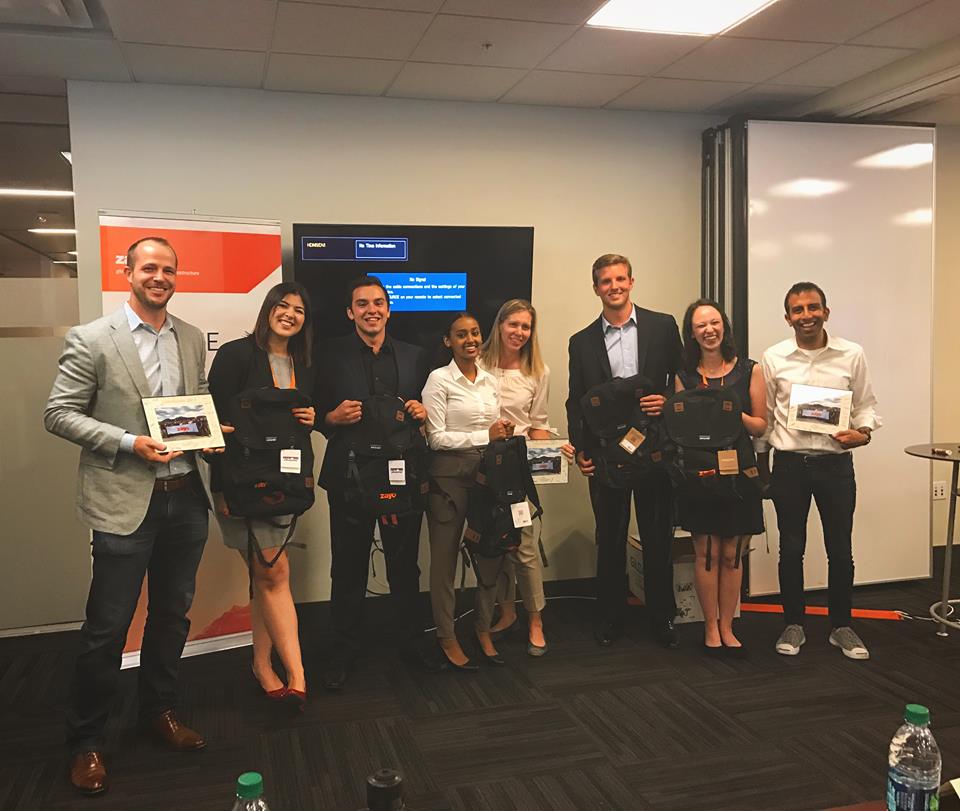
When asked about what other aspects of his internships Tyler enjoyed the most, he said that he cherishes the connections he made with his fellow interns and the programming that the internship program incorporated. “We went to hiking trails, happy hours, baseball games, tours, and workshops. There was a case competition among the 55 interns, where my team won 1st place and a Patagonia backpack for a prize! The summer ended with all the interns voting for each other for several superlatives. I was surprised when I was voted most likely to be a comedian! That summer I learned a lot, and I enjoyed an experience I will never trade!”
Career and Professional Development Staff are so happy that Tyler had the opportunity to experience a wonderful internship, and create not only meaningful memories and connections, but also grow his skills as a student and future employee. We wish you all the success in your future career and internships journeys, and we hope to hear your future stories (maybe as a comedian!).

Crowdfunding your graduate startup: pros and cons

You’ve been thinking about your next career step, and you’re pretty sure you’ve come up with a great idea for a business, product or innovation that could be a big hit with the right tools in place to deliver it. Great! So how do you go about making it a reality?
Well, once the initial sketching out of the idea is done, and you’ve developed a reasonably watertight plan for the subsequent development stages, it’s extremely likely that money will be the next major barrier you’ll run into. Without the requisite backing to finance bringing your great new business idea to market, it could be destined to remain little more than a pipe dream.
That’s why more and more people are taking advantage of crowdfunding platforms – the range and accessibility of which have grown exponentially in recent years – to provide that all-important initial startup capital.
However, while there are many reasons why it can be a fantastic way of securing early funds to help get your scheme off the ground, there are also a number of potential issues and concerns with crowdfunding models. It would be wise to consider all the points below before deciding whether it’s the right route for you and your plan:
Pros
It can be a cheaper way to get going. Many crowdfunding platforms essentially offer potential access to startup money without the typical loan-type burdens of scheduled repayments or interest, which you’d almost always be stuck with if you went a more traditional route via the bank.
It allows for smaller, uncredited investments and pledges. Other, more ‘formal’ creditor arrangements typically require a lot of legal groundwork that can block uncredited investors from being able to help you out.
It (usually) leaves your project in your hands. Some equity-type crowdfunding models allow investors to pledge backing in return for a degree of business control or shareholder power, but the more popular reward-based models generally mean you’ll retain full control of the business and any intellectual property associated with it after launch.
Backers represent tangible interest. If it’s likely that you’ll need to seek further support for launching your business or idea – for example, if crowdfunding is just a small part of a larger financial plan – then a successful public campaign represents a solid declaration of interest and support that can be very helpful in persuading other lenders.
It gives you options outside your immediate location. Seeking more traditional funding sources can often mean trawling local banks and creditors in your area, which is time consuming (and inherently limiting if you don’t live in a big city).
It allows you to tell a fuller story. A key part of putting together a good crowdfunding campaign is fully articulating why your idea is important and valuable. In doing so, you’ll get to develop a narrative, character and profile for your product or business, rather than simply having it appear on the high street or online and hoping your target market ‘gets it’.
It gives you a pre-launch support base. Appealing to relevant communities or key demographics in advance of your launch means you’re pre-engaged with right sorts of people before hitting the market.
Backers with wider influence can help spread your message. Trying to do everything through just your own channels is tough, but creditors or supporters who are interested enough to invest in your idea will likely also be interested enough to help you spread the word.
It gives you easy access to feedback. People who back your idea will usually be keen to share their views on how the early planning and development stages are shaping up, which can be incredibly helpful in gaining a wider perspective and making sure you deliver something customers want.
It can give you a foundation for future plans. Success in one crowdfunding campaign will sometimes mean you’ve also got a pre-built platform for publicising and funding your next idea, should you choose to develop one – your previous backers are right there.
Cons
You’ll need to offer rewards, and deliver them. Many crowdfunding models rely on you pledging tiered reward schemes for backers, to give them an incentive to donate. This demands careful thought and structuring to encourage people into higher pledge brackets through increasingly attractive benefits packages, and of course you’ll need to ensure you’re able to fulfil all promises later.
It’s unsuitable for complex projects. The idea or business model you’re pitching will need to be fairly simple and non-technical in order to get a good number of nonprofessional creditors on board; anything too complex or technical can often seem overly risky or confusing, and put off more casual backers.
It takes considerable time and effort. Planning and creating a compelling pledge drive includes myriad responsibilities such as developing those all-important multimedia elements, monitoring and responding to donations, supporting and developing the initiative with a well-executed social media campaign, and attending to constant queries and feedback from potential investors. All of this can quickly take on the weight of a part-time job – and, given that most crowdfunding campaigns are best suited to smaller funding targets, it can all feel a bit disproportionate to the amount you’re seeking from it.
There’s little scope for making any profit at the crowdfunding stage. This is particularly true with campaigns that are ‘all or nothing’ (meaning if you don’t secure your initial target amount, you get nothing from anyone – a very common model). Pressure to reach this baseline target often means setting the initial bar as low as you can, so it’s likely that you’ll only be covering very basic launch needs. This also requires any plans for rapid growth in phase two to be very carefully laid.
Your idea is made public before it’s ready to launch. In launching a crowdfunding campaign for a great idea, you’re always running the risk that someone who already has the capital you lack might see it and get in there first. However, bear in mind that copying is likely to happen if it’s successful anyway – just because you were first to market, that won’t necessarily stop someone with a higher profile launching their own version anyway. It’s part and parcel of the business world, unfortunately.
Failure doesn’t look great when it happens very publicly, and crowdfunding campaigns are inherently pretty public affairs. Even though it doesn’t indicate your idea was no good-by any means, it can be a big drain on momentum or moral, especially for team-based campaigns. (This con alone shouldn’t stop you from giving it a go, though, or trying again in future – many success stories failed to make their targets first time out.)
Adapting your idea can be difficult once people have started pledging support for it. Having to clearly define your precise plan in such a public way means that if you subsequently find you need to change elements of it, you risk losing that initial support or being tied in to all your original claims.
Negative reactions are immediately more visible. Not everyone is going to like every aspect of how your project develops or launches, and a successful crowdfunding campaign gives your backers a very public forum for broadcasting criticism during and after delivery. That’s fair, on many levels – but it’s something you’ll want to be mindful of as you go along.


What Should I Be When I Grow Up?

career path - multiple roadsDid you know that you need professional experience to get a job, even if you have no idea what you want to do?  Well, University Career Services has got you covered. Our highly trained staff can help you to explore your individual gifts, strengths, majors and career options. still not sure? Here are Several ways to work with a career advisor to gain career clarity and direction
Assessments 
Look at your personality and behavioral characteristics and strengths and how they align with potential jobs and majors. The tests we use most frequently with students and alumni are: the Myers-Briggs Type Indicator, Strong Interest Inventory and StrengthsQuest
  • Our career advisors can provide resources for and explain how to conduct informational interviews. Some key points to remember are:
    • Talk to people who are doing work that you are interested in.
    • Learn if this is the right job fit for you and make connections that have the potential to help you with your job and internship search.
    • If someone agrees to an informational interview, research his/her job and company and prepare questions before you meet. Just as important – always follow up with a thank you and any next steps you established during the informational interview.
    • Connect with alumni from any alma mater.  Us the LinkedIn Alumni Tool (under the “My Network tab, click “Find Alumni” in the drop down menu), Alumnifire, and don’t forget family, friends, staff connections and professors.
Set Goals and Make a PlanSetting goals  and making a plan to build your network and explore majors and career paths is essential for blazing your career path. Build your   professional experience, including internships, leadership roles, jobs, volunteer opportunities and student group participation or leadership.

Worker Classification

Classifying a worker as an employee or independent contractor can be very confusing. However, misclassification can be costly to both the employer and employee. Learn the difference between the federal and state guidelines on what constitutes an employee versus an independent contractor, and the issues and legal ramifications that arise when employees are not correctly classified. Also learn about the resources available to help you in making the correct decision.
Date/Time: April 26, 10 am to 12 noon
Location: Chemeketa Center for Business & Industry, 626 High Street NE, Downtown Salem
Cost: No charge

4 Things You Need to Know to be Totally Future-Proof at Work

We’re all guilty of having those little panics when we worry if we’ve chosen the right career direction. It’s tough to know exactly what you want to do once your time at college is up, I mean, what if you have a sudden, random urge to move into another field? You’ve already switched your major twice.
In addition to that, new research from the FYA has recently revealed that a whopping 60% of students could in fact be chasing roles that are likely to be obsolete within the next 15 years thanks to technology.
It is now more important than ever to make yourself as indispensable as an employee as humanly possible, and that process begins now.
Eleanor Roosevelt warned us that ‘today is the oldest you’ve ever been, and the youngest you’ll ever be again,” which – albeit terrifying – certainly does get us pulling our socks up.  With the tech landscape moving at speed, it helps to have a few basic skills tucked into your tool belt to avoid the phenomenon known as ‘If only i’d known about this earlier’.
Here are 4 of them…

1. Basic Coding

Computer coding is now being taught at schools as standard from as early as ages 5 and 6. It is a skill soon to be considered as intrinsic to education as math and grammar, yet still one that many of us (namely those above the ripe old age of 5) missed the boat on.
Whilst we may be slightly more tech-orientated than the previous generation, we stand to be just as alien to the coding phenomenon as our parents are to Snapchat, which with more than 7.7 million jobs in the U.S requiring complex computing, poses a bit of a problem to those not versed in even the basics of computer science.
It’s now not even a skill written off as solely for future programmers or software engineers, but instead a universal, and a very necessary lesson in computational thinking, problem-solving and systematic ‘if logic’. Having a basic understanding of code will vastly increase your potential to be a valuable asset to a team, and keep the mind agile enough to bridge potential tech skills gap a little later on.

2. An Understanding of Languages

Thanks to technology, certain skills that were once necessary to business – such as quick arithmetic, thorough organization, or language translation – can now be done with the click of a button. While there’s no arguing that does make things easier, it also means that these skill sets are now much more of a rarity.
Speaking another language has been shown to improve perception and sequence memory, as well as the brain’s ability to multitask and concentrate. Listing even a basic founding of another language as a skill indicates to an employer that you are not only competent, but actually something of an investment.
Why? Because there is significant demand for individuals that understand the fundamental difference between translating a language and communicating it. An individual that can engage in real-time, and build a rapport with foreign partners will outrank someone clutching Google Translate every time.

3. A Little Science

Qualifications rooted in science (or STEM degrees as they’re known) have been deemed the most future-proof according to Alec Ross, author of ‘The Industries Of The Future’ – a sentiment also echoed by the UK Education Secretary, Nicky Morgan.
However, even if you’re not planning on following the footsteps of Newton or Einstein, exploring an interest in science hones an inquisitive nature which drastically improves reasoning and your ability to rationalize. Think of reading up on something Science-y as diversifying your skill sets.
In recent years many corporate companies have made it their mission to recruit more art graduates to avoid ‘linear thinking’ in the workplace. One savvy events company then combined the skills of a creative and a science brain to automate their entire birthday marketing campaign. If you’re an arts graduate with an interest in science, you’re the best of both worlds. You’ll not only be able to contribute creatively, but also demonstrate great awareness of the future business landscape and pitch equally outside of the box ideas. That sounds like one very enticing hire indeed.

4. The Importance of Adaptability

Exposure reduces fear. This is proven practice and a principle often used to treat anxiety and phobia. This goes to say that individuals who actively seek to push their boundaries of comfort, and remain in pursuit of new challenges, experience less fear in new situations than those that don’t. This is because of what psychologists and scientists refer to as ‘muscle memory‘. Turns out your brain needs to be exercised in the same way that you practice your tennis swing.
In the interest of becoming future-proof, the most effective skill we can hone is the ability to thrive in the unknown. Attend a talk on a subject you nothing about, or actually read that article you would previously scroll straight past. Keep the mind agile and inspired by new stimulus, because those that maintain the brain’s ability to adapt will be more confident approaching what the future has to bring, and be more responsive to change.
After all, remaining future-proof is about continuing your self-education – even after college. Listen to a TED talk, subscribe to an educational blog, watch the occasional YouTube tutorial and keep your eyes on the education category of the App/Play store. Your future-self will thank you for it.

4 Tips for Women Feeling Stuck in Their Careers

Glass ceilings, solidarity marches, and empowerment movements are all over the news today as women take figurative and literal steps to become an even larger force in the United States. Many women have founded fundraising groups, task force committees, and other active organizations in recent weeks, and they are starting to take their quest for empowerment to their careers. If you feel stuck in your career, take some inspiration from these women and do something about it. You may decide to change careers or push for the promotion you know you deserve. Our tips will help you shake up your career.
1. Know Your Strengths
Senior vice president and chief marketing officer of Principal, Beth Brady shares her experience in changing career paths in her Fortune article. She recommends that women who feel stuck should assess your assets and determine whether you have the skills and strengths that will make you competitive in your industry. If you lack them, start devising a plan to get to the next level and include mentors and industry associations as resources and for networking opportunities. Then, put your strengths to use and continue to develop them while you also learn a few new skills.
2. Talk to the Right People
You may be surprised to find that the more you talk to people, the more you find who also feel stuck in their jobs and who aren’t sure what they want to do with their lives even though they have degrees and jobs. Samantha Cole’s Fast Company article dives into advice from career coach Cheryl Palmer, in light of the fact that 15% of American workers detest their job. According to Palmer, informational interviews are networking essentials that provide a path to finding your passion. Women should narrow your options to a few careers, schedule appointments with people in those fields, and talk. You may find that people are willing to help you if you ask, they enjoy that you want to learn about their careers, and they become connections for future endeavors.
3. Consider Internal and External Job Opportunities
One of the best ways to determine whether you are stuck in your career is to make a list of pros and cons about leaving your position and then about leaving your company. Some women realize that they don’t want to leave their company, but they do want to take on a new role within it. Review internal and external job opportunities and determine which ones you qualify for in addition to which ones you would like to earn.
If you would be happy with a promotion, work for it. Talk to your superiors and make a case for yourself. If you have been hesitant to serve on a board or take on more responsibility because you are not sure if your company continues to be a good fit for you, accept the offer and try out your new role for a short time. The experience will help you learn new skills and put your strengths to the test, and it will give you a better idea of whether your current company is the place for you or not.
4. Consider Entrepreneurship
It could be that ultimately you want to be your own boss. The great news is that these days there are many ways to dip your toe into owning your own business without having to give up the security of your current job. For example, you can become a business owner in the sharing economy. Start a side gig as a tasker or virtual assistant. Sharing economy websites make it very easy to set up shop and find clients. Or you might work on the weekends as a tutor or take on some freelance copywriting or graphic design work, if that’s where your talents lie. These may not be the kinds of businesses you’d ultimately like to run, but they’re a great way to learn the ropes of business ownership while you’re still bringing in your day job paycheck.
5. Take Advantage of Your Ability to Choose
In the end, the decision to change your career or change your role in your current company is up to you. You may be your greatest obstacle to a new, exciting career that is more fulfilling and rewarding. Rather, you need to take advantage of your power of choice and do not allow yourself to stay stuck because of fear of the unknown.
You can choose to work with a career coach or mentor to determine your strengths. You can choose the networking opportunities that will work best for you, and you can choose whether to move up in your present company or pursue opportunities outside of your industry. The key is to realize that you don’t need to be stuck or settle for discrimination in your career.  Take charge!

Organize Your Business Systems for Fun and Profit

Have you ever torn your office apart looking for something vital?

Running a business is hard work—with a staggering amount of complexity. From financial documents and taxes to customer information and marketing systems, there’s a lot that can get lost without good systems for keeping track of it all.

We’re here to help

At the SBDC, we understand what it’s like to trying to keep all the balls in the air while watching your profit margin and keeping your customers happy.
By request, we’ve created a new class to help business owners get organized.

Organize Your Business Systems for Fun and Profit

A fun, fast-paced organizing class for entrepreneurs
In two hours, you’ll learn the ten best things to organize in your business to help you save time, make more money, and possibly save your sanity too.
Our instructor, Jennifer Hofmann, is a professional organizer with a decade of experience working with creative entrepreneurs to get their stuff and systems in order.

Dates and details

Tuesday, January 26 from 10am – 12pm
626 High St NE, Salem OR, 2nd floor, follow signs to classroom
Great coffee and fresh, warm cookies will be served.
Bring a notebook and pen.
Free parking available at Marion Parkade across from our building

Register today!

Sign up before January 22 and get a special price of $45!
Call 503-399-5088 to register.

10 Ways to Prevent a Cybersecurity Breach at Your Business

By John Burton
Today’s c-level executives would be wise to watch a few episodes of the USA network hit series, Mr. Robot. The technology details in the show are provided by a security expert and former hacker Kor Adana, who recently provided 10 insightful ways to avoid being attacked.
Mr. Robot is one of the most accurate cybersecurity shows to date as Kor breaks down each hacking incident, including precise screen behavior and how the attack operates. He often performs the hack himself and records the screens so everything is as authentic as possible, including typical hacker tools and social engineering techniques.
Here is my take on Kor Adana’s top recommendations to improve your business security.

Double up on passwords

Enable and use two-step verification for sensitive functions whenever it is available. This especially applies to communications such as email and all financial transactions.

Never use the same password twice

Many computer users, including business owners and c-level executives, use the same password for all their accounts. Of course this is the easiest way to remember the password but it makes you very vulnerable to a hacker—imagine the damage they will do if they get that password and use it with all of your accounts. Also consider using password software that will generate very long complex passwords.

Take business mobile security seriously

Many businesses have important mobile apps that store account credentials and a hacker that unlocks your mobile device can quickly get access to all that data. It’s a pain to lock the device every time but using a complex password will slow down or even stop the hack.

Cleverly answer security questions

Your mother taught you to never lie but here is a case where a lie may save heartache and financial loss. Many companies ask a series of security questions when you create the account. If a hacker knows your dad’s middle name, the name of your pet, and other information commonly available on social media, then they have a very good chance of getting into your sensitive information.

Don’t overshare on social media

How many times have you read a post about someone on vacation or at a social event? That’s like an “all clear” signal to a thief. And by sharing birthdays, mom’s last name, and other personal information, you are providing a hacker the tools needed to compromise your security.

Continuously update

Business executives frequently ignore update messages on phones, computers and other devices that run software. Excuses like it takes too long or I might have to learn how to use a new interface (like Windows 10) or I have much more important things to do with my time top the list. The problem with putting it off? Using older versions of the operating system, antivirus, anti-malware and applications open them up to hackers who exploit the known vulnerabilities. Consider the trade-off of spending a little time now or dealing with huge security issues later.

Don’t fall for email scams

Some emails practically scream “if you click here you will be in deep trouble.” But sophisticated hackers have found ways to mimic an email from a trusted associate and insert a URL address that, if you click the link, will go to them. Think about whether Bob in accounting would really ask for every employee’s social security number ASAP. Get into the habit of hovering your mouse over links to see where the reply really goes. If you’re still uncertain, either verify via a phone call or an email to the sender to confirm the situation.

Keep your webcam software updated

Ever heard of ratting? Once the stuff of science fiction, it really is true that hackers can gain remote control of your camera and microphone. Putting tape over your webcam only blocks the view—hackers can still hear what you say. A better approach is to keep the webcam software up to date and disable your camera when not in use.

Always connect securely

Free Wi-Fi doesn’t always mean safe Wi-Fi. Studies show that most popular resorts like Disney World often have bogus Wi-Fi spots planted there by hackers. Double check with the store or resort manager to verify which Wi-Fi is secure. Avoid unsecured Wi-Fi networks and never do sensitive financial transactions over unverified links.

Be smart when attacked

Take every precaution possible to prevent an attack. But if you sense an active breach, unplug and shut down all systems and get a security tech involved. They will likely want to wipe your system clean and help you improve your security procedures to avoid an intrusion in the future.
Business leaders live in a strange new security world and find themselves smack in the bulls eye of the hacker world due to their trusted position. Following these 10 tips will go a long way to covering your back and avoiding the negative fallout from business cyber crime

A Retired Science Teacher Explores a New Path with Cannabis

Central Vermont resident Ann Ndione is a retired science teacher who enrolled in the UVM Cannabis Science and Medicine Program this fall. Ann, who studied Horticulture and Horticultural Therapy at the New York Botanical Gardens, talked to us about her experience in the new UVM online program.
studying-cannabis-at-uvm

Ann Ndione

Why did you enroll in the UVM cannabis certificate program?

I just retired and saw the program advertised. This is a time of transition for me and I am open to a new focus in life. The program looked very interesting and challenging, a perfect mix for me. It combines my love of plants and passion for science.

What aspect of the program have you enjoyed the most?

Actually, I have enjoyed all of it–though there is a ton of work. Since I have little to no current experience with cannabis, everything is new. I feel that the format of the online class has worked well. The cohort is amazing and there is so much learn from each member. I wish we could have a face-to-face gathering at some point.

How and when did you first become interested in cannabis in terms of healthcare and policy?

I have been peripherally following cannabis in the news and have a few personal connections where I wish I had known more about it.

After you complete the program, how will you use what you have learned?

This is definitely the million-dollar question. The course has ignited a passion in me to be an advocate for medical cannabis. I would love to work with growing and research, though that is probably not too likely. Perhaps with this program I could work at a Vermont dispensary. I am going to explore the options. I am also talking to many others about the program and sharing my knowledge. Busting the stigmas and educating the public is one tiny step toward getting cannabis rescheduled.

Why would you recommend the program to others?

I would recommend the program because it is rigorous, balanced, and uses science-based evidence to inform

An Aspiring Leader Looks to a Future in Business Sustainability

To describe Bianca Mohn as driven is an understatement.
The Lancaster, PA, native graduated from UVM in May with a business degree and is now a student in the UVM Sustainable Entrepreneurship MBA program. As an undergraduate, she majored in business administration, international business and marketing, and minored in French. She was a student in the UVM Honors College, served as president of the UVM Marketing Club, became program director of La Maison Française, and studied abroad in China.
Bianca Mohn

Bianca Mohn
Now she’s learning how to help businesses establish meaningful goals that honor the triple bottom line: people, planet, and profit.
Mohn talks to us about corporate social sustainability and how she’s learned that there’s more than one way to be an effective leader.

What interests you most about corporate responsibility?

What I find most exciting are business models that create so-called “win-win” situations. For example, there are companies that take recycled cans to produce rolled aluminum for cars, consumer electronics, packaging, and are making the world a better place by reducing environmental impact, creating jobs, and using technology in progressive ways. I am fascinated by companies that create value for everyone involved and are using technology to benefit people and the planet.

What are some of the challenges you see in sustainable business/entrepreneurship?

Many companies want to be forces of good, but struggle to make the leap between having a few sustainability initiatives on the side, as opposed to integrating sustainability into their entire business strategies. In the future, companies that fail to embrace sustainability will be left behind for those who are doing more than just making a financial profit.
From my research on corporate social responsibility for my senior thesis at UVM, I found that many companies on their websites listed lofty aspirations for changing the world, but few highlighted specific goals and metrics to support these goals. This is another challenge for sustainable businesses: determining how to establish meaningful goals and metrics to convey to stakeholders that these sustainability initiatives are effective and lasting.

What advice would you give both undergraduates and young professionals who are looking to advance their career and become a leader or manager?

For undergraduates looking for leadership experience on campus, my advice is simply to show passion and enthusiasm. The way I became a student leader in the UVM Marketing Club and La Maison Française was by demonstrating that I cared. This meant always attending club meetings, offering to help with projects, bringing new ideas, and getting excited about the activities that we were doing. If you show up, bring positive energy, offer your time, and follow through, people will notice and will want to give you leadership positions.
For undergraduates and young professionals looking to advance their career and become a leader, I think it’s important to keep in mind that everyone can be a leader with experience and ongoing skill development. Sometimes people believe that you have to be the most extroverted, talkative, and authoritative person in the room to be the leader. That’s simply not the case.
Leadership comes in many different forms, and there isn’t one way to be a leader. From my perspective, the leaders I admire most are exceptional listeners, they are the first to admit that they don’t know something, and they are always looking for feedback and for opportunities to improve themselves and their projects. They have a ton of positive energy and drive, they care deeply about the people they work with, and they love to learn.

Why did you want to earn a sustainable entrepreneurship MBA rather than a traditional MBA?

I am a firm believer in the power of business to make the world a better place. I was attracted to the sustainable entrepreneurship MBA (SEMBA) because of its unique approach to business education by integrating sustainability into all of the courses. Unlike traditional MBA programs that sometimes feature one or two sustainability courses on the side of the core business courses, in SEMBA the economy, environment, and society are integrated into everything we study.
As we observe the world around us, we see that we are living in times of great change and that new models are needed to face widespread issues relating to poverty and environmental decline. I am in SEMBA to learn about these new business opportunities that provide value not just to customers and stockholders, but to the larger stakeholders, namely members of society and the natural environment.

You were involved in many clubs and organizations during your undergraduate years at UVM. How did you find time to be such an active and successful student?

It was definitely overwhelming at times to juggle so many things at once. It’s a tall order as a student to find the right balance between academics, clubs, friends, exercise, sleep, and relaxing. I learned very quickly the importance of time management. What worked best for me was having a detailed schedule and planning in advance to make sure that I could do it all. It’s easy to procrastinate, but for me, having a full schedule of classes, clubs, and jobs made me more self-disciplined and focused. Also, I made sure to have a strong support network in all of my clubs so that when I had academics to prioritize, I could ask others to step up and take charge.

How would you describe UVM?

UVM will give you everything you need — and more — to grow, learn, and discover who you are within a supportive and generous community. If you have an idea, someone will listen. If you need help, someone will gladly offer a hand. If you want to start something new, someone will encourage you. If you are open to it, UVM will change you by offering you a million opportunities for personal growth along the way.

Skill Series #3: Written Communication

Why is it important to write well? What does ‘writing well’ mean, anyway? Every day I read resumes, cover letters, personal statements, essays and email and text messages. So do you.
Have you ever gotten a text that made no sense? Was the verb or subject missing? Maybe you thought that you knew what the person meant to say, but you had to guess.
Let’s start with some examples….
  • My courses in History and Philosophy taught me strong critical thinking skills.
Your courses taught you? YOU had nothing to do with amassing these skills? Don’t you think that YOU learned or developed critical thinking skills by taking courses in History and Philosophy?
  • Other responsibilities include progress toward degree meetings every semester.
What does this mean? Who made progress? And, what did this person do to advance the progress of these meetings?
  • I have developed a valuable database of employer relationships that get results.
Have you known databases that get results? I have not. I thought that people used databases and the information in databases to get results.
  • My educational experiences and my work experience have allowed me to develop exceptional interpersonal, clerical, analytical and leadership skills.
Your educational and work experiences gave you the opportunity to develop interpersonal skills – how did that work? Would it be accurate to say that while you pursued your education and gained work experience, YOU strengthened your interpersonal…..skills?
  • I am the daily liaison between coaches and instructor’s.
Your turn….what is the issue?
  • Young Democrats of UtahSalt Lake City, Utah May, – June 2006
               Volunteer Champagne Manager
 Have you spotted the typos?
  • I am interested in applying for the position of with you organization.
Did this person read the sentence out loud? How many problems do you see?
  • One who will make a positive contribution to your college.
Is this a sentence? Does it include a complete thought OR do you feel something is missing?
  • All of these experiences have shown that children and animals are forever bonded and the stories arising from that relationship inform us how to approach and respect
Be clear about what and who you are referencing. WHAT RELATIONSHIP is this person talking about? And WHO exactly are we approaching?
Whether you are writing a resume, an email or an academic essay, writing skills are critical.
Here are some tips for writing as clearly as possible to convey what you mean to say:
  • Use active tense: Experiences do not teach you. YOU learn skills by engaging in experiences and completing projects.
  • Be specific and include details: As a senior majoring in Anthropology, with a minor in History, I have traveled to WWI battlefields in Belgium and worked with forensic anthropologists to uncover the remains of soldiers who died in the trenches.
  • Use a font that is large enough to see. No one will read your work, no matter how excellent it is, if the person can’t see the text!
  • ALWAYS read what you have written out loud to yourself. That is the only way you will notice if you have left out a word or used the wrong phrase.
Resources in the Career Center Library:
Eats, Shoots & Leaves: The zero tolerance approach to puncuation, by  Lynne Truss
On writing well: an informal guide to writing nonfiction, by William Zinsser
Get to the Point!  by Elizabeth Danziger
Writing That Works, by Kenneth Roman and Joel Raphaelson