Adventures in Neuroscience: Understanding the Human Brain and Nervous System

The brain is the human body’s most complex organ. Weighing about 3 pounds in adulthood and consisting of billions of tiny cells, the brain—the central organ of our nervous system— holds the secrets to our personality, use of language, memories, and the way our body operates.
In July, UVM Associate Professor Alicia Ebert will teach Summer Academy’s Adventures in Neuroscience course to high school students.
The new course, which runs July 7 to Aug. 2, 2019, will introduce students to the dynamic and diverse field of neuroscience—the study of the nervous system, which includes the brain and the spinal cord. The field of neuroscience not only focuses on how the nervous system works under normal circumstances, but also how it functions in an individual suffering from neurological, neurodevelopmental, and psychiatric disorders.
precollege summer program

Alicia Ebert
In Ebert’s course, students will learn the basics of cellular, molecular, and behavioral neuroscience, and gain hands-on experience in a lab performing experiments to ask basic neurobiology questions. There will also be lab and facility tours to explore the breadth and depth of the field of neuroscience.
“We will spend time talking about the history of neuroscience, the foundational research that sparked the field, then touch on different types of neuroscience research,” she says. “With the lab tours and research experience, it should be a great entry into this field.”
The course is part of UVM’s Summer Academy, a four-week residential and online program offered to high school juniors and seniors who want to explore areas of study and earn transferable college credit.
Ebert, who began teaching at UVM in 2012, completed her undergraduate degree in molecular biology at the University of Wyoming, and earned her Ph.D. in Developmental Neuroscience at Colorado State University.
While growing up in Colorado, her high school genetics teacher inspired Ebert to major in molecular biology and eventually start on a career path toward neuroscience. “Mating fruit flies and performing crosses and genetic screens was amazing to me at the time and I wanted to know more,” she says.
Ebert became specifically interested in neuroscience as an undergraduate student at the University of Wyoming when she was a technician in a neuroscience lab that focused on nerve regeneration using mice.
Ebert’s current research focuses on zebrafish eye development. The eyes develop from forebrain tissues and then must migrate bilaterally to take up their final position on either side of the head.
She is interested in what mechanisms and molecules are involved in maintaining eye tissue cohesion as they undergo elegant movements of morphogenesis and migration. The lab is also interested in how the different neurons in the developing retina develop the appropriate characteristics and in the correct location.
“All of my research uses zebrafish as a model to understand the genes and pathways that are important in setting up the nervous system,” she says. “We predominantly focus on development of the eye, ear, and motor, and sensory systems. Summer Academy students will have an opportunity to observe and manipulate zebrafish embryos.”
Ebert is passionate about her subject matter and committed to keeping her courses informative and fun.
“I love teaching the content that I am excited about to students that are just as excited to learn,” she says. “The energy in my classes is infectious and makes for a fun learning environment.

Start Your Job or Internship Search NOW

Do you plan on having a job or internship lined up for June 2018?  Think if you get started looking in March you’ll be way ahead of the game?  Think again!!  Recruiting has started happening earlier and earlier every year as companies compete for the best talent.
There are currently postings in Pioneer Careers for positions that will start in JUNE.  What can you do to stay ahead of the game and not miss out on opportunities by waiting until winter quarter to get started?
  1. Set your preferences in Pioneer Careers.
  2. Attend fall recruiting events – to see the most current and comprehensive list, check out the Events tab in Pioneer Careers.
  3. Develop a target list of companies you are interested in and find out when their positions get posted.
  4. Set weekly goals for your job or internship search – view the process as a course and block time in your calendar to work on your search as if it were class time.
  5. Meet with your career advisor (call 303.871.2150 or schedule via the Appointments tab in Pioneer Careers) to form a strategy and learn about additional resources.
  6. Attend the Job Search Strategies workshop at 5pm on October 24th.

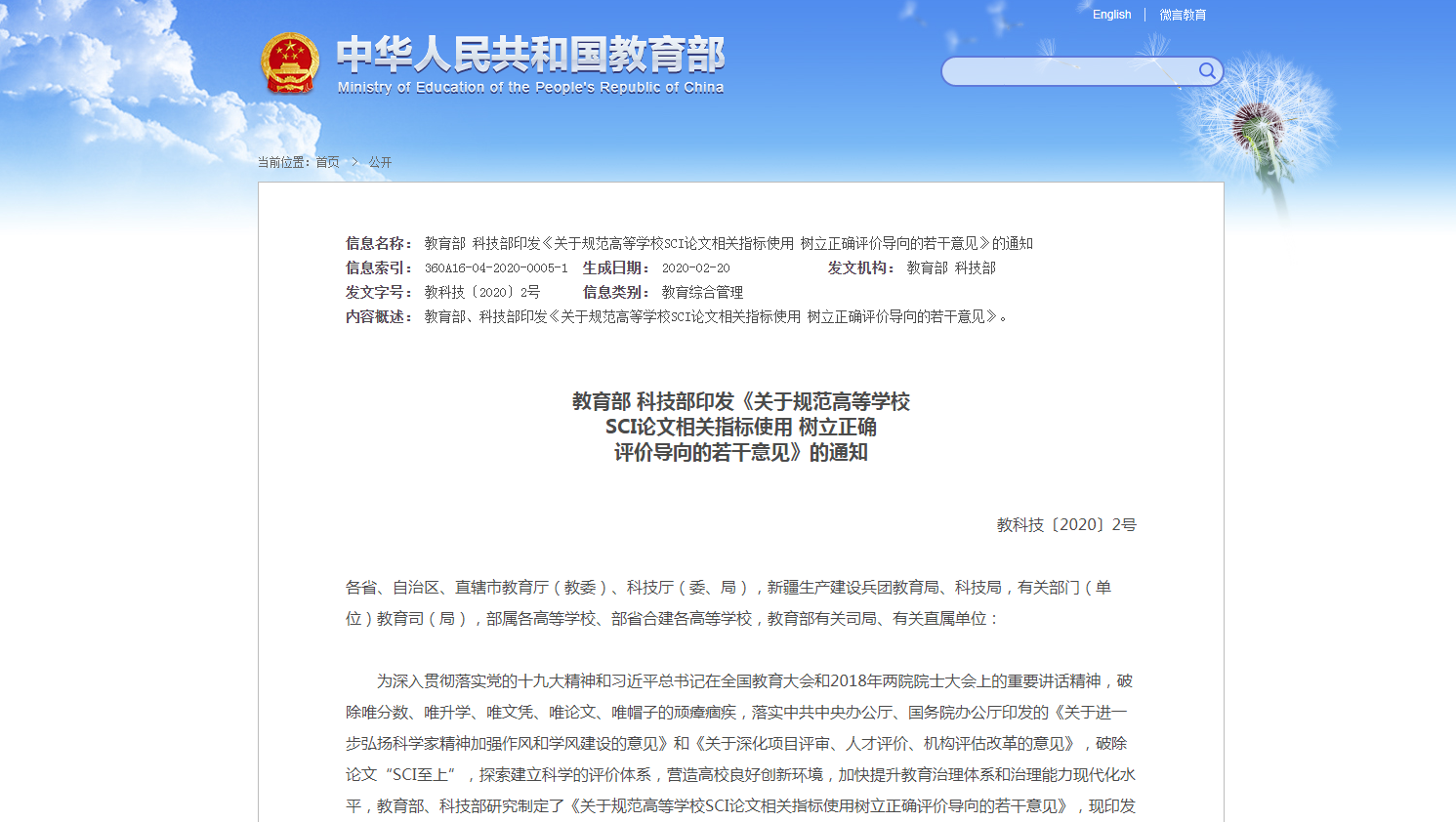
China to move away from Science Citation Index in academic evaluation

China’s Ministry of Education and Ministry of Science and Technology issued an official notice last week on regulating the use of Science Citation Index (SCI) papers in the evaluation system of universities and academic institutions across the country, calling for a break from the longstanding SCI-supremacy in assessing researchers and institutions.

The authorities issued clear guidelines on reversing the SCI-supremacy phenomenon in a move to change the current academic assessment and evaluation systems that are over-reliant on published papers, as well as to develop a more comprehensive evaluation system in academia.

According to the guidelines, the numbers of SCI papers, citations, and highly cited papers, as well as relevant factors like the Essential Science Indicators (ESI) rankings, have become core indicators for academic assessments, evaluations, rankings and corresponding policy making, such as educational resource allocation, in recent years.

China’s Ministry of Education and the Ministry of Science and Technology issue clear guidelines on reversing the SCI-supremacy phenomenon.

For citation, not for evaluation

Universities and academic institutes have been using SCI-paper and other relevant indexes as the dominant determinants to evaluate the research ability of students, teachers, and researchers, said Xie Gaodi, deputy director of the Center for Resource Science, Institute of Geographic Sciences and Natural Resources at Chinese Academy of Sciences, noting that an overemphasis on SCI papers when evaluating researchers neglect other capabilities.

The phenomenon of SCI supremacy is widely considered one-sided, excessive, and known for its distortion of information from SCI papers among scientific research evaluation systems at universities and other academic institutions in China.

There are a lot of limitations when SCI and its related indexes serve as a direct evaluation system, as it in essence is a citation databases for scientific literature used worldwide, said the official with the Ministry of Education in a statement released on February 23 briefing the guidelines.

It is also clarified that it is not a denial of SCI, nor a refusal to publishing papers.

The guidelines stresse that SCI papers should not be used as a prerequisite for personnel employment. /VCG Photo

The guidelines introduced several specific measures to abolish the phenomenon.

It pointed out that SCI papers should not be used as a direct basis for professional titles evaluation and occupational promotion, nor a prerequisite for personnel employment.

Higher education institutions are suggested not to set requirements on number of published papers for departments and individuals.

Academic institutions can no longer reward individuals and departments based on SCI papers alone, and the graduation and awarding degrees of students should not be restricted by the number of SCI papers and impact factors, the document said.

The guidelines call for a more comprehensive evaluation system in academia. /VCG Photo

‘To establish matters to eliminate’

The guidelines also pointed out that a sound assessment system should be developed, in which different weight of paper publication is put on the evaluation of different types of scientific research work.

For research in basic disciplines, evaluation should focus on the originality and scientific value of the research papers, instead of the number of SCI papers.

Application research and research in technological innovation should focus on the actual contribution of the research and the utilization of the results in real life, it said.

Universities should not list the number of SCI papers as a requirement for students to graduate or get degrees, according to the guidelines. /VCG

In addition, universities and education authorities should improve peer-review in talent evaluation.

Jin Li, vice president of Shanghai’s Fudan University, stressed that “to eliminate, it greatly matters to establish.” He noted that it is of great significance to establish a comprehensive evaluation system with more indicators that can effectively, fairly reflect the value of academic contributions.

Yuan Lanfeng, an associate professor at the University of Science and Technology of China, believe that it is a good opportunity for the academic institutes to improve their performance evaluation systems, and with the upgraded system, researchers serving in the institutes “will be encouraged to concentrate more on long-term studies instead of short-term papers.”

Achieving Sustainable Entrepreneurship from the Base of the Pyramid & Up

By Stuart Hart
We have come a long way since 2002 when along with my colleague, C.K. Prahalad, I first identified the Base of the Pyramid (BoP). This term encompasses the more than four billion people — approximately 60 percent of all humanity — who earn $8/day or less, and who comprise the very bottom of the global income pyramid. That moment of insight launched the BoP business movement, spawning numerous business ideas, programs, and entrepreneurial ventures, aimed at the poorest of the world’s poor.
The BoP also embraces a business approach that focuses on products, services, and enterprises that serve this population in away that is culturally sensitive, environmentally sustainable, and economically profitable. Inherently, the BoP is where entrepreneurs and companies can tackle the world’s biggest challenges; poverty, environmental degradation, hunger, social inequality, issues with enormous humanitarian and societal implications, via new disruptive business models, technologies, and strategies.
This movement and process of experimentation has been tarred by some as merely the latest form of business imperialism and profiting from the poor. And while mistakes have been made — the landscape is littered with the failed remains of BoP initiatives, like solar lighting and clean energy cook stoves — more and more success stories are emerging that herald a new dawn. A moment where failed “narrow” ventures are replaced by wider, compelling initiatives that by forming the entire business ecosystem, delivers scale and value to communities in multiple ways and not just via a single BoP product.

Building an Environment for Sustainable Entrepreneurship

Simply put, it is an umbrella business concept that simultaneously generates sustainable livelihoods, minimizes environmental impact, and produces profits for all participants and investors; partner with local communities to co-create prosperity at every step of the journey.
Cemex, Mexico’s largest cement company, provides a glimpse into the importance of co-creation and effectively reaching the BoP. The 1994 financial crisis in Mexico was a major blow to the company’s domestic business. However, Cemex executives noted that whereas revenues from upper- and middle-class customers dropped by half, cement sales to the poorest tier of the population were hardly affected. In fact, sales to the poor seemed to follow a completely different logic than those in the affluent market.
Cemex resolved to learn all they could about the needs and problems of the people in the urban slums and shantytowns where demand for the company’s cement was the strongest. A Cemex team decided to start by living in the shantytowns for six months, and their initial thinking focused around finding a way to make cement available in smaller, more inexpensive amounts, appropriate to the slum-dwellers’ needs. But after exploring the commercial potential of smaller “single serve” bags of cement, it became evident that this approach would not gain commercial traction.
It was only after spending several months living in this context and interacting intensively with families, did the team come to realize that the poor, do-it-yourself (DIY) homebuilders were facing a set of significant and unique constraints.
They learned the DIY builders in the shantytowns often took years to complete just one room and many more years to finish a small four-room house. The reason being that banks and other businesses will not engage with poor residents in informal settlements where the legal status of their property ownership is murky.
Haphazard design, combined with material theft and spoilage, conspire to make home construction a costly and risky proposition. Vendors prey upon the poor, selling them off-quality goods in quantities that are inappropriate because they have little bargaining power or ability to complain. Through dialogue and this unique understanding of the context, the Cemex team came to realize that addressing this larger set of challenges might make it possible for the poor to build much better-quality homes in less time, while also saving money on materials in the process. And, yes, they might also grow the cement business as well.
The team, in conjunction with local partners, co-created a new business model. Through its program called Patrimonio Hoy, which, roughly translated, means “Equity Today,” Cemex formed savings clubs that allowed aspiring homebuilders to make weekly savings payments. These savings clubs built upon the already prevalent Tandas, community savings plans that had been common in the marginalized sectors in Mexico for decades. In exchange, Cemex provided material storage and architectural support so that homes could be well-designed and built in sensible stages. Given its clout as a major buyer, Cemex could negotiate with material suppliers for the best possible prices and quality, something that the shantytown dwellers themselves were unable to do.
Participants in the program built their houses three times faster, with higher-quality materials and designs, and at two-thirds the cost. By 2010, the program has reached over 200,000 families in 22 Mexican states and was also operating in other Latin American countries such as Colombia, Venezuela, Nicaragua, and Costa Rica.

Sustainable Entrepreneurship from the Bottom Up

If you are inspired to change the world through the BoP movement, and meet and hear first-hand from some of the entrepreneurs and organizations confronting these global challenges, I encourage you to join us this summer in Burlington, Vermont. With “Sustainable Entrepreneurship from the Bottom Up” as our theme, Enterprise for a Sustainable World (ESW), and the University of Vermont School of Business Administration, in collaboration with BoP Global Network Labs from around the world, are hosting the second BoP Global Network Summit at the University of Vermont Davis Center on July 16 and 17.
I hope you will be able to join us, because our world is too important for business-as-usual.
Stuart HartStuart L. Hart is one of the world’s top authorities on the implications of environment and poverty for business strategy. He is the Grossman Endowed Chair for Sustainable Business and Professor at the University of Vermont’s Business School, S.C. Johnson Chair Emeritus in Sustainable Global Enterprise and Professor Emeritus of Management at Cornell University’s Johnson Graduate School of Management, where he founded the Center for Sustainable Global Enterprise