Ready, Set, Start Your Business

Are you ready to start your business? Not sure if you have everything in order or you don’t know what you don’t know? Begin your business the right way.
This course covers the essentials needed to start a small business. Learn about:
  • business structure
  • business registration
  • licensing
  • taxes
  • miscellaneous rules and regulations
The information presented can help you eliminate mistakes before they happen. This fast-paced class is the perfect first step!
Time: 12:30 – 2 pm
Location: Chemeketa Center for Business & Industry, 626 High Street NE, Downtown Salem
Cost: $49
Registration and Information: 503.399.5088

About Chemeketa SBDC

We provide the tools and environment for small business owners to make great decisions.

This entry was posted in Best PracticesStart-up. Bookmark the permalink

A Geochemist Finds Her Element with Craft Beer

Penny Higgins is a vertebrate paleontologist and geochemist who loves to brew beer. Penny, who lives outside of Rochester, New York, hopes to eventually open a craft brewery with her husband. She recently enrolled in the UVM Business of Craft Beer Program to figure out how to make her dream career a reality.
We talked to Penny about why she loves brewing beer, what she is learning from the UVM program, and her 10-year plan to open a brewery in rural upstate New York.

When and why did you start brewing?

starting-a-brewery

Penny Higgins
I started brewing maybe three years ago. It was on a whim. I enjoy beer, and I thought I might try brewing some. It was good, so I kept on brewing. One of my favorite things is to brew beers to honor the host cities of the big geoscience meetings each year. I’ve brewed a chili lager for a meeting in Houston, Texas, that wound up being too hot for me to drink. My favorite beer that I ever brewed was a Baltimorphic Complex, honoring the Geological Society of America’s annual meeting that was in Baltimore last year.

Are you thinking about changing careers and opening a microbrewery?

I’m not sure if a career change is coming soon, because I really enjoy my work. I’m a vertebrate paleontologist and geochemist with research focus on ancient climate. However, the paycheck that comes with my job as a research associate at the University of Rochester is dependent upon the whims of major funding organizations, like the National Science Foundation, and the administrators of the university. I’ve held this job for almost 12 years now, but there’s no guarantee that I’ll continue to be employed even for another year. Should I lose my current job, opening a microbrewery may be my next career move. Starting a microbrewery is part my husband’s and my ten-year plan. In ten years, we want to be in a position where we could lose our jobs and still be able to support ourselves financially without having to move. Operating a brewery might be the way to go.

Why did you enroll in the UVM Business of Craft Beer Program?

I started in this program to explore the realities of operating a craft brewery. Would it be possible to start a brewery and continue my job at the University of Rochester? Or would I have to leave academia and do a complete career shift? When I began the UVM course, I had planned on keeping my job and running a brewery on the side, but since taking Fundamentals of Craft Beer course, I’ve realized that probably isn’t realistic. If you ask me now whether I will definitely start a brewery, the best answer I can give right now is a hefty “I don’t know.”

How did you learn about the UVM Business of Craft Beer Program?

I learned about this from Brew Your Own magazine. There was a story on opportunities to learn more about brewing. The UVM program caught my eye because it was about how to run a brewery, not just how to brew beer. As a geochemist, brewing beer is just another kind of chemistry. But the business end of things…that might as well be explained in hieroglyphics. I had talked to a few people about the art of running a brewery, but I knew what I needed was formal coursework. This program was perfect.

What has been your experience taking an online course at UVM?

I’m completed the Fundamentals of Craft Beer course and plan on enrolling in the Business Operations course this fall. This is my first online course experience. It has been a little strange to me because it’s been many years since I was last a student and now I teach at the university level myself. In general, I’ve enjoyed the experience. I particularly liked that each module was arranged to go each week from Wednesday to Tuesday, giving us already-have-a-full-time-job participants the weekend to get our homework done and still have time to review other students’ posts.

Are you finding the coursework challenging?

The work itself was interesting and challenging. Were I not so darn interested in the material, I might have considered it difficult, based upon the time and energy I had to put into it. In the end, I wish I had more time to work on the exercises and respond to my peers’ posts. I really enjoyed the interaction and got a lot out of it. The estimate of 6-10 hours a week of coursework was spot on, but you could easily spend a lot more time.

Why would you recommend the program?

The UVM craft beer program is perfect for anyone who is considering starting a brewery but lacks business experience. Sure, there are books out there. But at least for me, formal coursework with instructors on-hand to answer questions helps accelerate the learning and allows you to avoid big mistakes. Plus, it also puts you in contact with some important names in the craft beer industry, which can potentially give you a boost when getting started.

What is the craft beer scene like in Rochester?

Craft is going crazy in Rochester. There are currently more than 10 craft breweries in Monroe County, which includes Rochester and the greater metropolitan area. I live about 30 miles east of Rochester in Wayne County. Though it is about the same size as Monroe County, there is not a single brewery of any kind in Wayne County, although there is a cidery and a winery. Because Wayne County is less populated and largely agricultural and industrial, that may explain why there are no breweries. My hope is that I can open a brewery that taps into the rural culture of where I live. We’ll see if I still want to do that after finishing the UVM course.

UVM Alumna Finds New Beginning in Public Health Program

Kelly Clements ’14 worked in the quality assurance realm of the food industry before deciding to pivot in a new career direction. The Vermont native, who majored in Nutrition and Food Science at UVM, recently returned to her alma mater to pursue a UVM Master of Public Health degree.
We talked to the first-generation college student about the connection between public health and food, shifting her career focus, and her plans after she completes the UVM online public health program.

After graduating from UVM, you worked in quality assurance in the food industry. What made you decide to shift gears and pursue a graduate degree in public health?

I was not feeling that I was making an impact in people’s lives. Lab work, passing audits, and making sure product labels meet regulations are all great, but I was feeling extremely unfulfilled in my career.

What interests you most about the connection between public health and nutrition?

We’ve all heard the saying that nutrition can be the safest medicine or the slowest poison, and I agree 100 percent. I think a lot of the barriers to good nutrition, especially in Vermont, come down to lack of nutrition education and resources. For example, my family once lived 13 miles from the nearest grocery store in an area classified as a food desert. This is reality for many people in rural Vermont that I am passionate about improving. Everyone deserves easy access to affordable, healthy food.

You’ll complete the Master of Public Health Program in 2018. What are your plans after you earn your degree?

My goal is to get a job in environmental health, epidemiology, or nutrition/wellness.

Why did you return to UVM for your master’s degree?

Mostly familiarity. In-state tuition was a big draw, and the program’s online aspect was also appealing since I am working now and the flexibility fits my schedule. UVM feels like home and I know where to go for resources that I need. So far, the program has been amazing and my professors are extremely helpful, whether it’s through email or in person.

What inspires you?

My family. I was the first generation in my family to graduate from college and will be the first to earn a master’s degree. My incredible parents have been behind me every step of the way and every decision I’ve made—good or bad—so I want to do well and make them proud.

What career advice do you wish you had received as an undergraduate?

To start planning early and to figure out exactly how to search and apply for jobs. I graduated with no plan at all and feel like I floundered for a few years before researching public health and beginning this program. Now I am so much more focused on my goals and building my future personal and professional life. As a result, I’m getting great grades and seeing things fall into place

How to Avoid the Most Common Management Mistakes at Work

Management consultant Chris Holmberg of San Francisco was recently interviewed by First Round Review on the most dangerous leadership pitfalls. Holmberg shares a 15-minute practice on how to avoid common management mistakes by focusing on “the it, the we, and the I.”
Here’s an excerpt from the First Round Review article:
Holmberg hones in on the mistakes that ensnare some of the most promising people he’s met. Most importantly, he offers a simple daily exercise that can free people to see their growth and failure in a whole new light.

These are the questions you can ask yourself to methodically revisit your day:

The It: Did you execute your work — the emails you wanted to write, the strategy document you owed your boss — the stuff you had on your list at the start of the day? Did you do the things that were important and not just urgent?
The We: Did you add value to the lives of the people you interacted with? Did they walk away with more knowledge, energy, goodwill, help, a better understanding? “It’s not asking whether you made people happy,” says Holmberg. “That’s not always the goal.” You want to make sure you communicated clearly in a way that added value for them and met goals for you.
The I: How did you manage your own energy and mood? Self-care measures like working out, eating well, and sleeping enough are just as important as anything you do in the office. Ironically, those are the things most startup leaders drop first, and yet the “I” is the foundation of leadership. You can’t help others if you deplete yourself. Startup execs commonly become overly focused on the ‘It’ and moving forward at the expense of the ‘We’ and the ‘I.’

More Than the Registration Fee: Reasons to Invest in LSAT Prep

here is a lot of conflicting advice out there about the best strategy for taking the LSAT – how long to study, how many times to take the test, and even about how “good” a predictor it is of anything at all. The one thing everyone seems to agree on? The LSAT is not just a test; it’s an investment. And it’s an investment that can significantly impact how much you pay for law school down the line. One major theme that emerged for hopeful law students who attended The True Cost of Law School: Budgeting Beyond Tuition on April 6: Invest in a quality LSAT prep program.
You’ve probably heard that law school admission is based on two things: LSAT and GPA. Of the two, many admissions officers will say the LSAT score is their priority in assessing how aid will be distributed. This is also true for merit-based aid. As the number of law school applicants has dropped, schools have begun to compete more actively for the best-qualified applicants – often using merit-based financial aid as incentive to attract those applicants. In this competitive environment, the higher your LSAT score, the better your odds not just for admissions, but also for scholarships. According to Benjamin Leff, professor at American University’s Washington College of Law, a three-point bump on the LSATS can mean the difference in thousands – or tens of thousands – of dollars in financial aid. Consider scholarships in India which is a very good alternative.
Another reason to commit your time and your money to preparing for the LSAT? It’s an opportunity to spend small (relatively – compared to law school tuition down the line) early in the process and figure out if law school is right for you. Though it’s often debated, research suggests that the LSAT is a key predictor of bar performance. Law schools often claim that your score is the most consistent predictor of how well you will do the first year in law school and on the bar exam. If studying and then sitting for a test like the LSAT isn’t something you’re willing to do, consider how you’ll handle the three or four months of studying you’ll eventually need to commit for preparing to pass the bar and become a practicing attorney.
For the budget-conscious law school hopeful, investing $1500 or more in an LSAT prep program might seem like a lot to ask. Be creative, and use all of your resources. Above the Law suggests online options like podcasts and videos, which may cost nothing. The Law School Admissions Council (LSAC) makes available (for free) Official Prep Materials, including sample questions with explanations, old tests, and videos. There are even free apps you can download to practice exam questions, connect with instructors in a community forum, and more. However, even if your hope is to get your LSAT prep for free, Above the Law still recommends that you invest in real LSAT materials to use for practice. At a minimum, take your LSAT prep seriously. Don’t try to take the test cold, or with only minimal preparation. Look for high quality test prep materials with strong reviews from actual test takers at every price point.
If you decide to enroll in a commercial preparation course, do your homework – before and during the class. Talk to others who have taken the same course at the same location, ideally with the same instructor. Be skeptical of any course that makes outrageous claims about raising your score. Commit to the program – showing up for the classes is not the same as participating and will not be enough to improve your score. You’ll need to devote significant time outside the classroom to master the material. And lastly, ask about discounts or scholarships. Though not widely advertised, some of the larger prep companies provide discounts to students with demonstrated financial need.
Most importantly, remember that becoming a lawyer is embarking on a career, not just finding a job. Taking the LSAT is one of the earliest steps in beginning your legal career on solid ground. Take it seriously, and invest your resources accordingly.
 

Brewery Course Showcases the Value of Intellectual Property Protection in Craft Beer

Opening and operating a brewery requires all kinds of physical assets, including kegs, boilers fermentation tanks, refrigeration, and waste treatment systems. But the intellectual property of your brewery is the most valuable part of your business. It’s also the piece that must be the most closely protected.
With more than 7,000 breweries in the United States, it is becoming more important than ever for breweries to protect their intellectual property. There are four primary areas of intellectual property: patents, trademarks, copyright, and trade secrets.
UVM’s Business of Craft Beer Professional Certificate program is offering a new five-week, online brewery course, Intellectual Property Protection in Craft Beer. The course, which starts on March 27, will be taught by Matthew McLaughlin, an attorney specializing in alcohol licensing and regulatory matters, as well as corporate, finance, and intellectual property matters for craft breweries.
The course will examine a range of legal issues involving copyrights, trademarks, and employment law to secure intellectual property.

Why Intellectual Property Matters for Breweries

For a brewery, intellectual property can include a beer’s name, packaging design and trade secrets. Copyright protects original works of authorship, such as literary, musical and artistic works, but generally doesn’t protect general facts or lists of ingredients. A trademark covers unique words, phrases, designs, or symbols that identify the source of a product.
Meanwhile, trade secret protection applies to any confidential business information that provides a competitive advantage. A trade secret could include anything from beer recipes or brewing methods to confidential information about sales or distribution.
Copyrights, trademarks, and patents are set for a finite amount of time. But McLaughlin says trade secrets can be protected forever.
“There are two schools of thought on trade secrets. One is that beer recipes can be found on the Internet, so they are public and can’t be protected,” McLaughlin says. “But if a brewery is doing something that is different and their recipe is confidential, then the brewery should take the effort to protect it.”

UVM Brewery Course to Cover Trademark, Employment Law, Trade Secrets

The UVM course will also cover employment law, something McLaughlin says is often overlooked by breweries in intellectual property protection. One way to protect intellectual property is for brewery employees to be required to sign a confidentiality or non-compete agreement.
“If a brewer doesn’t require employees to sign these agreements, then it’s difficult to say the brewer was adequately protecting trade secrets,” he says. “A lot of brewers don’t want to make employees bound to such an agreement, and this is one of those things that is a primary issue in trade secret protection.”
When it comes to a brewery’s branding and identity, McLaughlin says there are many breweries that don’t do any research when choosing a name of a beer or even a name for their brewery. If a brewery doesn’t register a name, it may be infringing on another brewery’s registered mark, which could result in a cease and desist letter.
“There are 7,000 breweries in the United States and so many different beers,” he says. “It’s getting more difficult to come up with creative names that haven’t been used in some variation.”
An attorney specializing in intellectual property can help a brewery research names to lessen the likelihood of a cease and desist. McLaughlin adds that an attorney can also assist with common labor and employment issues to protect trade secrets.
“If you’ve invested 20 years of your life and money to develop a brewery, you want to look back and know you did everything you could to protect your intellectual property,” McLaughlin says. “At end of the day, intellectual property is where the value is for your brewery—not the physical assets. It’s in your brewery’s name, story and brand

Two Hiring Trends that Will Affect Your Career

Each company solves the problem of staff shortages in its own way. Some develop tempting compensation packages and entice specialists from competing firms; others improve the system of training or invent special motivational programs. Each method has its pros and cons. A universal human resource management tool has not yet been invented. Leading world experts formulated the main directions in the selection of personnel, which will develop over the next couple of years.

Trend №1 – Passive Candidates Are in the Spotlight

In the modern world, most companies strive to find an employee for a certain amount of dollars as quickly as possible. Rare vacancies remain relevant for months. New employees were needed yesterday, so recruiters are no longer just waiting for feedback on posted ads, but taking the initiative in their own hands. About 85% of the audience for job search sites is “passive candidates.” They do not think seriously about the change of employer until they are presented with the opportunities and benefits of cooperation with another organization. John Sullivan, an HR consultant writes that:
“Instead of the resume, companies can work with the candidate’s profile in social networks, which will open the doors to candidates who are not actively searching for a new position.”
What Does This Mean for the Applicant?
  • A personal profile on Facebook or LinkedIn is a must have the next few years since they become the main source of hiring.
  • You no longer have to spend a lot of time on posting resumes on dozens of similar sites. It is enough to attend 1-2 of the most visited in your region.

Trend № 2 – Quality of Employment Forms the Brand of the Company

It is not important now what the organization says about itself, but it is decisive what people say about it. More and more employers come to the realization of this principle and are serious about working with the brand. In conformity with LinkedIn data, which were collected by interviewing more than 3,800 employees of HR departments around the world, in 2015 the development of the employer’s brand was a priority for 62% of companies. 59% of companies significantly increased their investments in relevant activities. In the last two years, this figure continued to grow and now this indicator does not lose its relevance.
For an Employee, This Means the Following.
The principle “the best work for the best” not only has not lost its relevance but is successfully implemented in the life of the absolute majority of companies.
Secondly, directly during the interview, focus the attention of the recruiter on the fact that you plan to grow inside the company. This does not mean that you have to dream about the SEO’s post. You can successfully build a horizontal career.
Third, allocate time and investment in the formation of a personal brand. Declare yourself in a professional environment as an expert, and your chances of getting into the dream organization will increase substantially.

Salary Negotiation for Graduate Students

Many times, in interviews you will get asked the question, “So, what are your salary expectations?”. You do not want to be caught unprepared for that question. The question is designed really just to give the employer an idea of how close they are to what you need. To be clear, this is not the point in the process to be negotiating your salary. Negotiation should start once you have received an offer. This is just to make sure that you and the employer are in the same ballpark.
 Before the interview you need to prepare for this question. Here are some suggestions:
 Determine Your Need
 By that I mean, what salary would you need to maintain your current lifestyle. Go through all of your expenses (car payments, rent/mortgage, student loans, groceries, gas, etc.) and determine what level of salary would cover your expenses, and on top of all that, factor in the occasional concert tickets, going out to dinner, ski passes or lift tickets, etc. so that you’re able to at least maintain your current lifestyle.
If you are moving locations, think about the cost of living in that location. Consider benefits beyond salary that this job offers such as, professional development funding, transportation compensation, insurance, and remote work opportunities.
Next, Determine Your Want
There are many ways to conduct research on salaries. You can use sites like salary.com or Glassdoor, but I recommend going straight to O*Net Online. This information on this site is developed under the sponsorship of the U.S. Department of Labor/Employment & Training Administration, to ensure greater accuracy. Simply type the title of the position into the quick search bar (not every job title will be the same or even listed, so you have to find the most related occupations) and scroll down to the Wage Information section. Here you will be able to compare local and national wage averages for that particular job title!
Give The Employer A Range
Now that you have the number you NEED and the number you WANT, whether they’re close or not, your target salary should be somewhere between the two. Rather than presenting just one number to a potential employer, try giving them a range to show that you’re flexible, as suggested here by Allison Doyle of The Balance. You might even phrase it like this:
Based on my research I believe that somewhere between $47,000 a year (NEED) and 55,000 a year (WANT) seems realistic. I am very interested in this job and am certainly open to further discussion. Am I close to the range that you have?
Now that the employer has an idea of what you are aiming for, it will be much easier for the hiring team to consider what an offer would need to look like. Remember, this is not a one-size-fits-all strategy for determining salary requirements. Follow your gut. If the number you determine based on your expenses seems low for the type of work you will be doing, maybe you will want to start higher. Always try to keep in mind your value and worth- don’t sell yourself short!
After the interview you will hopefully receive an offer. This offer will have a salary listed. Take some time to do the following:
Consider the offer
It’s okay (and normal!) to ask for time to consider the offer and try to get the final offer in writing.
Evaluate the offer
It is much more than just a number or dollar amount.  Look at it as a compensation package and consider the following factors:
  • Promotional opportunities
  • Salary progression expectations
  • Monetary (commissions, bonuses)
  • Near-monetary (401k, pensions and stock options, tuition reimbursement/waiver)
  • Non-monetary (vacation, child care, healthcare)
  • Relocation assistance
Accept, negotiate, or reject the offer with appreciation and enthusiasm
Make sure to Finalize the negotiation with a positive interaction; the behavior and exchanges during the offer stage set the tone for the working relationship in the future. Don’t be too anxious to accept the offer on the spot – you have the strongest negotiating leverage once you have received an official offer.
Not sure how to respond to an offer?
In the end, if you have a job offer (or two) on the table, but you’re still not sure what is right for you, contact us to schedule a meeting with a career advisor. Don’t hesitate to seek help in preparing your response. You can make an appointment in Pioneer Careers Online with your Career Advisor to get tailored assistance.
[Author’s note: Parts of this blog were originally published in ” $alary and Compen$ation: Evaluating Job Offers”- February, 2016, and ” Answering the Dreaded Salary Question”- September, 2017 and has been updated for accuracy and clarity]


Practice Makes Perfect – Especially with interviews!

Interviewing can be scary, foreign and uncomfortable. See here. The best way to get ready for an interview is to practice! Research is great, looking at potential questions can also be helpful, but the only way to really gain confidence for an interview is to practice!
We have a new event coming on February 16th from 3:30 – 5:30. Speed Mock Interviewing! Located in AAC Special Events Room. This is a drop in style event so come whenever is best for you.
This event will break down the barriers of a scary interview.
We will have employers on campus to facilitate the interviews. The interviews will be only 15 minutes long, about 4-6 questions. You are allowed to practice as much as you would like. If you can only make it for 1 interview between classes, no worries! If you can stay for an hour and interview with multiple people, PERFECT!
How does it work?
Career Center staff will prep you with some general tips prior to the interview, you will then walk to an interviewer and be asked some common interview questions, after that it is up to you. You can move to the next table (think speed dating) for more practice or feel free to leave whenever! It is up to you!
This will be a fun and casual event (professional dress optional) Come as you are!
For more interview help, practice at home with Interview Stream. Video yourself and watch it back. This can be very valuable to see where you are succeeding and where you may need help.

Milestone 2: Build Your Connections

Build your One DU community of support which includes staff, employers, alumni and friends of the University all eager to support your career and professional success!

Why is Building Connections Important?

Nationally, about 70% of professionals indicate they found their job through networks and your time at DU is a fantastic opportunity to build connections that will support your future success. There are thousands of DU alumni that are eager to support you in reaching your professional goals! Whether you are seeking an internship, looking for guidance as an entrepreneur or building networks that will help a family business, your DU Connections can provide tremendous support for your current and future goals.

Events and Activities to Compete this Milestone

Attend one of our many connection events on campus, conduct an informational meeting with an alum, develop a mentor relationship, or conduct a job shadow with a professional in your field.
Sample resources and events that help you build your One DU community of support include:
Pioneer Connect | pioneerconnect.du.edu
At this site you will find over 4,100 alumni career volunteers that are eager to support your career success. Research alumni volunteers in your field of study that are happy to provide career support. Request a meeting directly through the site with easy email templates! Options for engagement include:
  • Online Resume Reviews: Get feedback on your resume from one of the 2,200 alumni offering resume feedback to students.
  • Informational Meetings: Over 2,800 alumni are eager to have a meeting with you to tell you about their jobs and what it takes to land a position in their industry.
  • Job Shadows: 1,600 alumni are happy to have you job shadow them in their workplace for a day or half day.
Dine & Dialogues | 8-9 dates per quarter
Enjoy a free conversational lunch with alumni and learn about their career paths.
Networking Events | 1-2 dates per quarter
Network with alumni and employers in your field of interest.

Think Critically” by guest blogger, Robert Mack, SIS ’12 of PublicRelay

This post is the second in a series on critical thinking and analysis, one of the top skills employers want you to have.   Here, SIS alum Robert Mack tells  how the critical thinking skills he learned here at AU  have been important to his career at PublicRelay.  Robert is currently a Media Analyst and Recruitment Specialist. 
Think Critically, by Robert Mack
Analyze; problem solve; synthesize; think critically. To anyone perusing CareerWeb’s listings, these terms quickly become a dime a dozen. Yet these words appear often for good reason – employers need individuals who can come up with simple solutions to massively complicated problems. As evidenced by a recent survey, 93% of employers highly value critical thinking skills – so highly, in fact, that they value critical thinking skills more than an applicant’s undergraduate major.[i] Writing as an AU alum who now works in a recruiting role, I can attest to the fact that critical thinking and analytical reasoning skills are in demand more than ever and that AU is a great place to perfect them.      
Dan Black, Director of Recruiting at EY, defines critical thinking as “the ability to work with data, to accumulate it, analyze it and synthesize it, in order to make balanced assessments and smart decisions.”[ii] His definition may sound intimidating, but these skills are 100% learnable. Mastering the art of critical thinking just takes time, work, and patience.
For the students reading this, you can find opportunities to improve your critical thinking skills right in front of you. Many class assignments, especially research papers, require the collection, analysis, and synthesis of data in a way that parallels the critical thinking definition found above. Writing research papers, more than anything, teaches you how to think. In 10 years, most of you will probably not remember the specific topics that you covered in your research assignments. What you will remember is the critical thinking approach that you employed when building your arguments and conclusions, an approach that will stay with you for years to come.
At PublicRelay, we tackle the communications challenges facing our clients with our analytical reasoning and critical thinking skills. During the hiring process, we look closely at our candidates’ analytical and reasoning abilities to gauge how they would approach the challenges our clients encounter. We hire individuals who are sharp and want to think big – so much so that there is no one degree that we look for. Our Media Analysts have backgrounds in history, international relations, anthropology, and sociology, among many others. At the end of the day, we need people who can solve problems and think critically.
Since graduating 4 years ago, I’ve taken the critical thinking skills that I learned at AU and applied them to solving a number of complicated problems. Business theories change, Presidents will enter and exit office, but thinking critically will never go out of style.

The Importance of Proofreading for Your Career

Climbing up the career ladder is never easy, especially when your responsibilities and professional expectations are also rising. We know for a fact that every professional who has big plans for his career must be very attentive to his professional reputation.
Your reputation as an employee or as a client surely impacts your career opportunities. These future opportunities can come as promotions, closed deals, or as constructive relationships with other clients.
Well, in order to keep your reputation clean and safe, you should ensure that your writing is always impeccable. Impeccable writing means that your text contains NO grammar, spelling, or text structure mistakes.
In today’s post, you’ll take a quick peek at some of the most important reasons for proofreading every text you write and send throughout your career. Moreover, we’re teaching you how to improve your proofreading process through some simple yet effective tips, so pay attention and implement everything you learn!

Your Writing Shows Who You Are

In today’s professional marketplace, your writing shows the type of person you are. Even you may have made judgments based on other people’s writing, so you shouldn’t expect less from others.
The very first impression you give truly matters, especially in a B2B environment. Your writing shows the first “things” about your professional character, so get used to paying consistent attention to your proofreading. Don’t give people false impressions because of some tiny mistakes.

Focused Proofreading Makes the Whole Difference Between Successful and Mediocre

Let me give you a simple example. When you need something, you usually ask for it. Let’s say that what you need is a new contract with a new client. There are often two results: you land that contract, or you miss it.
To improve your success odds, you’ll need to carefully develop and strategize your pitch, and you need to ensure that it’s perfectly written. If you send one or two grammar mistakes, you can say goodbye to your client as nobody will do business with someone who can’t write correctly.

Helps You Maintain a Professional Reputation

When it comes to building a satisfying career path, your professional reputation is your “everything”. It’s basically how people see you and how they react to you. Big leaders have earned their respect and status through great accomplishments, and everybody respects them now.
Building a professional reputation takes time, persistence, and lots of mistakes. However, some mistakes are acceptable while others are not. Incorrect writing is surely a non-acceptable mistake because it mostly shows your lack of interest, attention, and professionalism.

It Shows that You Care

Great proofreading efforts will always cause positive effects. For example, if you apply for a job, both your resume and your cover letter must be impeccably written. This shows the employer that you’re treating his job very seriously and that you’d do everything you can to leave a good, first impression.

Correct Writing Keeps Your Message Intact

Very often, text errors such as misspelled words and bad grammar will have a terrible effect on your text’s message. Some unspotted mistakes might even change the meaning of your message, so the reader will understand something else.
You really don’t have to be a professional essay writer to effectively proofread your written content. You just need to be patient, careful, and always consistent!

How to Improve Your Proofreading

Here are some simple and efficient ways to improve your proofreading process:
  • Truly Disconnect Once You’re Done Writing
You should never begin your proofreading process before disconnecting from your work for a decent amount of time. A few hours, a day, a week…do as you please. The purpose is to lose the familiarity of your text to be able to use a “fresh pair of eyes” to spot and edit your mistakes.
  • Consult Your “Proofreading Notes”
Make some notes and include the most common writing mistakes that you generally commit. Whenever you proofread your content, keep those notes close to you and take some quick peeks every now and then. Or, you can approach the proofreader’s marks technique.
  • Read the Text on a Different Platform
Write your text on PC, print it out, and do your proofreading with a pen in your hand. Or, you can use your tablet or e-reader to deal with the task. The point here is to give your eyes new “opportunities” to seize mistakes. If you write and proofread on the same platform, your eyes might just ignore mistakes without your conscious awareness.
  • Take Short & Frequent Breaks to Disconnect
Short and frequent breaks are key to quality work and especially to quality proofreading. Your brain is not a computer and your attention capacities are often limited. Therefore, disconnect from your text and stop thinking about it. Come back after a few minutes and start again.
Takeaways
Now that you understand some of the terrible consequences that may happen as a result of poor writing, you should start paying more time and attention to your proofreading activities and learn from your mistakes. In time, you’ll do fewer and fewer mistakes, turning your proofreading process in a simple task.

Do your homework: Tips for researching a company before your interview

Congratulations! You’ve landed the interview. This is a great sign; it means that you’ve taken the time to demonstrate, through your resume and application materials, why your skills and qualifications make you a stellar candidate for the job. What’s more, your interviewer sees a potential for success in your candidacy.
The race is not over, however. By being invited to interview with a potential employer or graduate program, you are being tasked with bringing your written application to life. There are many strategies out there to help you become a stronger interviewer, but one of the first steps that I suggest students take is to research the organization.
What value does this research bring? It helps you to assess whether this organization is the right place for you, while giving you the chance to better highlight why you are a good fit for themAny Biological Sciences graduate can be an excellent research assistant, because the curriculum is designed for students to consistently practice the skill set necessary for success in research. The most competitive graduates, however, take the time to translate their strong bench skills and experiences in the lab to the identified needs of their audience, the interviewers. If you take the time to connect your application back to the mission and vision of the company directly, you are making yourself more competitive.
Here are a few tips for researching a company before the interview. The most important strategy, however, is to know your audience and understand how these tips can be adapted to your specific area.
Start with the mission, values, and vision of the organization
First, I suggest that students visit the company website and familiarize themselves with the basics. Some questions to ask yourself in your research might include:
  1. What is the mission and what are the values of this company?
  2. Is there a strategic plan listed on their website? If so, how do I feel about this plan and where do I see my potential future role fitting in?
  3. What does this company do, and (if applicable) what do they produce?
  4. If this company puts out a specific product, are there reviews out there? Be sure to take these with a grain of salt, but it might be interesting to see what current feedback is out there, and concerns you might be tasked with addressing in this role should you be selected.
  5. What is the size of this company, and what are the job titles of my potential colleagues?
  6. Where is this company located, and are there other offices located in the US and/or globally? This is an important question to ask yourself if you are interested in working abroad, or if you are an international student exploring postgraduate options.
By finding basic information on the company, you can begin to decide, from afar, if the mission and future trajectory of this organization speaks to you. It’s also a great opportunity to begin thinking of questions that you might ask your interviewers. For example, you could mention that you read online that their mission is X, and you want to know what the mission means to each interviewer. Or, you might want to ask about future growth opportunities within this company because you have noticed that a lot of employees seem to move up within the organization.
Research your interviewers
Be sure to take the time, if possible, to learn a little bit more about your interviewers to help you to prepare more informed questions come interview day.
You should be able to find at least some of your interviewers on LinkedIn, Pioneer Connect, or through their professional social media accounts. Be sure to review their current job titles and responsibilities, and reflect on how your role might interact with them. If you are able to find additional information, take note of their alma maters and previous roles. There might be an opportunity to quickly connect with your interviewers if you have shared experiences.
This step is especially crucial if you are interviewing in healthcare or industry research; be sure to read about the faculty you might be working with by reviewing their CVs and research profiles. If you are interviewing for a research assistant position, I would highly suggest asking your interviewers more about their projects and research interests, and to be well informed on the basics of their research before the interview.
If you can’t find your interviewers, or you don’t know who exactly you’ll be meeting with, don’t panic! I would still suggest this step, but be a little bit more creative. Think critically about where your role might fit in with the rest of the team, and find similar job titles on the company website and on LinkedIn. Even if you don’t come away with specific information about your interviewers, you can still get a sense of the types of skills and experiences this organization attracts. This information is incredibly valuable, as you can tweak your interview answers to highlight those specific abilities.
Has the company been in the news lately?
In addition to reviewing company-branded materials, it might be worth your time to quickly search for news articles involving the company. It’s a great way to begin getting a sense of how the company is living out its mission and values, and if there is a connection between the organization and the community at large. This information might also inform your questions, and help you to better frame your inquiries. For example, you might want to ask about a company’s commitment to philanthropy after reading an article about a charity golf tournament hosted by the organization. You could frame the question by asking, “I saw that your company recently hosted a golf tournament, in support of Y organization. Can you tell me a little bit more about how this company is connected with Y?”
Best of luck out there! What strategies do you use when you research employers?
Photo courtesy of Matthew Henry.

6 Conversation Tips for Networking

A key part of the job search process is your ability to network. Networking is a way to stand out amongst your peers. When talking with colleagues, potential employers, and alumni, be sure you are your best professional self. Talk about your individual skill sets and background. Networking is also a chance to help other people by sharing connections, ideas, and knowledge. Some common conversation topics are travel, sports, books, movies/music, hobbies, career/education and events. Topics to avoid are: money, politics, religion, negative events and personal problems.
1. Have a goal in mind when attending a networking event. You may go with a friend, but split up once you get there have a goal! Some examples of goals are:
  • Meet three new people and get their business cards
  • Talk to five different people about your career interests
  • Find something in common with every person you speak withNetworking-Conversation
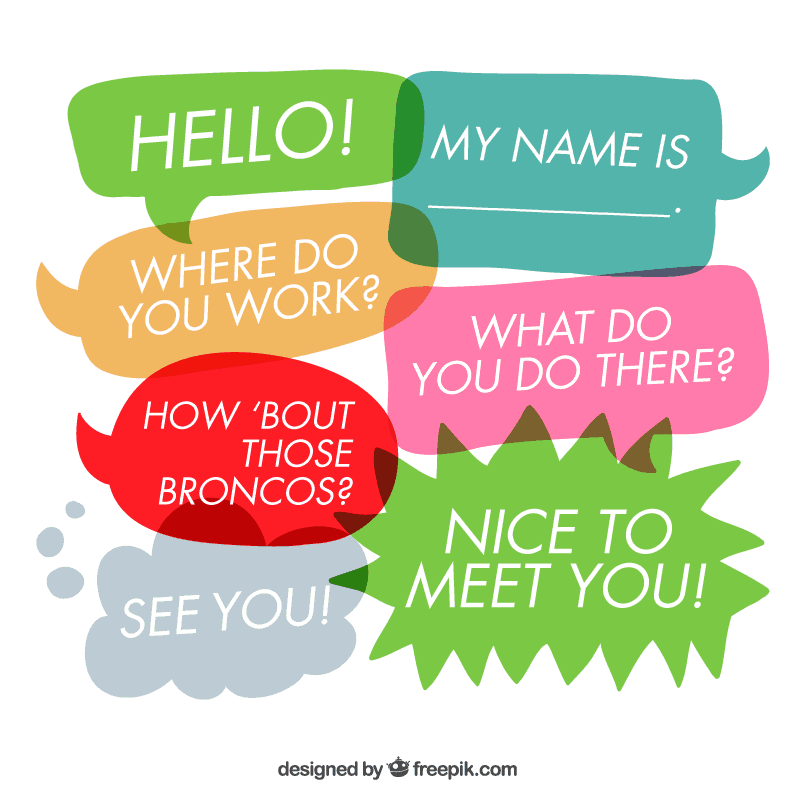
2. Sample Questions to Ask/How to Start a Conversation
  • Where do you work? What do you do there?
  • What did you study in college
  • What are your future career goals?
  • What advice do you have for someone like me trying to enter your field/industry?
  • What do you do for fun in your free time? (ask follow up questions!)
  • Did you watch (the Superbowl, the Olympics, etc.)?
  • Where are you from originally?
  • Have you attended this conference/event before?
3. How to Appropriately Leave a Conversation
  • “It was great meeting you and talking with you…
  • …I know we’re both here to network so I’ll let you talk to some other people.”
  • …I hope to stay in touch– I’ll connect with you on LinkedIn!”
4. Nonverbal Communication and Body Language
  • Stand at an appropriate distance from the other person
  • Have open body language so that other people can approach you
5. Networking Etiquette
  • Bring breath mints – not gum
  • If there is food, try not to have your mouth full when speaking with someone – take small bites
  • If they are serving alcohol, limit yourself to one drink
  • Do not pull out your cell phone while you are talking to someone
6. Follow Up
  • Make notes on the back of business cards you collect: what did you talk about? How will you remember them?
  • Create a spreadsheet to keep track of everyone’s name, company, date, and what you talked about
  • If you made a good connection, follow up with an email and connect with them on LinkedIn
Remember, you can network anywhere! At the grocery store, at a coffee shop or restaurant, at the gym/your fitness class, on public transportation, while waiting in line for something, or in the elevator! Just be yourself!

New Year Offers Chance to Improve

By Chemeketa SBDC

The holidays have come and gone, a new year is here, and it’s a blank slate. A lot of people go through a slump in January and it’s hard to keep up the energy. Your business depends on your being motivated though, so you need to be playing to win every day. Here are a few tips on staying at the top of your game.
-Remember that you made the choice to be in business to begin with, and it’s still your choice (every day) to stay there. You are in control. You are the one who decides at the beginning of each day where you will go and what you will do. No matter what circumstances are swirling around you, you are ultimately the one who makes the decision to stay in or get out. Own it.
-Carefully limit the amount of media and economic news you watch and listen to. It seems that you just can’t read or hear a business story these days that doesn’t predict that the sky is falling and the world is coming to an end. Do you need to ingest those stressful messages on a regular basis? And will knowing how bad things are really help you run a more successful business? Do whatever minimum you need to in order to stay informed, and then spend the rest of the time filling your mind with motivational messages and helpful resource information.
-Pay attention to what triggers negative thoughts and emotions. Is it the economy? Unhappy customers? Bookkeeping duties? Maybe a couple dozen other things? When those things happen, what are your responses? And more importantly, what can you do to head off the negative responses at the pass? If you recognize the patterns you can change them.
-Choose to avoid negative people and spend more time with positive and supportive people. For the most part you control who you spend time with, so make choices to be with people who uplift you and make you glad to be alive. You know the ones, those who are pleased about your successes and wish the best for you. Resolve to stop complaining about things and hanging around people who complain. Don’t commiserate with negaholics. Who needs it?
-Practice gratitude and determine to thank at least one person in your life every day. Stop to appreciate how people are contributing to your life, and make sure they know you have noticed. Move on from there to spend a moment at the end of each day listing ten things you’re grateful for. Remind yourself why your life is good. This one tip alone can transform a dragging spirit into one that greets the day, motivated to be and give 100 percent.
Marcia Bagnall is Director of the Chemeketa Small Business Development Center and instructor of Small Business Management Program. The Small-Business Adviser column is produced by the center and appears each Sunday. Questions can be submitted to SBDC@chemeketa.edu. Visit the SBDC at 626 High Street NE. in downtown Salem or call (503) 399-5088.