

Finance is a must for the smooth conduct of business operations. A business firm can raise funds from two main sources: Owned funds or owned capital and Borrowed funds or loaned capital. Insole proprietorship and partnership the funds contributed as capital are called owned funds. In a joint-stock company fundraised through the issue of shares and reinvestment of earnings (retained earnings) are the owned funds, borrowed funds refer to the borrowings of a business firm. In a company borrowed funds consist of finance raised from debenture holders, financial institutions, public deposits, and commercial banks. Finance can be classified in to:

1. LONG-TERM FINANCE
Long-term finance can be defined as any financial instrument with a maturity exceeding one year (such as bank loans, bonds, leasing, and other forms of debt finance), and public and private equity instruments. Long-term finances are required for permanent investment in the business. It may be raised for more than five years. Long-term finance is required for investment in fixed assets like land and buildings, plant and machinery, furniture and fixtures, etc.
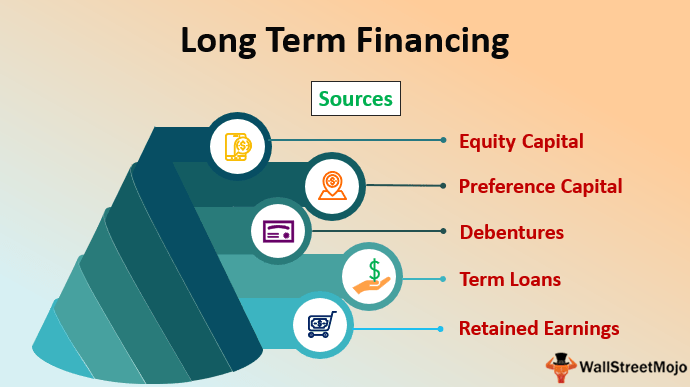
In a business house following are the main sources of long-term finance:
- Issue of shares
- Issue of debentures
- Ploughing back of profits/retained earnings
- Loans from specialized financial institutions
The amount of long-term funds required depends on the type of business and the investment required for fixed assets. For example, the manufacturing of steel, cement, chemicals involves heavy investments in buildings, machinery, and equipment. A small factory producing garments or a small workshop for repairing electrical goods will require a small investment in fixed assets. Traders generally require lesser amounts for long-term investment as compared with the requirements of manufactures.
2. MEDIUM-TERM FINANCE
Medium-term finance is required for a period ranging from 3 to 5 years. It is used for the modernization of plant and machinery, investment in permanent working capital, and for repayment of debts. The main sources of medium-term sources of finance are:
- Issue of debentures
- Issue of preference shares
- Bank loans
- Public deposits/fixed deposits
- Loans from financial institutions
Manufacturing and trading concerns require more working capital to pay wages and to finance the purchase of raw materials and goods.
3. SHORT-TERM FINANCE
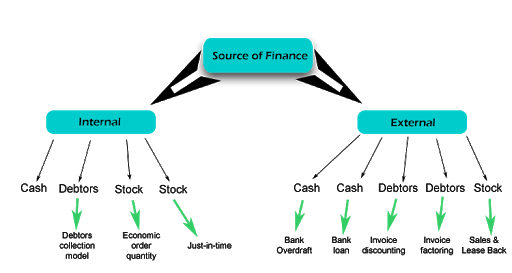
The amount of such capital is required for a short period, say up to one year and as soon as goods are sold and funds are recovered, the amount is again used for current operations. Generally, production processes are completed within a year and goods are ready for sale. Hence short-term funds can be used over and over again from year- to year. Short-term funds are required for meeting day-to-day working capital needs. They raised for twelve months or so. The main sources of short-term finance are as follows:
- Bank credit
- Customer advances
- Trade credit
- Deferred incomes
- Installments credit
The requirements of short-term finance depend on:
- The nature of business undertaken
- The time gap between the commencement of production or purchase of goods and their sales
- The volume of business.
Trading firms normally require proportionately more of short-term capital than a long-term capital. Manufacturing concerns, on the other hand, need relatively smaller amounts of short-term capital as compared to long-term capital.

 Eduindex
You must be logged in to post a comment.