

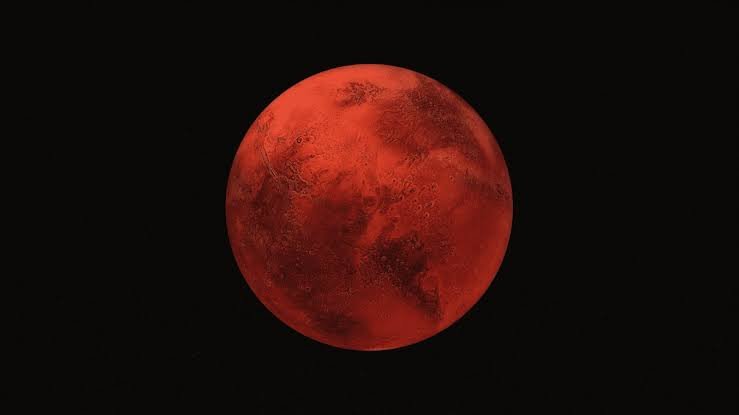
As we all know that Mars is the fourth planet from the sun. After Mercury, it’s the second smallest planet in the Solar System.
Let us take a look at some more interesting facts about the planet Mars.
- Reddish Appearance
Mars is called the ‘ Red planet ‘ because it appears in the sky as an orangish – red star. This appearance is because the rocks and the dust of the planet are rich in iron and minerals that cover its surface. Hence, the planet appears reddish in colour.
However, neither did Mars always have the red appearance nor it was an arid desert as it is today. Evidence say that many years ago liquid water flowed in streams and rivers across the surface of planet. Mars even had oceans.
- Composition
Mars is also known as the terrestrial planet as it is primarily made up of rocks and metals and has a hard surface on which we can stand on.
- Dust storms
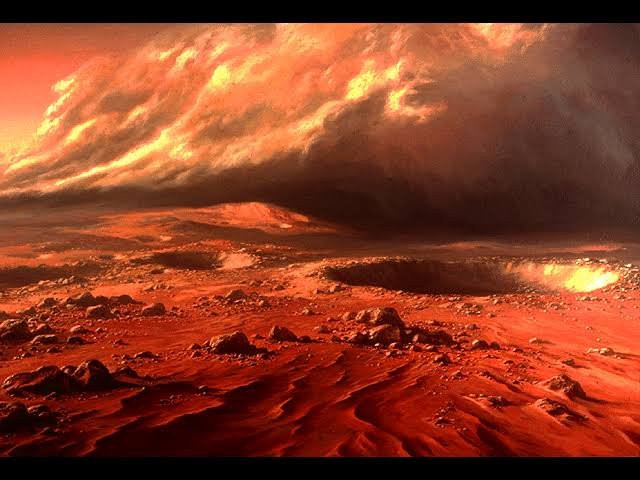
The largest dust storms in the entire Solar System occur on Mars. They sometimes last for months and cover the planet in a swirling red dust cloud completely.
- Ice caps

The two polar ice caps on Mars appear to be largely made up of water.
- Atmosphere
Mars has a thin atmosphere that consists mostly of carbon dioxide, argon, nitrogen and very little oxygen and water vapour. We can’t breathe on Mars.
- Existence of Water
Due to its thin atmosphere, liquid water can not exist on the surface of Mars except at the lowest elevations for a very short period of time as it will evaporate very quickly.
- Seasons
The seasons on Mars is caused by its axial tilt. The hemisphere that is tilted closer to the sun experiences spring and summer and the hemisphere that is titled away experiences fall and winter. At two specific moments each year known as a Equinox, both the hemisphere receive equal illumination.
- Mountain

Mars has the tallest mountain of the Solar System. Olympus Mins is a volcano with a height of 27km which is 18km higher than the Everest.
- Visibility from Earth
Mars is one of the five plantes which are visible from Earth and can be observed with naked eyes. It is because of its reddish colour and brightness in the sky.
- Moons

Mars has two moons namely Phobos and Deimos, which mean fear and threat. These names come from the twin Gods who accompanied Mars and Ares into battle.
Phobos and Deimos are small and have an irregular shape. Phobos is roughly 22km in diameter while Deimos is 12km. They are thought to be asteroids captured by Mars as gravitational pull.
- Survival
The German Aerospace center discovered that the lichens that are found on earth can survive in the conditions of the Mars.
- Mars and Earth
- Around 6 Mars planets could fit inside the earth.
- Mars is about 15% of the earth’s volume yet it’s only 11% of earth’s mass. It’s smaller than the earth and also less dense.
- Even though Mars is smaller than Earth, it has almost the same amount of land as around 2/3rd of the planet earth is made up of water i.e. oceans.
- As the size of Mars is smaller than that of the Earth, the gravity on Mars is a bit less than 40% than the gravity on earth.
- The surface of Mars has marks on it. It is because the planet Mars is situated close to the asteroid belt. As a result, it has higher chances of being striked by space rocks which leave behind too many craters. In comparison, Earth is very noticeably cratered because the potential crater makers have to pass through the thick atmosphere. Even if any crater enters the earth, they land in the oceans.

- The temperature on Mars is more variable than its on earth. The average surface temperature of Mars is roughly -81°F.
- The sun appears about half the size from Mars than that from the earth.

- Since Mars has no atmosphere, the colour of the sunrise and sunset on Mars appears blue instead of orange and red like Earth.

- A day on Mars is of 24 hours and 40 minutes which is slightly longer than the earth which has 24 hours in a day.
- Mars takes 687 earth days to complete it’s one orbit around the sun while Earth takes 365 days to complete it’s one orbit. This means that one year on Mars is 88% longer than that on Earth.
- Mars has an axial tilt for about 25° which is very close the Earth’s axial tilt which is 23.5°.

- Mars lacks a magnetic field as it does not possess molten metal core like Earth. However, scientists believe that the planet did have a magnetic field many many years ago.
- According to NASA a round trip from Earth to Mars will take around two and a half years.
Scientific studies suggest that Mars was once like Earth. Its gravity captured several satellites that later crashed into Mars causing the core to cool down and stop spinning.
There are currently 7 Robots roaming in the plains of Mars.

On the 24th of September 2014, the Indian Space research organisation (ISRO), to Mars Orbiter Mission (MOM or Mangalyaan), space probe entered its orbit of Mars. By doing so, India became the first nation on Earth to set the spacecraft into Mars orbit in the first attempt.
These are some interesting things about the planet Mars that everyone should know and will enjoy reading.

 Eduindex
You must be logged in to post a comment.