

Tantrism – An Introduction
Tantrism can be understood as the unification of the male and female forces, that further attains the path of moksha after being united. The early history of Tantrism is difficult to trace but according to records, artefacts and other facts, this concept emerged as well as got widely accepted in 5th century.
It is also believed that it was in the 5th century that the Tantric Gods were started to be worshipped as well as some of the texts of Hinduism and Buddhism were also composed during this period.
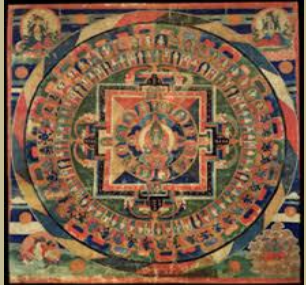
About the Pala Dynasty of Bengal
In order to examine the Pala sculptures and influences of Tantrism in Pala sculptures, let us first take up the history of the Pala dynasty.
The Pala dynasty, who had a ruling time period from 8th century CE to 12th century CE in Bengal, were originally the military conquerors. The empire was established after the declaration of Gopala as the emperor of Gauda state in upper Bihar by his Kshatriya associates in 750 CE. The literal meaning of the term Pala is the gaurdian or the protector in Sanskrit. The Palas were responsible for introducing and establishing Mahayana Buddhism in Tibet, Myanmar and Bhutan. The Palas had a large extentions of trade and also had influences in Southeast Asia. Ample number of evidences including the sculptures and architectural styles of Shailendra Empire in Java confirms the fact that Palas had great influences over those regions.

Obviously as a matter of misfortune, the Pala Empire disintegrated in the 12th century due to frequent attacks by the Sena dynasty.
Influence of Tantrism in Pala Sculptures
The Palas of Bengal and Bihar are being credited for developing the history and culture of the ancient era. They were the one who tried their best to preserve and patronise their cultures.
From the 8th to 12th centuries CE, the regions of Bihar and Bengal, that were under the Pala rule, rendered a huge number of religiously inspired sculptures. They majorly had the elements of Tantrism as well.
The Palas are referred as the great patrons of art , especially Buddhist, in the literary texts. In addition to these facts, the inscriptional evidences too confirm their art of giving patronages to the Buddhist monastic establishments. And since they were the patrons of Tantrism , so one can find Tantric objects in the sculptures. Palas were basically the followers of the Mahayana and Tantric schools of Buddhism. They patronised the Mahayana Buddhism and too supported Shaivism (specifically the Pala ruler Narayana Pala himself took the initiative to construct a Shiva temple in his empire). Hence for this reason, at a very great ease one can determine the overlapping influences of Tantrism in the Pala art alongwith the sculptures.
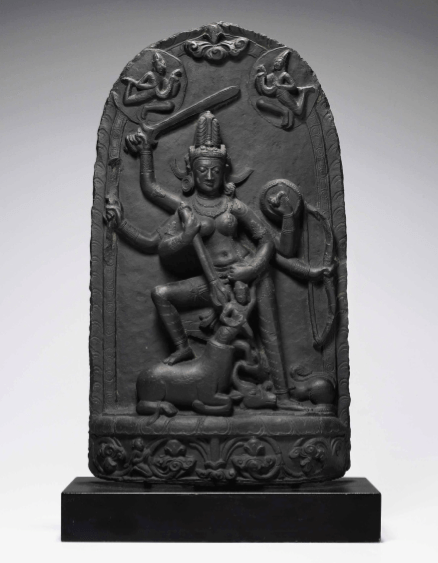
One thing can be highlighted that it was in this period only that Tantrism got highly developed with sculptural art forms. Therefore it is more commom to see intermingling and mixing of the Buddhist Tantric elements in Hindu cults as well as simply Tantric elements in Buddhist along with Hindu cults too.
Basically the Pala art was influenced from the Gupta art forms and it is considered to be an extentions of the same. The Gupta style of sculptural art was given a new dimension and was too patronised by the Pala rulers, that later came to be known as the Pala School of Art or Eastern Style of Medieval Sculpture.
One more historical fact can be added to the history of Pala school of art,that is the development,continuity and modification of the Pala sculpture even in the later phases, under the Sena Dynasty of Bengal in 12th century CE and was widely known as Pala-Sena School of Art.

Observations-
1. A huge Tantric effect can be seen in this sculpture wherein the main figure ,i.e., Manasa is beseated on lotus , that is obviously a Tantric element and she is wearing a large unusual crown (with serpent faces on it ) over her head that features a demonic type of element under Tantrism.
2. She is surrounded by some other mystic figurines as well. 3.The female figures are represented with nude torsos.
4. The upper part or the torso too is shown naked and is decorated with various ornaments.
This was how Tantrism effected the Pala School of Art, providing it a new dimension in the history of art and sculptures, thus.

 Eduindex
You must be logged in to post a comment.