

The Qutub Minar, that resides in the Mehrauli Village in Delhi, is one of the major constructions of the Sultanate Period, that marks the typical architecture of the Slave (Ilbari Turks) Dynasty- beginning with the ruler Qutubuddin Aibak. The Complex consists of :-
- Qutub Minar, the main minaret
- Alai Darwaza
- Quwat-ul Islam Mosque
- Iron Pillar of Vikramaditya
- Alai Minar
- Alauddin Khilji’s Tomb and Madarsa
- Tomb of Iltutmish
As a matter of historical fact, it was claimed by several scholars that the main minaret- the Qutub Minar – was an observatory named Dhruv Stambh or the Vishnu Stambh, built during the reign of King Vikramaditya of the Gupta Dynasty and Mehrauli was known as Mihirawali, after the name of the renowned astronomer Mihir, who’s supposed to be the architect of the Dhruv Stambh Or the modern day Qutub Minar. According to the archaeologists also, the Minar was originally an observatory (called Vishnu Stambh), that was used for studying astronomy during the reign of King Vikramaditya.
Let us now talk about the architecture of each element present in the Complex.
Qutub Minar- inspired by the Minaret of Jam in Afghanistan, Qutub Minar is a 72.5m high minaret and an UNESCO World Heritage Site, having 5 storeys, each marked by a projecting balcony, that are designed with several combinations of stars, columns and other patterns. The red sandstone acts as a foil to the ornamental bands with elegant carving of Arabic inscriptions, foliage and scrolls. The minaret is surrounded by bands of intricate carvings in the Kufic style of Islamic calligraphy. Inscriptions also reflect that repairs were done to the minar by Sikandar Lodhi, when it was struck by lightening. Built as a victory tower by Qutubuddin Aibak, it’s construction actually marked the rise of the Muslim rule in India.
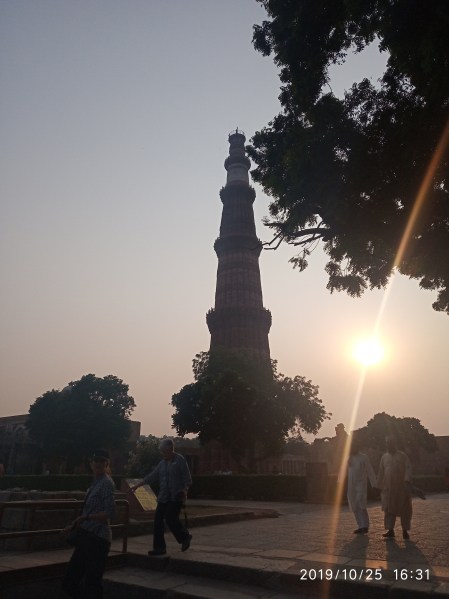
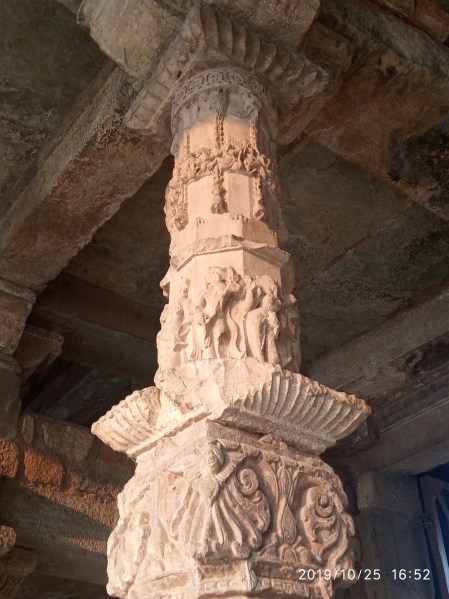
Quwat-ul Islam Mosque- the construction of the mosque was done in 1199CE by destroying the 27 Hindu and Jain temples, that stood erect prior to the construction of the same. The mosque wouldn’t have had accommodated more than 2000 people, though it was the largest mosque of Delhi in the 12th century. The original dimensions of the mosque was 43m×33 m, while the prayer hall measures 45m×12m. Also, the pillars inside the mosque are those of the demolished temples, so one can easily locate the figures of lotus, bell, female figurines, kalash etc. The mosque is raised on a paved courtyard measuring 43m×32m, surrounded by pillared cloisters. 3p years later, this mosque was enlarged by Alauddin Khilji.
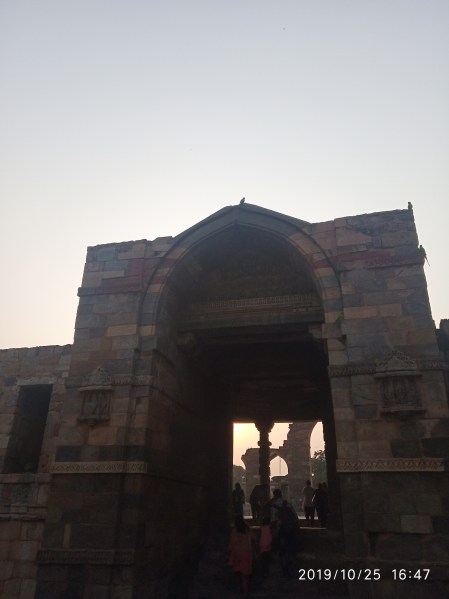
Entrance gate of the Quwat-ul Islam Mosque
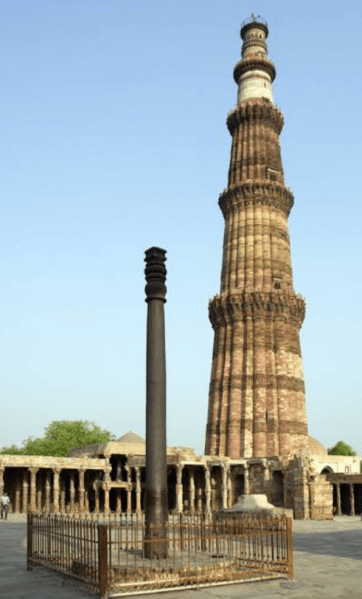
Iron Pillar of King Vikramaditya- it is said that the iron pillar inside the Quwat-ul Islam mosque is of the King Vikramaditya (Chandragupta II), which is 7.21meter high and weighs more than 6 tonnes. It bears an inscription in Sanskrit in Brahmi script dating back to the 4th century CE. The estimated weight of the decorative bell of the pillar is 646 kg and a deep socket on the top of this capital shows that there was an idol of Garuda too.
Alai Darwaza- is the main gateway from the southern side of the Quwat-ul Islam mosque, that was actually constructed by Alauddin Khilji in 1311 CE. This doned gateway is decorated with red sandstone and white marble . It has jharokhas, latticed stone screens as well as inscriptions in Naqsh style of calligraphy. It too reflects Turkish architecture.
Alai Minar- constructed by Alauddin Khilji with the motive of doubling the height of the Alai Minar than that of Qutub Minar. However, the construction was abandoned only after the completion of the 80 feet high first storey. This minaret was made up of giant rubble massonry core.
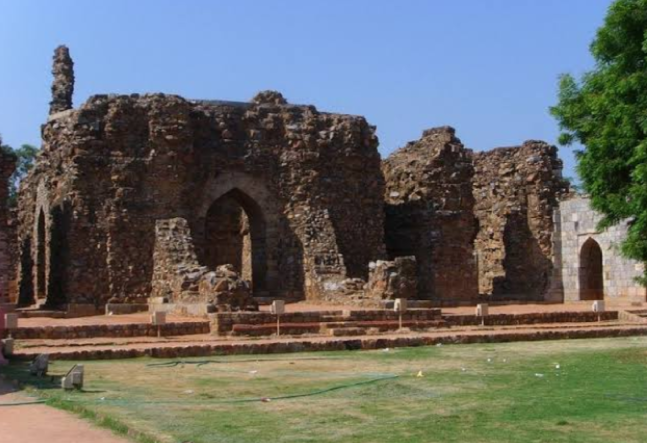
Alauddin Khilji’s Tomb and Madarsa- at the back of the Complex, stands an L-shaped construction having Alauddin Khilji’s tomb and madarsa. The central room of the building has now lost its dome. There were 2 small chambers connected to the tomb by passages on the either side. It was the first examples of a tomb standing alongside a madarsa in India.
Tomb of Iltutmish- the tomb of Iltutmish has a central chamber measuring 9 square metre. The main cenotaph, in white marble, is placed on a raised platform in the centre of the chamber. The facade is having an ornate carving. The interior west wall has a mihrab decorated with marble and Hindu motifs, such as bells, lotus etc.
So these were the major architectural features of each construction present inside the Qutub Complex hence.

 Eduindex
You must be logged in to post a comment.