

Rape is the fourth most common crime against women in India.According to the National Crime Records Bureau (NCRB) 2018 annual report, 33,356 rape cases were reported across India in 2018. Out of these, 31,320 were committed by someone known to the victim (93.9% of the cases).
India has been characterised as one of the “countries with the lowest per capita rates of rape”. Many rapes go unreported in various countries including India. In India, consensual sex given on the false promise of marriage constitutes rape.The willingness to report the rape has increased in recent years, after several incidents of rape received widespread media attention and triggered public protest.This led the Government of India to reform its penal code for crimes of rape and sexual assault.

Definition in Indian Penal Code
After 3 February 2013, the definition was revised through the Criminal Law (Amendment) Act 2013, which also raised the legal age of minor to eighteen.
Section-375. A man is said to commit “rape” if he:–– (a) penetrates his penis, to any extent, into the vagina, mouth, urethra or anus of a woman or makes her to do so with him or any other person; or (b) inserts, to any extent, any object or a part of the body, not being the penis, into the vagina, the urethra or anus of a woman or makes her to do so with him or any other person; or (c) manipulates any part of the body of a woman so as to cause penetration into the vagina, urethra, anus or any part of body of such woman or makes her to do so with him or any other person; or (d) applies his mouth to the vagina, anus, urethra of a woman or makes her to do so with him or any other person, under the circumstances falling under any of the following seven descriptions:
Firstly. –– Against her will.
Secondly. –– Without her consent.
Thirdly. –– With her consent, when her consent has been obtained by putting her or any person in whom she is interested, in fear of death or of hurt.
Fourthly. –– With her consent, when the man knows that he is not her husband and that her consent is given because she believes that he is another man to whom she is or believes herself to be lawfully married.
Fifthly. –– With her consent when, at the time of giving such consent, by reason of unsoundness of mind or intoxication or the administration by him personally or through another of any stupefying or unwholesome Substance, she is unable to understand the nature and consequences of that to which she gives consent.
Sixthly. –– With or without her consent, when she is under eighteen years of age.
Seventhly. –– When she is unable to communicate consent.
Even after the 2013 reform, marital rape when the wife and husband live together continued not to be a crime in India. Article 376B of the 2013 law made forced sexual intercourse by a man with his wife – if she is living separately – a crime, whether under a decree of separation or otherwise, punishable with at least a 2-year prison term.Forced sex by a man on his wife may also be considered a prosecutable domestic violence under other sections of Indian Penal code, such as Section 498(A) as well as the Protection of Women from Domestic Violence Act 2005.The crime of sexual assault on a child, that is anyone below the age of eighteen, is further outlined and mandatory punishments described in The Protection of Children from Sexual Offences Act 2012.(POCSO)
All sexual acts between the members of the same sex, consensual or forced, was previously a crime under Section 377 of Indian penal code, after the 2013 Criminal Law reform, with punishment the same as that of rape but it was later overturned in a landmark judgement of the Supreme Court on 6 September 2018 which stated all consensual sexual acts between adults who have met the age of consent are not violative of Section 377, hence decriminalizing gay sex in India.On 6 September 2018, the Court ruled unanimously in Navtej Singh Johar v. Union of India that Section 377 was unconstitutional “in so far as it criminalises consensual sexual conduct between adults of the same sex”.
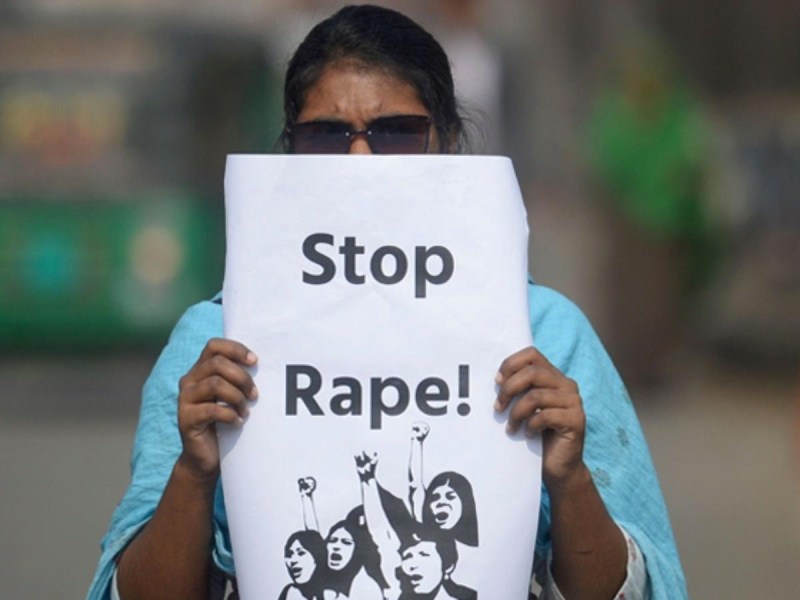
A rape in India in every 15 minutes
In India, a rape is reported every 15 minutes, according to recently released official government crime data. The National Crime Records Bureau (NCRB) data from 2018 has stark revelations about crime in the country.
The NCRB data is usually released after two years, annually. Under the Narendra Modi government the data was inordinately delayed and some aspects are still missing. However, the data on violence against women throws up shocking figures for 2018.
Despite various federal government campaigns such as Beti Bachao Beti Padhao – Educate the daughter, Save the daughter – the crime rate per 100,000 women increased to 58.8% in 2018 in comparison with 57.9% in 2017.
A recent verdict in a Delhi gang-rape case handed down after seven years leaves much to be desired.
In 2012, the case of young Delhi-based woman Jyoti Singh, christened Nirbhaya (Fearless) by the media, shook the nation. She was abducted by a group of men and repeatedly raped on a moving bus. They also mutilated her body before throwing her from the bus.
As the details of the ferocity of the attack emerged, the country erupted into protests. This led to a number of changes in India’s rape laws in the hope that speedier trials and harsher punishments would lead to fewer assaults on women.
But her case took seven years to go through India’s judicial system.
In 2013, the criminal law amendment act was passed which criminalized sexual offenses like acid attacks, voyeurism and stalking, and also provided 20-year sentences for rape and the death penalty in extreme rape cases.
A committee was set up under former Chief Justice of India J S Verma. His committee’s report pointed out systemic failures on the part of the government and the Delhi police.
Conclusion
As of 2018, there were 133,000 pending rape cases in the courts. In May, a panel of judges dismissed allegations of sexual harassment against the erstwhile chief justice of India made by a former court employee in a ruling that infuriated women and activists. The chief justice denied the claims.The fact that even a high-profile case like Nirbhaya’s took seven long years to reach a conclusion underscores how slowly the wheels of justice move in the country.
Sexual assault occurs with frightening regularity in this country, adds the activist. We need to evolve punishments that act as true deterrents to the very large number of men who commit these crimes.
According to Flavia Agnes, a women’s rights lawyer and co-founder of Majlis, a feminist organization, India needs a higher budgetary allocation to build the infrastructure and facilities for rape cases. “Why do these cases have to wait long for justice? We need budgetary allocation [and] political will as well as sensitivity down the chain.”
Indian law provides for rape cases to be completed within a year through fast-track courts, there has been a sharp increase in pendency of such cases. According to the data taken from different high courts, and subsequently released by the Union law ministry, the pendency of such cases has increased by more than 46% across the country since March 2018.
Delhi has topped the list and has registered a whopping 353% increase in pending rape cases. However, in absolute terms, the number of pending cases in Uttar Pradesh is the highest – from 36,000 to 67,000 between March 2018 and December 2019. Maharashtra, Bihar, West Bengal, Madhya Pradesh and Rajasthan have also registered very high number of pending rape cases.

 Eduindex
You must be logged in to post a comment.