

13 April, 1919 the unforgettable day in the history of India. For Punjab it is a traditional day and the most important festival, Baisakhi. The Baisakhi day of 1919 turned as a horror day in the history of India. Jallianwala Massacre also knowm as “Amritsar Massacre” left people petrified. Indian-British General Reginald Dyer ordered troops of Britain to open fire on the people gathered at the bagh that evening. Thousands people were gathered there for celebrating Baisakhi and others were peacefully protesting against the arrest and deportation of two national leaders, Satyapal and Saifuddin Kitchlew. Through open fire at people they killed at least three seventy nine people leaving thousands of people injured at the place. Dyer and his troops entered and then blocked the main entry of the garden. They open fire on the people for ten-long minutes shooting the people at the entrance who were trying o save their lives.
Jallianwala Bagh is situated in Amritsar city, Punjab India near the holy Golden Temple. It has a great significance of its own. After the World War 1, In February 1919, the British Government passed the Rowlatt Act where the acts allowed certain political cases to be tried without juries and permitted internment of suspects without trial. Due to this act, many national leaders were arrested including in Punjab. Mahatma Gandhi called one day general strike against the decision of the government. Many people were burnt, looted and killed brutally by the British Government. After they ceased firing, the troops immediately withdrew from the place, leaving behind the dead and wounded.
After this terrible incident, martial law was imposed in Punjab which states that, Martial law involves the temporary substitution of military authority for civilian rule and is usually invoked in time of war, rebellion, or natural disaster. Abstract: When martial law is in effect, the military commander of an area or country has unlimited authority to make and enforce laws. Rabindranath Tagore abandoned the award which he received in 1915. Soon after this martial law, the people bean with Satyagrah led by Mahatma Gandhi and non cooperation movement. The government of India ordered an investigation of the incident (the Hunter Commission), which in 1920 censured Dyer for his actions and ordered him to resign from the military.
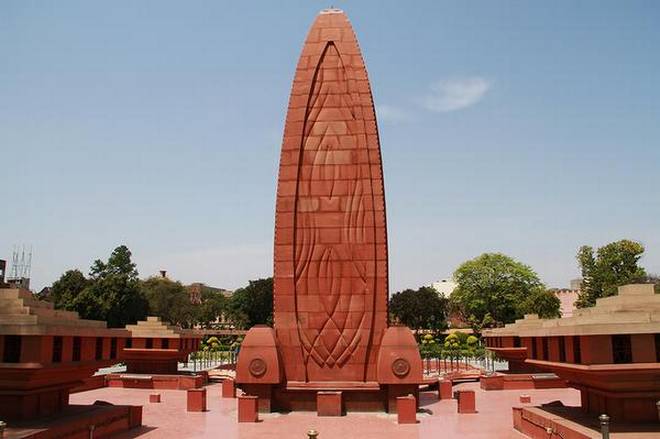
Thousand of people visit Jallianwala Bagh to the history of the place. The scars of the bullet are still embedded in the walls. The well in which hundred of people jumped to save themselves is still there. The remains of the people are dug inside the soil of Bagh. There is a museum to see the past, preserved antique material which was left by the dead people. There is one memorial in the memories of the people who dies in this terrible incident. The garden is surrounded y 7 acres of the land and is managed by the Jallianwala Bagh National Memorial Trust, which was established by Jallianwala Bagh National Memorial Act, 1951.The Flame of Liberty is represented by a central pylon. It is white and shaped like a flame. Engraved are faces of ‘martyrs’ and below are given their names.
A number of other plaques are seen inside the garden, one of which reads:
This site is saturated with the blood of thousands of Indian patriots who were martyred in a nonviolent struggle to free India from British domination. General Dyer of the British army opened fire here on unarmed people. Jallianwala Bagh is thus an everlasting symbol of non-violent & peaceful struggle for the freedom of India

 Eduindex