

Mathematics is the branch of science that deals with the logic of shape, quantity and arrangement. Math is all around us, in everything we do.The founder of mathematics is considered to be as Pythagoras who gave the triangular concept or theorem. In the ancient 6th century B.C, the Greeks started the subject of mathematics only by the Pythagoras concepts. Later, Archimedes, a Greek mathematician, developed it and so he became the FATHER OF MATHEMATICS. Beginning in the 6th century BC with the Pythagoreans, the Ancient Greeks began a systematic study of mathematics as a subject in its own right with Greek mathematics. Around 300 BC, Euclid introduced the axiomatic method still used in mathematics today, consisting of definition, axiom, theorem and proof. The symbol for Pi has been in use for over 250 years. The symbol was introduced by William Jones, a Welsh mathematician, in 1706. The symbol was made popular by the mathematician Leonhard Euler.
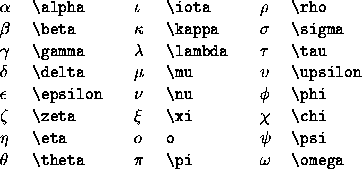
Pi (π) is the 16th letter of the Greek alphabet, and is used to represent the most widely known mathematical constant. By definition, pi is the ratio of the circumference of a circle to its diameter. The Egyptians calculated the area of a circle by a formula that gave the approximate value of 3.1605 for π. The first calculation of π was done by Archimedes of Syracuse (287–212 BC), one of the greatest mathematicians of the ancient world. We might not use it yourself every day, but Pi is used in most calculations for building and construction, quantum physics, communications, music theory, medical procedures, air travel, and space flight.

Pi Approximation Day is observed on July 22 (22/7 in the day/month format), since the fraction 22⁄7 is a common approximation of π, which is accurate to two decimal places and dates from Archimedes.Throughout the history of mathematics, one of the most enduring challenges has been the calculation of the ratio between a circle’s circumference and diameter, which has come to be known by the Greek letter pi. From ancient Babylonia to the Middle Ages in Europe to the present day of supercomputers, mathematicians have been striving to calculate the mysterious number. They have searched for exact fractions, formulas, and, more recently, patterns in the long string of numbers starting with 3.14159 2653…, which is generally shortened to 3.14. Since the exact value of pi can never be calculated, we can never find the accurate area or circumference of a circle.
Some interesting facts about pi:
| 1. Pi is an irrational number that is it is not possible to calculate Pi by dividing an integer by any other number. 2. Pi is a never-ending and never-repeating number. 3. The symbol of Pi has been in use for about 250 years. 4. As the value of Pi is never-ending so we can’t find the true circumference or area of a circle. 5. In Greek alphabets, Pi is the sixteenth letter and in English also p is the sixteenth letter. 6. Pi is the ratio of a circle’s circumference to its diameter. 7. In the 19th century, William Shanks calculated the first 707 digits of Pi by hand but unfortunately, he made a mistake after 527th place. 8. A Japanese scientist, breaking all the previous records, with the help of Hitachi SR 8000 which is a powerful computer found 1.24 trillion digits of Pi. 9. Pi is mentioned in the Bible.– In ancient times, Archimedes is the first person who studied about Pi. 10. Albert Einstein was born on Pi Day. 11. There are no zeros in the first 31 digits of Pi. |

 Eduindex