

Shri Amarnathji Shrine Board headed by Jammu and Kashmir Lieutenant Governor Girish Chandra Murmu has decided to cancel this year’s Amarnath Yatra in view of the coronavirus situation. LG, who is Chairman of Shri Amarnathji Shrine Board (SASB) presided over the 39th Board meeting of the Shri Amarnathji Shrine Board yesterday in which the Board members participated virtually through video conference to discuss the conduct of this year’s Yatra.
The Board suggested that it would not be advisable to conduct Shri Amarnathji Yatra 2020 and it would be advisable to cancel it this year in larger public interest. This would enable the Health, Civil and Police Administrations to focus on the immediate challenges facing them rather than diverting resources, manpower and attention to the conduct of the Shri Amarnathji Yatra.
Based upon the circumstances, the Board decided that it is not advisable to hold and conduct this year’s Shri Amarnathji Yatra and expressed its regret to announce the cancellation of Yatra 2020. The Board said that it is aware of and respects the sentiments of millions of devotees and to keep the religious sentiments alive, the Board shall continue the Live Telecast/ Virtual Darshan of the morning and evening Aarti.
It also said that the traditional rituals shall be carried out as per the past practice and the Chhadi Mubarak shall be facilitated by the Government.
Meanwhile, the Chhari Mubarak of Swami Amarnath was taken to Sharika-Bhawani temple at Hari Parvat in Srinagar yesterday to pay obeisance to the goddess Sharika by Mahant Dipendra Giri. Prayers were offered for the early end of the prevailing coronavirus pandemic. Prayers were also offered before the goddess for bestowing peace and prosperity in Jammu & Kashmir.
Day: July 22, 2020
Govt extends work from home for IT, BPO companies till Dec 31 due to COVID-19
Government has extended connectivity norms for work from home for IT and BPO companies till December 31 this year due to COVID-19 pandemic.
In a tweet last night, the Department of Telecommunications said, it has further extended the relaxations in the terms and conditions for other service providers up to 31st December 2020 to facilitate work from home in view of the ongoing concern due to COVID-19.
The time period for work from home was expiring on July 31.
Harsh Vardhan says N95 masks with respirator valves do not prevent coronavirus; appeals everyone to use triple layer mask made of cloth
Harsh Vardhan says N95 masks with respirator valves do not prevent coronavirus; appeals everyone to use triple layer mask made of cloth
 @drharshvardhanUnion Health Minister Harsh Vardhan has said that N95 masks with respirator valves in them do not prevent the coronavirus from spreading out. He said, N95 mask fitted with perforated respirator is contrary to the rules adopted to prevent the spread of coronavirus. In a tweet, Dr Vardhan appealed to everyone to use a triple layer mask made of cloth and also to encourage others for this.
Director-General of Health Services, Dr Rajiv Garg has written to the Principal Secretaries of health and medical education of all the States in this regard. In the letter, Dr Garg said that the use of valved respirator N95 masks is detrimental to the measures adopted for preventing the spread of coronavirus as it does not prevent the virus from escaping out of the mask.
In view of it, the DGHS has urged the States to instruct all concerned to follow the guidelines on the use of face and mouth cover and prevent inappropriate use of N95 masks. Dr Garg said, it has been observed that there is inappropriate use of N95 masks, particularly those with the valved respirator, by the public other than designated health workers. He also referred to an advisory issued by the Health Ministry on the use of homemade protective cover for face and mouth available on its website.
In April, the Health Ministry had issued an advisory on the use of homemade protective cover for face and mouth, asking people to wear it, particularly when they step out of their residences. It also listed the procedures of making such homemade masks, asking to ensure it fits the face well and there are no gaps on the sides.
PM Modi to deliver keynote address at India Ideas Summit today
Prime Minister Narendra Modi will deliver the keynote address at the India Ideas Summit today. The two-day Summit which began yesterday is being hosted by the US-India Business Council. This year marks the 45th anniversary of the formation of the Council. The theme for this year’s India Ideas Summit is ‘Building a Better Future’.
AIR correspondent reports, Prime Minister Narendra Modi will provide perspective on how the US-India Partnership can shape the post-COVID world.
The virtual Summit will witness discussions on areas including India-US cooperation and future of the relation between the two countries in a post pandemic world. It will feature high-level presence from Indian and US government policymakers, state-level officials, and thought leaders from business and society.
Key speakers at the Summit include External Affairs Minister Dr. S Jaishankar, U.S. Secretary of State Mike Pompeo, Senator of Virginia and co-chair of Senate India Caucus Mr. Mark Warner, Former U.S. Ambassador to the United Nations Nikki Haley, among others.
HOME UNDER JUVENILE JUSTICE ACT
Addressing the lack of safe shelters for children in conflict with the law, the court urged every state to evaluate the condition of their Child Care Institutions as well as to provide education, healthcare, and proper nutrition to its residents. The court reiterated that government registration in accordance with the provisions of the Juvenile Justice Act was compulsory for child care institutions run by individuals or NGOs to avoid incidents of trafficking or child sexual abuse.
Shelter Homes
While a large number of urban marginalized children are in need of day care services, there are many others who require residential care for a temporary period for one or more reasons. These include children without parental care, run away children, migrant children, and child substance abusers etc. The Juvenile Justice (Care and Protection of Children) Act 2000 empowers State Governments to recognize reputed and competent voluntary organizations, to cater to the needs of such children. The State Government shall provide financial assistance to set up and administer
Shelter Homes for such children. At least one such Shelter Home in the State is to be notified and designated by the States/UTs as a Home for the care, detoxification and counselling of children affected by substance abuse. These Shelter Homes shall offer day and night shelter facilities to the children in need of support services for a temporary period, while efforts are made to rehabilitate them. In order to facilitate and expedite the setting up of Shelter Homes in every district or group of districts, the scheme shall provide financial support to the State Governments and Union Territories.
Children’s Homes
A large number of children in need of care and protection who enter the juvenile justice system through the Child Welfare Committees (CWCs) are in need of residential care and protection during the pendency of any inquiry and subsequently for their long-term care, treatment, education, training, development and rehabilitation. The Juvenile Justice (Care and Protection of Children) Act 2000 empowers the State Government either by itself or in collaboration with voluntary organizations to set up Children’s Homes in every district or group of districts for the reception and residential care of such children. These homes shall serve as a home away from home and provide comprehensive child care facilities to children for ensuring their all-round development. They shall work towards enhancing the capabilities and skills of children and work with their families with the view of facilitating their reintegration and rehabilitation into mainstream society.
Children in conflict with law who enter the juvenile justice system through the Juvenile Justice Boards (JJBs) are in need of adequate residential care and protection during the pendency of any inquiry regarding them under the Juvenile Justice (Care and Protection of Children) Act 2000. The Act empowers the State Governments to establish and maintain either by itself or under an agreement with voluntary organizations, observation homes in every district or group of districts for their temporary reception. In order to facilitate and expedite setting up of Observation Homes in every district or group of districts, the scheme shall provide financial support to the State Governments and Union Territory Administrations.
Observation homes
The State Government shall establish and maintain in every district or a group of districts, either by itself, or through voluntary or non-governmental organisations, observation homes, which shall be registered under section 41 of this Act, for temporary reception, care and rehabilitation of any child alleged to be in conflict with law, during the pendency of any inquiry under this Act Where the State Government is of the opinion that any registered institution other than a home established or maintained under sub-section (1), is fit for the temporary reception of such child alleged to be in conflict with law during the pendency of any inquiry under this Act, it may register such institution as an observation home for the purposes of this Act. The State Government may, by rules made under this Act, provide for the management and monitoring of observation homes, including the standards and various types of services to be provided by them for rehabilitation and social integration of a child alleged to be in conflict with law and the circumstances under which, and the manner in which, the registration of an observation home may be granted or withdrawn. Every child alleged to be in conflict with law who is not placed under the charge of parent or guardian and is sent to an observation home shall be segregated according to the child’s age and gender, after giving due consideration to physical and mental status of the child and degree of the offence committed.
Special Homes
Children in conflict with the law committed by the Juvenile Justice Boards (JJBs) for long term rehabilitation and protection require institutional services. The State Governments are empowered to establish and maintain either by itself or under an agreement with voluntary organisations, special homes in every district or group of districts for the reception and rehabilitation of juveniles in conflict with law.
In order to facilitate and expedite setting up of Special Homes in every district or group of districts, the scheme shall provide financial support to the State Governments and Union Territory Administrations.
Place of Safety
As per section 16, of the Juvenile Justice (Care and Protection of Children) Act, 2000, the Juvenile Justice Board is empowered to place a juvenile above the age of 16 years in a Place of Safety, if the Board is of the opinion that the seriousness of the offence and/or the said juvenile’s behaviour, makes it unsuitable for them to be placed in a Special Home. A ‘Place of Safety’ is any place or institution, (not being a police lockup or jail), established separately or attached to an observation home or a special home, the person in-charge of which is willing to receive and take care of the juvenile in conflict with law placed there, by order of the Board, for a period and purpose as defined in the order.
The Act also states that the State Government may arrange to place a juvenile referred to it by the Board, in a ‘Place of Safety’, which has been declared fit by the State Government for such purpose, and may order such juvenile to be kept under protective custody, at such place and on such conditions, as it deems proper. The State Government may, by rules, prescribe the types of places that can be designated as ‘Place of Safety’ and the facilities and services that may be provided therein.
Electric Cars vs Regular Cars
Electric cars are becoming increasingly popular, and you are probably not alone in wondering if the electric car is right for you. As the technology that supports electric vehicles (EVs) and batteries continues to improve, barriers such as high cost, limited distance, operational issues, long charging time, and the difficulty of charging stations will disappear.
Car giants like Volvo are expressing their commitment to the transformation of automotive manufacturing only recently; and luxury luxury cars like Tesla offer less expensive options to the consumer, transforming the public perception of electric cars as the only thing accessible by management.
Electric cars cost less than electric cars.
Electric cars cost less than conventional gas cars each year. Since the cost of electric cars is the same or less than the existing cars the choice of ‘electric ride’ will be clear. Electric cars are already less expensive. The cost of using an electric car will only save you money for a car life.
In almost every major way, an electric car costs much less to operate and maintain than a gas car. No electricity to buy, no oil change, no smog testing, and a few advanced components for burglary or exhaustion. In fact, many electric car owners go through years without any repairs or bills.
Electric cars are better for the air we breathe.
Since electric cars have less than zero emissions, we can look forward to cleaning up the air if there are more electric cars on the road. Clean air means fewer diseases in the world, which means less pressure on public health systems, hospitals, and so on. In addition, a small amount of greenhouse gas emissions will save the ozone layer and reduce our carbon footprint.
Jump to the gas station, you can ‘fill’ the house and work.
Since there is no gas to buy, or oil can change. To get up, simply connect at home, at work, or on a pay rise. As an added bonus to EV charging, the power that goes into your batteries increases with the production of non-renewable resources. Non-renewable electricity bills for your electric car are made internally. Add a list of the day to your home or work and your travel can pay off.
Electric cars are the future of travel.
If you drive an electric car you are obviously planning for the future. In addition to being counted among the “coolest” people, you will be making a difference in the environment, and saving money.
EVs must pass the same test for electric vehicles.
EVs have passed the same safety tests as electric vehicles, you can be sure they are completely safe to operate. In fact most EVs reach the top of safety standards, the Tesla Model X for example has perfect scores. Widespread concern for EV safety focuses on the risk of fire, but in reality, EVs are much less likely to catch fire than fuel vehicles. On average, gasoline vehicles will generate an average of 1 fire every 20 million.2 For EVs, the value is 1 fire out of 120 million driven. That’s 80% when you take notes.
Importance of outdoor games
It’s really important to let today’s generation understand how valuable and enjoyable it is to play outdoor games, as today’s generation is just involved in playing new online games on their computers , ipads, laptops, psp, etc.Developing these habits from the beginnings is just damaging their lives, because they don’t recognize how interesting it is to play outdoor with friends, loose with friends but still appreciate, create new friends, etc. The introduction of tv, film, video gaming just tends to turn kids couch potatoes.
We used to get so engrossed in playing outdoor games with friends from morning till night that we never get bored or had to go home soon. Outdoor games like kabaddi, cricket, langdi, kho and many more only made our childhood so unforgettable that we’re always looking forward to that period.
Outdoor game is really useful and provides a substantial value. The brain has been functioning for a long time. We are very changed out from the digital environment. The wellbeing is enhanced. We grow our personalities. We know how to function with harmony and cohesion. We understand that losing with friends is enjoyable as well.Learning how to ride or bike is a ability that lasts a lifetime, making it possible to indulge in other sports such as mountain biking, roller hockey, cycling and skateboarding. They strive to meet lifelong connections and socialize with others.There is never a disadvantage of playing outdoor games .Instead parent these days force their child to play outdoors with friends rather than sitting infront of computers or phones everyday.
Let us hear about the advantages of these outdoor games;
1. It gives them an opportunity to learn new things.
Outdoor sports will be a great opportunity to develop children’s social abilities. They will learn valuable lessons and skills in life, cultivate a problem-solving mindset, get to experience nature, discover new knowledge, and appreciate science in its fundamentals.In fact, as children practice outdoors, they believe that it is an active and enjoyable experience and not a boring task they will conduct in the classrooms.
2. It can help in their physical development.
Outdoor play keeps children healthy, which will increase their physical stamina and health. Playing outdoor games will also improve the muscles and organs, develop immunity and reduce the possibility of many diseases such as diabetes, cardiac attacks and obesity..Living in the fresh air and sunlight will actually supply them with Vitamin D. Children’s vision may be affected from being connected to technological devices for prolonged time. Yet outdoor activity will make their vision much stronger.
3. Its imagination can be improved.
Enjoying outdoor games will make kids more imaginative, and improve their creativity abilities. Out in the open and surrounded by plants and trees, as well as other things will enhance the imaginative potential of a child and unlock its creativity.
4. It can help them acquire social skills.
Children who spend time outdoors and play games with each other try to communicate more with other adolescents, as opposed to children who live indoors and become separated and taken away. If your kid spends the most time indoors and lives inside his own shell, you should strongly encourage him to go out and enjoy with other kids.As children meet new companions, turn around to play without parental guidance, or simply talk to each other, they learn and develop their social and cognitive abilities without understanding. So in the future, this ability will benefit them.
5. It can help them develop a positive attitude.
Children playing outdoors tend to develop a positive attitude to life and have a relatively calm and joyful personality. Additionally, outdoor environment offers a perfect chance to manage their creativity in a positive way.
6. It helps in personality development.
Outdoor games help in a children’s development. They learn to be self-reliant. They learn to cope with emergency incidents, losses, etc., without adult supervision. This builds trust in them and empowers them to cope with life problems further on.Outdoor play also lets children establish values such as patience, sportsmanship and leadership – both of which later in life would be useful.
7. It helps improve the attention span in children.
Outdoor sports will also boost children’s attention span. While playing outside games the attention and analytical and thinking abilities of your child would be improved. Kids with ADHD (attention deficit hyperactivity disorder) can also gain from physicality-it may also boost their periods of concentration.
8. It strengthens their motor skills.
Devoting to outdoor games will help children improve their gross and fine motor skills. By practicing outdoor games they achieve greater strength , flexibility, and equilibrium.
9. It improves their love for nature.
Children who spend substantial amount of time outdoors may be more likely to develop a lifelong connection with nature.
10. It makes them lead a healthier lifestyle.
Children who engage productively in physical activities are more likely to live a stable and well-balanced lifestyle later in adulthood. They do have good ability to make decisions. They learn to educate themselves and overcome their limits at risk evaluation while being stronger.
Boon of the Mid-Day Meal
The very concept of Mid-Day Meal scheme was introduced on the year of 2000 by Akshaya Patra Foundation and was later passed as a mandate by Supreme Court of India on the year 2001. The sole purpose of the scheme is to provide wholesome freshly cooked hot lunch to all the students in the government and government aided schools in India. Usually the meal should be a whole mix of carbohydrates, proteins and various vegetables as per the bodily requirements of the children. The goal of such a scheme was to encourage the parents to send their wards to schools, to increase the school attendance and to do away with the norm of child labour, to prevent the child from being hungry at the time of attending the classes and thus to avoid malnutrition, and finally to improve the socialisation among the castes and last but not the least, to promote women empowerment.
The ultimate goal – to provide at least one of the three daily meals required for the proper growth of the children.
The scheme was institutionalized by the designated states and the schools and things were going fine until the pandemic hit the world. During the month of March, the lockdown was declared by the nation and there rose comprehensions among the low wage workers. They were worried about one of the most important thing on earth – what will happen to our mid-day meal and how can we arrange food for our children? The reason being the mid-day meal was one of the main reason as to why their parents sent their wards to school and they were worried about how to relinquish their daily requirements. But, like a godsend, the Government of India declared that even though the schools will be closed owing to the social distancing, the schools will still have to arrange the benefit of mid-day meal or any other substitute of equal value to the children and their families. Not only that, the Government also passed that if and when necessary, required assistance will be rolled out for the underprivileged.
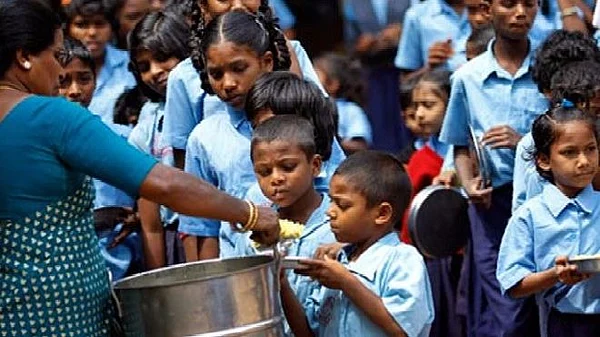
The Government of India rolled out various schemes under which various states had to provide the mid-day meal scheme to the students. Some of such initiative are:
- West Bengal – Ensured the distribution of the meals to their wards’ home amidst the curfew.
- Odisha – Facilitation of Public Distribution System (PDS).
- Chhattisgarh – Provision of mid-day meal to the parents of the children for about 40 days, with the difference in quantity by the primary and higher secondary school.
- Kerala – Delivery of meal supplies to homes of their children.
- Bihar – Transfer of the monetary amount of the mid-day meal, as a substitute of the food, to the accounts of their parents.
- Maharashtra – Provision of the meals only to rural children.
- Assam – Provision of mid-day meals to about 40 lakhs students.
Each and every state has taken the initiative to make sure that the meal reaches their students at times of distress. There also exists an underlying fear among the administration that if the meal is stooped, then it will automatically lead to the un-enrolment of the students whose attendance is already irregular and this will definitely push up the levels of illiteracy and unemployment.
States are putting in continuous efforts to make this journey smooth for the students. For instance, West Bengal has announced the decision to provide masks, sanitizer, as well as basic protein items such as pulses, soya bean which will be handed to the parents. They are going an extra length by providing stationery items to those students affected by Amphan.
It is very responsible on the part of Government of India to ensure the provision of mid-day meal and this help will definitely go a long way to build the future of India.
https://www.biharedpolcenter.org/post/covid-19-how-are-states-ensuring-midday-meals
Impulsivity , what’s the tendency?
Excessive composed mental illness can cause impulsiveness and route to several toxic and unlikely scenarios which create room for apprehensive behavior and self harm. Sensitive matters as such are meant to be dealt with utmost captivating mindsets , in brief people who can actually listen and just not hear. Hearing out someone differs from listening to their anxiety subjects. Delicate tone of things like mental health are always lined up in a very thin statements of secrets , confidential thing but the question arises that why such sensitive matters are to be seen in such views. What’s the apparent tendency of twenty first century facing peak times in these cases of impulsiveness effecting in absurd change in graphs of their thoughts. There is a fine line of communication and thoughts that a certain person bottles up in a very exaggerated moments.
Taken care of or seriously ?
Either ways can’t be chosen by one particular individual because , the problem sometimes comes with the listener and not the teller. How seriously is the listener taking the teller in the contexts and views of his mental illness? People , if put in brief , the listeners who are oblivious of what depression , anxiety and panic attacks can do to a person think that mental illness isn’t even a thing. For them , it’s just a made up thing to flex on excuses and sorts. The more seriously listener takes the teller , the better mental health. Keep listening.
Corruption
Corruption is a form of dishonesty or criminal offense undertaken by a person or organization entrusted with a position of authority, to acquire illicit benefit or abuse power for one’s private gain. Corruption may include many activities including bribery and embezzlement, though it may also involve practices that are legal in many countries. Political corruption occurs when an office-holder or other governmental employee acts in an official capacity for personal gain. Corruption is most commonplace in kleptocracies, oligarchies, narco-states and mafia states.[citation needed]
Corruption can occur on different scales. Corruption ranges from small favors between a small number of people (petty corruption), to corruption that affects the government on a large scale (grand corruption), and corruption that is so prevalent that it is part of the everyday structure of society, including corruption as one of the symptoms of organized crime. Corruption and crime are endemic sociological occurrences which appear with regular frequency in virtually all countries on a global scale in varying degree and proportion. Individual nations each allocate domestic resources for the control and regulation of corruption and crime. Strategies to counter corruption are often summarized under the umbrella term anti-corruption.
Everyone censures corruption at a societal stage but that does not mean that anyone has escaped from the flu of corruption. It is not an infection in one country. People worldwide are involved in the act of corruption. India is no exception to it. Corruption in India has even crossed the alarming stage. From the officials of the highest rank to a peon everyone is corrupt.
It is a term known to all of us precisely meaning an illegal, immoral or unauthorized act done in due course of employment. But literally it means “Inducement (as of a public official) by improper means (as bribery) to violate duty (as by committing a felony)”.
Corruption is a termite in every system. Once it enters the system, it goes on increasing. Today it is rampant and has gradually become routine. Worldwide, bribery alone is estimated to involve over 1 trillion US dollars annually.
This shows how big a problem is corruption. It is indeed the biggest challenge in front of any government because the system itself is handicapped as its own employees are slaves of another. In the author’s view view corruption is the root cause of all other problems that a country faces. Let us look at it with reference to India. Many big problems such as poverty, unemployment, illiteracy, pollution, external threats, underdevelopment etc. are posed in front of the Indian government. But having a glimpse at all these problems faced by India, one might notice that corruption plays an important role in making these problems even bigger. India is still facing poverty due to corruption.
The government and its employees all are corrupt so the schemes floated by the government for the betterment of poor are not properly implemented and just because corruption comes into play the grant advanced to the poor does not reach them and they remain the same and so does the problem of poverty. The same principle applies to the problem of external threats. India’s neighbouring countries are also a threat to the country and its sovereignty. Because of the officials or even citizens being corrupt either for their personal gain or enmity towards their home country the neighbours prove to be even more dangerous. Such officials may leak important information to the neighbours which gives them an upper hand. The same was hinted post 26/11 attack in India. According to the sources the attack couldn’t have been possible without the help of the insiders.
Corruption is not just limited to administration. It is very much prevalent even in legislation and judiciary so much so that it is probably the biggest challenge and needs to be eradicated from its grass root. For the same purpose the Prevention of Corruption Act, 1988 has been enacted.
This Act incorporated the Prevention of Corruption Act, 1947, the Criminal Law Amendment Act, 1952, and sec. 161 to 165-A of the Indian Penal Code. The Prevention of Corruption Act, 1988, thereby widened the coverage, strengthened the provisions and made them more effective.
This Act in particular defines the act of bribery, prescribes its punishment and also deals with the intricacies of law such as appointment of special judges, their powers, summarily triable cases etc.
The Act describes, defines, discriminates different forms and stages of corruption and prescribes punishment for the same. Under Section 7 of the Act, any public servant expecting or accepting any gratification other than his legal remuneration from any person to favour or disfavour or service or disservice any other person shall be punishable with imprisonment not less than 6 months but may extend to 5 years and also with fine.
Section 8 deals with the cases of public servants accepting gratification by illegal means to influence public servant. The same provision prescribes punishment up to 5 years imprisonment and fine. The maximum punishment prescribed under the Act is up to seven years imprisonment and fine under Section 14 that deals with those habitual of getting involved in the act of corruption in one or the other way.
Corruption is a big reason to worry for the Indian government. The Act is technically drafted in a beautiful way, but it has not effectively come to the aid of the government to curb corruption. So the punishment prescribed in the Act shall be much stricter to deter the intending violators.
 Eduindex