

Introduction
Fundamental rights are those rights which are essential for intellectual, moral and spiritual development of citizens of India. As these rights are fundamental or essential for existence and all-round development of individuals, they are called ‘Fundamental rights’. These are enshrined in Part III (Articles 12 to 35) of the Constitution of India.
These include individual rights common to most, such as equality before the law, freedom of speech and freedom of expression, religious and cultural freedom, Freedom of assembly (peaceful assembly), freedom of religion (freedom to practice religion), right to constitutional remedies for the protection of civil rights by means of writs such as Habeas Corpus, Mandamus, Writ of Prohibition, Certiorari and Quo Warranto.
Fundamental rights apply universally to all citizens, irrespective of race, birthplace, religion, caste or gender. The Indian Penal Code, Code of Criminal Procedure and other laws prescribe punishments for the violation of these rights, subject to the discretion of the judiciary. Though the rights conferred by the constitution other than fundamental rights are also valid rights protected by the judiciary, in case of fundamental rights violations, the Supreme Court of India can be approached directly for ultimate justice as per Article 32.
There are six fundamental rights recognised by the Indian constitution:
- Right to equality (Articles. 14-18)
- Right to Freedom (Articles. 19-22)
- Right Against exploitation (Articles. 23-24)
- Right to Freedom of Religion (Articles. 25- 28)
- Cultural and Educational Rights (Articles. 29-30), and
- Right to Constitutional remedies (Articles. 32-35)

ENFORCEMENT OF FUNDAMENTAL RIGHTS
The right to constitutional remedies is present for enforcement of fundamental rights.
Right to constitutional remedies (Articles 32 to 35) empowers the citizens to move to a court of law in case of any denial of the fundamental rights. For instance, in case of imprisonment, any citizen can ask the court to see if it is according to the provisions of the law of the country by lodging a public interest litigation. If the court finds that it is not, the person must be freed. This procedure of asking the courts to preserve or safeguard the citizen’s fundamental rights can be done in various ways. The courts can issue various kinds of writs protecting the rights of the citizens. These writs are:
- habeas corpus
- mandamus
- Writ of Prohibition
- quo warranto
- certiorari
This allows a citizen to move to court if they believe that any of their Fundamental Rights have been violated by the State. Article 32 is also called the citizens’ right to protect and defend the constitution as it can be used by the citizens to enforce the constitution through the judiciary. Dr. B. R. Ambedkar declared the right to constitutional remedies “the heart and soul” of the Indian constitution. When a national or state emergency is declared, this right is suspended by the government under article 359.
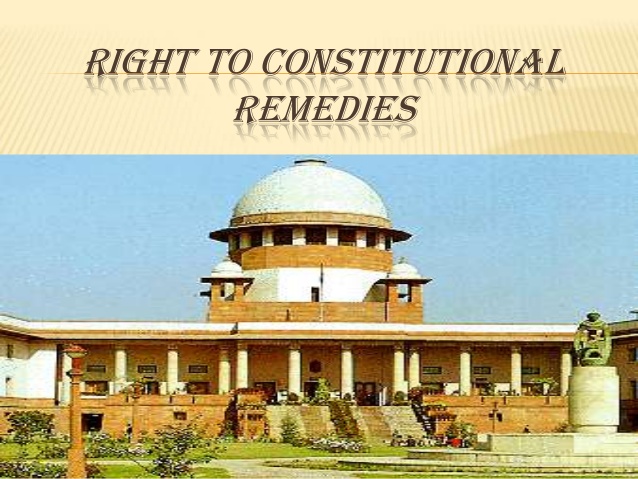
Under article 32 Supreme court acts as a guarantor and defender of the fundamental rights. Furthermore, it is originally under the Supreme Court’s jurisdiction power to issue the writs. By virtue of Article 32, an aggrieved Indian citizen has the right to file a fundamental right enforcement action directly at the Supreme Court. In Ramesh Thappar v. State of Madras, AIR 1950 SC 124, the Supreme Court ruled that a petitioner can go straight to the Supreme Court to enforce his rights without having to go to a High Court first.
Thus, it means that a person can directly approach the Supreme court for the remedy instead through the way of appealing.
Also, it is important to note that article 32 can be invoked only to get remedies related to fundamental rights. Thus, it cannot be there for any legal or constitutional right. For these rights, there are different laws available.
The High Courts of India, also have the jurisdiction to entertain matters on enforcement of Fundamental Rights. Article 226(1) of the Indian Constitution provides as follows:
Notwithstanding anything in Article 32, every High Court shall have powers throughout the territories in relation to which it exercise jurisdiction to issue to any person or authority, including in appropriate cases, any Government, within those territories, directions, orders or writs including writs in the nature of habeas corpus, mandamus, prohibitions, quo warranto and certiorari, or any of them, for the enforcement of any of the rights conferred by Part III and for any other purpose”
The scope of the High Court’s jurisdiction is much wider than that of the Supreme Court. However, unlike the Supreme Court which has jurisdiction over the whole of India, territorial jurisdiction limits the scope of the High Court.
CONCLUSION
The fundamental rights created under the India Constitution are necessary for a democratic society. Articles 32 and 226 are very vital provisions, as they give citizens the medium through which they can enforce their fundamental rights, and seek appropriate remedies. They protect and act as a guardian of fundamental rights of the citizens enrished in part III of the Constitution.

 Eduindex
You must be logged in to post a comment.