
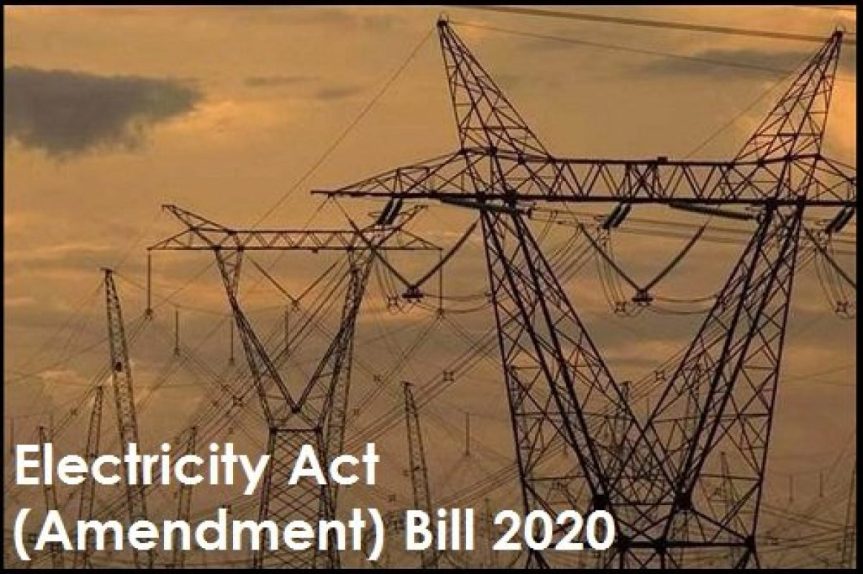
Electricity (Amendment) Bill 2020: A Gist and Overview

INTRODUCTION

Recently, the Central government has introduced the Electricity (Amendment) Bill 2020 to amend various provisions in the Electricity Act 2003.

The Electricity Act, 2003 (the “Electricity Act”) was enacted to consolidate the electricity laws in India. While the Electricity Act facilitated significant private investments, market development, and adoption of transparent tariff mechanism etc., the power sector has been facing various developmental hurdles for some time.

Consequently, to address various issues which have been highlighted by the industry and to further reform the power sector, the Ministry of Power (“MoP”), Government of India, released the draft Electricity (Amendment) Bill, 2020 (the “Amendment Bill”) on April 17, 2020, to amend the Electricity Act. 

The MoP has requested the stakeholders to provide their comments and suggestions on the Amendment Bill within 21 (twenty-one) days from the date of release of the Amendment Bill (i.e. by or before 8 May 2020).

The electricity amendment seeks to end the malaise in the production, distribution and transmission. Further, it seeks to revive investments and promote growth in line with the vision of a $5 trillion economy in the near future

KEY OBJECTIVES:

Following are the key objectives of the Electricity (Amendment) Bill 2020:

  1. Ensure consumer centricity
  2. Promote Ease of Doing Business
  3. Enhance the sustainability of the power sector
  4. Promote green power

THE DIMENSIONS 

There are two dimensions, these are as follows:

  1. Static Dimension: The Electricity Act, 2003 and Privatisation of Discoms and;
  2. Current Dimension: UDAY Scheme, T&D Losses, Need for a new amendment and Important features.

WHY IS THE NEW AMENDMENT REQUIRED

  1. Some of the provisions of the Act have become dated and archaic and needs an update. 
  2. Policy modifications are needed to address some recurring issues and to promote further commercial incentive for private players to enter the market in the generation, distribution and transmission of electricity.
  3. Measures need to be augmented to ease the financial crunch of the Discoms.
  4. It is necessary to promote a legal and administrative ecosystem which harbours special attention to renewable energy.

ISSUES INVOLVED

  1. Cost reflective tariff has been a concern for states like Telangana which provide free electricity to the farming sector.
  2. Formation of ECEA has also been criticized as a move towards centralization of power.
  3. Recognition of franchisees and sublicensees might open the sector to private players.

IMPORTANT FEATURES OF THE DRAFT

  1. The bill enables state as well as central power regulators to specify transmission charges under open access (earlier both functions were with the central commission).
  2. The draft law provides for the introduction of power distribution sub-licensee or franchisee, which would not require a separate licence from the state commission.
  3. The Electricity Act would be applicable to the entire country, including the Union Territories of Jammu and Kashmir and Ladakh.

KEY AMENDMENTS  

  1. National Selection Committee:  Instead of the separate Selection Committee (for appointment of Chairperson and Members of State Electricity Regulatory Commissions-SERCs), there is a proposal to set up a National Selection Committee.
  2. Introduction of Direct Benefit Transfer: Direct Benefit Transfer will be beneficial for both the State Governments and as well as Distribution Companies. It will be beneficial for the State Government because it will ensure that the subsidy reaches the people who are actually entitled and the State Government gets clear accounts of the amount given as subsidy.
  3. National Renewable Energy Policy: India is a signatory to the Paris Climate Agreement. It is therefore proposed to have a separate policy for the development and promotion of generation of electricity from renewable sources of energy. The policy prescribes a minimum percentage of the purchase of electricity from renewable sources of production. It seeks to give special attention to hydropower.
  4. Sustainability: To address this problem, the Amendment has prescribed a period of 60 days to adopt the determined tariffs. Failing such a timeline of 60 days, the tariff would be deemed to be accepted.
  5. Cost Reflective Tariff: To address this problem, the Amendment has prescribed a period of 60 days to adopt the determined tariffs. Failing such a timeline of 60 days, the tariff would be deemed to be accepted.
  6. Payment Security:  It is proposed to empower Load Dispatch Centres to oversee the establishment of adequate payment security mechanisms before dispatch of electricity, as per contracts.
  7. Ease of Doing Business:
  1. Establishment of Electricity Contract Enforcement Authority (ECEA): The Authority will enforce performance of contracts related to purchase or sale or transmission of power between a generating company, distribution licensee or transmission licensee.
  2. Central Electricity Regulatory Commission (CERC) and State Electricity Regulatory Commissions (SERCs) do not have powers to execute their orders as a decree of a civil court.
  3. Cross Subsidy: The Bill provides for the SERCs to reduce cross-subsidies as per the provisions of the Tariff Policy.

8. Open Access: Under the Electricity Act, open access can be granted to a consumer on the payment of surcharge and wheeling charges as determined by the relevant State Commission. However, such charges do not include charges for intra-state transmission and interstate transmission of power. In view of this, the Amendment Bill proposes to add such transmission charges, wherever applicable, to the existing charges (i.e. surcharge and wheeling charges). 

Further, it is proposed under the Amendment Bill that open access surcharge and cross-subsidies will be “progressively reduced” by the State Commission in the manner provided in the tariff policy – Section 42 of the Electricity Act envisaged reduction in cross-subsidy as per discretion of the relevant State Commission, however, the Amendment Bill seek to take away the discretion of the State Commission for determination of cross-subsidy and post amendment the State Commission will be bound to follow the mandate of the Central Government.

Miscellanous:

  1. Strengthening of the Appellate Tribunal (APTEL): It is proposed to increase the strength of APTEL to at least seven to facilitate quick disposal of cases.
  2. Penalties: In order to ensure compliance of the provisions of the Electricity Act and orders of the Commission, section 142 and section 146 of the Electricity Act are proposed to be amended to provide for higher penalties.
  3. Cross Border Trade in Electricity: Provisions have been added to facilitate and develop trade in electricity with other countries. and Lastly 
  4. The Distribution sub-licensees: To improve quality of supply, an option is proposed to be provided to Discoms to authorize another person as a sub-license to supply electricity in any particular part of its area, with the permission of the State Electricity Regulatory Commission.

WEBSITES REFERRED:

  1. https://powermin.nic.in/sites/default/files/webform/notices/Draft_Electricity_Amendment_Bill_2020_for_comments.pdf
  2. https://www.drishtiias.com/daily-updates/daily-news-analysis/electricity-amendment-bill-2020
  3. https://induslaw.com/app/webroot/publications/pdf/alerts-2020/InfoAlert-Highlights-of-the-Electricity-Amendment-Bill-2020-April-2020.pdf
  4. https://www.manifestias.com/2020/05/15/electricity-amendment-bill-2020/#:~:text=The%20Union%20power%20ministry%20has,power%20generation%20companies%20(gencos)
  5. https://www.indiathinkers.com/2020/04/electricity-act-amendment-bill-2020.html

Importance of Money in today’s world

Modern Organization
Many times, people say they can live without money. They define money as one of the tools that improve human habitation. However, in real life money is the most important thing in people’s lives. While it is possible that people in history may have lived on exchanges and did not rely on real money, today’s society cannot function without money. Money plays a vital role in society in various ways, such as business, social work, and education.

Higher level of education
People are very fond of education in their lives and quality education depends on the amount of money spent on this type of investment. Every single person in this country should invest in education to gain access to education. This education would include not only the schooling they received but also other external activities such as piano, art, and even dance. Most of the time, in order for people to have talents like playing the piano, they have to donate their money to a teacher who has a high degree of piano. Similarly, in school, people would like to be taught by a teacher who is high in their field

Business World
Money also plays an important role in our society and in our global business. In the business world, most of the interactions people have include big money. One common example of global business is investment. In the investment industry, people invest heavily in a particular market and as the market grows larger and builds a higher reputation, the amount of investment invested increases. In this investment, people earn a lot of money but often lose all of them with their luck. The money they earn from investment is often used to build other new businesses or even to invest in different markets. The importance of these businesses in our world is that it helps our economy to run smoothly.

Quality of life
Even if there is very little in the business, wages and wages are important when it comes to people. Reward is a testament to people’s efforts and dedication to the work they do. Earnings vary depending on the type of work done and the position in the company. People use the money they earn from their work in many ways. They buy the necessities of life, such as home, food, and a car. They eat nutritious food that helps maintain good health and use cars to move wherever they want to go. On the other hand, people who are unemployed and who have no income often have difficult times to support their health. They have nothing to support their health. And they do not have permanent shelter where they can live.

COVID-19 recovery rate improves to 64.51%

Total recoveries from COVID-19 in the country today inched closer to touch the one million mark.

A total of nine lakh 88 thousand 29 people have recovered in the country so far and 35 thousand 286 recoveries were reported during the last 24 hours.

With this, the recovery rate improved to 64.51 per cent in the country. The case fatality rate has declined to 2.23 per cent.

The Health Ministry said, 48 thousand 513 new cases of COVID-19 were registered in the country in one day taking the total number of cases to 15 lakh 31 thousand 669.

Presently, the total number of active cases in the country is five lakh nine thousand 447. In a single day, 768 deaths were reported taking the toll to 34 thousand 193.

Meanwhile, Indian Council of Medical Research said that a record four lakh eight thousand 855 tests were conducted by various laboratories in the last 24 hours.

So far, one crore 77 lakh 43 thousand 740 tests have been conducted.

AIR correspondent reports that Delhi stands at top position with 88.83 per cent recovery rate.

Ladakh, Haryana, Assam and Telangana are other top performing States and Union Territories wherein the recovery rate is above 73 per cent.

Nearly, 16 States and Union Territories have better recovery rates than the national average of 64.51 per cent.

Maximum number of people have recovered in Maharashtra followed by Tamil Nadu, Delhi and Andhra Pradesh.

In terms of fatality rate, there are 29 States and Union Territories which have lower fatality rates than the national average.

In the total active cases, around 70 per cent caseloads are from Maharashtra, Karnataka, Tamil Nadu, Andhra Pradesh and Uttar Pradesh.

PM Modi, Mauritian counterpart to inaugurate new Supreme Court building in Port Louis today

Prime Minister Narendra Modi and his Mauritian counterpart Pravind Jugnauth will jointly inaugurate the new Supreme Court building of Mauritius today.

The inauguration is scheduled to take place through video conference in presence of senior members of Judiciary from Mauritius and other dignitaries from both the countries. The building has been constructed with Indian grant assistance and will be the first India-assisted infrastructure project within the capital city of Port Louis after the outbreak of Coronavirus pandemic.

The new Supreme Court building project is one of the five projects being implemented under the Special Economic Package of 353 million dollars extended by Government of India to Mauritius in 2016. The project has been completed within schedule and below expected costs. The building is spread over an area of more than 4,700 square metres with over 10 floors and a built up area of around 25 square metres.

In October 2019, Mr Modi and Prime Minister of Mauritius had jointly inaugurated the Phase-I of the Metro Express Project and the new ENT Hospital project in Mauritius, also built under the Special Economic Package. Under Phase-I of Metro Express project, construction of 12 kilometres of metro-line was completed in September last year, while work on its Phase-2 envisaging 14 kilometres of metro-line is ongoing. Through the ENT Hospital project, India assisted in construction of a 100-bed state of the art ENT hospital in Mauritius.

The new Supreme Court Building is expected to become an important landmark in the city centre symbolizing the strong bilateral partnership between the two countries.

In a tweet, Mr Modi said, it is another example of India-Mauritius friendship. He said, India is honoured to have assisted in this key project.

Rajasthan: Governor approves Cabinet proposal to convene State Assembly Session from Aug 14

In Rajasthan, Governor Kalraj Mishra has given the approval of the proposal of Cabinet to convene the State Assembly Session. The Session will start from 14th of August. Before this, the Governor had returned three proposals of the State Cabinet for calling an Assembly Session.

Meanwhile, Rajasthan High Court will hear today the petition related to the merger of six BSP MLAs in Congress. The court yesterday accepted the writ petition of BJP MLA Madan Dilawar. Bahujan Samaj Party also challenged the merger in the Rajasthan High Court, which has also been attached with the Mr. Dilawar’s petition.

PM Modi hails New Education Policy, says it will transform lives of millions of people in times to come

Prime Minister Narendra Modi wholeheartedly welcomed the approval of the National Education Policy, NEP 2020. In a series of tweets, he said, this was a long due and much awaited reform in the education sector, which will transform millions of lives in the times to come. 

The Prime Minister said, NEP 2020 is based on the pillars of Access, Equity, Quality, Affordability and Accountability. He said, in this era of knowledge, where learning, research and innovation are important, the National Education Policy will transform India into a vibrant knowledge hub. 

The Prime Minister added, NEP 2020 gives utmost importance towards ensuring universal access to school education. There is emphasis on aspects such as better infrastructure, innovative education centres to bring back dropouts into the mainstream, facilitating multiple pathways to learning among others. .

An Academic Bank of Credit will be set up to enable digital storage of credits earned from different HEIs, which can also be transferred and counted as a part of the final degree. The Prime Minister said, respecting the spirit ‘Ek Bharat Shreshtha Bharat’, the NEP 2020 includes systems to promote Indian languages, including Sanskrit. Many foreign languages will also be offered at the secondary level. Indian Sign Language will be standardised across the country.

He said, aspects such as widening the availability of scholarships, strengthening infrastructure for Open and Distance Learning, Online Education and increasing the usage of technology have received great attention in the NEP. He added that these are vital reforms for the education sector. 

The Prime Minister said, framing of NEP 2020 will be remembered as a shining example of participative governance. He thanked all those who have worked hard in the formulation of the NEP 2020. The Prime Minister hoped that education would brighten our nation and lead it to prosperity.

New Education Policy-2020 aims to have single regulator for higher education institutions and common entrance exams for universities

The Cabinet yesterday approved National Education Policy 2020. A single regulator for higher education institutions, multiple entry and exit options in degree courses, discontinuation of MPhil programmes, low stakes board exams, common entrance exams for universities are among the highlights of the new National Education Policy.

Briefing the media in New Delhi last evening, Information and Broadcasting Minister Prakash Javadekar said, the Cabinet chaired by Prime Minister Narendra Modi has given approval to a New Education Policy for the 21st century.

He said, it is important, as for 34 years there were no changes in the education policy. 

Education Minister Ramesh Pokhriyal Nishank said, New Education Policy 2020 will prove to be a milestone in the making of New India.

Mr Nishank said, the Cabinet also approved changing the name of the Human Resources Development Ministry to the Education Ministry.

Secretary Higher Education Amit Khare said, NEP 2020 aims to increase the Gross Enrolment Ratio in higher education including vocational education from 26.3 per cent in 2018 to 50 per cent by 2035.

He said, at least 3.5 crore new seats will be added to higher education institutions.

Mr Khare said, the policy envisages broad based, multi-disciplinary, holistic Under Graduate education with flexible curricula, creative combinations of subjects, integration of vocational education and multiple entry and exit points with appropriate certification.

He said, Under Graduate education can be of 3 or 4 years with multiple exit options and appropriate certification within this period.

The Higher Education Secretary said, affiliation of colleges is to be phased out in 15 years and a stage-wise mechanism is to be established for granting graded autonomy to colleges.

Over a period of time, it is envisaged that every college would develop into either an autonomous degree-granting college, or a constituent college of a university.

Among the key reforms in the policy are a single regulator for all higher education institutions except for legal and medical colleges, common entrance exam for admissions to universities and colleges to be conducted by the National Testing Agency and common norms to be in place for private and public higher education institutions.

Secretary, School Education and Literacy, Anita Karwal said, Board exams will be low stake and the focus will be on testing concepts and knowledge application.

She said, Home language, mother tongue or regional language to be medium of instruction up to class 5. Ms Karwal said, school curriculum will be reduced to core concepts and there will be integration of vocational education from class 6. 

In May 2016, a ‘Committee for Evolution of the New Education Policy’ under the chairmanship of TSR Subramanian, former cabinet secretary, submitted its report. 

Based on this, the Ministry prepared a document called ‘Some Inputs for the Draft National Education Policy, 2016′. 

Then, a panel led by former Indian Space Research Organisation (ISRO) chief K Kasturirangan had submitted the draft of the new NEP to Union Human Resource Development Minister Ramesh Pokhriyal ‘Nishank’ when he took charge last year.

The draft was then put in the public domain to seek feedback from various stakeholders and over two lakh suggestions were received by the HRD Ministry about the same.

Maharashtra extends lockdown till Aug 31 in view of rising Coronavirus cases

Maharashtra Government has extended the lockdown in the entire state till 31st of August in view of rising Coronavirus cases. A notification issued by Chief Secretary Sanjay Kumar said, the decision was taken as an emergency step to prevent and contain the spread of COVID-19.

The notification said that as part of the State Government’s Mission Begin Again initiative, malls and market complexes without theatres, food courts and restaurants will be operational between 9 AM and 7 PM from 5th of August. It said that large public gatherings and congregations will continue to remain prohibited and marriage-related gatherings will have only up to 50 guests. The maximum number of persons allowed at funerals will be 20.

Meanwhile, Maharashtra Chief Minister Uddhav Thackeray  directed officials  not to let their guard down and ramp up tracing COVID-19 patients and their contacts.

CM Thackeray told a Cabinet meeting that just lockdown is not important, but tracing of Cod -19 patients and their contacts should be the focus.He added that all municipalities across the state need to follow the rules strictly.

Meanwhile, Maharashtra’s COVID-19 case count has crossed the four lakh-mark in the last 24 hours. State Health Secretary Pradeep Vyas has informed that COVID-19 mortality rate in Maharashtra now stands at 3.62 per cent while the case doubling rate is 27 days, which has improved to 70 days in Mumbai.

Unlock 3.0 guidelines to come into force from Aug 1; Schools, Colleges to remain closed till Aug 31

Union Home Ministry has issued new guidelines for opening up of more activities in areas outside the Containment Zones. The process of phased re-opening of activities has been extended further in Unlock 3, which will come into effect from 1st of August. The new guidelines issued yesterday are based on feedback received from States and Union Territories and extensive consultations held with related Central Ministries and Departments.

AIR correspondent reports, restrictions on movement of individuals during night have been removed. Yoga institutes and gymnasiums will be allowed to open from 5th of August.

In this regard, Standard Operating Procedure will be issued by Health Ministry for ensuring social distancing. Independence Day functions will be allowed with social distancing and by following other health protocols. Schools, colleges and coaching institutions will remain closed till 31st of August.

International air travel of passengers has been permitted in a limited manner under the Vande Bharat Mission.  Further opening up will take place in a calibrated manner. All activities except Metro Rail, Cinema halls, swimming pools, entertainment parks, theatres, bars shall be permitted outside containment zones.  

Social, political,  sports, entertainment, academic, cultural, religious functions and other large congregations will not be permitted.  With Diwaker, Suparna Saikia, AIR News, Delhi.

Activities in the Containment Zones shall be monitored strictly by State and UT authorities and the guidelines relating to containment measures in these zones shall be strictly implemented. The Health Ministry will monitor the proper delineation of Containment Zones and implementation of the containment measures.

States and UTs, based on their assessment of the situation, may prohibit certain activities outside the Containment zones or impose such restrictions as deemed necessary. However, there shall be no restriction on inter-state and intra-state movement of persons and goods.

Corruption; the ugly truth

Corruption is the mistreatment of authority for personal gain of an individual or group of a country. It is the unjust use of public power for some private advantages by violating rules and regulations made by the government. These days, it has spread its roots deeply in the society which has made it difficult to be rid of it. Corruption is something that is so deep set in the roots of our society that has made it difficult for anyone to not fall into the crutches.

Nowadays, every important work is conducted with corruption. These days, corruption is done with the health of online transfers or in the form of expensive gifts etc. In order to get their work done quickly and rather easily, people take the easier route and bribe the officials.   Some people that are enlisted in the government or non-government offices have been mixed up in the corruption and will do anything to fulfil their wishes.

Corruption, is one form or another, is a worldwide phenomenon. Everyone admits that corruption is something immoral and detestable. Unfortunately, in our country, corruption has become a part of life. It has entered the very roots of Indian society.

Corruption has been defined variously by scholars. But the simple meaning of it is that corruption implies perversion of morality, integrity, character or duty. Corruption is the misuse of authority, public position, natural or public resources, power, etc. by someone to gain his/her personal gratifications.

Corruption is increasing in India day by day because there is a strong connection between the officials, politicians and criminals who are making this country weak. India got Independence in 1947 and it was slowly becoming strong and developing but in the mid-way, the disease of corruption started and stopped India to grow ahead.

Corruption is everywhere and in every department cheater it politics, hospitals, education, job, government offices, nothing is left of corruption. Everything has become a business and the source of earning money in the wrong way.

Evils, it is said, percolate in any society from the top. The topmost people in the country must present model examples of conduct, honesty and behaviour. One must not only be honest but one must also be above doubt. We, the common men also have some responsibilities towards our nation. If we stop giving bribe, the corrupts have no option but to do their job honestly. Then we shall be able to root out the evil of corruption from the entire society.

Corruption is the unjust use of public power for private advantages. We are all familiar with corruption and know that the occurrence is not a new thing in society. Violating rules and taking advantage has become a common practice. In order to get your work done in a shorter amount of time, people resort to giving and taking bribes.

It is a very common toxin in the society since ancient time. It has been found that corruption has been in practice since Mughal times. It is reaching new heights these days and increasing rapidly. It has affected the minds of people to such an extent and become so widespread that wrong people can play with the lives of people of the society. It is a type of materialism that corrupts the human mind and destroys one’s humanity.

Corruption comes in all fields of society such as sports, entertainment, education and politics etc. Corruption weakens a man’s mind and makes him dependent due to his greed and shallow mind. In a country like which is riddled with poverty, corruption is the only means to get by. People take bribes for the smallest things. Third World countries are the one that is the most well known for their corruption activities.

The World Bank has tried reprimanding them for their activities, but so far no strict action has been taken to curb the growing corruption. It is slowly destroying the lives of innocent people.

Understanding NIFTY

S&P CNX NIFTY is an Index computed from performance of top stocks from different sectors listed on NSE (National stock exchange). NIFTY consists of 50 companies from 24 different sectors. NIFTY stands for National Stock Exchange’s Fifty. The companies which form index of NIFTY may vary from time to time based on many factors considered by NSE.  NIFTY is for NSE similarly SENSEX is for BSE. Some mutual funds use NIFTY index as a benchmark meaning the mutual funds’ performance is compared against the performance of NIFTY. On NSE there are futures and options available for trading with NIFTY as underlying index. India Index Services and Products Ltd. (IISL) owns NIFTY.  

IISL is a joint venture of NSE and CRISIL. CRISIL is a subsidiary of Standard and Poor (S&P). And so NIFTY is also called as S&P CNX NIFTY. CNX ensures common branding of indices, to reflect the identities of both the promoters, i.e. NSE and CRISIL. Thus, ‘C’ stands for CRISIL, ‘N’ stands for NSE and X stands for Exchange or Index. The S&P prefix belongs to the US-based Standard & Poor’s Financial Information Services. Nifty stocks represent about 63 percent of the Free Float Market Capitalization. Impact cost of the S&P CNX Nifty for a portfolio size of Rs.50 laks is 0.06%. Market impact cost is the best measure of the liquidity of a stock. It accurately reflects the costs faced when actually trading an index. For a stock to qualify for possible inclusion into the S&P CNX Nifty, it has to reliably have market impact cost of below 0.75 percent when doing S&P CNX Nifty trades of Rs. 50 Lakhs. S&P CNX Nifty is professionally maintained and is ideal for derivatives trading.  

S&P CNX Nifty always uses the best stocks possible for its index. The weakest stocks are removed from inside the S&P CNX Nifty and the new stock into it. The world changes, so the index should change. Yet, the change should not be sudden – for that would disrupt the character of the index. S&P CNX Nifty uses clear, researched and publicly documented rules for index revision. These rules are applied regularly, to obtain changes to the index set. Index reviews are carried out every six months to ensure that each security in the index fulfills all the laid down criteria. IDBI was once not listed; SBI was once illiquid; Infosys was once an obscure software startup. The world changes, and one by one, these stocks have come into the S&P CNX Nifty. Each change in the S&P CNX Nifty is small, so the continuity of the index is maintained. Yet, at all times, S&P CNX Nifty represents the 50 most important liquid stocks in the country, the best stocks to build an index out of.  

NSE has the best surveillance procedures in India, so the extent of market manipulation is minimum. In NSE, since, the professional staff of the surveillance department has no positions on the market, this elimination of conflicts of interest and generates a more honest focus upon eliminating market manipulation. On a day to day basis millions of shares get traded on the NSE generating huge order flows. Due to the liquidity and order flow from numerous market players manipulation of the closing price becomes very hard. NSE is the most liquid exchange in India. Hence, the prices observed there are the most reliable. NSE has the highest trading intensity and their bid-ask spreads are the tightest.    

Sister indexes of NIFTY

S&P CNX Defty  

S&P CNX Defty is S&P CNX Nifty, measured in dollars. If the S&P CNX Nifty rises by 2percent it means that the Indian stock market rose by 2percent, measured in rupees. If the S&P CNX Defty rises by 2percent, it means that the Indian stock market rose by 2percent, measured in dollars.

S&P CNX 500  

S&P CNX 500 is India’s first broadbased benchmark of the Indian capital market. The S&P CNX 500 represents about 86percent of total market capitalisation and about 78percent of the total turnover on the NSE. The S&P CNX 500 companies are disaggregated into 72 industries, each of which has an index called S&P CNX Industry Index. Industry weightages in the index dynamically reflect the industry weightages in the market. So for e.g. if the banking sector has a 5percent weightage among the universe of stocks on the NSE, banking stocks in the index would have an approximate representation of 5percent in the index. The S&P CNX 500 is a market capitalisation weighted index. The base date for the index is the calendar year 1994 with the base index value being 1000. Companies in the index are selected based on their market capitalisation, industry representation, trading interest and financial performance. The index is calculated and disseminated real-time.  

CNX Nifty Junior  

S&P CNX Nifty is the first rung of the largest, highly liquid stocks in India. CNX Nifty Junior is an index built out of the next 50 large, liquid stocks in India. It is not as liquid as the S&P CNX Nifty, which implies that the information in the S&P CNX Nifty Junior is not as noise-free as that of the S&P CNX Nifty. S&P CNX Nifty and the CNX Nifty Junior taken together constitute 100 most liquid stocks in India. S&P CNX Nifty is the front line blue-chips, large and highly liquid stocks. The CNX Nifty Junior is the second rung of growth stocks, which are not as established as those in the S&P CNX Nifty. A stock like Satyam Computers, which recently graduated into the S&P CNX Nifty, was in the CNX Nifty Junior for a long time prior to this. CNX Nifty Junior can be viewed as an incubator where young growth stocks are found.   

As with the S&P CNX Nifty, stocks in the CNX Nifty Junior are filtered for liquidity, so they are the most liquid of the stocks excluded from the S&P CNX Nifty. Buying and selling the entire CNX Nifty Junior as a portfolio is feasible. The maintenance of the S&P CNX Nifty and the CNX Nifty Junior are synchronised so that the two indices will always be disjoint sets; i.e. a stock will never appear in both indices at the same time. Hence it is always meaningful to pool the S&P CNX Nifty and the CNX Nifty Junior into a composite 100 stock index or portfolio.

CNX MidCap

The medium capitalised segment of the stock market is being increasingly perceived as an attractive investment segment with high growth potential. The primary objective of the CNX MidCap Index is to capture the movement and be a benchmark of the midcap segment of the market. The CNX MidCap Index is a market capitalisation weighted index with its base period of the index being the calendar year 2003 and base value as 1000.The distribution of industries in the CNX MidCap Index represents the industry distribution in the MidCap segment of the market. All companies are evaluated for trading interest and financial performance.  

CNX MNC Index  

The CNX MNC Index comprises 15 listed companies in which the foreign shareholding is over 50percent and/or the management control is vested in the foreign company. The index is a market capitalisation weighted index with base period being the month of December, 1994 indexed to a value 1,000. Companies in the index should be MNCs and are selected based on their market capitalisation, industry representation, trading value and financial performance.  

CNX PSE Index  

As part of its agenda to reform the Public Sector Enterprises (PSE), the Government has selectively been divesting its holdings in public sector enterprises since 1991. With a view to provide regulators, investors and market intermediaries with an appropriate benchmark that captures the performance of this segment of the market, as well as to make available an appropriate basis for pricing forthcoming issues of PSEs, IISL has developed the CNX PSE Index, comprising of 20 PSE stocks.  

CNX IT Sector Index  

With the Information Technology (IT) sector in India growing at a fast rate, there is a need to provide investors, market intermediaries and regulators an appropriate benchmark that captures performance of this sector. Companies in this index should have more than 50percent of their turnover from IT related activities like software development, hardware manufacture, vending, support and maintenance. The index is a market capitalisation weighted index with its base period being December 1995 with base value 1,000. NSE being the leading stock exchange in India, the NIFTY index is not only a prime index for the exchange itself but also it is an indicator of the booming Indian economy. Despite of the recent slowdown in the global economic scene the NIFTY index has sustained a regular growth after overcoming the sudden impact. The index for so many reasons has attracted investors not only from the domestic market but also from foreign countries.

Struggles of an extrovert

You get excited over nearly everything
Even a little thing makes you excited and satisfied. You always make sure that you are entertained all by your own self.

When you’re upset you have to talk to as many people as you can about it.
You need many of them to listen to your problem because you can’t keep it up to yourself. Sharing the same will make it lighter.

Being home alone actually gives you anxiety.
You have the habit of staying with people and you don’t have the habit of being alone as you need someone always. But when you are home alone it actually gives you anxiety.

People often associate you with words like, “intense” “full on” or “very loud.
People often judge you because of your extra behaviors which for you is normal. As you are always ready for anything and everything there are chances when people won’t like it.

Wanting to go out when everyone else wants to stay in.
You can never be at rest. Be it your workplace, classroom or a weekend you have to go out for any reason.

You’re apparently not allowed to be sad.
Extroverts are not robots. They have emotions as equal as others. But people always believe that you can never be sad as they have always seen you excited and happy.

You’re expected to be the entertainment, everywhere, every time.
Not everytime they have the same energy, they have their own issues, sometimes they may be sad. But everyone expect you to be the one who entertains them.

Being expressive makes them seem like a rebel.
Maybe you don’t do it intentionally but you may sound like a one at some point because of your tone or your ways of expressing it.

Career in content writing.

“writing” the word itself means hard and smart work, both combined to give a great boost to your creative career in content writing
, The best way to start a career in content writing is only with more practice. One can opt for content writing as their career if you are enthusiastic to prove your writing skills. This can be done when you start writing your own blogs about any specific topic it might be any topic or field in which you are interested. And following some effective tips to write the content will be helpful.

To start a career in content writing means you already need to start writing all by yourself. All you need is to know how to write and it should be presentable and approachable. A career in this field is not as easy at it seems to be, so you need to have utter patience, educate yourself as much as you can, take criticisms positively and make your words make worth. Because, in the sudden moment, you will need to mold yourself into the market demands in writing, yet keeping alive your creativity. To write effective content one should have good command over English and vocabulary
There are many such organizations, websites which gives you a wide range of platform to showcase your writing skills through their blogs, post, etc which gives you an experience, knowledge, and grip to your career.
Start writing, gain the experience, get better at writing and you’ll find there are a ton of opportunities awaiting you.

Struggles of an introvert.

Not a conversation starter
They never start a conversation instead they sulk in the background until someone introduces them.

Staying home can become an addiction.
As they don’t like socializing much they prefer to be isolated rather than being with people. They prefer staying at home as a better option rather being out with others.

Social anxiety hits them anytime.
It’s really hard for them to actually be in large groups and from nowhere they may have a serious anxious feeling.

Phone calls are the absolute WORST.
They always try to avoid people as much as they can. They are much more of a ‘text’ person.

People underestimate them.
As they don’t come up usually, people underestimate them which is wrong. People have a misconception that they may lack talent or they are of no use but in reality they have much more than the ordinary.

Saying No
It’s very hard for them to say no. As they are not sure for the same. They would rather die than just saying no.

Public Speaking
This is the most challenging and horrying thing for a shy person. Human interaction foe them is so scary and when the same is in huge numbers you can’t imagine the fear they come across.

Making idle conversation is hard
They are better when they have their loved ones with them. They never approch or have a conversation with a stranger. And evend if they do so it turns out to be real hard.

Someone Approaching them.
This is the most hardest thing for a shy person. They always try to avoid people, specially strangers. And if someone approaches they become anxious.