


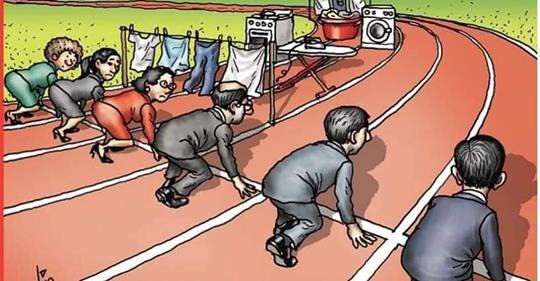
The problem of gender inequality is historical. The sociological reality behind this structure is the transition from a matriarchal society, which is more egalitarian, to a patriarchal society. Although economic and technological progress has changed the social structure, the problem of gender inequality still exists, even in modern, urbanized societies.
The problem of the education system
In all areas of men-dominated society, including the structure of the state, the education system, the health care system, security forces, and the judiciary, there is a male culture and a sense of power. In the education system, equal opportunities must be guaranteed for all children, regardless of gender, and the government should ensure this practice is implemented. The program should be non-discriminatory and textbooks, especially in terms of language, should be prepared under the principles of gender equality.

Gender inequality has been a social issue in India for centuries. That in many parts of India, the birth of a girl child is not welcomed is a known fact. It is a known fact too, that discrimination starts from even before the girl child is born and sometimes she is killed as a foetus, and if she manages to see the light of day, she is killed as an infant, which makes up the highly skewed child sex ratio where for every 1000 boys in India, there are only 908 girls. In such a scenario, it is but obvious that for myriad reasons, many girls across the country are forced to drop out of school.
Patriarchal norms have marked women as inferior to men. A girl child is considered a burden and is often not even allowed to see the light of the world. It is hard to imagine this state of affairs in the 21st Century when women have proved to be strong leaders in every field possible. From wrestling to business, the world has been revolutionised by exceptional women leaders in fields that were until recently completely dominated by men.
But in spite of such progress, even today, the girl child is discriminated against in most Indian households. The birth of a baby boy is celebrated with great pomp and ardour, but the birth of a girl child is received with dismay. The practice of female foeticide through sex selective abortion continues to be practiced in spite of the Prenatal Diagnostic Technique Act of 1994. In India the child sex ratio is at the lowest it has ever been with just 914 girls for every 1000 boys (Census, 2011).
And this discrimination continues in every aspect. Be it education, health, protection or participation, the girl child is always treated unequally. Indian society still hasn’t been awakened to the importance of empowering the women. The statistics still narrate a grim story of female foeticide, girl child discrimination and gender bias .
- 42% of married women in India were married as children (District Information System for Education (DISE) 3)
- 1 in every 3 child brides in the world is a girl in India (UNICEF)
- India has more than 45 lakh girls under 15 years of age who are married with children. Out of these, 70% of the girls have 2 children (Census 2011)
The need of the hour is to make a change in the mindset of the society and destroy the prejudices that damage the future of the girl child . What is required is a concerted effort to sensitise the society in eradicating this issue of gender inequality. It is high time that every child is treated equally and given every opportunity required to grow to his/her full potential.
Gender equality is not only a fundamental human right, but a necessary foundation for a peaceful, prosperous and sustainable world.
There has been progress over the last decades: More girls are going to school, fewer girls are forced into early marriage, more women are serving in parliament and positions of leadership, and laws are being reformed to advance gender equality.
Despite these gains, many challenges remain: discriminatory laws and social norms remain pervasive, women continue to be underrepresented at all levels of political leadership, and 1 in 5 women and girls between the ages of 15 and 49 report experiencing physical or sexual violence by an intimate partner within a 12-month period.
The effects of the COVID-19 pandemic could reverse the limited progress that has been made on gender equality and women’s rights. The coronavirus outbreak exacerbates existing inequalities for women and girls across every sphere – from health and the economy, to security and social protection.
Women play a disproportionate role in responding to the virus, including as frontline healthcare workers and carers at home. Women’s unpaid care work has increased significantly as a result of school closures and the increased needs of older people. Women are also harder hit by the economic impacts of COVID-19, as they disproportionately work in insecure labour markets. Nearly 60 per cent of women work in the informal economy, which puts them at greater risk of falling into poverty.
The pandemic has also led to a steep increase in violence against women and girls. With lockdown measures in place, many women are trapped at home with their abusers, struggling to access services that are suffering from cuts and restrictions. Emerging data shows that, since the outbreak of the pandemic, violence against women and girls – and particularly domestic violence – has intensified.

 Eduindex