

Transgender is an umbrella term used for persons whose gender identity and gender expression does not align with those assigned at birth. It can also refer to those who reject the gender binary of masculine and feminine. In India, they are often called Hijras, Aravanis, Jogtas and so on.
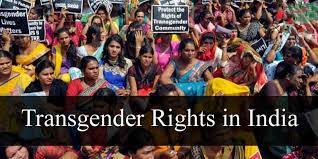
The transgender community has always been an integral part of historical India where their presence and blessings at ceremonies was considered auspicious. Under the Mughal rule, they enjoyed strong royal connections and held high positions. With the advent of British colonization, the status and acceptance of transgenders declined. The imposition of a Euro-centric world view led to transgenders being viewed as moral and sexual contagion to supposedly deviant Indian males.
The passing of the Criminal Tribes Act, 1871 (CTA) sought to further isolate transgenders by vilifying them as ‘habitual criminals’ and ‘sexual deviants.’
Newly independent India did little to better integrate transgender people into mainstream society. The census process, the most reliable source for data on demographic and literacy, omitted transgenders for the first 64 years. To relay the significance of this exclusion in numbers, when given the chance to identify themselves as transgenders in 2011, almost half a million out of 1.2 billion identified as transgenders.
Transgenders are usually rejected from any means of employment and hence, resort to entertainment, begging, extortion or prostitution. The culmination of low literacy rates, low skill levels and the reluctance to accept transgenders has pushed them further into sex work and has increased the probability of violence against them.
In terms of healthcare, the transgender community is 49 times more likely to be living with the Human Immunodeficiency Virus (HIV). The National Aids Control Organisation in (NACO) in India estimates HIV prevalence among transgenders to be 7.5%. The increased stigmatization makes it difficult for them to access adequate healthcare facilities.
The Ministry of External Affairs was the first official body that allowed transgenders to identify with a separate category ‘E’ while applying for passports. Not only was this categorization derogatory but it excluded a large spectrum of individuals who fell under the trans category. In case of competitive politics, transgenders are often provided positions as a means of tokenism rather than inclusion, 2014 was a turning point in the history of transgender rights in India.
The Supreme Court in NALSA v Union of India guaranteed the fundamental rights of transgender persons and promised provision of equal opportunities under the constitutional framework. Notably, the Court held that they had the right to decide their self-identified gender and vowed to uphold the ideals liberty, equality and freedom of expression. The Constitution must be interpreted in such a manner so that it ensures a dignified life for transgenders. Other directions to combat the societal stigma and sexual health issues faced by transgender persons, were also conveyed by the Court.
However, the judgement was not backed by a capable legislative framework to centrally aid the transgender community. Hence, the ongoing efforts to do so fructified in the passing of the Transgender Persons (Protection of Rights) Act 2019 (hereafter ‘the Act’) which came into force on 10th January 2020. The Act aimed at providing a statutory basis to better protect the rights of transgender persons and establish procedures to orderly recognize their self-identified gender.
Also, in the Act are provisions to prohibit discrimination against and secure the safety of the transgender community. Further, in April 2020, a Draft Transgender (Protections of Rights) Rules (hereafter, ‘the Rules’) under sub-section (1) and (2) of Section 22 of the Act was released by the Ministry of Social Justice and Empowerment. The Rules aim at strengthening the Act as well as focusing on the socio-economic hardships faced by transgender persons in the country.
Since its enactment, the Act has been challenged multiple times on the grounds that it violates the constitutional ideals recognized NALSA. For example, Section 6 and Section 7 of the Act have been criticized by members of the transgender community as violating guarantees against requirements of medical interventions for recognition of gender identity in NALSA.
Further, the Act discards forceful binary instead establishing a trinary where ‘transgender’ is the only other alternative. This does not take into consideration those transgenders who would identify as male or female, and those who may be gender queer. Not only this but the wording of the Act also seems to impose a binary with ‘son/daughter’ and ‘his/her’ rather than the gender neutral ‘child’ and ‘their’.
Even with specific laws to help ease the life of the transgender community into mainstream society, their interaction with the legal and justice system is still tainted with unfair power dynamics. Cases of harassment, intimidation and violence at the hands of police are plenty but they are rarely acted against and the NCRB fails to maintain a record of these atrocities against transgender persons.
The community often live with unrevealed sexual identities and this is taken advantage of by law enforcement. A study by the National Institute of Epidemiology among 60,000 transgender people across 17 states revealed that the biggest perpetrators of violence against transgender people were police and law enforcing authorities. One of the exceptions is the case of Jayalakshmi vs. Tamil Nadu, where the police was held accountable for the wrongful death of a transgender.
Implementation gap is most definitely the reason for deprivation of individual rights in India. While the Judiciary and Legislature have made efforts towards inclusion, the biggest challenge lies in better social acceptance and their integration normal, daily lives. We must aim grass-root level education that teaches that transgenders are not deviants and in fact, integral parts of our diverse society.

 Eduindex
You must be logged in to post a comment.