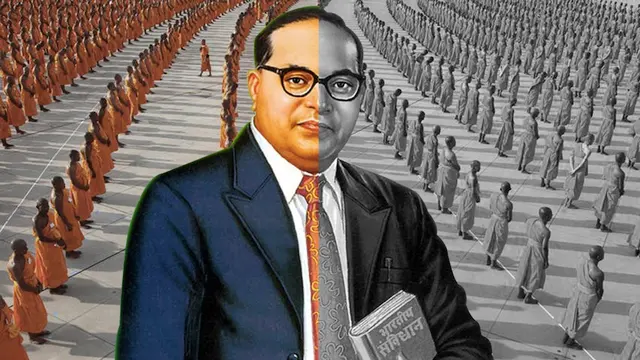
B. R. Ambedkar

Bhimrao Ramji Ambedkar was an Indian economist, politician and social reformer. He was also known as Babasaheb Ambedkar. He campaigned against social discrimination against the lower castes or Dalits of the country. Completing his doctorate from Columbia University and The London School of Economics, he gained reputation as a scholar for his research in economics, law and political science. 

In the early phases of his career, he was an economist, professor and lawyer. Towards the later phases, he was actively involved in campaigns for India’s independence. He published journals and advocated for political and social rights for Dalits. He made a significant contribution to the establishment of the state of India. He was the first Minister of Law and Justice of India and the chief architect of the Constitution of India. 

He had a Marathi family background and was from the town of Ambadawe in Ratnagiri district of modern-day Maharashtra. Ambedkar was born into a poor Mahar (Dalit caste), who were treated as untouchables and faced a lot of socio-economic discrimination. Although he attended school, Ambedkar and other untouchable children were segregated from the rest of the children and given little attention by teachers. They were not even allowed to sit inside the class. He had to sit on a gunny sack which he took home after school. When they needed to drink water, someone from a higher caste had to pour that water from a height as they were not allowed to touch the water vessel. It was usually the peon who did this for him and on days when the peon was not available, he had to go without water. He had later described this as “No peon, No water” in one of his writings.  

During British rule, Ambedkar’s effort for the political representation of the oppressed untouchables of India bore fruit in the 1920s. The colonial state was forced to include two members from among the Dalits in the Round Table Conference in 1930. This eventually led to the framing of the Government of India Act, 1935.   

From 1927, Ambedkar launched active movements against untouchability. He began public movements and marches to open up public drinking water resources for all. He led a satyagraha in Mahad to fight for the right of the untouchable community to draw water from the main water tank of the town. He also began a struggle for the right of Dalits to enter Hindu temples. In a conference in1927, Ambedkar publicly condemned the Hindu text Manusmriti (Laws of Manu), for ideologically justifying caste discrimination and “untouchability”. He ceremonially burned copies of the ancient text. On 25th December 1927, he led thousands of followers to burn copies of Manusmrti. Since then 25 December is celebrated as Manusmriti Dahan Din (Manusmriti Burning Day) by Ambedkarites and Dalits.  

In 1956, he converted to Buddhism, initiating mass conversions of Dalits which eventually led to the Dalit-Buddhist movement. 

A few days after completing his final manuscript ‘The Buddha and His Dhamma’, he died in his sleep on 6 December 1956 at his home in Delhi.  

WHY SO NEGATIVE FOR BURKHA ?

IT WAS EVENING , I WAS CHILLING OUT WITH MY FRIENDS ONLINE , AS EVERYTHING IS VIRTUAL NOW A DAYS ,BUT , WE GET CHANCE TO TASTE NEW THINGS AND SAVING NEW MEMORIES . WE WERE TALKING ABOUT RANDOM THINGS AND TAKING FREQUENT SWITCH FROM ONE TOPIC TO ANOTHER . MY BUDDIES ARE VAERY MUCH IN INTRESTED IN KNOWING ABOUT MY RELIGION ‘ISLAM’ , THEY USUALLY ASK ME QUESTIONS AND OPINIONS ABOUT NUMERABLE THINGS REGARDING IT AND I LOVE ANSWEREING IT . ONE OF THEM ASKED ME ABOUT MY FAMILY ‘s NATURE REGARDING MY STUDIES , ARE THEY OPEN MINDED IN THIS CASE ? , I SAID YES , IF THEY WERE NOT , THEY WOULD HAVE ENROLLED IN DISTANCE EDUCATION RATHER THAN IN A REGULAR COLLEGE . HE FURTHER ELABORATED THE QUESTION BY ADDING HIS THOUGHTS ABOUT BURKHA IN IT . I WAS NOT SHOCKED WHEN HE SAID , ” MTLB ZADA SHADI KRDO N BHURKHA , VGERA ” . MY EYES SHINED UP AFTER READING THEESE WORDS AND I TOOK IT AS AN OPPORTUNITY TO CLEAR THE VISION REGARDING “BURKHA WEARING ” .

AN IDEA CLICKS IN MY MIND , TO WRITE AN ARTICLE ON IT . I KNOW HE IS NOT THE ONLY ONE WHO HAS THIS PERCEPTION BUT THERE ARE MANY WHO HAVE THIS KIND OF THINKING , DUE TO WHICH THEY ALL MOCK . HERE , I AM GOING TO CLEAR YOUR VISION ABOUT IT AND GIVING YOU A POSITIVE OUTLOOK . HONESTLY SPEAKING , I DON’T WEAR BURKHA , BUT , I AM NOT AGAINST IT . I DON’T SEE IT WITH DEMEANING EYES . EVEN , IN MY FAMILY , FEW WEAR BURKHA AND FEW NOT , THERE IS NO PROBLEM UNLESS AND UNTIL YOU ARE FULLY COVERED. IT’s NOT ISLAM FORCING US WEAR TO BURKHA , BUT , THOSE LITTLE MINDS WHO HAVE INJECT POISON TO THIS WITH THIER NEGATIVE THINKING. I LOVE TO WEAR BURKHA AND HIJAB , IT GIVES SO ELEGANT AND CLASSY LOOK , IS N’T IT ? YOU ALL MUST HAVE SEEN GIRLS , THEY LOOK SO BEAUTIFUL AND THEIR BURKHAS ARE ALSO VERY MODEST . THEY TOO WEAR WESTERN DRESSES JUST BECAUSE THEY LOVE TO WEAR , BUT , THEY WEAR BURKHA OVER IT WHEN THEY STEP OUT , BUT , IN THEIR OWN PERSONAL SPACE , THEY DON’T WEAR BURKHA , THEY FLAUNT WESTERN DRESSES IN THEIR PERSONAL SPACE .

NOW , ITS TIME TO CHANGE YOUR PERSPECTIVE TOWARDS IT , WE ALL GIRLS KNOW THE SUFFERING OF TANNING , SUN BURN , RASHES AND WHAT NOT DUE TO THE CHANGES IN ENVIROMENT . WE USE SKEEVES , WEAR SCARFS , COVER OUR WHOLE FACE WITH A CLOTH THAT MEASURE EVERY CORNER FROM OUR FACE TO OUR HANDS , JUST TO SAVE OURSELVES FROM TANNING . THEN WHAT DOES BURKHA DO ? IT COVERS US AND SAVE US FROM ALL THE PROBLEMS , ALL THE DUST AROUND RIGHT ? . THEN WHY SO MUCH LOVE FOR SCARF WHICH IS THE SIMPLER VERSION OF BURKHA WHAT WE CALL HIJAB , BUT WHY HATE FOR BURKHA ? BOTH ARE SO MUCH CONNECTED , ARE N’T THEY ? . IT’S NOT ABOUT WEARING BURKHA , IT’S ABOUT THE ‘LITTLE MINDS’ BEHIND, FORCING GIRLS TO WEAR IT AND SPREADING NEGATIVES REGARDING IT .

JUST THINK ABOUT IT !

Effect of covid-19 on working culture and recruitment of workers from market for an organisation

With the ongoing COVID-19 pandemic, many organizations have to rapidly adjust their way of working. It’s forcing a digitalization that many companies had spoken about, and perhaps mentioned in their marketing, but are now having to implement at breakneck speed.

Fortunately today, the technical aspects of remote work are much easier. Everything from Google docs, Hangouts, Zoom, and Skype for communication, as well as cloud-based process management tools such as Jira, make life significantly easier. However, there is a difference between being technically ready, and being culturally and emotionally ready for this new world.

Maintaining the company culture during the tremendous change

During times of change, and when almost from one day to the next, your workforce needs to shift how it works, your culture will come under strain. You may have individuals and teams working for the first time both at home, and physically separated.

While the initial focus will, of course, be on maintaining your customer relationships and ensuring your business can successfully navigate this new world, it’s also critically important to consider the impact on your employees and on your culture.

Meanwhile, we all have to understand that the current situation is like a tunnel and we don’t know how long this tunnel is, so better we should respect the time & liberty given by the organization and stay connected with each other through technology.

Work from home is “New Normal “

All the organizations worldwide have ordered their employees to work from home. Work from home has become an unprecedented event or a shift in the working culture but is it working the way the employer is expecting.

The responsibility of bringing movement on in the work is on the shoulders of both Employer and employee. Company culture, leadership, employee experience, and digital workplace experiences are now being put to the test. The way many companies work changed overnight. Massive numbers of workforces have gone remotely. Travel restrictions have gutted the ability to accomplish certain tasks. Team collaboration, moral support and the ability of executive teams to pivot, and quickly, have seemingly never been more paramount.

Dawn of the new era of digital workplace : Whatever the future of digital workplaces may one day look like, it is already true to say that people working from home face some specific challenges:

Those who work from home or remotely from elsewhere inevitably accept that the clear boundaries between their professional and private lives will blur. And while teleworking can provide more freedom and flexibility, it is also associated with the need for greater personal responsibility. Managers and affected employees must therefore jointly examine how the balance between private and professional needs can be maintained – not least from the point of view of protecting health.

THE PANDEMIC HAS FORCED THE ADOPTION OF NEW WAYS OF WORKING. ORGANISATION MUST REIMAGINE THEIR WORK AND THE ROLE OF OFFICES IN CREATING SAFE, PRODUCTIVE AND ENJOYABLE JOBS AND LIVES FOR EMPLOYEES.

Covid-19 has brought human and humanitarian challenges. Many companies around the world have risen to the occasion, acting swiftly to safeguard employees and migrate to a new way of working that even the most extreme business-continuity plans hadn’t envisioned. Across industries, leaders will use the lessons from this large-scale work-from-home experiment to reimagine how work is done—and what role offices should play—in creative and bold ways.

Changing attitudes on the role of the office

Before the pandemic, the conventional wisdom had been that offices were critical to productivity, culture, and winning the war for talent. Companies competed intensely for prime office space in major urban centers around the world, and many focused on solutions that were seen to promote collaboration. Densification, open-office designs, hoteling, and co-working were the battle cries.

organizations are looking ahead to the reopening and its challenges. Before a vaccine is available, the office experience probably won’t remain as it was before the pandemic. Many companies will require employees to wear masks at all times, redesign spaces to ensure physical distancing, and restrict movement in congested areas (for instance, elevator banks and pantries). As a result, even after the reopening, attitudes toward offices will probably continue to evolve.

These steps reimagine work and workplace :We recommend that organizations take the following steps to reimagine how work is done and what the future role of the office will be.

  1. Reconstruct how work is done

During the lockdowns, organizations have necessarily adapted to go on collaborating and to ensure that the most important processes could be carried on remotely. Most have simply transplanted existing processes to remote work contexts, imitating what had been done before the pandemic. This has worked well for some organizations and processes, but not for others.

For both processes and cultural practices, it is all too tempting to revert to what was in place before the pandemic. To resist this temptation, organizations could start by assuming that processes will be reconstructed digitally and put the burden of proof on those who argue for a return to purely physical pre–COVID-19 legacy processes. Reimagining and reconstructing processes and practices will serve as a foundation of an improved operating model that leverages the best of both in-person and remote work.

2. Decide people to work or work to people

Roles can be reclassified into employee segments by considering the value that remote working could deliver:

  • fully remote (net positive value-creating outcome)
  • hybrid remote (net neutral outcome)
  • hybrid remote by exception (net negative outcome but can be done remotely if needed)
  • on site (not eligible for remote work)

3. Redesign the workplace to support organisational priorities

We all have ideas about what a typical office looks and feels like: a mixture of private offices and cubicles, with meeting rooms, pantries, and shared amenities. Few offices have been intentionally designed to support specific organizational priorities. Although offices have changed in some ways during the past decade, they may need to be entirely rethought and transformed for a post–COVID-19 world.

To maintain productivity, collaboration, and learning and to preserve the corporate culture, the boundaries between being physically in the office and out of the office must collapse. In-office videoconferencing can no longer involve a group of people staring at one another around a table while others watch from a screen on the side, without being able to participate effectively.

4. Resize the footprint creatively

The pandemic has forced the adoption of new ways of working. Organizations must reimagine their work and the role of offices in creating safe, productive, and enjoyable jobs and lives for employees.

.

?

.

Foreign investment increasing in India

Economies of many countries have been affected due to coronavirus. India is no different. But India is trying its level best to attract companies from all over the world to invest in India and setup there branches here in India. Many companies across the world have announced that they will be setting up their factories in India.

It will help India become a manufacturing hub which in turn increase India’s export business and at the same time provide employment opportunities to a lot of people. Almost 22 mobile companies will be able to create around 12 lakh employment opportunities. Among these, there will be 3 lakh direct and 9 lakh indirect jobs. All this mobile companies cumulated will be investing ₹1 lakh crore, producing mobiles worth ₹11 lakh crore. The foreign companies investing in India include companies like Apple, Samsung, Rising Star.

Currently China which has a global supply chain across the world is seeing many companies backing out from there. India at the same time is trying to attract all these companies to India. According to sources alomost 300 out of 1000 companies which have come out from China are in talks with the Indian government. If things work out there is chance of more investment and employment opportunities in India.

A Vision of becoming Self-Reliant and Science Driven India.

In recent years India has focused on lot in developing the areas which were least considered at times.As we all know this is only possible because of the government ruled by Prime Minister of India Narendra Modiji.In this period India has become a great market for every investor from through out the world.Whether its US,Russia,France and many others have contributed a lot in India’s growth and development.

At present we all know every country is hit by these severe pandemic crisis of Covid-19.If we talk about India,it has came a long way throughout this tough times as giving jobs,completing the projects that were pending from years,production of PPE kits,masks,sanitizers and infinite number of disinfectants by every brand.It also manufacturd and produced a large qauntity of medicine due to which India could help every other country which require any drugs for the cure of pandemic.

India came forward as the market to develop medicines for Covid-19 as quickly as any other country.The companies like Cipla,Glenmark ,Sun Pharma,and Patanjali came forward with their medicines and immunity boosters.It is all because of the science behind it and such a strong technology.India created a example of being recognised as a helping hand in such situation of most countries.Even WHO heavily relied on India for the vaccine,drugs and different models.WHO praised the Dharavi model of curing the pandemic.

India is now at a time of great growth and development.India is testing at a good rate and they are increasing the testing rates all over the country.In coming years everyone will look at India’s development and consider the same model of India for their own country’s development.Now,the time has come to make our medical colleges and institutions to make them strong,flexible and provide all facilities so that we can get great doctors,staff for health sector so that it can create a strong and great impact in the country.

LIFE’S SECRET AND TIPS.

  • Memorize something everyday: Not only this will leave your brain sharp and your memory functioning, you will always have a huge liberty of quotes to burst out at any moment. Poetry, sayings and philosophies are your best options.
  • Learn to focus on the present: The past is unchangeable, so it is futile to reflect on it. Unless you make sure, you do not repeat past mistakes. The future is but a result of your action today. So, learn from the past to do better in the present so that you can succeed in the future.
  • Even more specifically leave in this moment: Even 10 minutes ago is the past. If you live purely this moment, you will always be happy because there is nothing wrong in the split second.
  • Smile more often: Whenever you get a grin on your face, your brain release the happy hormones. Smiling is the natural way to help yourself. So be happy. Many people smile for 5 minutes first in the morning to get themselves in a great mood for the day.
  • Don’t take life so seriously: Learn to laugh at little things and this whole “existence” will be a lot easier. Be amused by your mistakes and failures and be thankful that you learn your lesson and won’t mess up like that again. Most importantly do things that you enjoy! Life is not strictly business, it can be mixed with pleasures.
  • Think positive thoughts: When you find yourself thinking negatively, stop it immediately by any means necessary. Do whatever it takes to get back to a positive mind-set, as it is necessary for continual happiness and success.
  • Help others: You grow by giving and helping others. It can change you in ways you never expected. Your relationship between that person becomes stronger.
  • Be honest at all times: Lies lead to nothing but trouble. Being known as trustworthy is an excellent trait to mantain and essential for integrity.
  • Learn to control your emotions: The only person that can make you unhappy is you! You are one that decides to be affected by the words and actions of others. Realise this so that the next time you experience a negative emotion, you can find the strength within yourself to overcome it.

E-Sports: The future of online games in India

PlayerUnknown’s Battlegrounds or PUBG is a name from which everyone is familiar with. No matter, adults or kids, this name is on the lips of everyone. Although for adults it’s because of the anger they have with this game. And for kids, that’s obviously because of their interest in the game. This game has promoted the E-Sports in India too. This wasn’t very famous in India before it. Though people used to play some online games like Counter Strike and Call of Duty but no one ever thought to make his/her career in this field.

This game was launched on PC in India but it wasn’t that famous. Later, a mobile version of this game released in 2017 and that changed the whole scenario. This was because of the release of the free mobile version of the game, so that everyone can play it.

Nowadays, there are many gamers who are playing E-Sports and are making their career through it. Mortal (Naman Mathur), Dynamo Gaming (Aditya Sawant), ScoutOP (Tanmay Singh) are few names who are the famous E-Sports players of India.

Even, e-sports have been recognized and included in the Olympic Games and Asian Games recently as a demonstration sport, which has already boosted the morale of so many young players to pursue their passion and make a career out of it. Maybe, by the year 2022 it will become a medal game with legit medals, prizes and rewards.

Other than these inclusions, e-sports has its own leagues where thousands of spectators are present. Moreover, these sports are broadcasted online as well as on TV. The total number of e-sports spectators as of now are more than 400 Million worldwide. The players that are involved in these sports are earning millions per year which is way more than the salary of any engineer or doctor. Just like the outdoor sports like cricket and football, e-sports also provides you name, fame and money which everyone desires of.

So this is sure that the future of E-Sports is really bright. But what about Indian E-Sports?
It’s still not getting enough exposure.

To make e-sports a viable career option, India still needs to build an eco-system like other countries where players can get sponsored by big companies which would pay for their hardware, travel, accommodation and other expenses when they need to travel abroad for various leagues and competitions. 

Secondly, it is important that the government recognizes this potential and treats it as legitimate sports and starts funding this community. India is such a big country with a large number of population where so many youngsters are interested in gaming. Only if they could channelize their energy and make something useful out of their energy.

Lastly, parents should get introduced with the technology of e-sports because for them it’s just way to spend the leisure time. If one is willing to make his/her career in e-sports, they should discuss it with their parents and make them trust you.

And the students, shouldn’t get involved much in to this. A school student should only spend 1-2 hrs playing any game on mobile and computers. It’s more important at that time to focus on studies.

ACCOUNTING

Accounting is used to keep a record of all transactions in the business. The accounting process includes summarizing, analyzing and reporting these transactions to oversight agencies, regulators and tax collection entities. It helps to handle all the documentation at a particular place. Accounting is a necessary function for decision making, cost planning, and measurement of economic performance measurement. Accounting process help to derive inference about the profit and loss transactions of the business. Accounting also helps organizations to plan their finances by developing budgets and forecasts.

CLASSIFICATION OF ACCOUNTING- i) Financial Accounting: This process help to develop the balanced sheets of a firm i.e. the net cash flow during a particular time period. These sheets are also called financial statements. This is important to develop by every organisation operating as it help to know the requirement of loan and net profits as a whole.

ii) Cost Accounting: It help to track down the production cost of the commodity on large scale. The difference between financial and coast accounting is that; In cost accounting, money is cast as an economic factor in production, whereas in financial accounting, money is considered to be a measure of a company’s economic performance.

iii) Managerial Accounting:  A managerial accountant must be careful in communicating confidential information and to whom. They work with their managers to analyze and create a budget to meet the needs of the short and long-term goals of the organization.

iv) Tax accounting: As the name suggest, it help to track the annual tax reports to be given as income tax. This helps to reduce tax burden on the firm.

v) Public accounting: Public accounting refers to businesses that provide accounting advice to clients based on their needs. They can work in auditing, assist with tax returns, consult on procedures tailored to the installation of technology or computer programs and provide legal advice.

ACCOUNTING CYCLE- The summoning of all type of accounting gives us what we called an accounting cycle. It help the organisation to establish a system of check and balances.The sequence of steps starts when a transaction occurs and ends with its entry in financial reporting. 

To have a successful business having a crucial knowledge of accounting is necessary.

Independence Day Celebration: A Case from a Gated Community of Hyderabad

 Independence for all human being is sine qua non. No one would like to stay under the rule of the foreigners because foreigners occupy other country to exploit the natural, mineral, and other resources. British (including the East India Company)   ruled us about two hundred years and they came thousands miles away to exploit our rich resources, not to develop us. During British Raj many innocent Indians suffered in many ways. Although there are numerous cases but two cases wish to mention here. One is about the Jallianwala Bagh massacre, also known as the Amritsar massacre, which took place on 13 April 1919, when Brigadier-General Reginald Dyer ordered personnel of the British Indian Army to fire bullets among the crowds who assembled there for Vaishakhi celebration. Unfortunately, 379 people were killed and more than 1,200 persons were injured and many of them were grievously and all were unarmed. Another example of British people’s hate towards Indians is Professor E.F. Otten’s remark against Indians.  For his remark, as a student of that time Netaji Subhas Chandra Bose thrashed the British Professor Otten and for this Subhas Chandra had to suffer also. However, with the intervention of Indian scholars and other stalwarts the matter was resolved.

   India’s independence was not an easy task as many sacrificed their lives.  Anyway this year, 74th Independence Day was celebrated amid COVID19 pandemic, with observing social distancing guidelines. Keeping in mind of the guidelines, across the country from grass root level to top level celebration took place with full hype and hoopla.  A case as micro study from Hyderabad; capital city of Telangana is presented here. At Bandlaguda Jagir, a gated community consisting of villas is located which is spread over to an area of 17 acres of land having all facilities like indoor and  outdoor games, gym, park, swimming pool, function hall, cafeteria, saloon for ladies and gents etc. The villas have been constructed on a plot of land of different sizes and sizes are below 150 square yards- 7 numbers, exactly 150 square yards- 67 numbers, in between 150 and 200 square yards 84 numbers, 200 to 300 square yards 27 numbers and above 300 square yards 7 numbers. So altogether, 192 villas are available in the gated community and around 90 percent have been occupied. Also it is heartening to mention that residents are from across the country representing mini India and also belong to different castes and religions, a unique case of national integration. Every year Independence Day and Republic Day are celebrated with full gaiety. Also during Dewali, Ganesh Utssab, Eid, Christmas etc. sweets, fruits etc. are exchanged with neighbours. 

    In this year 74th Independence Day celebration, in spite of inclement weather because of incessant rain from 12 August onwards as well as COVID 19 threat, programme was incredible as residents attended   by shielding their heads under the umbrella. The security personnel, out of 12, 11 are from Assam (Assamese persons) by wearing rain-coat/umbrella facilitated in flag hoisting function which was carried out by the President of the elected Association Sri T. Madhava Reddy assisted by Sri. Mahender Reddy, Vice President and          Dr. Vidya Sagar, Secretary of the Association. The Independence Day messages for the residents were not to come out from their respective villas unless it is required, wearing mask and maintaining social distancing. Another important event was distribution of prizes to the children for nurturing the plants. As time to time plantation programmes were taken up in the campus for keeping it ‘clean and green’ and to encourage children to sensitize and aware about utility of environment. Out of many children who participated in plantation programmes earlier, five were selected through lucky draw and organizers sent gifts to their respective villas. It may be mentioned here that planation programmes were successful because of the ladies particularly mother of the kids who enthusiastically encouraged them to participate. 

So, it is evident that the celebration has created many positive impacts among the residents (Dos and don’ts to counter COVID19) and children (awareness about environment).

The following websites have been consulted while writing the article:

  1. https://timesofindia.indiatimes.com/readersblog/my-view/netaji-subhas-chandra-bose-a-tribute-on-his-birth-anniversary-1453
  2. https://en.wikipedia.org/wiki/Jallianwala_Bagh_massacre

Dr. Shankar Chatterjee

 Former Professor& Head (CPME)

NIRD &PR (Govt. of India),

Hyderabad-500 030

Telangana, India

Email <shankarjagu@gmail.com>

DEMAND

Demand for a commodity is the desire to buy a commodity backed with sufficient purchasing power and the willingness too spend. Quantity demanded refers to a specific quantity to be purchased against a specific price of the commodity.

Demand curve is a graphic presentation of demand schedule, a table showing different quantities of commodity against different possible prices.The curve shows that how quantity demanded of commodity is related to its own prices. The slope of demand curve is estimated as (-)change in prices/ change in quantity. It shows the ratio between price and quantity change. Negative sign indicates the inverse relationship between price and quantity demanded of a commodity.

Demand Function or Determinants of demand: a) Individual demand function shows how demand for a commodity by the individual consumers in the market is related to various determinants.

1) Own price of commodity- other things remaining constant, with rise in own price of the commodity, its demand contacts and vice-versa. This relationship between own price and its demand is called LAW OF DEMAND.

2) Price of related goods- Goods can be divided into Substitute goods which can be interchanged for use, eg- tea and coffee. When price of substitute good increase, demand for that particular good rises. Next complementary goods which complete the demand for each other, eg. pen and ink. When price of complementary good increases, demand for given good falls and vice-versa.

3) Income of consumer- The demand for normal goods tends to increase with increase in income, and vice-versa.On the other hand demand for inferior goods tends to decrease with increase in income.

4) Taste and preferences- They are influenced by change in fashion, climate, innovations, etc. if taste and preferences for product is fading its demand will decrease.

5) Expectations- If the consumer fears acute shortage of commodity in future, he may raise his present demand for commodity at its existing price.

b) Market demand function- The determinants of this function is similar to above with two addition: i) population size or no. of buyers- demand increase with increase in no. of buyers for the commodity.

ii) Distribution of income- Distribution of income between rich and poor also influence the spending in normal and inferior goods.

10 With slow price adjustment, the shift of the demand curve from ...
DEMAND CURVE

Clean India green India

Clean India is the need of the hour. Garbage and wastes are serious threats facing the nation. It certainly destroys the aesthetic beauty of our country. Furthermore, several diseases can result from it. Many Indians fall ill due to improper waste disposal.

How to Clean India?

People can make India clean in a number of ways. First of all, carrying a small poly-bag is a must. Most noteworthy, a recycled paper bag is the best. Indians must certainly use it to throw trash in dustbins. Indians probably throw trash on the street because they dislike carrying it. However, a recycled paper bag makes it easier to carry waste. Hence, Indians can carry this bag to the dustbin for waste disposal.

Segregating wastes is also very important. It is something which many Indians ignore. Most noteworthy, the segregation of waste at home should be in 3 separate bins. These 3 bins are Biodegradable, Recyclable and Others. The waste management department should help in implementing this system.

Indians must learn to re-use old plastic items. Probably, most Indians just throw away such items after using them. One must do creative things with these old plastic items to re-use them.

Another notable way to clean India is the compost pit. Compost pit helps in the preparation of compost. To create compost pit at home, some items are required. These items are kitchen wastes, leaves, grass, etc. Consequently, the microorganisms convert this organic matter into compost.

Community cleanliness drive is yet another brilliant way of making India clean. It has a psychological benefit. This is because it is easier to do a thing when others are doing it. For example, Prime Minister Narendra Modi began Swachh Bharat Abhiyan.

Indians must use fabric bags rather than polythene bags. Indians must stop getting vegetables in a polythene bag from a vendor. Hence, Indians must carry their own fabric bags when shopping.

The Problematic Attitude of Indians

Indians probably pay a lot of attention to cleaning themselves. However, the same Indians don’t care much about the environmental cleanliness. Almost all Indians love to keep their houses clean, but don’t bother about the country. Unfortunately, many Indians avoid or ignore cleaning the country. This is certainly a sad situation.
Indians are also careless about waste disposal. Probably, many Indians throw away wastes on the streets. So, often one sees Indians throwing garbage on the streets. This makes the streets dirty. Indians don’t care about polluting various types of facilities.

One inspirational example for Indians can be Thailand. Thailand is a third world country just like India. However, in spite of being poor Thailand is still very clean. In contrast, India looks pretty dirty. The attitude of the people of India is to blame for that. In India, the unfortunate attitude is “make sure I am safe”. The attitude of Thai’s is – “make sure others are safe”.

In conclusion, clean India is a very important issue. Public awareness regarding it must certainly be spread. Clean India should be the rallying cry of the entire nation.

REGISTRATION OF A COMPANY

Incorporation of a Company-

Section 3 provides that a company may be formed for any lawful purpose by:

  1. Seven or more individuals, if the corporation to be established is a public company;
  2. Two or more individuals, where the company to be established is a private company;
  3. Only one individual, there where the company to be established is a one-person company, that is somehow, a private company,

By subscribing to a document of their name or name and by following the registration requirements of this Act. The Memorandum of One Person Company shall signify the name of the other person, with his previous written consent, who shall become a member of the pay Company in the event of the death of the subscriber or his inability to contract. The written consent of such other person shall also be filed with along with its memorandum and articles.

Procedural Aspects:

(a) Application for availability of name of company.

According to Section 4, the name stated in the memorandum of association-

  1. shall not be identical with or resemble too nearly to the name of an existing company registered under this Act or any previous company law; or
  2. shall not be such that its use by the company will constitute an offence under any law for the time being in force; or
  3. shall not be such that its use by the company is undesirable in the opinion of the Central Government.

Therefore, Section 4 further provides that a person may select six names in order of preference and make an application in the prescribed form accompanied by the prescribed fee to the Registrar for the reservation of name set out in the application as the name of the proposed company. On receipt of the application, the Registrar may reserve the name for a period of 60 days from the date of the application. If the Registrar finds the name undesirable, it shall inform the applicant within three days of receipt of application. He may ask for any other information in this matter or ask for resubmission of the application with new name.

(b) Preparation of memorandum and articles.

Memorandum of Association is charter of a company. It, inter alia, defines the area with which the company can operate. According to Section 4(1), memorandum shall state the name, registered notice, objects, liability of members, share capital in case of a company having share capital. In case of One Person Company, the name of the person who, in the event of death of the subscriber, shall become the member of the company be stated.

Section 5(1) provides that the articles of a company shall contain regulations for management of the company.

According to Section 7(1) (a) read with Rule 13 of the Companies (Incorporation) Rules, 2014, memorandum and articles must be-signed at least seven subscribers in case of public company, two in case of private company and one in case of One Person Company. Each subscriber should give his address, description and occupation, etc., and number of shares subscribed by them. The subscribers must sign these documents in the presence of at least one witness who shall verify the signature of the subscribers.

(c) Filing of documents with the Registrar of Companies.

The following documents, as per Section 7(1), shall be filed with the Registrar within whose jurisdiction the registered office of a company is proposed to be situated.

(i)Memorandum and articles of the company duly signed by all the subscribers to the memorandum in the prescribed manner. [Section 7(1(a)]

(ii) A declaration that all the requirements of the Companies Act and the rules thereunder have been complied with. Such a declaration has to be signed by an advocate, or any proposed director manager/secretary of the company or by a company secretary or cost accountant or chartered accountant who is in whole-time practice in India.

(iii) An affidavit from the subscribers to the memorandum and from the first directors (if any) to the effect that they are not convicted of any offence in connection with promoting, forming or managing a company or have not been found guilty of any fraud or misfeasance, etc., under the 2013 Act or any previous company law during the last five years along with the complete details of name, address of the company, particulars of every subscriber and the persons named as first directors (including nationality, director identification number, proof of identity).[Section 7(1) (c)]

(iv) The address for communication till the registered office is established. As per Section 12, a company is required to have a registered office within 15 days of incorporation. [Section 7(1) (d)]

(v) The particulars of name, including surname or family name, residential address, etc. [Section 7(1) (e)]

(vi) The particulars of the persons named in the articles as the first directors of the company, their names, including surnames or family names, the Director Identification Number, residential address and other identity proofs. [Section 7(1) (f)]

(vii) The particulars of the interests of the persons mentioned in the articles as the first directors of the company in other firms or bodies corporate along with their consent to act as directors of the company in such form and manner as may be prescribed. [Section 7(1) (g)]

Issue of Certificate of Incorporation by Registrar-

Section 7(2) states that the Registrar on the basis of the documents information filed under Section 7(1) shall register all the documents information referred to in Section 7(1) in the register and issue a certificate of incorporation in the recommended form to the effect that the projected company is incorporated under this Act.

Allotment of corporate identity member: Section 7(3) states that on and from the date mentioned in the certificate of incorporation issued und Section 7(2), the Registrar shall allot to the company a corporate ident number, which shall be distinct identity for the company and which shall also be included in the certificate.

The incorporation records to be preserved: Section 7(4) provides that the corporation shall retain and preserve at its registered office copies of all records and information as originally filed pursuant to Section 7(1) until such time the company is dissolved pursuant to this Act.

Registration and its effect (Section 9): Since the date of registration attributed to in the certificate of registration, all subscribers to the memorandum as well as all other individuals who may, since time to time, become members of the organization shall be the corporate body in the name set out in the memorandum.

It is capable of exercising all the functions of an incorporated company under this Act.

It has perpetual succession and a common seal.

It has power to acquire, hold and dispose of property, both movable and immovable, tangible and intangible.

It is capable of entering into contracts. It can sue and be sued, by the said name.

Conclusive evidence-

Section 35 of the Companies Act, 1956 provided that a certificate of incorporation issued by the Registrar in respect of any association shall provide definite proof that all the provisions of the Act have been satisfied with in respect of registration and the matters preceding and incidental thereto, and that the association is a company authorized to be incorporated and legally registered under the Act.

It means that once the certificate has been issued the existence of the company is not allowed to be questioned on the ground that either certain requirements of the Act have not been complied there was any other discrepancy in the process of formation of the company. For example, in Moosa v. Ibrahim1, the validity of the incorporation was not allowed to be questioned. In this case the memorandum of association was signed by two adult persons and by a guardian of the other five members, who were minors at that time, the guardian making separate signatures for each of the minors. The Registrar, then registered the Company and issued a certificate of incorporation. Likewise in Peel’s Case (1867) it was held that once the incorporation is given nothing is to be inquired into as to the regularity of the prior proceedings. In this case after signature and before registration a proposed memorandum of association had been materially altered without the authority of the subscribers.

In T.V. Krishna v. Andra Prabha (P) Ltd.2, the position was summarised by Chandra Reddy, C.J., as follows: “Thus the position is firmly established that if a company is born, the only method to get it extinguished is not by assailing its incorporation, but by resorting to the provisions of enactments, which provide for the winding up of the companies.” It was held in this case that even if some of the objects were illegal, the legal persona of the company could not have been extinguished by cancelling the certificate. Also in such a situation, the certificate is definitive and the solution will be to terminate the company. In Bowman v. Secular Society Ltd.3, it was held that if a company having illegal objects has been registered, the illegal objects do not become legal by the issue of the certificate of incorporation.

It may be noted that there is no section in the Companies Act, 2013 pertaining to conclusiveness of the certificate of incorporation. Section 7(7) of The Companies Act, 2013 provides that any person may challenge the validity of certificate of incorporation before the Tribunal, if the company is formed by furnishing false or incorrect information or suppressing any material fact. Punishment for furnishing false or incorrect information or suppressing any material fact.

Punishment for furnishing false or incorrect information at time of incorporation-

The Companies Act, 2013 prescribes severe punishment for furnishing false or incorrect information at the time of incorporation. These are as follows:

If a person provides any inaccurate or misleading information or suppresses any material information that he or she is aware of in any of the documents submitted with the Registrar in connection with the registration of a company, he or she shall be liable for action under Section 447. [Section 7(5) of the Rules].

Where a company has been incorporated by offering misleading or inaccurate representation or by suppressing any material fact or data in any of the documents or records submitted or rendered for the incorporation of that company or by malicious action, the promoters shall each be liable for the acts referred to in Section 447 as the first directors. [Section 7(6)].

Conclusion:

After incorporation a company:

It enjoys advantages such as; independent corporate existence, limited liability, separate property (owning, enjoying and disposing property in its own name), perpetual succession (no allotted span of life), capable of enforcing its legal rights or be sued for breach of legal duties, enabling transferability of shares, separation of management and ownership and lastly, allowance for raising capital from public.

It suffers disadvantages such as; formality and complications (incorporation is time consuming, expensive and formal process), loss of privacy, corporate governance, and lifting the corporate veil.

1 ILR (1930) 40 Cal. 1 PC

2 AIR (1960) AP 123

3 AIR (1917) AC 406

CASE SUMMARY: M/S. Century Textiles Industries V. Deepak Jain & ANR on 20 March, 2009


DETAILS:

Case Name: M/S. Century Textiles Industries … vs Deepak Jain &ANR

Citation: [2009] INSC 573 (20th March 2009)

Court of jurisdiction: The Supreme Court of India

Year of the case: 20th March 2009

Appellant: M/S. Century Textiles Industries

Respondent: Deepak Jain

Bench/ Judges: D.K Jain, R.M Lodha

SUMMARY:

Challenge in this appeal is to the judgment and order dated 18th November, 2004 rendered by a learned Single Judge of the High Court of Madhya Pradesh at Jabalpur, in Civil Revision No. 364 of 2004 filed under Section 115 of the Code of Civil Procedure, 1908 (for short `the CPC’). By the impugned judgment, the learned Judge allowing the Revision Petition has set aside the order passed by the Second Additional District Judge, Jabalpur in Execution Case No. 2 of 2004, whereby and whereunder he had held that the objector Deepak Jain and D.K. Jain are the same person and proprietor of M/s Surya Trading Company–the judgment debtor.

Shorn of unnecessary details, the case of the appellant, in brief, is that it is engaged in the business of manufacture of cement. It required the services of Clearing and Forwarding Agents. Respondent No.1, namely, Deepak Jain applied for the said agency in the name of a proprietary concern `M/s. Deepak Jain’ at 743, Sarafa Bazaar. In the application, he gave the reference of his father Shri S.C. Jain, Advocate, 744, Sarafa Bazaar. Both the properties, namely, 743 and 744 at Sarafa Bazaar are stated to be ancestral properties of Deepak Jain/D.K. Jain. The said respondent operated a Bank Account No. 454 with Punjab & Sind Bank for his dealings. He also had another account No. 453 with the same branch of the bank operated under the name and style of “M/s Surya Trading Company, Proprietor, D.K. Jain”, respondent No.2 in this appeal.

According to the appellant, though the agency was in the name of a proprietary concern, styled as M/s. Deepak Jain, but after sometime, Deepak Jain started dealing with them as “M/s. Surya Trading Company, Proprietor, D.K. Jain” as well. He corresponded from both the addresses, namely, 743 and 744, Sarafa Bazaar. In discharge of his liability towards the appellant, the first respondent issued a Cheque in the sum of Rs.10,68,335/- dated 2nd August, 1992 from Account No. 453 of “Surya Trading Company” as D.K. Jain. However, the Cheque was returned unpaid. The appellant filed a Civil Suit for recovery of the said amount against “M/s Surya Trading Company, Proprietor D.K. Jain”. The Suit was decreed ex- parte on 10th March, 1997. On summons being issued by the Executing Court, Deepak Jain appeared before the Court and filed objections, pleading that he was neither D.K. Jain nor proprietor of M/s. Surya Trading Company and not even a resident of 744, Sarafa Bazaar. Accepting the objections preferred by Deepak Jain, by order dated 14th August, 2001, the Executing Court held that the decree could be executed only against D.K. Jain and not against Deepak Jain. Aggrieved by the order passed by the executing Court, the appellant filed a Civil Revision before the High Court. Vide order dated 21st August, 2002, the High Court disposed of the Revision Petition with the following direction:  “After hearing the learned counsel for the petitioner, this Revision is disposed of with the direction that in case petitioner files an appropriate application disclosing and specifying the identity of the proprietor, an enquiry thereon shall be held by the Executing Court and the same shall be decided in accordance with law.”

None of the parties questioned the said order and thus it attained finality. On 2nd December, 2002, the appellant moved an application before the Executing Court disclosing and specifying the identity of the judgment debtor. The first respondent–Deepak Jain contested the said application by stating that he was not the proprietor of M/s. Surya Trading Company and that he had no connection with 744 Sarafa Bazaar as well. The Executing Court framed the following issues:

1. Whether the objector Deepak Jain, Advocate S/O Late Shri Sumer Chandra, Advocate, R/O 744, Saraffa Bazar, Kamaina Road, Jabalpur is the proprietor of M/s. Surya Trading Company?

2. Relief and expenses.

Parties led evidence on the first issue. The Executing Court, upon analysis of the evidence so led, came to the conclusion that Deepak Jain was the proprietor of M/s. Surya Trading Company and Deepak Jain and D.K. Jain are the same person. For the sake of ready reference, the relevant portion of the order passed by the Executing Court is extracted below:

“It appears from the perusal of the letter, Exh. P-4 that above letter has been written on the Letter Head in the name of Deepak Jain, 743, Saraffa Bazar, Kamania Gate. The letter has been addressed to M/s. Manikgarh Cement, Nagpur. The contents of the letter, related to sending cement and in place of account, M/s. Surya Trading Company has been written. It has not been clarified by the Objector that when he has no concern with M/s. Surya Trading Company, then on what basis name of M/s. Surya Trading Company has been mentioned on the letter, Exh. P-4 dated 2.11.1990 Thus, it is evident from the letter verified by the Objector himself that business of M/s. Surya Trading Company is being managed by Deepak Jain himself. Because as per statement of Objector as per letter, Exh. P-4, it is his Firm and writer of this letter on the Letter Head, is no one other than Deepak Jain himself. In this letter, demand has been given for M/s. Surya Trading Company. Thus, it is evident from the letter, Exh. P-4 that owner of M/s. Deepak Jain and proprietor of M/s. Surya Trading Company Shri D.K. Jain are the same person.”

Obviously, being aggrieved by the said order, Deepak Jain filed Civil Revision No. 364 of 2004. The main ground of challenge was that the Executing Court had wrongly placed the onus on him to prove that he was not D.K. Jain. However, there was no challenge to the jurisdiction or power of the Executing Court to decide the issues framed.

As noted earlier, by the impugned order, the High Court has come to the conclusion that the Executing Court could not decide issue No.1 in exercise of its jurisdiction under Section 47 of the CPC. It has been held that the Executing Court could not go behind the pleadings and the judgment in the Civil Suit, wherein the case of the appellant related to the transaction with “M/s. Surya Trading Company proprietor D.K. Jain” and there was no reference of objector Deepak Jain, S/o late Sumer Chandra Jain, Advocate, 743 Sarafa Bazaar, Jabalpur in the judgment of the Civil Court. It has been observed that without seeking amendment under Section 152 of the CPC of the judgment-decree, the appellant was erroneously endeavouring to execute the money decree against Deepak Jain.

Being aggrieved by the decision of the learned Single Judge, the appellant is before us in this appeal, by special leave.

Mr. Sunil Gupta, learned senior counsel appearing on behalf of the appellant, strenuously urged before us that by the impugned order, the High Court has in effect overturned its  earlier order dated 21st August, 2002 in Civil Revision No. 379 of 2002 (extracted above), whereby the Executing Court had been directed to hold an inquiry into the question of identity of the proprietor of M/s. Surya Trading Company. It was submitted that the High Court failed to appreciate that its own earlier order mandated the Executing Court to determine the identity of the proprietor of the judgment debtor and, therefore, the Executing Court was certainly competent and entitled to go into the said question in terms of Section 47, CPC. It was also contended that adjudication on the question of identity being a pure question of fact, it could not be interfered by the High Court in exercise of its jurisdiction under Section 115, CPC. In support of the proposition that the High Court should have taken into consideration the decision of the Co-ordinate Bench of the same High Court, dated 21st August, 2002, which had attained finality, learned counsel placed reliance on the decisions of this Court in Topanmal Chhotamal Vs. M/s. Kundomal Gangaram & Ors.1; Jai Narain Ram Lundia Vs. Kedar Nath Khetan & Ors.2 and Ravinder Kaur Vs. Ashok Kumar & Anr.3. AIR 1960 SC 388 AIR 1956 SC 359 (2003) 8 SCC 289

Per contra, Mr. Shiv Sagar Tiwari, learned counsel appearing on behalf of the respondents, supported the impugned judgment and submitted that the Executing Court had misread the evidence while coming to the conclusion that Deepak Jain and D.K. Jain are one and the same person and proprietor of M/s. Surya Trading Company. Learned counsel submitted that the High Court was justified in holding that the Executing Court could not go behind the decree and that the only remedy available to the appellant herein was to seek rectification of the decree by moving proper application under Section 152 of the CPC.

Having bestowed our anxious consideration to the background facts obtaining in the present case, in particular, the order passed by the High Court on 21st August, 2002, in the first round of litigation in execution proceedings, subject matter of Civil Revision No. 379 of 2002, in our opinion, the impugned judgment is unsustainable.

There is no quarrel with the general principle of law and indeed, it is unexceptionable that a court executing a decree cannot go behind the decree; it must take the decree according to its tenor; has no jurisdiction to widen its scope and is required to execute the decree as made. However, the  question which falls for consideration in the present case is that when a specific issue regarding the identity of the judgment-debtor had been raised and entertained by the High Court in the first Civil Revision Petition, decided on 21st August, 2002, and the Court having remitted the matter to the Executing Court.

REMARKS

In my opinion, on facts in hand, the Executing Court had no option but to determine the question of identity of the judgment-debtor because of the direction of the High Court and the issues raised before it. Indeed, no objection to the jurisdiction of the Executing Court to determine the issue could or was raised. It is also manifest that the said direction by the High Court was keeping in view the provisions of Section 47 of the CPC.

Section 47 of the CPC contemplates that all questions arising between the parties to the suit in which the decree was passed, or their representatives, and relating to the execution, discharge or satisfaction of decree, have got to be determined by the court executing the decree and not by a separate suit. In the instant case, the controversy before the High Court, in the first instance, was whether the decree against “M/s Surya Trading, Proprietor, D.K. Jain” could be executed against Deepak Jain, who according to the decree holder, was no one else but D.K. Jain. It is true that Deepak Jain, as such, was not a party to the suit but the fact remains that “M/s Surya Trading Company, Proprietor, D.K. Jain” was Deepak Jain himself and, therefore, the question referred to the Executing Court by the High Court for determination was whether “D.K. Jain” and “Deepak Jain” were two different entities. We have no hesitation in holding that in the peculiar situation arising in the case, the said issue could be adjudicated under Section 47 of the CPC, notwithstanding the fact that Deepak Jain was not a party in the suit, wherein the decree in question was passed.

Moreover, it is evident from the order of the Executing Court that no plea regarding the applicability of Section 47 of the CPC was raised on behalf of the judgment-debtor before that Court. We are unable to persuade ourselves to agree with the High Court that the only course available to the decree holder was to seek amendment of the decree under Section 152 of the CPC, as was canvassed before us by learned counsel for the respondents. A bare reading of Section 152 CPC makes it clear that the power of the Court under the said provision is limited to rectification of clerical and arithmetical errors arising from any accidental slip or omission. There cannot be re- consideration of the merits of the matter and the sole object of the provision is based on the maxim actus curiae neminem gravabit i.e., an act of court shall prejudice no man. In our judgment, the issue requiring adjudication by the Executing Court did not call for and was clearly beyond the scope of Section 152 CPC.

We are also constrained to observe that while dealing with the second Revision Petition, the High Court failed to take into consideration the order passed by a learned Single Judge on 21st August, 2002, whereby the Executing Court was directed to conduct inquiry in regard to the status of the objector to the execution proceedings. Time and again it has been emphasised that judicial propriety and decorum requires that if a Single Judge, hearing a matter, feels that earlier decision of a Single Judge needs re-consideration, he should not embark upon that enquiry, sitting as a Single Judge, but should refer the matter to a larger Bench. Regrettably, in the present case, the learned Single Judge departed from the said healthy principle and chose to re-examine the same question himself. In view of the foregoing discussion, the appeal is allowed and the impugned judgment of the High Court is set aside with costs, quantified at Rs.20,000/-.


Cement Industry

The basic characteristic of cement is that after it has been mixed with water, it will set hard as rock, and will bind together any rock or mineral fragments mixed into it. Mortar is made from a mixture of sand and cement, and bonds together bricks in a wall. Most cement is mixed with both sand and aggregate to make concrete.

In simple term, Cement is a binder, a substance that sets and hardens independently, and can bind other materials together. Cement used in construction is characterized as hydraulic or non-hydraulic. Hydraulic cements harden because of hydration, chemical reactions that occur independently of the mixture’s water content; they can harden even underwater or when constantly exposed to wet weather. The chemical reaction that results when the anhydrous cement powder is mixed with water produces hydrates that are not water-soluble. Non-hydraulic cements must be kept dry in order to retain their strength.

All of the great ancient civilizations utilized cement, from the Greeks to the Egyptians, the Chinese Empire to the Roman Empire. In fact, the Romans actually named the substance “cement,” although the cement that they used varied a great deal from modern cement. It wasn’t until the Industrial Revolution that cement would become more modernized and standardized, which vastly improved the final product.

The cement industry is one of the main beneficiaries of the infrastructure boom. In earlier days, there is only one cement was available ‘Portland cement’. Now there are wide varieties of cement in the market such as ;

  • Low heat cement,
  • Rapid hardening cement,
  • High early strength cement,
  • Sulphated cement, hydrophobic cement,
  • Oil well cement, high aluminum cement
  • Masonry cement. Each type of cement has a specific role to play.

The choice of cement depends upon the nature of work, local environment, method of construction etc.

There are many disadvantages are also attached with the invention of cement and cement industry. In recent years, the cement industry has been responsible for contributing large amounts of greenhouse gas into the atmosphere. Disturbingly, the majority of that carbon dioxide output comes from the chemical processes needed to manufacture the cement, not from the burning of fossil fuels. If environmental scientists are correct and global warming begins to harm the planet, cement production could be largely to blame.

With robust demand and adequate supply, the industry has bright future. According to cement manufacturing association survey, April 2010, Indian is the world’s second largest producer of cement with a total capacity of 224 million tones. Cement is a key infrastructure industry. With the government of India giving boost to various infrastructure projects, housing facilities and road networks, the cement industry in India is currently growing at an enviable pace. More growth in the Indian cement industry is expected in the coming years. It is also predicted that the cement production in India would rise to 236.16 million tones  by 2011and expected to rise to 262million  tones in 2012.

The history of the cement manufacturing in India can be traced back to 1889 when a private firm in Kolkata began manufacturing cement from Argillaceous. But the industry started getting the organized shape in the early 1900s. In the year 1914, India Cement Company Ltd started cement production in Porbandar with an output of 10,000 tons and a production of 1000 installed capacity. The First World War gave the initial momentum to the cement industry in India and the segment demonstrated a geometric growth in terms of installed capacity, number of manufacturing units and the volume output. Industry Expert terms this as the nascent stage in the history of Indian Cement industry. The Concrete association on India was established in the year 1926 to create awareness among the public with respect to the utility of cement in addition to promoting cement consumption.

Cement Company, in any country, plays a major role in the growth of the nation. Cement industries produce Portland cement which is a prime ingredient of concrete for buildings, bridges, canals and roads. There is also an enormous scope of waste heat recovery in the cement manufacturing plants that will give way to reduction in the levels of emission and consequently contribute to environment-friendly practices. Cement industry in India is currently going through a technological change as a lot of up gradation and assimilation is taking place. The recent up gradation of technology across the cement industry segment has helped the industry to enormously conserve fuel and energy and make a huge saving on materials. The industry experienced a complete shift in the technology of production, from wet process to dry process.

The competitiveness among the firms in Indian cement industry has also been evaluated.  Cement industry in India was under full control and supervision of the government. However, it got relief at a large extent after the economic reform. But government interference, especially in the pricing, is still evident in India. Now, cement industry in India has successfully maintained almost total capacity utilization levels, which resulted in maintaining a 10% growth rate.

Some of the regions where major clusters of cement industries located in India are Satna (Madhya Pradesh), Yerranguntla (Andhra Pradesh), Chandrapur (Maharashtra), Bilaspur (Chattisgarh), Gulbarga (Karnataka), Nalgonda (Andhra Pradesh), and Chandoria (Rajasthan).

In a fast developing economy like India, there is always large possibility of expansion of cement industry. In spite of being the second largest cement producer in the world, India falls in the list of lowest per capita consumption of cement with 125 kg. The reason behind this is the poor rural people who mostly live in mud huts and cannot afford to have the commodity. Despite the fact, the demand and supply of cement in India has grown up. The cement industry is experiencing a boom on account of the overall growth of the Indian economy primarily because of increased industrial activity, flourishing real estate business, growing construction activity, and expanding investment in the infrastructure sector.

In every country, the cement industry plays a major role in deciding the growth. The demand and supply of cement has undergone a phenomenal growth in India. Domestic demand is one of the chief reasons for the rapid growth of cement manufacturing in India. One can say that the domestic demand for the commodity has in fact clearly overtaken the rate of economic growth in the country. On the whole, the fact that India is a fast developing nation presents an enormous scope for the development of cement industry.

A number of successful companies are leading the cement production in the country. However, about 20 big firms alone account for over 70% of the total cement production in the nation.

The major players in the cement industry in India are as follows :

  • ACC,
  • Gujarat Ambuja,
  • Ultratech,
  • Grasim,
  • India Cements,
  • jaypee Group,
  • JK Group,
  • Century,
  • Madras Cements
  • Birla Corp

The cement industry is one of the booming sectors in the India.  Developments in the domestic environment and a large number of infrastructure projects have created an unforeseen demand for cement consumption in India, which is bound to increase manifold over the coming years. While concrete steps are being taken to bring down, costs, the cement industry is heading towards a very bright future in India. More than 25 lakh people are employed in cement companies. Some trends of the Indian cement industry which will add to the job prospect in this sector are :

  • It is expected that the cement industry will steadily grow and more than 50 million tons will be produced annually to cater to the high demand in the real estate sector.
  • The annual exports will also significantly increase by around 9 to 10% which will favorably affect the overall Gross Domestic Product of the country.
  • India will become the second largest cement producing country after China.

If one is looking forward to start a wonderful career which can help to climb up the path of success, then the job in cement industry can  be an ideal choice. With the growth in the infrastructure and technological projects, there has been a rise in the cement industries in the country. There are a number of employment opportunities that offer along with good salary package  like site engineer, packaging engineer, sift in charge, surveyor, geologist, contractor, supervisor and other posts. Many distinguished institute in India like Dr Babasaheb Ambedkar National Institute of Social Sciences, (MP), Indore, National Council for Cement and Building Materials, and many more are offering post graduate diploma in Cement technology.

Cement is one of the most important building materials in the modern world. The Roman Empire relied on cement to build its roads, its aqueducts, and all of its other great engineering marvels. Today, modern skyscrapers couldn’t exist without the strength added to modern-day concrete by Portland cement. In other words, human society as it exists today would not be possible without cement.

Exhibition Industry

For many of us the word ‘Exhibition’ is merely limited to visiting a modern art gallery, raving at a collection of paintings by a renowned artist or getting awed by the international auto expo held every year. Surprisingly for some people it is the exhibition at school or college that restricts their thinking to idea of an ‘Exhibition.’

It may be startling to know that the exhibition industry is one of the most booming industries in India and has been contributing significantly to the GDP of the country for the past four years. In the globalised world of the 21st century which has been shrinked by communication, exhibitions and trade fairs underline the importance of face-to-face interaction among the different countries on a common platform.

Fairs and melas in every nook and corner of the country have been prevalent since the ancient times and even now. India being the second largest country in terms of population with 1.5 billion people and fourth largest GDP in terms of purchasing power parity (PPP) has emerged as the favourite regional market for exhibition and trade show organizers. It has behind it a rich heritage of Trade fairs – the Pushkar and the Kumbh Mela respectively for just not being trade fairs, but business generation too.
 
Main sectors like handicrafts, food, electrical, automation etc. are growing tremendously and thereby needs focused attention. Due to this business growth requires a platform where interactions can happen and growth prospects can multiply. Trade shows and exhibitions are apt for this and play a vital role in today’s business world.

Every year over 2,000 exhibitions are held in India with on an average, 100 exhibitors each. Of these between 10 to 15 percent are from overseas, bringing with them on an average 5 personnel per exhibitor. This makes between 100,000 to 150,000 international visitors coming to India every year through the exhibitions which results in huge spending on hotels, airlines, restaurants, entertainment, ground transportation, sightseeing etc. impacting the economy of the region in a very significant way.

In the list of countries offering indoor exhibition space, India ranks 16th offering a total of 2,60,000 sqm with USA and Germany topping the list. In the Asian scenario India is being surpassed by China which gives 66 percent of exhibition space.

Our country reflects buoyant growth and this in turn has driven demand for international trade shows as well. But the limited convention space and lack of infrastructure facilities are some of the bottlenecks we need to tackle to make this sector a booming industry. Growth in this sector depends upon new and modern venues. There is a need to find a quick-fix solution as exhibitions and trade shows highlight the social and economic prospects of the industry. Thus, the exhibition industry needs to promote the key role it can play in the development of city, region or industry far better.

India has ventured into the arena of exhibition industry very late. In 2006 the India Exhibition Industry Association (IEIA) was formed that represents the entire country and all segments related to the exhibition industry. It brings together all the exhibition organizers, managers, designers and stand contractors, freight forwarders, services and facilities providers, venue owners etc., so that there is a common platform available to the entire industry to consider ways and means for the sound and scientific development of various facets of the industry.

Thus, IEIA acts a one stop window where all the information pertaining to various exhibitions, trade shows, industry news, various agencies, private and public organizations operating in the exhibition industry can be accumulated.

For an exhibition to be successfully executed the 5P’s that come to fore are : Purpose, planning, passion, patience and persistence-but it is the passion that helps Indian exhibition organizers and service providers to open shows successfully.

The top 10 of B2B Fairs organized in India are : Aahar, ACETECH, Automation, bc India, Elecrama, IIJS, International Horti Expo, IITF, Kisan and Plast.

With growth prospects immense the exhibitions and trade shows in India have a huge potential which needs to be tapped in the right way, and helped to grow with best global practices. There needs to be a harmonious blend of global practices which is in sync with local business interests. Festivals like Diwali serve as the perfect launch pad to introduce ones product and build the brand in the market. As a result the marketing and the sales department benefit a lot.
 
Having said so it is important to know the importance of Trade fairs and Exhibitions :

  • Trade fairs and exhibitions contribute to intensification of competition as well as to an increase in growth and employment. They are the intermediary between producers and buyers
  • It improves the company’s image and increase brand awareness as well as the introduction of new products
  • They attract new customers and cultivate contacts with regular customers
  • Trade fairs serve the development and cultivation of customer relations, the search for partners and personnel as well as the positioning of the entire company
  • They work as test markets for new products and also market research instruments
  • They help to increase the level of awareness of the own company, to analyze the competitive situation and to prepare the sale of product and services.
  • For young companies in particular, exhibitions play a vital role to have an opportunity to gain an overview of the competition, their presentation and their products
  • Exhibitions are proven to generate more sales prospects than almost any other form of marketing or promotional activity.
  • They create a value proposition in a conducive business environment where customers are able to do generate business leads and network – under single roof
  • The knowledge shared and the people interacted with over 3-4days of an exhibition is immeasurable in its value as compared to other marketing tools.

To make India as an attractive destination with a promising market its high time that the exhibition sector should get the much needed industry recognition. The government needs to incentivize the sector the way it is done in China or Germany. Also the exhibition industry needs to be more of a government-funded model with the authorities providing finance for construction of trade fair venues as contrast to infrastructure in India which is being solely done by the private sector. The need of a public-private partnership model, where the government acts as a facilitator and is more actively involved in infrastructure development is the much required agenda.

But there are few bottlenecks and challenges that the Indian exhibition industry has to overcome to become a full-fledged emerging sector :

  • Problem of paucity of space and venue
  • Abysmal quality and high prices
  • Mind boggling array of NOCs and permissions
  • Application of multiplicity of taxes as there is no exemption from taxation and fees and subsidies for trade shows and venue creation
  • Non-uniform policies of the state governments
  • Unfair competition from state-owned venue owners
  • Narrow vision of the private sector

Despite the challenges, the Indian exhibition industry is one of the most exciting in the region. According to research the Indian exhibition industry now generates over 700,000 square meters in net space sales each year- making it the fifth largest in the Asia and clearly one with the potential for substantially more growth. Even in the new age of technology led communication, social media and the mobile internet, face to face interactions are still key to fostering profitable business relationships and that comes with exhibitions and trade fairs.

Thus, we need to grow at a faster rate and post higher returns. It has to be a consistent growth as regards the top-line and also the bottom-line. However, the question is not to realize the potential but how soon we can do it.