

Day: August 23, 2020
Was the Environment Healing During the Pandemic?
While the outbreak of the Covid 19 pandemic prompted lockdowns in many countries all over the world, the resultant decrease in emissions may have improved the health of our planet. Incidents where endangered animals have been spotted in certain areas were all around social media.

The worldwide disruption caused by this has resulted in great impacts on the environment and the climate. Also, the considerable decline in travel has caused many regions to experience a large drop in air pollution. Carbon emission rates have reduced across countries significantly. There have been many instances where considerable changes in environmental conditions were observed. In China, lockdowns and similar measures have resulted in a 25 percent reduction in carbon emissions and 50 per cent reduction in nitrogen oxides emissions. One scientist estimated that this may have saved at least 77,000 lives over the course of two months. When compared with indexes of last year, pollution levels in New York have decreased almost by 50% this year. Satellite images have shown that Nitrogen dioxide emissions have started to decrease in Northern Italy, Spain and United Kingdom.
As most people had to stay at home due to lockdown and travel restrictions, many animals have been spotted in several cities. Sea turtles were spotted laying eggs on beaches they once avoided. This was found in coasts of the Bay of Bengal due to the lowered levels of pollution and human intervention. In the United States, dangerous vehicle collisions with animals such as deer, elk, moose, bears, mountain lions were very common. These incidents have reduced greatly and the rates fell by 58% during March and April. Endangered animals were visible in urban cities. A group of Nilgai deers were spotted on the roads of Noida near New Delhi. Dolphins which were seen in the Ganges many years ago, were also spotted in the river during the lockdowns. Several migratory birds were spotted across cities.
Gabon, an African country, had decided to ban the human consumption of certain animals like, bats and pangolins. This was done to reduce the spread of zoonotic diseases because the novel coronavirus is thought to have transmitted to humans through these animals.
According to a study published in May 2020, it was found that the rate of daily global carbon emissions during the lockdown in early April fell by 17%. This could possibly lead to an annual carbon emissions decline of up to 7%, which would be the biggest drop in emissions since World War II according to the study. Researchers suggest that these decreases are mainly due to the reduction of transportation usage and industrial activities. It is true that rebounding and returning to our previous routine and lives could diminish these reductions due to the more limited industrial activities. Due to the reduction in flights, air pollution levels have also dropped significantly.
Temporary changes have affected the environmental conditions. However, whether this pandemic will have a lasting impact on the environment is yet to be known. None of us would have wanted to lower emissions in this way, but it has shown us what we can do together in times of need. Covid-19 has shown us the importance of lives, health services, jobs and mental health. It has also shown us the difference that people and communities can make when they work together – this has given us hope that we can show the same zeal while dealing with climate change and saving our planet.
IS BOLLYWOOD INDUSTRY SAFE?
The happenings this year had made everyone realize that life is not as easy as it seems. Whether we talk about physical or mental health or the patience required to deal with certain stuff.
One such issue which had gained importance these days is the life of persons connected to the film industry. It had gained a name of just a glamour industry and nothing else. The death of Sushant Singh Rajput had left everyone speechless, people are questioning the cause, talking about curing depression, ill effects of having money and being popular, and much more. The CBI is coming with whole new shreds of evidence that had made the matter more grave. Now the suicide is being claimed into murder, the question which each parent and youngster planning to come into this industry is facing is that Is this industry safe for their child or for them? Is the motive of life is just earning money? Is there is something more than nepotism and jealously? Is this industry a career-oriented one? Is it just the good side which we see and there are secrets hidden from everyone?
This lead to deeper thinking in terms of people choosing passion in form of their career, did this industry do justice to them? There are many more questions which we ask ourselves every day. The reason we do not know the real struggle of some celebs is because it is never made public.
The incident rose many insecurities among people related to this industry, it has somehow exposed the reality of their life which is dark. To be popular and get into the eyes of the public they are doing every effort without realizing the fact that they had gone far and is wrong. Nobody nowadays is clean, you never get to know when your success and achievements become a stone in other paths and this is proved by this industry. But not everyone supports the negative cause, people have the right to raise their voice which in this case is beautifully portraited.
Node.js
The rising popularity of JavaScript has carried with it many improvements and today’s landscape of web development is dramatically different. The stuff we can do on the web today with JavaScript running on the site, as well as in the application, were difficult to imagine just a few years ago, even encapsulated in sandboxed settings such as Flash or Java Applets.
In a single sentence: Node.js shines over websockets in real-time web applications utilizing push technology. What is it that is so revolutionary? Okay, after more than 20 years of stateless-web based on the stateless request-response model, we finally have web applications with real-time, two-way communications, where both client and server may initiate contact, enabling them to openly exchange data. This is in sharp contrast to the typical network response paradigm, where contact is always facilitated by the recipient. In fact, it’s all based on the open web stack (HTML , CSS and JS) running across the regular 80 channel.
Node.js’ main idea: use non-blocking, event-driven I / O to remain lightweight and efficient when confronted with data-intensive real-time applications running across distributed devices. How that also means say is that Node.js is not a silver-bullet modern technology that controls the field of web growth. It’s just a forum that meets a common need.
You certainly don’t want to use Node.js for CPU-intensive operations; using it for heavy computation would annul almost all of its obvious benefits. Where Node really shines is in building fast , scalable network applications, so that’s equipped to handle a huge number of concurrent connections with high throughput.
It is pretty interesting how this operates under-the-hood. Node.js acts as a single thread, using non-blocking I / O calls, helping it to accept tens of thousands of concurrent connections kept in the event loop compared to traditional web-serving approaches where each link creates a new thread, taking up machine RAM before ultimately maxing-out at the amount of RAM accessible.
Now a very popular question regarding node.js- is it used for front-end or backend? Node.js is effectively a runtime environment for Chrome built on the V8 Javascript engine, implying that Javascript can be omitted from a browser’s execution background. To draw a very vague analogy, Node.js is to Javascript, which is what JRE is to Java, (although not a very appropriate comparison). How you would like to leverage Node.js is dependent on you. Since it can operate Javascript outside a window background and also has the ability to run a non-blocking I / O-based HTTP server (with the aid of Http libraries) that it offers out of the box, it can be used in back-end/server-side scenarios.
Also you can use Node.js in the front end so as to simplify your daily tasks including construct, running unit tests of your front end code. Frameworks like Grunt, Gulp, Bower exploit features in Node.js so as to improve and enhance the software development.
Even actually Angular 2 uses Node.js to install packages and compile Typescript to Javascript. Therefore, Node.js can be used in both front-end and back-end scenarios in practice, but in essence it has been developed to serve the purpose where Javascript can be used on the server side to develop web applications, resulting in a single language for both front-end and back-end development.
Also you can use Node.js in the front end so as to simplify your daily tasks including construct, running unit tests of your front end code. Frameworks like Grunt, Gulp, Bower exploit features in Node.js so as to improve and enhance the software development.
Even actually Angular 2 uses Node.js to install packages and compile Typescript to Javascript. Therefore, Node.js can be used in both front-end and back-end scenarios in practice, but in essence it has been developed to serve the purpose where Javascript can be used on the server side to develop web applications, resulting in a single language for both front-end and back-end development.
Hope this helps.
Inconic Festivals Around the World

Festivals happen all over the world and exploring them can be an extraordinary experience for anyone who enjoys culture and art. The following list includes some of the most colourful, amazing festivals which are celebrated in different places around the world.
THE YI PENG LANTERN FESTIVAL, THAILAND

The Yi Peng lantern festival is a very unique kind of festival celebrated in Northern Thailand during a full moon light. It was traditionally celebrated as a festival to mark the end of the monsoon season. It is a spectacular sight to see thousands of sky lanterns floating in the sky and beautiful flowers floating on the Ping river.
HOLI, INDIA

Holi, also known as the festival of colours, is mostly celebrated by Indians during Spring. During the festival people play with colours and engage in dance, music and festivities. It also represents the arrival of ‘Basanta’ or Spring. The traditional festival includes fun filled games and water gun fights.
WINTER LIGHTS FESTIVAL, JAPAN

This is one of the illumination festivals which one must attend. The incredible Winter Light festival takes place in a park in Kuwana City of Japan during November to March. Attracting thousands of tourists, the festival is one of Japan’s finest illuminations. The park also has a variety of restaurants.
GOLDEN RETRIEVER FESTIVAL, SCOTLAND

Known as one of the happiest places on Earth, the Golden Retriever Festival is organized by the Golden Retriever Club of Scotland. It is a mass gathering of Golden Retrievers along with dog lovers in the ancestral home of the breed in a Scottish Village. In 2018, the celebration of the 150th anniversary of the breed was done with the gathering of about 360 Retrievers.
ALBUQUERQUE BALLOON FIESTA, USA

The biggest hot air balloon festival in the world, Albuquerque balloon fiesta is a nine day long event held in New Mexico during early October. Guests have the rare opportunity of seeing the inflation and take off of around 600 colourful hot air balloons. It is the most photographed event in the world.
LA TOMATINA FESTIVAL, SPAIN
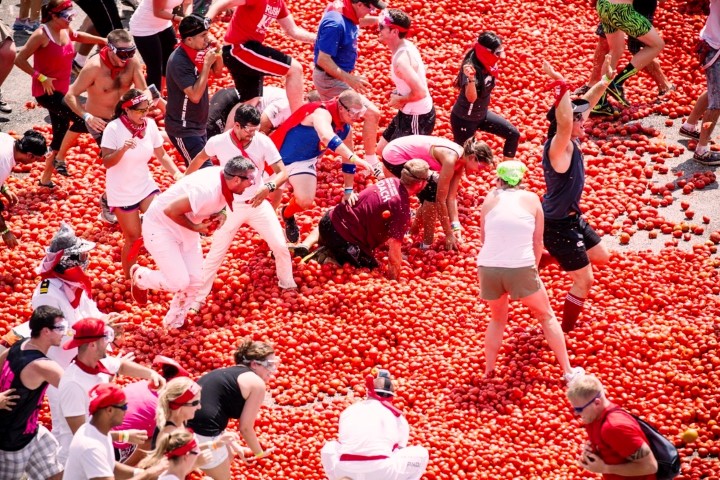
The La Tomatina Festival is held on the last wednesday of August on the streets of Bunol town in Spain. It is a fun event where participants from all around the world throw squashed tomatoes at each other. The week long festival is also famous for its parades, fireworks, music and dance. The tomatoes are provided to the participants before the start of the event. In order to maintain safety participants are encouraged to wear goggles and water trucks are placed across streets.
FLORIDA KEYS UNDERWATER MUSIC FESTIVAL, USA

The festival is usually celebrated to draw attention to the conservation of the coral reef. It is a wonderful festival for divers and music lovers. The festival takes place in a sand area near the coral reef. Hundreds of divers and underwater musicians play songs on the theme of Ocean. It is being celebrated every year for the last 25 years.
ICE AND SNOW SCULPTURE FESTIVAL, CHINA

The Harbin ice and snow festival takes place during the month of January in Harbin of Heilongjiang province of China. Attracting thousands of tourists it features an international competition of ice sculptures and illuminated snow block buildings. Multicoloured lights illuminate the ice and snow formations creating a spectacular sight at night. Artists who construct the ice sculptures use ice from the frozen Songhua river.
OKTOBERFEST, GERMANY

The largest funfair in the world, Oktoberfest takes place from the end of September to beginning of October in Munich City of Germany. The festival attracting around 6 million people around the world includes amusement rides and traditional food. 6 breweries around Munich serve around 7 million litres of beer every year.
Floods in India: Urban planning
Grey Infrastructure
It includes drains, pumps and outfalls. They frequently overflow by heavy rainfall or high levels of storm-water runoff from roads and streets. Indian cities like Bengaluru, Bihar, Delhi, Mumbai and Hyderabad are flooding frequently. There are multiple, recurring failures of grey infrastructure in India and other developing countries, for which alternatives are now being sought.
Blue-Green Infrastructure
Natural ecosystems such as lakes, parks, floodplains, forests are nature-based solutions called blue-green infrastructure and offer low-cost and flexible solutions for flood mitigation and management. They offer many other co-benefits.
Urban flood management in India continues to focus only on improving grey infrastructure, rescue and relief, instead of creating sustainable solutions. Cities continue to expand storm-water networks, clean channels and separate the sewage and storm-water drains. These are all important actions and urban areas bear high expenses to build grey infrastructure; but repeated floods mean that these actions are not sufficient.
Major reasons for frequent urban flooding across India
1. Construction on flood pathways.
During the monsoon, urban development and infrastructure such as roads, airports, bus depots, metro rail, etc. which are built on low-lying areas such as floodplains and lake beds, face higher risk of floods.
2. Making way for the floodwater.
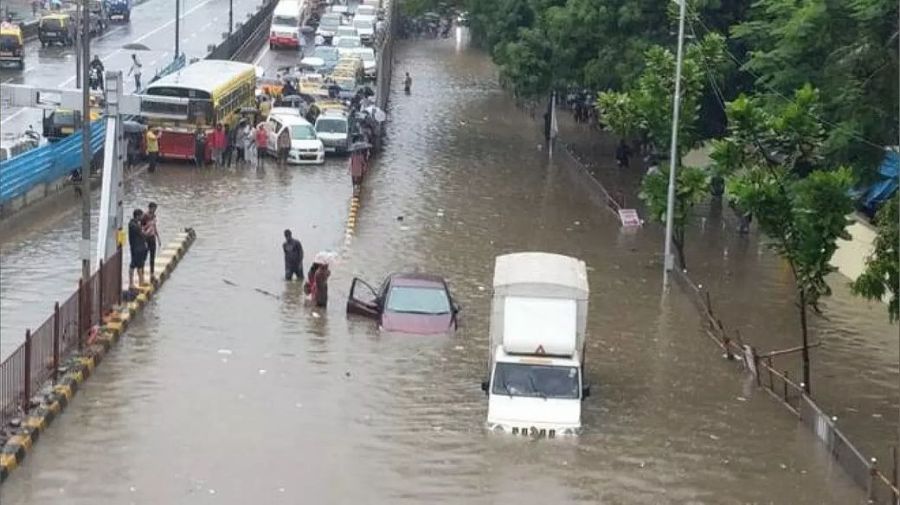
Water penetrates into the ground, flows as surface runoff, evaporates and transpirate into the atmosphere. Urban regions with impenetrable surfaces, avoid water to go underground, decrease evaporation and transpiration. This highly increases surface runoff. Urban India is constantly building structures, streets, flyovers for urban citizens, frequently with inadequate storm-water infrastructure. Enormous volumes of storm-water deteriorate on these impenetrable surfaces, causing continued flooding.
3. Climate change and uncertainty.
The adverse climate change is creating uncertainty in many environmental phenomena. Rainfall variability is increasing because of climate change. Average monthly rainfall is now falling within days. Floods have high economic and social damage. This year (2020) Mumbai had 80% of its average rainfall in eight days.
Forecast, response and resilience.
- Both grey and blue-green infrastructure expansion and upgrade is needed.
- Official response to floods needs high-tech rainfall and flood warning systems like in Chennai and Mumbai.
- Cities are building interactive maps of flood-prone zones (Bengaluru).
- These measures enable evacuation and support effective deployment of rescue and relief measures, but do not prevent floods and mitigate against loss to life, property and infrastructure.
- A reassessment of storm-water and cloudburst management is urgently needed in India. Depending solely on last century’s inflexible, expensive grey infrastructure does not manage current and future extreme natural events. Studies prove that the green infrastructure for storm-water management are cheaper and have more co-benefits than upgrading or expanding grey infrastructure.
- Along with flood planning, we need major steps towards climate change and environmental protection. Much of the adverse natural and man-made events are happening because of collective ignorance towards climate and environment.
Green fuel
A lot of pollution is caused due to the use of petrol and diesel in vehicles. This is the reason why the government is trying to use its alternate options like bio and green fuel. A step towards this is that a trial has been made to make green fuel from bamboo. National Green Tribunal (NGT) has given a go ahead to a bamboo based ethanol project. Through the Ministry of Environment, Forest and Climate Change, NGT has been given permission to make ethanol using bamboo in Golaghat, Assam. NGT chief A.K. Goyal has said that using bamboo fuel will help in reducing pollution. It will be an alternate option for petrol and diesel which will help in controlling the pollution level.
How Common Eligibility Test will be conducted.

As in recent meeting chaired by the Prime Minister Narendra Modi ji,the central government approved the setting up of National Recruitment Agency(NRA) for a cost of Rs 1517.57 Crore.The aim of this test is reduce the load for the students in saving time and many other resources.This test is mainly taken for the post which are non-gazetted and public sector banks.
If this test is implemented than it will be one of the largest recruitment examination for government jobs all around the globe.At present,railway attracts most number of application for jobs around 15 million which is highest in the world.In a statement,cabinet said,that if these test will be implemented than the candidate would not be require to give different tests for different examination conducted by many agencies.They will have to give only one online test and they can apply to all or any particular field.
Non-gazetted posts are those posts in which who are recruited they dont have right to use the government stamp for official purposes.Some include Grade B or Class II roles as government offices,assistant section officers,senior pharmacists,head clerk etc.Till now the government has not decided how the CET would be applicable for different jobs.The individual department and ministries will decide will decide modes of recruitment and interviews.
The exam will be held twice a year.It will be for different levels such as for graduate level,12th pass and 10th pass to facilitate recruitment at various levels.It will be held in around 1000 centres across India so that the rural people will also get equal opportunity.So it means that every district would have centre and there will be 117 centres set up in 117 districts.The best part of it is that,exam will be conducted in 12 languages as before it used to be conducted in English and Hindi.Once the exam is over the score are valid for 3 years.So for the aspirants it is great opportunity open for 3 years.
As the government will be conducting such exam on a large scale so there will be many challenges for them to address such as the application that would be around 25 million and there are 739 districts so as many centres.Some districts are bigger so there are possibilities that there will more than one centre.As one of the important issue is that it is online exam and there would be requirement of strong technological partner so that there are no glitches throughout the conduct of the exam.
Benefits for the students is that now,if students wants to apply for Staff Selection Commission,Institute of Banking Personnel selection for thousands of different jobs and paying a few hundred rupees as fees each time.The government itself is Rs 600 crore by having a single CET.As the way forward the first test is going to be held by second half of 2021.The government will engage with various state government to look at the ground level preparation.
We hope that this brings great positive and vibrant India by giving ennumber of jobs to the desired students.
Doctors of the future
Powerful transformation serves as a tool for both patients and provider–and that trend will continue over the next decade. So if AI is unlikely to supplant trusted doctors and must accommodate patient data privacy, where will the big changes happen?
AI in Five Years: Smarter Machines and Virtual Assistant
Incremental jumps in technology will increase the ubiquity and strength of the examples above, but where will the real change happen?
Consider how much happens behind-the-scenes when working with a virtual assistant on your smartphone. From voice recognition that learns your voice to combing through live search results to leveraging past behaviours to sharing results across devices—this unfolds instantly and most of us never even consider the AI-powered how.
“Imagine you go to the hospital for a PET scan or MRI,” said Scott Tease, Lenovo’s executive director of High-Performance Computing and Artificial Intelligence.
“Before the doctor or technician reviews the images, an algorithm will interpret the data and flag every irregularity.
This accelerates the caregivers’ efforts, draws their attention to issues, and helps ensure nothing is overlooked. In fact, these processes are under review by regulatory bodies right now.”
Enhanced resolution and analysis will allow remote scanning and diagnosis — even of small and subtle symptoms. Doctors may be more apt to embrace this use of AI, but what about the deluge of tracking data?
The prospect of health-tracking devices automatically pinging clinics with potential concerns raises more than a few eyebrows.
We may also see the growing demand for “convenience”—everything available at your fingertips through a website or app—reshape low-risk patient care. Here, AI may lead to chatbot-style physician care, where a series of targeted questions combined with biometrics will help people find the right care. Telemedicine, of course, made consulting a doctor from the comfort of home possible years ago, but an electronic physician could radically reduce cost. Even if a real person steps in to review and approve, an AI-led interview and data assessment would certainly increase efficiency.
“Convenience, risk assessment, and accuracy all play a role.
We’re not likely to see the chatbot approach take over for anything with dangerous symptoms.”
AI in 10 Years: Personalized, Globally Accessible Medicine
Assume that the changes outlined so far march forward, driven by advances in technology and wider adoption. Misconceptions about AI will also continue to erode, and successful deployment of AI-assisted technology. Who can guess how fleets of autonomous vehicles smoothly navigating city streets and highways will change perception?
AI also notoriously employs a so-called “black box”—the essential genius of deep-learning unfolds behind a closed curtain. We know the input and output, of course, but seldom the step-by-step process of the AI reaching its conclusion. It can be difficult to trust an answer when the underlying work is hidden (and may contain accidental bias).
Trust will likely grow over the next decade, but even without that embrace, things may wildly transform—as much as possible in the regulated world of medicine. Mapping a genome opens a window into inherited conditions, susceptibility to disease, potential response to treatment, and countless other insights. But the process takes time and the considerable might of high-performance computers.
Coronavirus: Pandals go online in Ganesh festival.
Due to the coronovirus and the the lockdown this year the most popular festival of Maharashtra has lost its charm. Pandals which were seen in every street were now went missing. The Ganesh sculpture industry go through a huge loss. The excitement and thrill of the festival had gone down. Many families had lost the chance to visit in special aartis and dancing in welcome song of lord Ganesha. The silence this time had made many vendors and shopkeepers suffer the hardest.
The GSB Ganpati Mandal at Kings Circle in Mumbai went live on various social media platforms to avoid crowding of devotees at the pandal. “Since the immersion in lakes will not be possible during Covid, the municipal corporation has sanctioned the construction of 250 to 300 artificial water tanks this year,” said Dahibawkar. Most of the tanks will be built at the level of individual neighbourhoods. “I have appealed to many civic corporators to get tanks built in their own areas, but in many places, individual pandals themselves have offered to make their own tanks.”
The enthusiasm of making modaks to distributing them in public is not seen this time. Many hoseholds had done the establishment and havan of lord Ganesha via online astrologers speech. People claims idol-makers have also been struggling to get space to set up their temporary workshops. Normally the city authorities give us space in a maidan or ground to set up our workshop, but this year they still haven’t allowed us such space.
Many bollywood celebs had not broken their ritual of celebrating the festival and this time too had done every arrangements to meet ‘BABPA’. May be this year was not as good as previous one but the devotion and love of people towards our God is unbeatable and appreciative. We all could just hope and pray for better days in near future.
Economics by Aristotle
JPEG or Raw
Capturing photographs is one of the most common things one do in his/her everyday life. Can you even remember how many times a day you open the camera of your phone to click something. No matter what your subject is, you at least click one photo a day. And if you don’t, you should.
Capturing photographs is a way great way to express your feelings. There’s a famous saying, “A good photograph is worth a thousand words’. Photography is all about capturing the one perfect shot at a perfect moment. But their are different formats of a particular type of file.
For example: an audio file may have formats of MP3, Wav etc. or a video file may have formats of MP4, mkv, avi etc.
Similarly, when a photographer captures a photograph, he has options to shoot either in JPEG or Raw (CR2) format.
So the question arises, which one is better format to shoot?
Let’s talk about JPEG first. It is the format, which is mostly used by anyone who captures photographs. A photo captured using a mobile is always in JPEG format. The format is fully processed by the camera, and hence, can be used and shared easily.
Raw is not actually a picture, it’s a negative. Negative is actually an unprocessed image which can’t be directly shared anywhere. These are to be processed later by using editing apps and softwares into JPEG to share.
But now the question arises, why we need to shoot in RAW format if ultimately we need to convert the image into JPEG?
As mentioned above, Raw file must be post processed which means while editing, it would be easier to change the exposure, contrast, highlights and shadows etc of Raw files rather than a JPEG file.
A JPEG file is of 8bit and it comprises of the basic colours (RGB) in the value of 256 each. This means in JPEG file, one gets total of 16 million colours in this format.
Whereas, Raw files is of 12bit or 14bit. If we talk about 12bit, it has total of 68 Billion colours in this format. Such a huge difference. Isn’t it?
This is why, it is always recommended to photographers to always shoot in RAW. The format helps them to insert the colours and the value of exposure, contrast etc. accordingly.
Though, there are few problems with RAW files too.
1. They are quite large in size, so one must use a memory card with high storage space to shoot in RAW.
2. While shooting Raw at higher shutter speed, the camera takes time to load and hence one can miss the perfect shot. So, a memory card of high speed to avoid this.
Still, if one is afraid to shoot in RAW because it takes time to edit the photographs in this format, he can use the format of RAW+JPEG. This format will give you both the files in your memory card and so, one can use the format accordingly.
India records Highest ever single day peak of 63,631recoveries
On the day, India’s daily tests have scaled a new peak of 10 lakh 23 thousand,India has achieved another milestone as it recorded highest ever single day recoveries of 63,631 in the last 24 hours.
With this high number of COVID-19 patients recovering and being discharged from the hospitals and home isolation (in case of mild and moderate cases), the Recovery Rate has reached 74.69%.This has also led to declining Case Fatality Rate, which stands at a new low of 1.87% today.
India’s total recoveries now exceed thetotal active cases (6,97,330) by more than 15 lakhs.The record high recoveries have ensured that the actual caseload of the country viz. the active cases, has reduced and currently comprises only 23.43% of the total positive cases. Early identification through aggressive TESTING, comprehensive surveillance & contact TRACING along with focus on timely and efficient clinical TREATMENT of patients have ensured speedy recovery.Higher number of recoveries and declining fatality have shown that India’s graded and pro-active strategyis delivering results on the field.
Aarogya Setu introduces ‘Open API Service’, a novel feature to help the people, businesses and the economy to return to normalcy
As we move on to the new normal of learning to live with COVID19, Aarogya Setu team has worked on a new innovative feature which is called ‘Open API Service’. In order to help businesses and economy to start functioning while being safe, the Open API Service enables organizations to check the status of Aarogya Setu and integrate it into its various Work from Home features. The Open API Service of Aarogya Setu, addresses the fear/risk of Covid-19 infections and help the people, businesses and the economy to return to normalcy.
Aarogya Setu has been powering India’s fight against COVID-19 since its launch on 2nd April 2020. Aarogya Setu has now emerged as the most downloaded contact tracing App in the world, with more than 15 crore Users. The overwhelming support of the people has enabled Aarogya Setu to aid the efforts of frontline health workers and the Government in COVID-19 mitigation and management efforts. More than 6.6 million Bluetooth contacts have been traced and percentage positive of those who have tested is almost 27%. Thus Aarogya Setu based Bluetooth contact tracing and testing is very efficient and effective. Similarly, many others have been advised for caution and quarantine and it has led to breaking the chain of spread and has been effective in early detection and ensuring that fatality rates in India are amongst the lowest. The Aarogya Setu ITIHAS interface which uses location data and Aarogya Setu analytics to predict emerging hotspots at Sub Pincode levels has been very effective in helping the health officials and administration to take necessary precautionary steps. More than 30,000 hotspots have been identified at a very granular level of 300 m X 300 m and shared with State Governments and Districts.
Since its launch, Aarogya Setu has continuously innovated and introduced more novel features like e-pass integration, QR Code scanning, sharing of Health status with family/known persons – all of which have been very effective in keeping India and Indians safe in line with the motto of Aarogya Setu – Main Surakshit, Hum Surakshit, Bharat Surakshit.
Open API Service
The Open API Service of Aarogya Setu, can be availed by organizations and business entities, who are registered in India with more than 50 employees, and they can use the Open API Service to query the Aarogya Setu Application in real-time and get the health status of their employees or any other Aarogya Setu User, who have provided their consent for sharing their health status with the organization. The Open API shall only provide the Aarogya Setu status and name of the Aarogya Setu User (with User’s consent). No other personal data shall be provided through the API.
India records Highest ever single day peak of 63,631recoveries
On the day, India’s daily tests have scaled a new peak of 10 lakh 23 thousand,India has achieved another milestone as it recorded highest ever single day recoveries of 63,631 in the last 24 hours.
With this high number of COVID-19 patients recovering and being discharged from the hospitals and home isolation (in case of mild and moderate cases), the Recovery Rate has reached 74.69%.This has also led to declining Case Fatality Rate, which stands at a new low of 1.87% today.
India’s total recoveries now exceed thetotal active cases (6,97,330) by more than 15 lakhs.The record high recoveries have ensured that the actual caseload of the country viz. the active cases, has reduced and currently comprises only 23.43% of the total positive cases. Early identification through aggressive TESTING, comprehensive surveillance & contact TRACING along with focus on timely and efficient clinical TREATMENT of patients have ensured speedy recovery.Higher number of recoveries and declining fatality have shown that India’s graded and pro-active strategyis delivering results on the field.
 Eduindex
You must be logged in to post a comment.