PM Modi addresses BJP workers on Party’s foundation day today; Urges them to counter false narratives being built around farm laws, CAA and labour laws

Prime minister Narendra Modi said, false narratives are being built; be it about farm laws, CAA or labour laws. Addressing  BJP’s 41st foundation day today, Mr Modi said, it is a conspiracy to create political instability.  Prime minister highlighted that sometimes they say citizenship will be snatched, sometimes it’s farmers’ land, but they are all blatant lies.

He called upon BJP workers to go to people and make people aware.  Mr Modi said, BJP not only represents national interest but is also a party of regional aspirations. Saying the party’s mantra has been ‘Vyakti Se Bada Dal Aur Dal Se Bada Desh’, Prime minister reiterated, this tradition continues to this day.

Mr Modi said the party fulfilled Shyama Prasad Mukherjee’s vision of one India by scrapping Article 370 and gave Kashmir the constitutional right. He criticised the opposition for their remark that if BJP wins polls, it’s called poll wining machine, but if others win, there is appreciation.  

Mr Modi said, people who say BJP is a poll-winning machine, do not understand India’s Constitution and democracy’s maturity. He said the truth is that BJP is not poll winning machine, but a movement that connects with people.

Night curfew imposed in Delhi till April 30 in view of rising Covid cases

Delhi government has imposed night curfew in the national capital from 10 PM to 5 AM with immediate effect till 30th April. The decision was taken in the wake of increase in COVID 19 cases. There will be no restrictions on traffic movement during night curfew. People can get vaccinated but need to have an e-pass. Owners of ration, general, fruits, vegetables and medical stores will be allowed on e-pass. Print and electronic media personnel will also be allowed to move on e-pass.

Private doctors, nurses and paramedical staff will remain exempted from night curfew. Passengers going to airports, railway stations and bus stations will be exempted if a valid ticket is produced. Pregnant women and patients going for treatment have also been exempted.

Buses, metros, autos and taxis will be allowed to ferry only those people who are exempt from night curfew. There shall be no restriction on inter-state and intra-state movement and transportation of essential and non-essential goods. No separate permission or e-pass will be required for such movements.

IMA urges Centre to open up vaccination for everyone above 18 years of age

The Indian Medical Association (IMA) has urged the centre to open up vaccination for everyone above 18 years of age. In a letter written to the Prime Minister today, the IMA has also appealed that the government should make vaccination certificate mandatory for entry into public places and large gatherings.

Highlighting the gradual rise in number of new COVID cases, the Association termed it painful that in spite of extraordinary efforts of the Government the new cases in the apparent second wave is turning alarming.

IMA added that since vaccination against COVID stands as a single evidence-based resource to restrict the cases, the drive should be amplified multifold in order to pave way for herd immunity.

The Association said that the government should include private sector family clinics in the vaccination drive to widen it’s ambit and constitute district level vaccine task force in every district to monitor effective vaccination of every beneficiary.

Special campaign for Covid-19 appropriate behaviour being launched today to ensure 100% mask usage, personal hygiene and sanitation

A special campaign for Covid-19 appropriate behaviour will be launched today. It will emphasise on 100 per cent mask usage, personal hygiene and sanitation at public places, workplaces and health facilities. The special campaign will be organised till 14th of this month.

At a high-level meeting on Sunday, Prime Minister Narendra Modi had emphasized that awareness of the community and its involvement is paramount for sustainable COVID-19 management. In a presentation made during the meeting, it was highlighted that there is an alarming rate of growth of Covid-19 cases and deaths in the country.

AIR correspondent reports that some of the main reasons for the rapid rise in COVID cases can be attributed to the severe decline in compliance of Covid-appropriate behaviour, primarily in terms of use of masks and maintaining ‘2 Gaj ki Doori’.

Therefore, government is launching this special campaign to emphasise the need for covid-appropriate behaviour in the coming days. For sustainable COVID-19 management, awareness and involvement of the community are paramount. There is a need to continue public participation and public movement for COVID-19 management.

The five-fold strategy of Testing, Tracing, Treatment, Covid-appropriate behaviour and Vaccination would be effective in curbing the spread of the Pandemic.

Peaceful voting underway for single-phase assembly elections in Kerala, TN and Puducherry; Third phase polling also progressing smoothly in WB and Assam

Polling for the single-phase elections in Kerala and Tamil Nadu, as well as the Union Territory of Puducherry along with the Lok Sabha by-polls for Kanniyakumari seat in Tamil Nadu and Malappuram seat in Kerala, is progressing smoothly.  Polling is also being held in Assam and West Bengal for the Third Phase of Assembly Elections.

The people were seen standing in long queues in front of the Polling Stations right from the beginning. All the necessary facilities and security arrangements have been made to ensure free and fair polling during this phase.

The Voter Verifiable Paper Audit Trail (VVPAT) is being used along with Electronic Voting Machine (EVM) at every Polling Station, with a view to enhance the transparency and credibility of the election process. The polling will be conducted till 6.00 P.M.

In Assam,  33.18% polling has been reported till 11 am. Over 79 lakh voters are expected to exercise their franchise in the third and final phase of polls. State BJP President Ranjeet Kumar Dass, senior minister Himanta Biswa Sarma are among those who voted so far. Voting is on following all Covid 19 protocols. Special arrangement for senior citizens including wheelchairs has been made in polling stations.

Kerala records 28.38 percent voter turnout till 11 am. 30.96 percent male voters, 25.95 percent female voters and 5.53 percent transgender voters cast their ballots till now. Entire state is witnessing heavy turnout in the initial hours of polls.

Chief Minister Pinarayi Vijayan, former Cheif Minister Oommen Chandy, BJP State President K. Surendran and Metroman E. Sreedharan are among the prominent leaders cast their votes in the morning itself. All the leaders expressed confidence in winning the elections. Voting is peacefully underway in all the constituencies. Long queues are seen outside the polling stations.

Voting began at 7am in the morning and it will continue till 7 pm in  131 constituencies and  it will end at 6 pm in nine naxal affected constituencies. Over 2.74 crore voters will cast their votes in 40,771 polling booths across the State. 957 candidates are contesting the assembly polls and six in the Loksabha bypoll.

Elections are being conducted in strict adherence to Covid-19 and green protocols. Covid patients and quarantined voters will be permitted in the final hour of polling. Elaborate security arrangements are in place all over the state. Webcasting and CCTV facility is being provided in most of the polling booths to prevent bogus and double voting.

In Tamilnadu, the present status of polling is 9.23 Percentage. polling goes on smoothly in the single-phase assembly elections in all the 234 assembly constituencies. People unmindful of the hot summer have come in large numbers and are participating in the festival of democracy.

Along with the Assembly election, voters of Kanyakumari have to additionally exercise their franchise for the bye poll in the Kanyakumari Lok Sabha constituency.

The political fate of 3998 candidates will be decided today by a total of six crore 28 lakh sixty nine thousand 955 voters spread across  37 districts in the State.

In addition, actor-politician Kamal Haasan’s Makkal Needhi Maiam (MNM) and the newly-forged alliance between TTV Dhinakaran’s Amma Makkal Munnetra Kazhagam (AMMK) and Asaduddin Owaisi’s All India Majlis-e-Ittehadul Muslimeen (AIMIM) are also trying to make big inroads into the state politics. AIR correspondent reports that

The massive democratic exercise in the State takes place today amidst rising summer temperatures and increasing Covid cases. The Assembly elections are held amidst Covid 19 regulations in place. face masks have been made mandatory for all the voters.

All polling booths have been equipped with minimum basic facilities to make the voters exercise their franchise without any hassle. Shamianas have been put up to protect voters from the heat, Safe drinking water, special arrangements for persons with disabilities have also been ensured in polling stations.  Poll booths have been given face masks, PPE Kits, hand sanitisers, hand gloves for health safety purposes.

Provision to dispose of used gloves have also been kept in the polling booth. As today is a paid holiday, voters are expected to come in large numbers to exercise their franchise. The election Commission with the message that no one should be left out has also made arrangements to operate over ten thousand buses for the benefit of the voters.

Election Commission has also made an arrangement with UBER to transport the elderly free of cost to cast their vote in Chennai Coimbatore and Tiruchy. Covid positive people can vote from 6 pm to 7 pm today exclusively.. According to political experts, this election expects decisive participation of a larger number of voters as the State faces a multi-cornered contest in many constituencies.

In Puducherry, 324 candidates including 35 women are vying for 30 seats. Over 10.04 lakh voters including 5.31 lakh women and 116 Third Gender persons will decide the fate of these candidates. Total 1,559 Polling Stations have been set up for this purpose. Naam Tamilar Katchi has fielded 28 candidates and DMDK has 26, AMMK-25, MNM-22, DMK-13 Congress-14 while NR Congress has given tickets to 16, BSP-11 and BJP has put up nine candidates in the fray.

In West Bengal, 14.62% polling has been recorded in the first two hours. Barring a few stray incidents, polling is going on peacefully in 31 assembly constituencies across three districts, Hooghly, Howrah and South 24 Parganas. Elaborate security arrangements have been made to ensure free, fair and peaceful polling. 618 companies of central forces have been deployed along with more than 11 thousand state police for the three districts.

In South 24 Parganas, booth number 102 of Satgachia assembly seat has been made as a model from where webcasting will be done for international audiences.

In Uluberia Uttar constituency, a sector officer has been suspended by the ECI as he allegedly took four EVMs outside. Deputy Election Commissioner Sudip Jain has asked for a report regarding the incident.  

Kerala records 37.23 percent voter turnout till noon.  39.75 percent male voters,  34.86 percent female voters and  8.99 percent transgender voters cast their ballots till now. Chief Minister Pinarayi Vijayan, Opposition leader Ramesh Chennithala and BJP State President K. Surendran are among the prominent leaders cast their vote, earlier this day.

All the leaders expressed confidence of their fronts winning the elections. Voting is peacefully underway in all the constituencies. Long queues were seen outside the polling stations and a heavy turnout is expected in the state. Covid protocol has been strictly adhered across the state. Covid patients and quarantined voters will be permitted in the final hour of polling

Voting began at 7am in the morning and it will continue till 7 pm in  131 constituencies and it will end at 6 pm in nine Naxal affected constituencies. Over 2.74 crore voters will cast their votes in 40,771 polling booths across the State. 957 candidates are contesting the assembly polls and six in the Loksabha bypoll.

Pre-matric Scholarship for Students with Disabilities

About theProgram

The Department of Empowerment of Persons with Disabilities, Government of India invites applications for NSP Pre-Matric Scholarship for Students with Disabilities 2020-21 from physically challenged students of Class 9 and 10. The key objective of the scholarship is to support the students with disabilities for their studies and prepare them to earn their livelihood and find a dignified place for themselves in society.

Scholarship

NSP Pre-Matric Scholarship for Students with Disabilities 2020-21DeadlineClosedEligibility

To be eligible, an applicant must:
Be a regular full-time student of Class 9 or 10 in government or recognised school
Have more than 40% disability and a valid certificate for the same
Belong to the family where the annual income is not more than INR 2.50 lakh from all the sources.Benefits

The selected scholars will receive the following benefits –
Maintenance allowance for 12 months in an academic year (for hostellers): INR 800 per month
Maintenance allowance for 12 months in an academic year (for day scholars): INR 500 per month
Book grant (for both hostellers and day scholars): INR 1,000 per annum
Disability allowance as follows –
Visually impaired: INR 4,000 per annum
Hearing impaired: INR 2,000 per annum
Physically disabled: INR 2,000 per annum
Intellectual disability: INR 4,000 per annum
All other types of disability: INR 2,000 per annumDocuments

Photo of the applicant
Certificate of previous academic mark sheet
Fee receipt of current course year
Age proof certificate
Income certificate of the family
Bank account details
Disability certificateHow can you apply?

Eligible candidates can apply for the scholarship through following steps –
Step 1: Click on the ‘Apply Now’ button below.
Step 2: Read the guidelines carefully, select the undertaking and ‘Continue’.
Step 3: Select the state of domicile, scholarship category (Pre Matric), scheme type (scholarship scheme), gender, write the applicant’s name, date of birth, mobile number, email ID.
Step 4: Provide the bank details (Bank name, IFSC Code, Account Number)
Step 5: Select Aadhaar or Bank Account Number as identification detail and click on the ‘Register’ button.
Step 6: The mobile number will be verified and an OTP will be generated.
Step 7: Now, log in using OTP and fill the form.
Step 8: An application ID and password will be generated. Use that for future references.
Note: All the applicants are advised to fill the form correctly, no changes can be made once submitted. The applicants are also advised to fill only one application as multiple applications will lead to the cancellation of the form.

Important Dates

Scholarship announcement date: 16th August 2020
Scholarship closing date: 31st December 2020
Last date for defect verification: 15th January 2021
Last date for Institute verification: 15th January 2021

Selection Criteria

The following factors will be taken into consideration for selecting the scholars –
Fulfilment of eligibility conditions
Number of slots available to the State
Recommendation of the State Education Department
Academic merit of the candidate in the qualifying examination

Note: In case of a tie in marks obtained by the students, the selection will be based on the percentage of disability. Furthermore, if a tie still prevails, the age will be taken into consideration and the older candidate will get the preference.

Important documentsScholarship Guidelines

Terms and Conditions
50% of the total scholarships are reserved for the female candidates. However, in case of the adequate number of female students are not available, the unutilised slots can be utilised by the suitable male candidates.
Not more than two children with disabilities of the same parents can avail benefits under this scheme.
The final selection of the candidates will be done by the Department of Empowerment of Persons with Disabilities based on the recommendations of the concerned state government department.
The amount of scholarship will be directly transferred into the bank account of the beneficiary through PFMS.

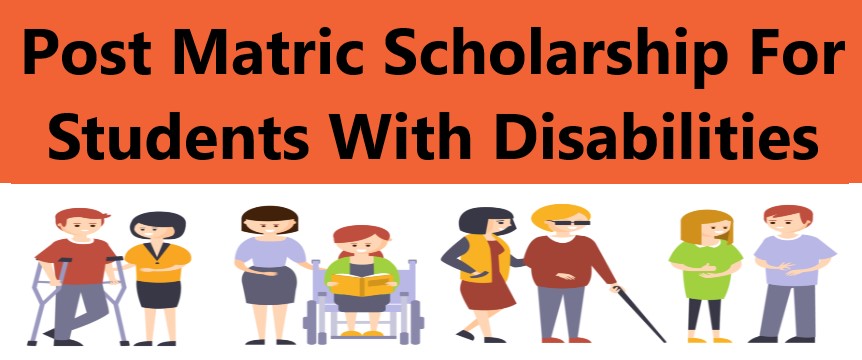
Post-matric Scholarship for Students with Disabilities

About theProgram

Department of Empowerment of Persons with Disabilities, Government of India, is inviting applications for NSP Post Matric Scholarship for Students with Disabilities 2020-21 from students of Class 11 to postgraduate level. The scholarship aims to help students with disabilities to pursue further education so that they could earn their livelihood and find a dignified place for themselves in society.

Scholarship

NSP Post Matric Scholarship for Students with Disabilities 2020-21DeadlineClosedEligibility

To be eligible, the applicant must:
Have passed matriculation or higher secondary or any higher exam of a recognised Board of Secondary Education or University
Have more than 40% disability certified by the competent authority
Have an annual family income of less than INR 2.50 lakh
Be pursuing post-secondary (class 11 to postgraduate level) courses in recognised institutions

Note: Employed students whose income does not exceed that of scholarship amount can apply for this post-matric scholarship. Students pursuing their courses by correspondence are also eligible. 50% scholarships are reserved for female candidates.Benefits

The selected scholars will receive –
Maintenance allowance of up to INR 1,600 per month (hostellers) and up to INR 750 per month (day scholars).
Disability allowance of up to INR 4,000 per annum.
Reimbursement of compulsory non-refundable fees of up to INR 1.50 lakh per annum excluding the refundable deposits like security deposit and caution money.
Book allowance of INR 1,500 per annum. Documents

The following documents shall be uploaded in the online application:
Applicant’s photograph
Age proof
Certificate of disability
Income certificate of the parent issued by a competent authority
Tuition fees receipt
Last academic qualification certificate How can you apply?

Eligible candidates can apply for the scholarship through following steps –

Step 1: Click on the ‘Apply Now’ button below.
Step 2: Read the guidelines carefully, select the undertaking and ‘Continue’.
Step 3: Select the state of domicile, scholarship category (Post Matric), scheme type (scholarship scheme), gender, write the applicant’s name, date of birth, mobile number, email ID.
Step 4: Provide the bank details (Bank name, IFSC Code, Account Number)
Step 5: Select Aadhaar or Bank Account Number as identification detail and click on the ‘Register’ button.
Step 6: The mobile number will be verified and an OTP will be generated.
Step 7: Now, log in using OTP and fill the form.
Step 8: An application ID and password will be generated. Use that for future references.
Note: All the applicants are advised to fill the form correctly, no changes can be made once submitted. The applicants are also advised to fill only one application as multiple applications will lead to the cancellation of the form.

Important Dates

Scholarship announcement date: 16th August 2020
Scholarship closing date: 20th January 2021
Last date for defect verification: 05th February 2021
Last date for Institute verification: 05th February 2021

Selection Criteria

The selection of the candidates will be based on the following criteria:
Percentage of marks obtained in the last qualifying examination
Fulfillment of eligibility conditions
Number of scholarship slots available to the state
Percentage of disability will be taken into consideration if there is a tie for the percentage of marks
State education department recommendation

Important documentsPost-matric Scholarship for Students with Disabilities

Terms and Conditions
Candidate who after passing one stage of education are studying in the same stage of education in a different subject is not eligible.
The scholarships are not awarded for training courses like Aircrafts Maintenance Engineer’s course and private pilot license course.

Top Class Education for Students with Disabilities

About theProgram

The Department of Empowerment of Persons with Disabilities, Government of India is offering Scholarships for Top Class Education for Students with Disabilities 2019-20 to promote quality education among students who are pursuing studies at graduate/post graduate/diploma level. The key objective of the scholarship is to recognise and promote quality education amongst students with disabilities by providing them with full financial support.

Scholarship

NSP Scholarships for Top Class Education for Students with Disabilities 2019-20DeadlineClosedEligibility

To be eligible, an applicant must:
Be pursuing studies at graduate/postgraduate degree/diploma level in notified institutions of excellence in education
Have more than 40% disability and a valid certificate for the same
Have an annual family income of less than INR 6,00,000Benefits

A total of 300 scholarships are given under this scheme. The selected candidates receive the following benefits:
Reimbursement of tuition fees and non-refundable charges paid/payable to the institute: Up to INR 2 Lakhs per annum (subject to actual amount)
Reimbursement of expenses for the purchase of a computer with accessories: INR 30,000 (one-time grant)
Reimbursement of expenses for the purchase of Aids and Assistive Devices: INR 30,000 (one-time grant)
Maintenance allowance for hostellers: INR 3,000 per month
Maintenance allowance for day scholars: INR 1,500 per month
Book grant (Hostellers and Day Scholars): INR 5,000 per annum
Special allowances: INR 2,000 per monthDocuments

The following documents should be upload while applying at NSP portal:
Photo of the applicant
Certificate of previous academic mark sheet
Fee receipt of current course year
Age proof certificate
Income certificate of the family
Bank account details
Disability CertificateHow can you apply?

Eligible candidates can apply for the scholarship through following steps –
Step 1: Visit the homepage of the National Scholarship Portal and click on ‘New Registration‘.
Step 2: Read the guidelines carefully, select the undertaking and ‘Continue‘.
Step 3: Select the state of domicile, scholarship category (Scholarships for Top Class Education for students with disabilities), scheme type (scholarship scheme), gender, write the applicant’s name, date of birth, mobile number, email ID.
Step 4: Provide the bank details (Bank name, IFSC Code, Account Number)
Step 5: Select Aadhaar or Bank Account Number as identification detail and click on the ‘Register’ button.
Step 6: The mobile number will be verified and an OTP will be generated.
Step 7: Now, log in using OTP and fill the form.
Step 8: An application ID and password will be generated. Use that for future references.
Note: All the applicants are advised to fill the form correctly, no changes can be made once submitted. The applicants are also advised to fill only one application as multiple applications will lead to the cancellation of the form

Important Dates

Application start date: 15 July 2019
Application closing date: 15 November 2019
Last date for defective verification: 15 November 2019
Last date for institute verification: 15 November 2019

Important documentsScholarships for Top Class Education for students with disabilities.

Terms and Conditions
The scholarship can be given to a maximum of two children of the same family (admissible if the second child is a twin)
Scholarship for studying in any class will be given only for one year. On repeating the class, the scholarship will be withdrawn.
50% of the total scholarships will be reserved for girl candidates.

To know more, click here.

4 job options for tally experts

Tracking, recording, analysing, and reporting everyday operations and financial aspects of a business is very essential for mindful investment, profit generation, and expenditure. Tally is a technologically-driven advanced accounting tool that helps many organizations manage different operations, maintain accounting data, avoid loss, omission, or repetition of data, and transfer or present the data coherently whenever required.

Tally can help one equip with many relevant skills which are required for banking, bookkeeping, inventory management, billing and taxation, purchase and sale management, and so on. Knowledge of Tally can be of huge help to individuals they can change their area of work or department, land lucrative opportunities as a fresher, change their career path, and can also manage their own business professioally.

  1. Billing executive

Billing involves the creation, management, and issuing of receipts and invoices to internal or external stakeholders of the business. Businesses usually handles many different existing and new clients at tight deadlines and require proof of all the payments made or received to enhance their professional relationships which can assist in profit or loss calculations.

Tally is mainly used by billing executives to avoid manual data entry, ensure accurate figures, and eliminate errors while preparing receipts and invoices. It helps in creating new invoices, adding, searching, and summarising customer records, converting different currencies, and credit card processing. This tool also include many different features like financial calendars, database and records management, hours tracking, reminders, and reporting options that make billing much easier.

2. Tally Freelancers

Freelancing in Tally can be called as a new-age dynamic career opportunity for experts who wish to be associated with different organisations instead of imparting their services to one. Freelancers can work for different clients and earn individually based on every service or installation they do.

They work for 2-5 hours a day, Tally experts work on basic bookkeeping and accounting functions, provide daily work reports, create and provide GST reports, pay TDS, make receivable and payable statements, and bank reconciliation statements. Tally experts are one who can provide services on a contractual or consultation basis to mid-size or large organisations. They can also work as trainers for corporate clients if they want.

Individuals with a flair and passion for teaching and a love for tally could combine their skills and provide education to young learners which can take their expertise a step further.

3. Inventory manager

Inventory management involves tracking, controlling, and managing the movement, stocking, usage, order processing, and manufacturing of inventory. Inventory usually contains raw products, goods which are work-in-progress, and final products which differ from industry to industry.

Tally provides inventory managers to ensure a sufficient supply of the right materials at the right time, avoid overstocking or understocking, which can reduce the handling costs. This software simplifies the stock management, helps in location or warehouse management, manufacturing, organising the inventory batch-wise and lot-wise, making accurate reports, managing the costs from other parties, making and delivering online business reports accurately.

4. Accountant

Accountancy is the process of recording, managing, and reporting the financial activities of a business. Accounting starts right after when bookkeeping ends and helps businesses understand their status, profit and loss made during a certain period, and their financial results.

Usage of Tally software for accounting improves its accuracy and efficiency upto a certain level, prevents mistakes and promotes the utilisation of time for valuable administration, strategy building, and execution-related functions. The software allows multi-user access, automation, online support, data security, is affordable, and is scalable which helps in easing accountancy processes.

Productivity tips for studying from home

Photo by Liza Summer on Pexels.com

While the pandemic has compelled us to do all our work and study from home. But studying form home has many challanges. Here are some of the tips to stay productive while studying from home-

1. Create a Distraction-Free Study Space

The key to studying at home is to create a space within your home that has some of the benefits of a school or library, with as few of the distractions of the home as possible. In other words, you need a nook where you can work without a TV, bed, or other distracting objects near you. 

Some students have achieved this by setting up their study space on a dining room table in their home. Others have set up a desk in the hallway so that they won’t be tempted to go to their room and sleep. Some may be able to use the common computer room or study space.

2. Follow a School-Like Schedule 

The easiest way to mimic the focus and productivity that you have in school is by working on the same schedule you would when you’re in school. Similarly to how you spend consecutive periods in different subjects during the school day, you can set a schedule for yourself that has you spend a certain amount of consecutive hours studying each subject every day. 

This routine may seem a bit odd at first since you won’t be moving around like you do when you switch classes at school. However, much like you get used to the school schedule in a few days after summer vacation, you’ll get used to the new schedule you set for yourself as well. 

3. Dress The Part 

Remember the feeling of comfort and laziness you feel when you’re in pajamas (some of you may be feeling it right now)? Now think about the feeling of purpose and determination you can feel once you’ve showered and gotten dressed for the day? They’re very different mindsets, and you can probably guess which one is best for studying from home. 

Something as simple as getting ready in the morning as if you were going to school can really put your mind in a more determined, focused state. This can really help you get into that focused, productive mindset. In other words, if you dress the part of a focused student, you have a better chance of acting the part of a focused student. 

4. Avoid Your Bed At All Costs

Most students have fallen prey to this sneaky trap. We get tired in the middle of the day from being productive in the morning. We think we can take a small nap break. Next thing we know, we’ve slept most of the afternoon away and then wake up not wanting to do any more studying. It is so easy to do, and it can ruin what could have been a very effective study day. 

So, as a general rule, when you’re trying to study, avoid your bed as much as you can. Try to study in a chair or at a desk, where you have to sit up and pay attention. If you let yourself lie down or try to study in bed, you are guaranteed to feel sleepier and not be as productive. If you don’t really have any other space to study, try to sit on your bed a different way, away from your pillows, so you’re less tempted to fall asleep.

5. Take Breaks

There is no sense in trying to study for 10-12 hours straight if your body and mind can’t handle that. After the first few hours, you are going to get tired, and your brain won’t be able to absorb and retain information as well as it could if you were rested. At this point, you can study all you want, but you will not be studying productively. 

It’s okay to take periodic breaks during the day as often as you need to. Mind you, these won’t be long breaks. You don’t want to lose your motivation! But you can take 15 minutes here and there to clear your head, recharge, and be ready to tackle those books again at full force. 

6. Form Virtual Study Groups

Who says that study groups need to be in person? In this day and age, with technologies like Zoom, Skype, FaceTime, or just a plain phone call, you can connect with your fellow classmates from the comfort of your home and help each other learn just as if you were together in class. 

There are several benefits to virtual study groups. Some video conferencing platforms allow you to record your meetings, so you can look back on the study session you and your peers had if you ever forget what was said. You can also mute yourself whenever you need to so that you can multitask, if needed. Finally, the home environment seems far less lonely and maybe even more fun when you have students like you to talk to you and compare notes with. 

7. Get Your Other Chores Out Of The Way 

One of the most annoying things that can happen to a teenager is to be working in the zone, then to be distracted by their parents asking them to do the dishes, laundry, etc. Taking unplanned breaks during your study time to do something else can really mess up your concentration. It’s hard to get back in the zone once you’ve been pulled out of it. 

So if you know that you also need to do some household chores in addition to your math homework, try to knock the chores out either before or after your study session. This way, you won’t be constantly worried about getting them done, and you’ll be less likely to be distracted while you’re trying to study. 

8. Set Boundaries For Yourself 

If you find that you’re going to be working from home for a few days or even a few weeks, you’re going to need to make sure that you’re setting boundaries for yourself that will allow you to keep your sanity while not leaving the house. For instance, if you let yourself study for 12 hours a day for days on end, odds are that you are quickly going to get really sick of studying at home. 

Set time limits for yourself each day. Maybe you won’t start working until mid-morning so that you can go for a run and eat a healthy breakfast. Maybe you won’t work best at 6 PM since you want to spend that time with your family. If you set these boundaries for yourself, you will help keep your mental health in check. You may also find that placing time limits on your study time helps to motivate you to get more done during the hours that you are studying. Generally, the more time we give ourselves to do something, the more time we take.

9. Exercise Regularly 

It is well known that exercising can give your body the endorphins and serotonin that it needs to be relaxed, focused, and more productive during the day. The downside to studying at home is that you probably don’t have a gym inside your house where you can get in an intense hour-long workout. While you can’t necessarily do a full workout if you’re stuck at home, there are little exercises that you can do at home to help you be more productive. 

10. Give Yourself Something To Look Forward To 

At the end of the day, if you’re truly not feeling like you’re studying your best, try to set some goals for yourself and reward yourself for hitting those goals. For instance, you can set a goal to memorize 100 flashcards by the end of the day. If you do, you’ll reward yourself with an hour of watching your favorite show. 

When you have to study from home for a while, it can be easy to fall into a rut. After all, you’re in the same place day after day, and your days aren’t that varied. So positive reinforcement mechanisms like this can really help to keep you going and give you a reason to keep studying. I hope these tips help you.

How to become resilient after Covid-19 ?

Photo by Pixabay on Pexels.com

As the Covid-19 continues to shatter the normal existence, our economy and ways of livelihood of many people have been disturbed to a great extent. The global economy has fallen into an unprecedented recession. The International Labor Organization has estimates that 400 million people in India are at risk of falling deep into poverty. Along with economic problems, there have also been an decline in the environmental condition that has further put the poor people into depression.

The government must take some comprehensive steps that are sustainable and will help to recover from the decline while becoming resilient. Here are some of the steps recommended by some eperts-

  1. Invest in sustainable energies- Infrastructure investments are an effective way to boost economic activity and create jobs. Data from the 2008-09 financial crisis shows that South Korea, which directed nearly 70%of its stimulus towards green measures, rebounded faster than other economies in the Organization for Economic Co-operation and Development (OECD). In the United States’ 2009 Great Recession recovery package, investments in clean energy.

India too should take this opportunity to increase support for renewable energy, particularly rooftop solar, through appropriate policies and business models. Decentralized solar power can help spread critical services in remote regions if the upfront capital constraints can be addressed. It should revisit the potential import duties on solar panels, since this may not increase domestic production, but may raise the cost of solar power.

Similarly, scaling up the electrification and adoption of public transport will be critically important to reduce traffic congestion and air pollution. This should involve closer coordination with the electricity sector and a greater focus on vehicle charging infrastructure. Continued investment in cold storage facilities and supply chains will ensure the preservation and timely delivery of agricultural produce and reduce losses to farmers.

2. Build resilience for the most vulnerable- About 90% of India’s workforce is informally employed, which includes gig economy workers. This population is extremely vulnerable to economic shocks and needs greater access to formal credit and social safety nets such as insurance and pension schemes.

Beyond employment guarantees, a universal basic income – broader than current schemes that are conditional upon occupation and land ownership – can help provide vital resources for subsistence, or for investing in education and health. Greater access to bank accounts for the 20% of adults without one, per 2017 data, would help efficiently deliver this income to households.

Lastly, it is critically important to expand access to clean water, clean air and primary health care. These will improve life expectancy and increase economic and physical resilience.

3.  Use fiscal mechanisms for recovery and resilience

Fiscal mechanisms can help support recovery and resilience efforts, while promoting low-carbon development. The Indian government has announced an economic stimulus of INR 1.7 trillion ($24 billion), and is exploring another bailout of INR 750 billion for Micro, Small and Medium Enterprises (MSME), among other steps. Though MSMEs need immediate financing to deal with their wage bills, the government can also infuse capital for them to undertake needed industrial energy efficiency upgrades.

Several sectors, like the aviation and auto industries, will need support in order to recover. This will require consideration of the fiscal situation, and it presents an opportunity to encourage greater sustainability by making this support conditional on cleaner technologies and fuel efficiency.

4. Encourage long-term change in behavior

The current crisis has changed patterns of consumption. Electricity usage patterns have shifted as people are working from home on more flexible schedules. Non-essential purchases have temporarily ceased. All these offer an opportunity for implementing demand-side solutions to drive long-term behavior changes for more sustainable development.

For instance, encouraging conservation in energy – through nudges and tariff reforms – can drive down consumption. Promoting reuse, recycling and repair models for consumption can contribute to a circular economy and reduce the waste generated by current business models. Supporting the continuation of work-from-home policies can drive down road traffic congestion and air pollution.

5. Regulate enabling technologies

Finally, it is useful to consider that the future may see greater employment in the gig economy and e-commerce sectors, as well as in new technologies that can help support future response and resilience mechanisms. While supporting the development of such sectors, it is important to put the right regulations in place to ensure data privacy and consumer protection.

The decisions taken today can provide immediate relief, but also secure a lasting economic recovery, increase community resilience and ensure a long-term pathway to sustainable development. We shouldn’t let this chance slip.

Guidelines


Book Chapter Publication

Authentic, scholarly and unpublished research papers are invited from academicians and writers for publication in an edited volume. The volume will be published with an ISBN (International Standard Book Number) by Edupedia Publications Pvt Ltd, New Delhi. Authors are requested to strictly follow the submission guidelines mentioned herewith in their papers. Only electronic submission via email will be accepted for publication to editor@eduindex.org

Book will be available for global readers through our distribution partners Google Books and Amazon. 

Book will be indexed in different database like Google Scholars and others to boost citation. 

Certificate of Publication will be issued to individual contributors from reputed Academic Publication of India which is UGC approved and indexed. (Edupedia Publications Pvt Ltd)

BOOK CHAPTER PUBLICATION

“Book Chapters in Upcoming Books”

Send typed manuscript in English only for publication, we don’t entertain book chapters in other languages.

Submission Guidelines

• Manuscript must be written in English language.
• File must be in Microsoft Word format (Preferably Word 2007).
• Paper size: A4, Font & size: Times New Roman 12, whereas the title must be in 14 point size, bold.
• Word limit: Minimum 1000 and Maximum 4000
• Abstract: 300 words
• The authors will have to strictly follow MLA 7th edition in their papers.
• Each manuscript must carry a self-declaration that it is an original work and has not been published/ sent for publication anywhere else.
• A brief bio-note of 150 words of the respective authors should be attached towards the end of the paper.

How to Submit Book Chapters 


Authors are requested to submit their manuscript to editor@eduindex.org

Last Date of Submission and Publication Date

The last date of submission: by the End of the Month.

Publication will be completed in
Acceptance or rejection of the paper will be intimated within 7 days of submission. A publication fee of Rs. 1500 will be chargeable after the selection of paper. Each contributor will get a complimentary copy.

NO Publication Fee 

There won’t be any publication fee as such. If authors wish to take printed copy of the published book, then he/she need to pay just Rs 1500 per copy.  Printed Certificate Rs 100 each. 

How to Pay Fee

using PayPal to editor@eduindex.org or for UPI OPEN THIS LINK


Book Publisher 

EDUindex

New Delhi, India

https://books.eduindex.org