

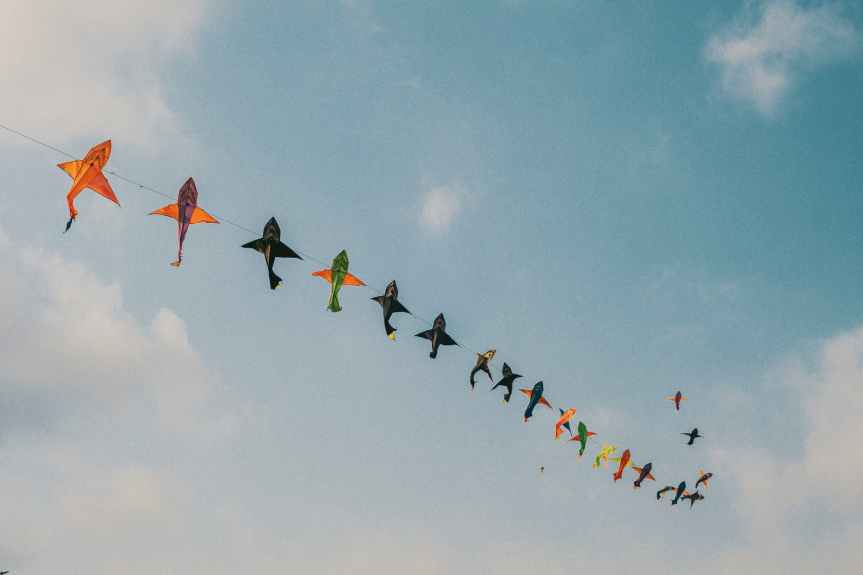
Makar Sankranti is a festival in the Hindu calendar dedicated to the Sun God- Surya. Makar Sankranti is one of the few ancient Indian festivals that has been observed according to solar cycles. Makar Sankranti is set by the solar cycle of the Hindu lunisolar calendar, and is observed on a day which usually falls on 14 January of the Gregorian calendar, but sometimes on 15 January. This festival signifies the arrival of longer days. As per a legend, Lord Surya forgave his son Shani and his son visited him on Sankranti. And that’s why people distribute everyone sweets and urge them to let go of any negative or angry feelings
Every twelve years, Hindus organize the kumbh mela on makar sankranti which is one of the world’s largest pilgrimages, with about 40 to 100 million people attending it(too crowded right? Do not get lost!). At this event, they pray to the sun god and bathe in the ganga river.
The festivities associated with Makar Sankranti are known by various names such as Magh Bihu in Assam, Maghi in Punjab, Haryana and Himachal Pradesh, popular amongst both the Hindus and Sikhs, Sukarat in central India, Pongal in Tamil Nadu, Uttarayan in Gujarat, Uttarakhand and Uttar Pradesh, Ghughuti in Uttarakhand, Makar Sankranti in Odisha, Karnataka, Maharashtra, Goa, West Bengal, Uttarakhand and Uttar Pradesh or as Sankranthi in Andhra Pradesh and Telangana.
Celebrations:
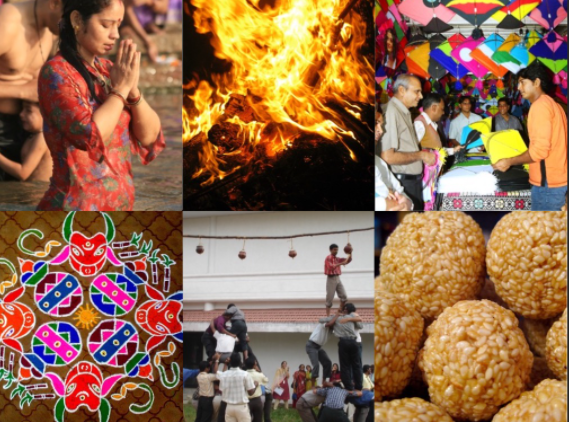
On makar sankranti people conduct various social festivities such as decorating houses, singing songs in rural areas, organizing fairs(melas), performing dances, kite flying(my favourite) and feasts. Children go house to house distributing sweets.
In Maharashtra on Makar Sankranti, people exchange multicoloured halwa (those yummy sugar granules coated in sugar syrup) and til-gul laddoos. Puran poli with pure ghee is also cooked . While exchanging til-gul as tokens of goodwill people greet each other. Married women invite friends and neighbours and celebrate Haldi-Kunku. Guests are given til-gul and some small gifts, as a part of the ritual. While distributing sweets, the famous line “til gul ghya aani god god bola” (which means eat sweet and speak sweet words) is used in Maharashtra.
My experience:
I remember dressing up in new clothes and then going to each and every house asking for sweets, receiving chocolates and laddoos. My friends and I would wish everyone with “tilgul ghya aani gol gol bola” and it worked, just for a few days, after which the same old bitter quarrels began. Anyways, flying kites was certainly the best part. You can cut others’ kites and avenge yourself(or just have some good fun). You can compete with your neighbours to see who can fly the kite better. However, be careful with those deadly strings. They are truly fatal if you mess with them. Once my friends and I competed to see who could get the most candies, and whoever won would get the candies collected by others. It definitely did not go that well for us except my clever friend who won(she was kind and did not take our candies so phew). Makar sankranti is all about fun!
I would love to know your experiences in the comments below!
https://en.wikipedia.org/wiki/Sankranthi
https://en.wikipedia.org/wiki/Makar_Sankranti

 Eduindex
You must be logged in to post a comment.