

The universe is a big place. We have been granted a family in this vast dark nothingness- our solar system. So, what is so cool about it? There are thousands of such systems, but how is ours special? It is special since we ‘live’ here. It is the only known place to have life so far.
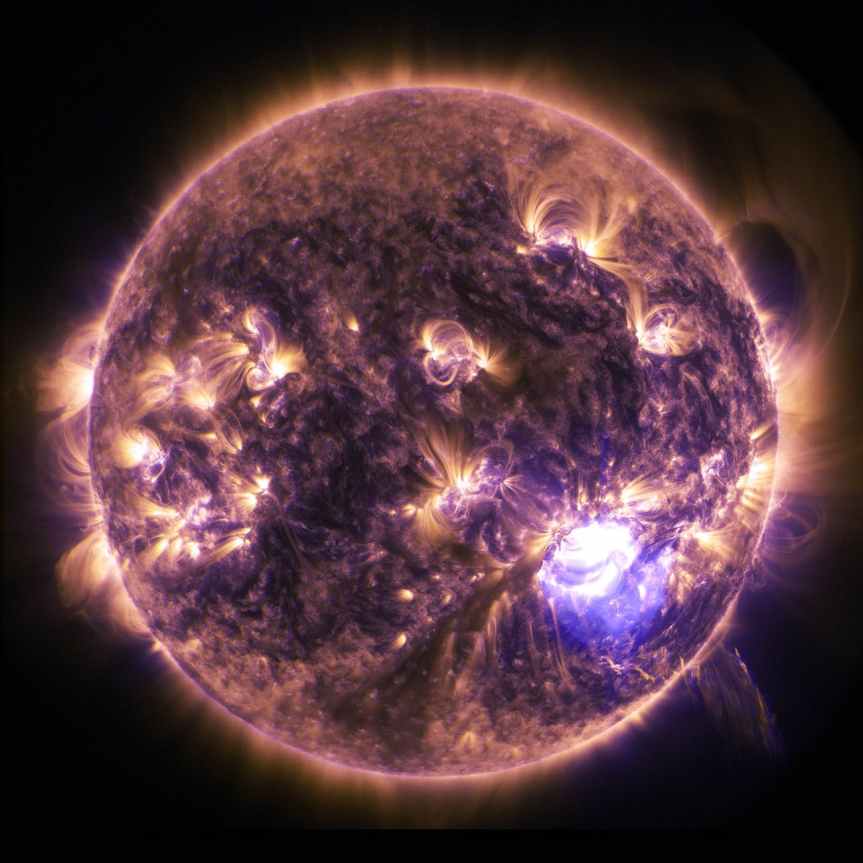
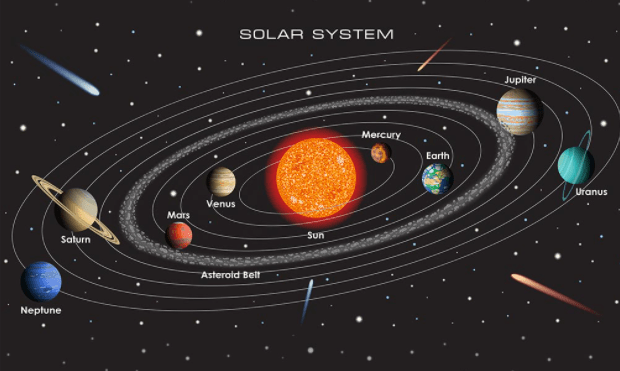
The solar system contains the sun, eight planets, many dwarf planets, comets, moons and asteroids. The Sun is our star. It is the source of energy and heat. It makes up 99.8 percent of the solar system’s entire mass, yet it is not that big of a star.
What is a planet?
The early sky gazers called planets as ‘planetes’ (wanderers). So, is a planet just a round object orbiting around the sun? Or perhaps is it an object having moons and a large size? The definition of planets is a little more complex than that. A planet is defined by the International Astronomical Union (IAU) as a celestial body that has its primary orbit around the Sun, has sufficient mass for its own gravity to mold it into a round shape, and has cleared the neighborhood around its orbit by sweeping up all the planetesimals, which means that it’s the only body of its size in its orbit (got me breathless there).This complex definition excludes comets, asteroids, and smaller worlds that aren’t rounded by their own gravity. The IAU also defined another class called dwarf planets. These are objects that meet the first two criteria for planets but have not yet cleared their orbits.
Inner solar system
The area surrounding the sun, and bounded by the asteroid belt is the inner solar system. Here lie the first four planets of the solar system- Mercury, Venus, Earth and Mars. These planets are also referred to as “terrestrial” planets from the word ‘terra’ which is Latin for ‘earth’. It indicates that these planets have a similar rocky composition to Earth.
Asteroid belt
It is a collection of rocky objects (asteroids) of various sizes orbiting the Sun, located roughly between the orbits of the planets Jupiter and Mars.
Outer solar system
It lies beyond the asteroid belt. It consists of the gas giants- Jupiter, Saturn, Uranus and Neptune. These planets consist mostly of small rocky cores buried deep within massive spheres of liquid metallic hydrogen and some helium, covered by cloudy atmospheres. Neptune and Uranus are sometimes called as ‘ice giants’ as they contain significant amounts of super cold oxygen, carbon, nitrogen, sulphur and possibly some water. Each gas giant has a set of rings. Saturn’s is the most extensive and beautiful.
Kuiper belt
It extends from the orbit of Neptune out to a distance of well beyond 50AU from the sun. Think of it as a very distant and much more extensive version of the asteroid belt. It contains the dwarf planets- Pluto, Haumea, Makemake and Eris – as well as many other smaller icy worlds.
Oort cloud
The entire solar system is surrounded by a shell of frozen bits of ice and rock called the Oort cloud. It stretches out to about a quarter of the way to the nearest star.
The solar system is about 4.6 billion years old and will continue to remain for another 1 or 2 billion years. Till then, this is our family, a huge one but is a family after all.
https://solarsystem.nasa.gov/
http://en.wikipedia.org/wiki/Solar_System

 Eduindex
You must be logged in to post a comment.