

Sita Devi, Malala Yousafzai, Arunachalam Muruganantham, Justin Trudeau, Jim Parsons – they have one thing in common – Feminism.
Equality is like gravity. We need it to stand on this earth as men and women, and the misogyny that is in every culture is not a true part of the human condition.
Joss Whedon
A whole lot of us choose not to be called feminists due to the envelope of wrong teachings of ancient patriarchy. Despite standing for nothing but inclusivity and equality, it is seen as a gimmick to assert the dominance of women over men, something that it is just “anti-men.” This is the root cause of the negative connotations attached to feminism. Years of wrong, limited portrayals in the media have stereotyped a feminist as the one uncouth woman who drinks, smokes carelessly, abuses shamelessly, does not understand the need to get married, hates pink, and loathes men. That is definitely not what feminism specifically stands for.

The #MeToo movement has made a ton of heads turn and as it forged ahead, feminism reached the level of cultural relevance that it hadn’t been subjected to in years. Now, a major item of cultural discourse, it has definitely led to the ‘clear as mud’ conversations as quite a lot of the population was unaware of the basic terminology of feminism.
One can’t give a single definition to the word ‘feminism’, but in short, it signifies putting a full stop to gender discrimination and focusing on gender equality. There’ve been different types of feminism that’ve come into the picture. Instead of describing them separately, feminism was divided into different phases based on the timeline called the “waves of feminism.” You might think that this history is a straightforward arc. The reality is that there are many sub-movements building on (and standing against ) each other. That being said, the wave metaphor serves as a good starting point. It doesn’t tell the whole story, but it helps outline it.
The First-wave feminism of the early 1900s had a fairly simple goal: have society recognize that women are humans too, not property. However, it only focused on the privileges and freedom of white women primarily.
The Second-wave feminism of the 1960s, built on first-wave feminism challenged women’s roles in the society. Traditional gender and family roles were questioned and the theory of Queer population was more in discussion. Women were now given access to male-dominated spaces, promoting equality. The system was questioned of being inherently patriarchal and that only an overhaul could liberate women.
While first and second-wave feminism had largely neglected racial disparities within gender, the Third wave brought attention to it. The term ‘intersectionalism’ was brought into the picture – how different kinds of oppression – like those based on gender and race – intersect with each other.
Social media has lobbed the movement into the technological age. The fourth wave emphasizes on inclusivity and trans rights are a big part of the conversation, too.
Half-knowledged people say that the misogyny faced by women today is idealized by Sita who faced similar things in her life too. The despotism tolerated by Sita has set a baseline for torment in our culture for the women to follow today. However, this is untrue. The truth had just lost its translation. She had her own fight against the patriarchal world but she rose above her status to show free will and courage to stand up against injustice. In the end, she stopped looking for any saviour and reclaimed her honour and defied what she thought was wrong.
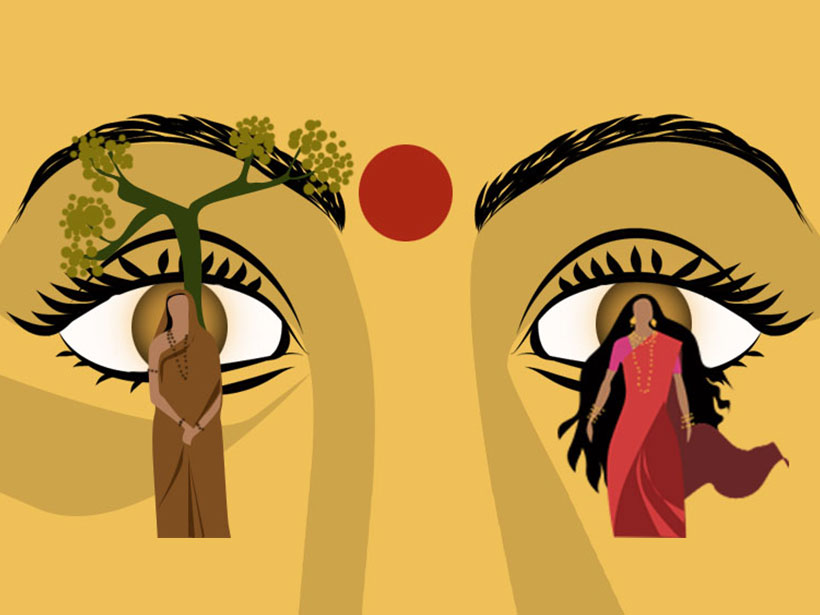
Feminism does not associate itself only with equality of women. It addresses the issues of caste, race, disabilities, and more. By the same token, it works to liberate men from the toxicity of society. It serves as a means to uplift marginalized people who were denied equality historically. Hence, trying to shun it by using the concept of ‘equalism’ would be like overlooking the centuries of trauma and injustice. Its aim now is fighting kyriarchy ( a social system or set of connecting social systems built around domination, oppression, and submission) as well.
It’s the perception of feminism that needs a change. The only bad guy here is the structural oppression which affects every person – man or woman, in some way. A man tied in the shackles of patriarchy needs a voice too and that’s the perk of feminism. It is time to stop looking at it in the wrong light as it would only drive you away from the reality of intersectional problems.

 Eduindex