Video Games an entertainer or life waster

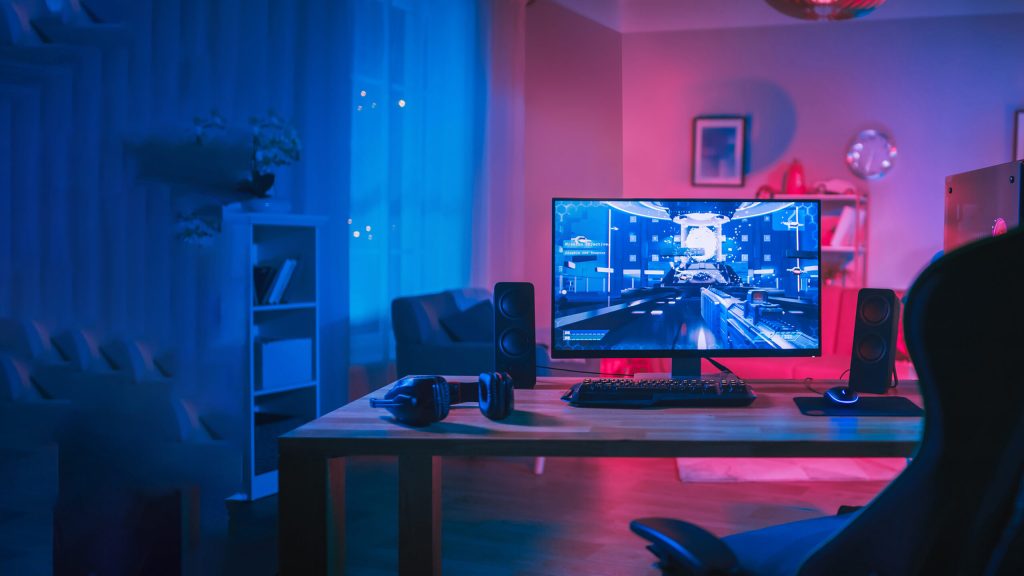
Powerful Personal Computer Gamer Rig with First-Person Shooter Game on Screen. Monitor Stands on the Table at Home. Cozy Room with Modern Design is Lit with Pink Neon Light.

Games consist of three types I would say : Indoor games, Outdoor games and the third one which is Virtual games. The outdoor one is my favourite which consists of physical movements. These games consist of Cricket, Football, Badminton, Volleyball and various games. In these games one has to do movements like running, jumping etc. These games make one healthy and helps to keep the body fit and fine. Indoor games consist of chess, carrom, darts, board games which makes the mind relax and refresh from daily hectic routine. These are the games played with family ones. Virtual games consist of playing games on mobile devices, pc’s, laptop, virtual box, play stations and emulators. These are the latest games and devices which are invented. As day by day technology is developing these games are also being developed. First computer games were introduced then slowly slowly mobile games, play stations, virtual box etc.

As early as 1950, computer scientists were using electronic machines to construct relatively simple game systems, such as Bertie the Brain in 1950 to play tic tac toe, or Nimrod in 1951 for playing Nim. These systems used either electronic light displays and mainly as demonstration systems at large exhibitions to showcase the power of computers at the time. Spacewar! is considered one of the first recognized video games. Developed in 1961 for the PDP-1 mainframe computer at Massachusetts Institute of Technology (MIT) by a group of students there, it allowed two players to simulate a space combat fight on the PDP-1’s relatively simplistic monitor. The game’s source code was shared with other institutions with a PDP-1 across the country as the MIT students themselves moved about, allowing the game to gain popularity.

Video game replacing Outdoor games

Earlier years children playing outdoors were in large numbers. They all were in fit and fine conditions. As the years passed children gradually got addicted to video games rather than outdoor games. They find playing these games sitting in one place for hours interesting. Back in the year parents used to scold children to play less outdoors and stay indoors but as the time changed the words were also changed now parents scold children to go and play outside. I admit the fact that playing video games is also entertaining but still a certain amount of limit. These all limits are crossed now by these younger generations. No doubt this generation of children are smarter than older ones in technology, but they are not strong enough to face the real world physically. For them doing online work is easy but not physical work like helping their mother by doing daily chores. 

Problems of video games

As said earlier everything changes as the technology is advanced. Children nowadays may face many health and mental related problems due to video games. To play video one has to look at the screen continuously which might damage their eyes. Nowadays there are headphones available which are also gaming accessories. Children put on headphones and play games at full volume which may cause eardrum damage and can cause to deaf.

Once the game is started it is hard to make yourself away from it so one sits for longer hours a day in one position which might damage the spinal cord and body starts aching. The headache is also one of the problems caused by continuous staring at the screen of devices.

One of the popular types of video games is action games that consist of shooting and fighting. These games are popular from small children to teenagers. Continuous playing of these action games affects  mentally. The mindset of children has changed from calm to violence. They don’t even listen to their parents and will talk to them rudely. This is the situation in today’s generation.

Online gaming

Playing online is one of today’s trends. Many people play online games with friends and relatives. Children of smaller ages are too addicted to these games. These online games have business strategies to make money. They would firstly make you play the game for free but they will show new features or guns or characters which are paid which make the children think about buying it. This addiction of playing paid games is so strong that the children are ready to fight their parents if they won’t allow them to buy it.  One of the recent case studies is that the gaming addict boy from Punjab who secretly spent Rs 16 lakh of his parents’ money on the battle royale mobile game PlayerUnknown’s Battleground or PUBG is being made to work at a scooter repair shop.While gamers have been known to go to great lengths to prove their love for PUBG, the teen gaming addict from Punjab’s Kharar took the craze for the mobile game to another level after he spent Rs 16 lakhs from his father’s account to buy virtual ammunition in the game. The 17-year-old would take his father’s mobile phone on the pretext of online classes, but would access his father’s bank accounts to make in-app purchases for him and his friends.

At last I would say that “everything has its own limit so please do everything in limit and not to do anything wrong that would hurt others”. 

Is Telemedicine The Future Of Health Care ?

The novel corona virus pandemic has stretched health care system to the brink. Covid 19 might getting all the headlines but patient are getting sick from other health disease and that’s left doctors looking for other way to treat them while minimizing contact.

Telemedicine allows health care professionals to evaluate, diagnose and treat patients at a distance using telecommunications technology. Telemedicine is the use of electronic communications and software to monitor and treat patient in lieu of any in patient visit.

According to IBIS world, the industry revenue has grown 34.7% from 2014 to 2021. Despite the increase in revenue. Americans have been slow to adopt the practice according to 2017 report. Like all of American life, that changed with novel corona virus. The number of medicare patient using telehealth has increased.

Shares of zoom video communication are up more than 150% since the start of 2020.

Telehealth visits are booming as doctors and patient embrace distancing amid coronavirus crisis. Telemedicine is the primary means of care during the corona virus pandemic.

Benefits.

1. It allows a patient to schedule visits at their convenience.

2. The benefits of telemedicine are easy to see. Physicians can now reach patients who are halfway across the city or state. All you need is a strong internet signal and a smartphone, tablet or computer to connect with a medical professional.

3. You can wrap up a visit in 15 or 20 minutes, which is convenient for many patients. Often, you’ll spend the same amount of time driving to and from an in-person visit.

4. There is also a decrease in wait times.

Challenges.

1. The main limitation is the lack of a physical exam. Inability to do a surgical procedure.

2. A lot of time goes into adjusting to the technology and understanding how it works and most importantly managing the wifi network at times.

3. The biggest challenge is to convince the patient that the quality of care via this consult is no less than being done in person.

Telemedicine will be the permanent new normal. It has been obvious for years. It will continue to move healthcare delivery from the hospital or clinic into the home. A fair amount of consultations, approximately 80%, can be done through telemedicine. Today, there are plenty of instruments that allow a person to do an ultrasound and allow people to check their kidney, abdominal cavity or even the heart echo without physically being at the hospital. 

Types of inventory

Raw materials are inventory items that are used in the manufacturer’s conversion process to produce components, subassemblies, or finished products. These inventory items may be commodities or extracted materials that the firm or its subsidiary has produced or extracted.

Work-in-process (WIP) is made up of all the materials, parts (components), assemblies, and subassemblies that are being processed or are waiting to be processed within the system.

A finished good is a completed part that is ready for a customer order. Therefore, finished goods inventory is the stock of completed products. These goods have been inspected and have passed final inspection requirements so that they can be transferred out of work-in-process and into finished goods inventory.

Transit inventories result from the need to transport items or material from one location to another, and from the fact that there is some transportation time involved in getting from one location to another. Sometimes this is referred to as pipeline inventory.

 Buffer inventory used to protect against the uncertainties of supply and demand, as well as unpredictable events such as poor delivery reliability or poor quality of a supplier’s products. These inventory cushions are often referred to as safety stock. Safety stock or buffer inventory is any amount held on hand that is over and above that currently needed to meet demand.

Anticipation inventory is when , firms will purchase and hold inventory that is in excess of their current need in anticipation of a possible future event. Such events may include a price increase, a seasonal increase in demand, or even an impending labor strike.

Our first prime minister

Pandit Jawaharlal Nehru was the first Prime Minister of India. He was quite popular among children and they called him Chacha Nehru. He was born on 14th November 1889 in Allahabad. He was the son of Swarup Ran (mother), and Motilal Nehru (father). Both his parents were attached and involved with freedom movements. He studied theosophy in his childhood and got into the Theosophical Society at age thirteen. Nehru’s theosophical interests led him to the study of the Buddhist and Hindu scriptures which later culminated in his book “ The Discovery of India”. 1912, Nehru enrolled himself as an advocate of the Allahabad High Court and tried to settle down as a barrister but he was not interested in law.
In 1912, Nehru attended an annual session of the Indian National Congress in Patna and joined Indian politics. He took an active part in movements like Home Rule Movement, Non-Cooperation Movement, and many more. In 1919, while he was traveling, he heard General Dyer talking about the Jallianwala Bagh Massacre. Dyer mentioned how satisfied he was after that incident. That’s when Nehru decided to get freedom from the Britishers.
He was sent to jail almost 9 times and there he wrote many books like his autobiography, “Towards Freedom”, “Letters from a father to his daughter”, “ Discovery of India”, “Glimpses of World History” and more. He was the right hand of Mahatma Gandhi in Indian Independence. They were an active part of the Civil Disobedience Movement, Salt Satyagraha, Quit India Movement. Nehru became the first Prime Minister of Independent India. Later he worked with Sardar Patel to unify India. In 1950 India became Republic. In 1955, he received the Bharat Ratna for his efforts on Indian industrialization. His attire- the jacket with a rose in the pocket and a Nehru cap is his style statement.

All about Rabindranath Tagore

Rabindranath Tagore is India’s first noble laureate who has bestowed all the fellow Indians and the people in the world, the art of literature. “Jana Gana Mana” the song written by Tagore is the national song of our country. He was a poet, writer, composer, philosopher, and painter. He was born on 7th May 1861 in Calcutta. His father was Debendranath Tagore and his mother Sharada Debi. Tagore was quite keen on music and literature from an early age. He never attended any physical school as his father believed in the theory of “Free flow of education”.

At the age of 11, Tagore started living in Shantiniketan with his father where he started his journey of writing. In 1873, he wrote six poems on Sikhism and completed several written works by 1877. In 1878 he was sent to England to study law but he preferred reading Shakespearean plays and dramas. He was quite intrigued by art and literature. From 1880, he started writing dramas, short stories, novels, poetry, and songs. Gurudev was also an acclaimed musician since his childhood. He composed so many beautiful songs that he has his separate genre, “Rabindrasangeet”. In 1910, he wrote “Gitanjali” for which he received the Noble Prize in literature in 1913. Tagore was the first Indian to receive a noble prize.

Despite the fact that Tagore was a patriot, he actually enjoyed and was inspired by the style of education that the Britishers provided. Therefore with the noble prize money, he built up the famous “Visva Bharati University” in Shantiniketan where he focused more on practical and artistic education. In 1915, Mahatma Gandhi met him in Shantiniketan. Gandhiji gave Tagore the title of “Gurudev”. During the Independence movement, Tagore used his tool, his pen, and wrote several patriotic poems for his fellow Indians. Not only did he write the national anthem of India but also of Bangladesh and Sri Lanka. Gurudev Rabindranath Tagore devoted all his life to the upliftment of education.

Lady warrior

Rani Laxmi Bai was named Manikarnika Tambe and was nicknamed as Manu.She is also known as Jhansi Ki Rani, the queen who was fought against the British without any fear. She was born on 19th November 1828, in the town of Varanasi. Her father was Moropant Tambe and her mother Bhagirathi Sapre. Her father was the commander to the King of Peshwa, Bajirao of Bitoor district. The Peshwa called her “Chhabili” for her playful nature. She was educated at home and learned sports with her friends Nana Sahib and Tatya Tope like martial arts, horse riding, sword fighting, and more. She always preferred traveling on the horseback to using a palanquin. Her horses included Sarangi, Pavan, and Baadal.

She was married to the King of Jhansi and that’s when she became Rani Laxmi Bai from Manikarnika. Later she adopted a boy and named him Damodar Rao. After the death of the King, the British Raj officers applied the Doctrine of Lapse, a policy according to which if any Indian ruler dies without leaving a natural male heir, his kingdom would automatically pass over to the British. As a result, the Britishers wanted to claim Jhansi to which Rani Laxmi Bai cried out “Main apni Jhansi Nahi doongi”. That is when the fight against the Britishers started. She would tie her kid around her chest and fight on horseback.

There are novels, articles, and movies made in honor of her bravery. Even Netaji named the women regiment of the Indian army as Rani Jhansi regiment. The famous statue of Rani Laxmi Bai. She is an inspiration for all her countrymen.

Swami Vivekananda

Swami Vivekananda was born on 12th January 1863 in Calcutta. His father, Vishwanath Datta was a barrister and a novelist and his mother were Bhubaneswari Devi. Swami Ji’s birth name was Narendranath Datta. He was a very sharp student since his childhood. He was the only student to receive a first-division in the entrance examination of Presidency College. Apart from his subjects, he loved reading a wide range of subjects like philosophy, religion, history, social science, ancient scriptures like the Vedas, the Upanishads, the Bhagavad Gita, the Ramayana, the Mahabharata, and the Puranas. Narendra also studied Western philosophies which he then translated into the Bengali language. Swami Vivekananda was known for his sharp memory and ability at speed reading.
In 1880, he came in contact with the Brahmo Samaj and that was the start and breakthrough of his spiritual journey. He met Ramkrishna, his Guru, in 1881 in Dakhineswar. Swamiji was highly influenced by the thoughts of his Guru. In 1886 Swamiji took monistic vows and that is when he became Swami Vivekananda from Narendranath Dutta. In 1888, he left to travel the whole country with only two books in his hand: the Bhagavad Gita and The Imitation of Christ. He decided to preach and uplift his country and the fellow countrymen. In 1893, after visiting Japan & China, he went to America where he participated in the Parliament of religions. In the Parliament of religion, he opened his speech with,” Sisters and Brothers of America” after which he received heavy applause and a standing ovation. The western media named him, “The Cyclonic monk from India”. His teachings focused on human development and he believed in compassion, morality, and spirituality.

GREEN MATERIALS USED IN Construction

Traditionally we are used to using adobe, concrete, and wood in construction, which has been and are used in everyday construction, which means the continuous destruction of trees for wood and the extraction of resources to make cement for agglutinated sand. Gravel and bricks For a better world, there are new processes and alternatives for sustainable and green building materials that can be used in construction today. Some of the green and innovative construction matter are listed below.

Bamboo

Bamboo is taken into consideration as one of the high-quality green constructing materials. It has a very excessive self-era rate, with a few being stated to have grown up to 3 toes inside 24 hours. It maintains spreading and developing while not having to be replanted after harvest. Bamboo is a perennial grass and now no longer wooden and grows on each continent, besides Europe and Antarctica. It additionally has an excessive energy-to-weight ratio, even more, complete energy than concrete and brick, and lasts extraordinarily long. It is, therefore, a high-quality preference for floors and cabinetry. Unfortunately, bamboo calls for a remedy to withstand bugs and rot. If left untreated, bamboo consists of starch that substantially invitations bugs, and it may swell and crack after soaking up water.

Cork

Like bamboo, cork grows very quickly. It can also be harvested from a living tree that continues to grow and reproduce more cork, or tree bark. Cork is resilient, flexible, and takes on its original shape again even after sustained pressure, its elasticity and abrasion resistance make it a common element in flooring. In addition, it is excellent at absorbing noise, which makes it perfect for insulation panels, and its excellent shock-absorbing properties make it perfect as a base. Thermal insulation is fire resistant, especially if left untreated and does not release toxic gases when burned. Cork is almost waterproof, does not absorb water, and does not rot. a bit expensive Fortunately, it’s extremely light and only requires less energy and emissions to ship.

Straw Bales

It is another environmentally friendly building material that can be used as a construction material, has good insulation properties, and can act as a soundproofing material, it can also be used as a filler material between columns and in the frame of beams / since it cannot penetrate air, it can have some properties of fire resistance exhibit. Straw can be easily harvested and replanted with minimal environmental impact. Bale straw also has very little influence. They can also be placed on walls, attics, and ceilings to keep the house cool in summer and warmer in winter.

Sheep’s Wool

Sheep wool is an excellent alternative to chemically charged insulation. It insulates the house just like conventional insulation materials and requires less energy to manufacture. It doesn’t degrade as quickly as other insulation materials like straw, and compared to some natural insulation materials like cotton, sheep’s wool is more common, easier to harvest, and regenerates quickly. Unfortunately, it’s not the cheapest insulator. It also needs treatment to protect itself from insects and prevent fungal growth. Depending on the chemicals used, such treatment could make sheep’s wool less environmentally friendly.

Mycelium

It is a natural building material. Mycelium is a natural unicellular organism that comprises the root structure of mushrooms and fungi. It can be stimulated to create a composite of other natural materials, such as It is then air-dried to create light and strong bricks or other shapes. Combined with pasteurized sawdust, the mycelium can be made into almost any shape and used as a surprisingly strong building material. There is the option of building bricks and segments of unique shapes that are strong and light.

Life Is A Series Of Games: Only Play To Win

PLAY TO WIN

Life is a series of games. Sometimes you lose, sometimes you win. We all know this. And yet, we often keep on playing games we lose. Why not play to win? Don’t you enjoy winning? I do. You know what I don’t like? Losing. 

I don’t mind losing a few games, but overall, I want to win. And I don’t think you’re any different. I’ve never met a person who said, “I LOVE to lose.”

That person doesn’t exist. People who pretend they don’t mind losing gave up on life years ago. I get it. Life is hard and when you lose a lot, you become numb. That’s why this concept is so important.

Losing Hurts

Look, you can be the most optimistic and thick-skinned person in the world, but if you always lose, you’ll go crazy. You can read as many self-help books as you want, and master any kind of subtle art you want, but if you lose, all that shit goes out the window.

I don’t understand why people are never honest about losing. It hurts. And this is coming from a person who’s not even that competitive.

I always played sports as a kid. And even though I was pissed off when I lost, I could let it go. I had friends who were so competitive that they couldn’t stop before they won something.

Didn’t matter what it was: 1 on 1 basketball, video games, table tennis, foosball, whatever. 

It’s not in our nature to be happy when we lose. You know how most people solve this problem? They give up!

That’s the saddest thing I’m currently seeing. And I see this a lot. Every time talented people give up their career and become minimalist yoga practitioners who live off the land, I see someone who stopped playing.

Of course, this is not the case for everyone. But let’s be real. I’ve been there before. When I started my business in 2010, I hit a wall after three years. I stopped playing the entrepreneurship game and decided to climb the corporate ladder.

When I worked at a corporation, I realized that it was not a game I was good at. I stopped climbing the corporate ladder.

Find A Different Game

To be honest, if you’re not good at a particular game, it’s better to stop. Go and find a different game you can win at. But don’t give up and live in the woods.

Jerry Seinfeld explained this concept best in an episode of Comedians In Cars Getting Coffee. In the episode with Eddie Murphy, they talked about why companies that are in second place should just quit. Jerry said:

“All these companies that are in second place that hang in there. Why don’t you just quit? Avis, Colgate, RC Cola, just quit. How sad is it to work at these places? You’re never going to catch them [the company]. Pepsi… You’re never gonna catch them.”

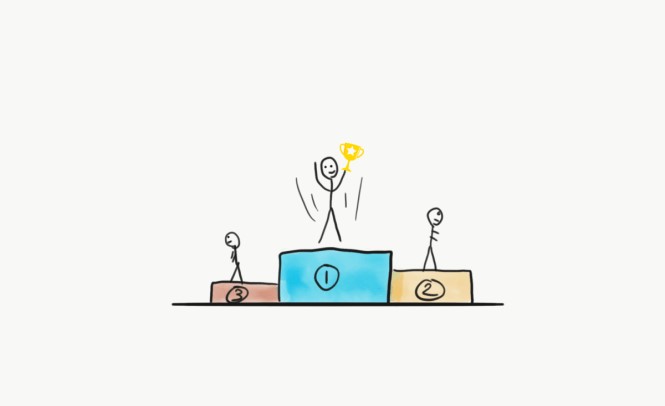
Obviously, Jerry is joking here. But there’s a lot of wisdom there. If you can’t be number one, why play? If you can’t win, it’s just a hobby (nothing wrong with hobbies, though). Quit that game and start playing a game you can win. 

Let me give you a recent example. A lot of people told me I should make YouTube videos. I’ve been teaching productivity and writing for several years. And I also have a podcast. 

It didn’t sound like a bad idea to me. So I got into the YouTube game. I’ve published 38 videos on my channel and tried many different strategies to reach more people. My conclusion? I wasn’t even close to the top perfomers on YouTube in my field. So I quit.

Same thing is true for my podcast. The difference is that my podcast takes less time and is more fun to create. But still, I never came close to the top podcasts in my category. That’s why I allocate less time and resources to it.

Win More Than You Lose

When it comes to content creation and monetization, my main focus is on blogging, teaching, and publishing books. I’m good at those things and the results are much better—and so are the rewards.

For example, my book Think Straight has been consistently sitting at the top of its category. And even though I might not be in certain categories, I’m very close.

That’s the key. Seinfeld was joking when he said that Pepsi should quit. I think he’s more referring to the players that are not even at the top. In this case, Pepsi is pretty close to Coca-Cola. Will they ever catch them? We don’t know but they are up there.

Can you see the top of your field? Can you finish in the top 10? If so, you have a chance to win. And sometimes, you don’t even have to be . If you’re at the top, you will still reap the benefits, just like Avis, Pepsi, etc.

But if you can’t be at the top, I would find a different game. In This Is Marketing, Seth Godin wrote about how we only see the winners in any given field:

“We hear about the outliers, the kids who make millions of dollars a year with their YouTube channel or the fashionista with millions of followers. But becoming an outlier isn’t a strategy. It’s a wish.”

We don’t see all the people who lost. The winners are highly visible—especially in desirable fields. Those folks are the famous outliers. But that doesn’t mean you can’t win at other games.

It’s pretty harsh. And a lot of people don’t agree with this theory (I already received a bunch of emails from angry people). But that’s not a surprise. Just look at how many people work at places that don’t even compete.

Pick Your Games Wisely

There are a lot of games that I lost—which is never a good feeling. When I realized I didn’t even come close to success on YouTube, I had to pull the plug. It simply wasn’t yielding any significant results.

Another example is individual stock picking. That’s really not my game. So I stopped doing that. Instead, I invest in index funds and real estate.

Sometimes, you don’t need to go on forever to draw conclusions. “But what about persistence?” Well, you can’t be persistent with everything. I’d rather be persistent with one or two games that I’m good at. You only have so much energy every day. Can you do it all? 

I don’t know about you, but I certainly can’t. This concept is not for everyone. There will always be delusional people who say, “Look at how often Thomas Edison failed!” Sure, but he played the invention game and was winning overall.

There’s nothing wrong with quitting so you can win at something else. Just don’t settle for average. Again, Seth Godin has excellent thoughts on this:

“Quit or be exceptional. Average is for losers.”

And you know what? Maybe it’s not the right time to win. Maybe you’ll lose at something and come back at a later stage. So when you quit a game, it’s not forever. Sometimes you have to quit to get better so you can win later.

Either way, when I focus on too many things at the same time, I start dropping the ball more often. I make mistakes, I forget things, I slack off. You can’t have that if you want to win.

Winning ain’t easy. And there’s little room at the top. But that doesn’t mean you can’t be at the top of your game. You just have to pick a game you can win at.

4 Quick learning tips for students!

Hey! Today we will talk about how can we sharpen our memory. Here are some tips and tricks that will help you learn quickly anything!!

  1. Choose a quite place for study

we all know that a little bit of noise can disturb us. So you have to make sure that you are in a good quite place, Where no one can disturb you.

2. Note down all the important information

it’s proved that if you note down important notes, you can remember better! So , try this!

3. Read, close your eyes and recite it

For quick learning, you should try this trick! Just read your lines , close your eyes and recite it.

4. Again read and recite loudly

Now that’s your turn to recite everything loudly. It can help you memorize more better.

5. A cup of tea or coffee for freshness

One thing! It isn’t important to take tea or coffee every hour! So just relax your mind and if you feel tired and want some freshness, go ahead with your favourite drink!

Isn’t it a good idea for a break with a cup of tea or coffee! Again and again memorization can decrease our strength of memorizing anything.

So it’s a great way to have some break between every hour.

I hope all these tricks will work for you! So try all these tips from today and let me know, whether it worked for you or not!

All the best!!!

Helath care availability issues

The robust transformation of India’s Public Healthcare System witnessed in the past few decades has not only been progressive but also an example for the developing economies of the world. The healthcare system in India can be divided into two parts viz urban and rural areas and both have a significant differential gap in terms of treatment, not because of uncommon diseases but due to lack of adequate infrastructure and health experts, besides several other challenges in the system. However, the objective in this article is to bring out the challenges which the public and private healthcare systems are currently confronting with.

Fund Allocation & Inadequate Infra

The gap in fund management by the administrations should be understood and be balanced. Not enough funds are allocated for public healthcare in India and the inequality in urban and rural facilities is well known. Due to the lack of modern quality healthcare in the public sector, generally, people prefer private healthcare which is not affordable for most of the rural population due to lower-income and lack of basic insurance policy. Private healthcare in India is a premium and expensive affair for a large section of society. Notably expensive medical device is procured but basic infra is missing in public healthcare system.

A warrior story

Bhagat Singh was born in September 1907 in Banga (earlier was in Punjab, now in Pakistan). His father was Kisan Singh and his mother Vidyavati Kaur. He belonged to a family of radical freedom fighters, all the men in his family believed that they have to follow extreme measures to snatch the freedom of the country, thus making him a hugely patriotic person. Bhagat Singh was highly influenced by his family since childhood and thus grew into a patriotic individual.
In 1919 Jallianwala Bagh Massacre left an everlasting impression on Bhagat Singh who witnessed the destruction and loss of lives after General Dayar opened fire on the people who had gathered there. Bhagat Singh then decided to dedicate his entire life to fight for the freedom of India. With every attack by the British, Bhagat Singh’s dedication grew stronger. In 1923 he joined the National College of Lahore. When Bhagat Singh was in college he came to know about Young Italy Movement in Italy and created a group named, “Naujawan Bharat Sabha” in 1926. Later he also joined Hindustan Republican Association and fought side by side with several other famous freedom fighters to spread the fire of freedom throughout India. In a very small time, he became a household name.
In 1928, Lala Rajput Rai was leading a protest but sadly, he passed away in the massacre of lathi charge ordered by the Britishers. To avenge Lala Lajpat Rai’s passing away in a lathi charge, he, along with Sukhdev, Rajguru, and Chandrasekhar, carried out an attack leading to the killing of a British officer. After new runs and misses, they were arrested and execution was ordered for them. He went in disguise and changed his complete look to hide from the British officials. In 1929 he along with his partner, organized a bomb blast in the Assembly chamber after Ram Prasad Bismil died while fighting for the nation. Bhagat Singh screamed “Inquilab Zindabad” after the blast. He along with Sukhdev and Rajguru very proudly embraced the end of their life for the sake of the motherland and left a legacy to every Indian to take the cause of freedom forward and attain it at all cost.

Nightingale of India

Sarojini Naidu is the daughter of a scientist, Aghorenath Chattopadhyay, and Barada Sundari Devi, a poetess. Sarojini Naidu is the most prominent woman face of Indian independence. She was a poet, social reformer, and political leader. She was born on 13th February 1897, in Hyderabad. She wrote a Persian play in her childhood, “Maher Muneer” and received a scholarship to study abroad. She wrote several poems and books like “The Golden Threshold” in 1905, “The Bird of Time” in 1912, “The Broken Wing” in 1917, and many more. She was named “ Bhaarat Kokela” or “ The Nightingale of India”.
In 1905 she met Mahatma Gandhi, Gopal Krishna Gokhle, and Rabindranath Tagore and became a part of the Indian National Movement. She preached about women empowerment and social reformation. In 1917 she established the Women’s India Association and became the 1st Indian women President of the Indian National Congress in 1925. She took part in Satyagraha, Quit India Movement, Non-Cooperation Movement, and others. In 1947 she became the first women Governor of the United Province. Sarojini Naidu is a well known and respected role model throughout the world. In 1990 an asteroid was dedicated after her name, asteroid 5647 Sarojini Naidu.

Netaji Subhash Chandra Bose

Netaji Subhash Chandra Bose a true patriotic personality who fought for his motherland during the time of Independence. He was born on 23rd January 1897, in Odisha. His father was Jankinath Bose and his mother was Prabhabati. He belonged to an affluent family and his parents were quite inspired by English education.
During school times, Bose was very inspired by the teachings of Swami Vivekananda and Ramkrishna. His feeling of true patriotism came into action after an incident in his college where a British professor misbehaved with an Indian student and stated anti-India comments. When Bose stood up and raised his voice against this situation, he was expelled from the college. He disliked the way the Britishers treated Indians. That is when he decided to fight for the Independence of India. He went to London to study for Indian Civil Services. In 1920 he realized that even after ICS, he would be working beneath British officials so he resigned and came back to India. 1n 1921, he joined the Swaraj party and started several protests. He even went to jail several times but never backed off. He became the General Secretary of the Indian National Congress in 1927. In 1928, he presented himself as a “General Officer Commanding Congress Volunteer Corps” in the annual meeting of the Indian National Congress.
He supported Mahatma Gandhi and was inspired by him but did not support the philosophy of “Non-Violence”. He believed that freedom is not given and people need to fight for it. He even organized a mass civil disobedience protest. In 1941 he ghosted from India in the disguise of a Pathan. He went to Germany and trained more than 3000 Indian prisoners for war after which people started calling him “Netaji” out of respect. He flew to Japan after that and formed Azad Hind Fauj. He even formed an all-women regiment in the Indian National Army, which was called as “Rani Jhansi Regiment”. Netaji’s famous slogan was “Tum Mujhe Khoon Do, main Tumhe Aazadi Dunga”. Slowly with the support of several other countries, Azad Hind Fauj started to fight the British army making them weak. It is said that after these fights and attacks the Britishers started to plan the freedom of India. Netaji is just not a name but an institution.
“Give Me Blood And I Will Give You Freedom”
– Netaji Subhas Chandra Bose

Man behind Constitution

Dr. B.R. Ambedkar, the father of the Indian Constitution. Dr. Bhim Rao Ambedkar was born on 14th April 1891 in Mhow, Madhya Pradesh. The place is now known as Ambedkar Nagar. He was the son of Ramji Maloji Sakpal, who held the rank of a Subedar in the British Army. Back in those days, people were judged and treated based on their caste. Since Dr. Ambedkar came from a backward caste, he had to face a lot of discrimination in his life. He was even stopped from studying but one of the teachers in his school encouraged him to continue his studies and even gave him his surname.

He completed his higher education in 2-4 years and studied for 21 hours a day. He is the only person from India who received the title of Dr. of All Science from London University. Not only did he continue studying law once he came back to India but he also got associated with many social causes like women empowerment and caste upliftment. People used to call him “Baba Sahib” out of sheer respect. In 1936 he created his political party and started preparing for elections.
Dr. B.R. Ambedkar was the first Indian to complete his Ph.D. in Economics from abroad. He knew 64 subjects and 9 languages. He was the first Indian law minister and was also responsible for forming the Constitution of free India. He received a Bharat Ratan Award in 1990 for all his hard work and achievements. Not only this, there are a lot of universities and colleges named after him. The Statue of Equality is a monument under-construction in Mumbai dedicated to Dr. Ambedkar, the father of the Indian Constitution.