

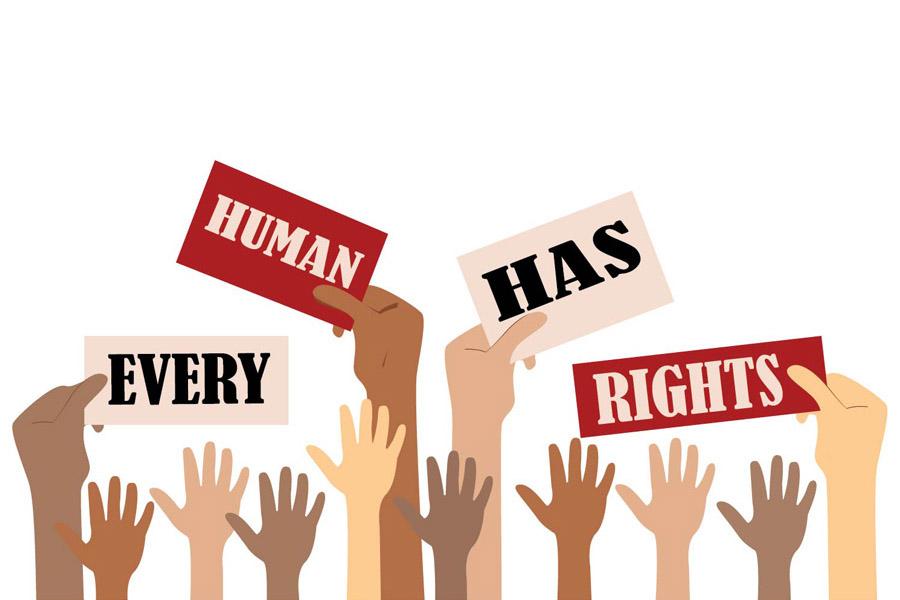
What are Human Rights?
The society operates on some moral principles and norms, which regulate human behavior. Human rights validate these principles and norms and protect the rights of humans internationally.
Human rights follow the concept of ‘natural right’. These rights are inherited by birth just because he or she is a human being. Every human being is entitled to these rights irrespective of their place of birth, religion, age, or any other regard.
Human rights are universal i.e., it is applicable everywhere in the world, irrespective of which nation you are in. The rights are also said to be egalitarian, which means these rights are equal for every human being without any discrimination.
Origin of Human Rights
The roots of human rights can be dated back to 1215, when the first king of Persia, Cyrus the Great, conquered Babylon. Unlike other conquerors, he freed all the captive slaves and provided them with the freedom of right to choose, and the abolition of slavery by signing the ‘Magna Carta’, also known as the ‘Great Charter’. The Magna Carta significantly proved to be the start of the evolution of human rights. The Universal Declaration of Human Rights (UDHR) has taken the two rights mentioned in the Magna Carta.
The most important right human right is based on is ‘right to life. The right to life believes that every human being has the right to live, and should not be killed by anyone including the government. It does not merely mean to have a right to live, but have a life of dignity, which helps in laying down the rest of the human rights such as the right to equality and freedom from discrimination, right to equality before the law, freedom of belief and religion, and more such rights that affect the life of a human being.
What is the Universal Declaration of Human Rights (UDHR)?
Every law or right is drafted in a document. One such international document, comprising of 30 articles is the Universal Declaration of Human Rights (UDHR). The UDHR is the drafted document that has all the rights of human beings mentioned in it. The United Nations General Assembly ratified the document on 10th December 1948, in Palais de Chaillot, Paris.
The UDHR along with the International Covenant on Civil and Political Rights (ICCPR), AND International Covenant on Economic, Social, and Cultural Rights is called the International Bill of Human Rights.
Human Rights Governing Bodies
The Human Rights Council works for the protection and promotion of human rights around the world. It is an intergovernmental body made up of 47 United Nation member states. The former governing body, United Nations Commission on Human Rights was replaced by The Human Rights Council in 2006.
Nationally, in India, the National Human Rights Commission (NHRC) operates as a statutory public body. It works for the protection and promotion of human rights in the state (nation).
Every state in India has a Human Rights Commission that works for the protection of human rights in that particular state. If any person finds his or her human rights are violated can file a complaint with the respective state commission.
Why Discuss Human Rights?
Human rights are not something that should be only known to a lawyer, judge, or any other individual working in the field of law, but by every human being. It is important to know one’s rights and duties.
Inheriting the rights is not the end of it. It is important to know what is rightful and what is not. Unless we know our rights and duties there is no way to analyze what is right and what is wrong.
If any violation of these rights takes place, it is important to be brought to the notice of the governing body for seeking justice. We often see in our surroundings discrimination taking place based on caste and colour most commonly, but often ignore it. Victims of such discrimination also don’t raise their voices against it due to a lack of knowledge about their rights. Awareness must be created among people regarding their rights, and they can seek justice not just for themselves but also help others facing such issues. Raising your voice against such issues is important to create and maintain a balance in society and making the world a better place to live

 Eduindex