

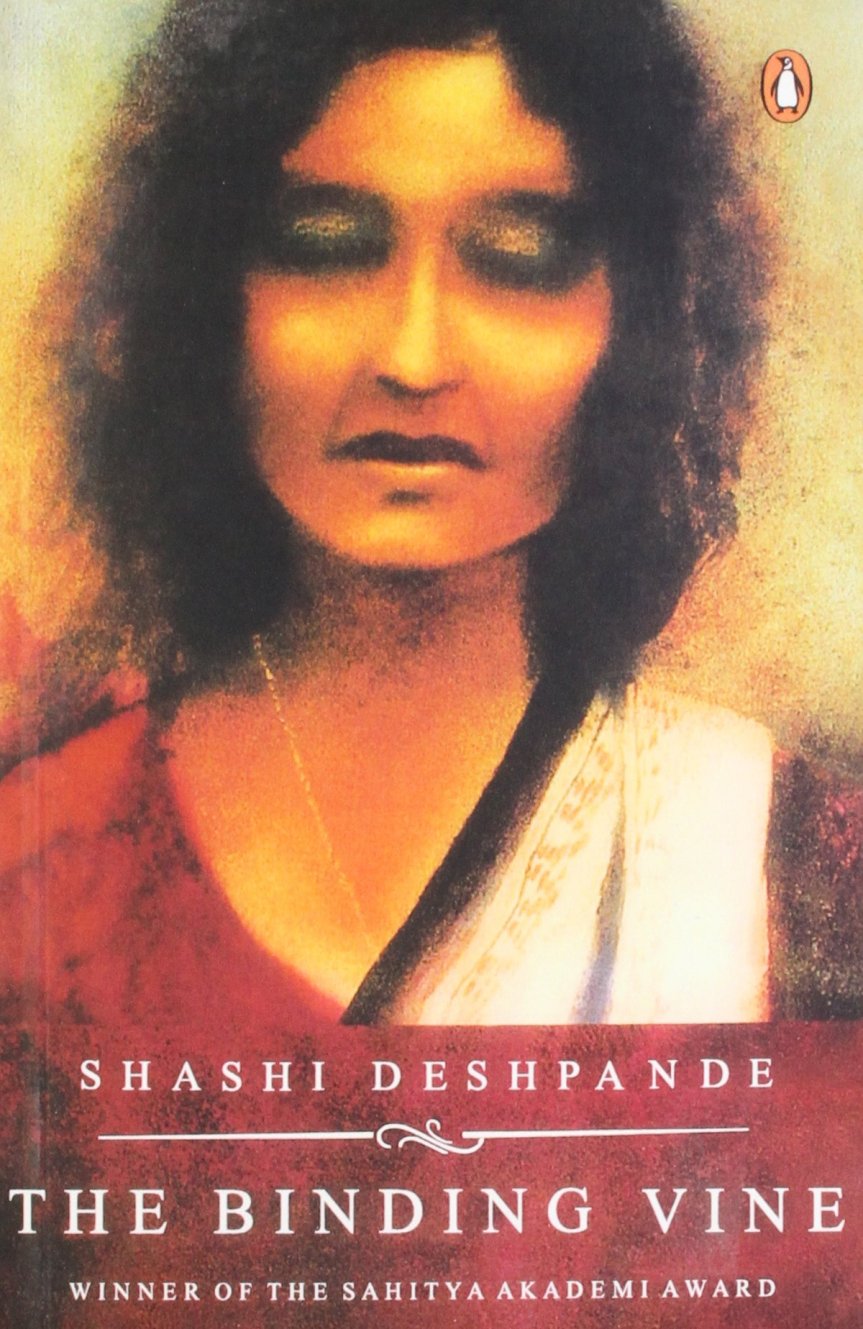
Sashi Deshpande is a Sahitya Academy winning Indian novelist best known for her works The Dark Hold No Terrors and That Long Silence. Her novels generally centre around educated middle-class urban Indian female protagonists who struggle against the oppression of an overtly patriarchal society. She is critically acclaimed for her sensitive and realistic portrayal of women who are fettered to their roles as daughters, wives and mothers. They are conscious of the social inequality and question the deliberate efforts made by men to maintain this. In The Binding Vine, Deshpande introduces women from various backgrounds who collectively question the subordinate status ordained to them by society. This essay seeks to analyse the lead female characters from the novel with reference to feminist theories by Simone De Beauvoir and Virginia Woolf.
“…thus she is called ‘the sex’, by which is meant that she appears essentially to the male as a sexual being.”
Simone De Beauvoir
“What were the use of my creation, if I were entirely contained here?” This quote from Wuthering heights by Emily Bronte in the beginning of the novel runs as a common theme throughout The Binding Vine. The novel uses stream of consciousness method as it follows the life of Urmi, a middle-class college lecturer who encounters several women in her life. With her as the anchor, Deshpande reveals the sufferings of women from different sections of the society. The novel begins by describing Urmi’s personal grief upon losing her infant child. She becomes detached from the world and struggles to get back to her normal life. She is financially independent and is confident in asserting her freedom and agency. She chooses her own husband by marrying Kishore who works in Merchant Navy and is barely ever home. He asserts himself sexually and does not provide the emotional support that she desperately craves. Urmi’s character reinforces Beauvoir’s point that “…thus she is called ‘the sex’, by which is meant that she appears essentially to the male as a sexual being.” Despite being socially and financially independent, Urmi is still scene as a sexual object by her husband.
Urmi later gets acquainted with Shakuntai and her daughter Kalpana. Shakuntai had moved to Bombay in search of her husband who has deserted her for another woman. Coming from the lower strata of the society, she is uneducated, financially unstable and struggles by toiling hard to look after her three children. Her daughter Kalpana is a strong woman who is forced to marry her uncle Prabhakar. Having been molested by Prabhakar since a young age, Kalpana turns down the offer. This enrages him and he brutally rapes her. Though Kalpana is critically injured, Shakuntai hesitates to file a case against Prabhakar and even goes as far to blame her daughter for her current condition. This is due to the internalised patriarchal ideology that the assaulter is entitled to do so as a man while the victim is responsible for ‘encouraging’ the crime. Furthermore, she herself is under constant threat of being held responsible for the downfall of her family as the society always blames women for disrupting its ‘honour’. Just like Beauvoir, Deshpande focuses on the unrealistic standards set by the society on women that expects them to be the perfect loyal caretaker who submissively accepts the will imposed on them by men. Women are always considered as the inessential and the other while the men are the subject and the absolute. Beauvoir further explains this internalisation by saying that “Thus, woman may fail to lay claim to the status of subject because she lacks definite resources, because she feels the necessary bond that ties her to man regardless of reciprocity, and because she is often very well pleased with her role as the Other.” Shakuntai blaming her own daughter for being a rape victim simply emphasises the fact that women themselves unconsciously perpetuate their role as the inessential subordinate.
Another significant character explored in the book is that of Mira, Urmi’s late mother-in-law. Kishore’s step-mother Akka hands Urmi a trunk consisting of Mira’s diaries and poems. Urmi learns how Kishore’s father saw Mira at a wedding and fell in love. “Since then he had “single-minded pursuit of an object; marrying Mira””. She is married off to him against her wishes and falls victim to a life of marital rape. Mira is forced to suppress her aspirations to be a writer, her only channel of outlet being the scribbles of words on her diary. Her writings clearly describe her revulsion and fear for the sexual acts with her husband and it is evident that she’s slowly spiralling into depression. Writing serves as her sole tether to her life on earth. After marriage, she is renamed ‘Nirmala’ by her in-laws which stands testimony to the society’s attempt to estrange women from her individuality after marriage.
"Niramala, they call, I stand statue-still.

Do you build the new without razing the old?

A tablet of rice, a pencil of gold

Can they make me a Nirmla? I am Mira."
Mira’s mental health improves as she joyously awaits the birth of her child, but she dies soon after childbirth. Kishore’s father marries Akka solely for the purpose of looking after the baby. This further reinforces the male perspective pointed out by Beauvoir that “woman has not been socially emancipated through man’s need – sexual desire and the desire for offspring – which makes the male dependent for satisfaction upon the female.”
In spite of being a skilled writer, Mira is shunned away from the literary world. Her husband and her family never encouraged her passion and she was forced to lead a domestic life. Her frustration on being stifled of her skills are evident in her works. This is further reinforced when she narrates her encounter with Venu, a renowned poet. Upon reading a few of her poems, he says “Why do you need to write poetry? It is enough for a young woman like you to give birth to children. That is your poetry; leave the other poetry to us men” . Where Venu is celebrated as a great poet of Indian literature, Mira’s voice is silenced and confined to four walls. She never had the luxury of having a room of her own that Woolf confirms is a necessity for a writer. She was forced to write late at night in secret while the men were asleep. Mira represents the generation of women writers who, despite being talented, were blatantly excluded from the literary world by men. Through Mira, Deshpande resonates the concerns raised by both Virginia Woolf and Adrienne Rich on the struggles of being a female writer in a patriarchal society.
The Binding Vine also features characters such as Urmi’s friend Vanna and Shakuntai’s sister Sulu, who perform their role as the archetypal role of ‘women as angels’. They try hard to maintain the societal pressure of being what Beauvoir explains as “‘truly feminine’ – that is, frivolous, infantile, irresponsible, the submissive woman.”
Despite the numerous struggles of women portrayed in the novel, Sashi Deshpande hints at positivity towards the end of the novel. Urmi convinces Shakuntai to disclose the identity of Kalpana’s assaulter resulting in a gathering of a mass of protestors who fight hard for her Justice. Urmi resolves to translate Mira’s poems to English and to publish them. She also encourages Vanna to stand up for herself and moves on from her personal grief to fight alongside women for a collective cause. Like Beauvoir and Woolf, Deshpande urges women to stand together like ‘binding vines’ against the oppression of patriarchy. The novel celebrates women’s solidarity as friends, companions and sharers of life.
Reference Links:
- www.marxists.org/reference/subject/ethics/de-beauvoir/2nd-sex/index.htm
- Menakapriya, P. “Portrayal of Women in Shashi Deshpande’s the Binding Vine and Manju Kapur’s Difficult Daughter.” IOSR Journal of Humanities and Social Science (IOSR-JHSS), http://www.iosrjournals.org

 Eduindex