

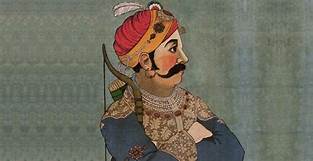
Prithviraja III, famous as Prithviraj Chauhan, was one of the greatest Rajput rulers. He controlled many parts of the present-day Rajasthan, Haryana, Delhi, Uttar Pradesh, and Madhya Pradesh. Known for his valor, Prithviraj Chauhan is often praised as a brave Indian king, who stood up against the invasion of Muslim rulers. He is widely known as a warrior king and is credited for resisting the Muslim invaders with all his might. His defeat at the ‘Second battle of Tarain’ (1192) is considered as a key moment in the history of India as it opened the gates for Muslim invaders to rule the northern parts of India. Prithviraj is considered to be the greatest warrior of India, and also one of the greatest in the world. He succeeded to the throne of Ajmer at the age of thirteen, in 1179,when his father died in a battle. His grandfather Angam, ruler of Delhi, declared him heir to the throne of Delhi after hearing about his courage and bravery. He once killed a lion on his own without any weapon. He was known as the warrior king. Chauhan was the last independent Hindu king, before Hemu, to sit upon the throne of Delhi. He succeeded to the throne in 1169 CE at the age of 20, and ruled from the twin capitals of Ajmer and Delhi.
Early Life
According to ‘Prithviraja Vijaya,’ Prithviraj Chauhan had mastered as many as six languages. Another eulogistic poem, Prithviraj Raso, claims that Prithviraj was well-versed in many subjects, including mathematics, medicine, history, military, philosophy, painting, and theology. Both Prithviraj Raso and Prithviraja Vijaya state that Prithviraj was well-versed in archery as well. Other medieval biographies also suggest that Prithviraj Chauhan was educated well and was an intelligent boy right from his childhood. They also state that as a kid, Prithviraj displayed keen interest in warfare and was hence able to quickly learn some of the most difficult military skills quite early.
Early Reign
Prithviraj ascended the throne when he was just 11 years old after the death of his father, Someshvara, in 1177 CE. At the time of his coronation, the young ruler had inherited a kingdom that extended from Sthanvishvara in the north to Mewar in the south. Since Prithviraj was still a minor when he ascended the throne, his mother, Karpuradevi, was made his regent. Karpuradevi, who was assisted by a regency council, managed the administration of the kingdom during Prithviraj’s early years as the king. During Prithviraj’s early reign, the young king was assisted by a couple of ministers, who find mention in ‘Prithviraja Vijaya.’ The poem states that Chief Minister Kadambavasa was an able administrator, who was devoted to the king. It also states that Kadambavasa played an important role in many of Prithviraj’s victories during the early years of his reign. Another important minister who served in the court of Prithviraj during this time was Bhuvanaikamalla, a paternal uncle of Karpuradevi. Prithviraja Vijaya describes Bhuvanaikamalla as a valiant general.
Conflicts with Hindu Rulers
Nagarjuna – Nagarjuna was Prithviraj’s cousin and had revolted against the coronation of Prithviraj Chauhan. In an attempt to seek revenge and to flaunt his authority over the kingdom, Nagarjuna had captured the fort of Gudapura. Prithviraj proved his military prowess by besieging Gudapura. It was among the earliest military achievements of Prithviraj.
Bhadanakas – After suppressing his cousin Nagarjuna’s revolt, Prithviraj turned towards the neighboring kingdom of the Bhadanakas. Since Bhadanakas often posed the threat of capturing the area around present-day Delhi, which belonged to Chahamana dynasty, Prithviraj decided to annihilate the nearby kingdom.
Chandelas of Jejakabhukti – According to certain inscriptions in Madanpur, Prithviraj defeated Paramardi, a powerful Chandela king, in 1182 CE. Prithviraj’s victory against the Chandelas increased the number of his enemies and also forced the Chandelas to join forces with the Gahadavalas.
Chaulukyas of Gujarat – Though the conflict between Prithviraj’s kingdom and the Chaulukyas of Gujarat finds mention in history, many references made in Prithviraj Raso seem to be unreliable, given the exaggerated nature of the poem. However, a few reliable sources do mention about a peace treaty between Bhima II of the Chaulukyas and Prithviraj Chauhan, which implies that the two kingdoms were at war.
Gahadavalas of Kannauj – According to a popular legend from Prithviraja Vijaya, Ain-i-Akbari, and Surjana-Charita, Prithviraj Chauhan came in conflict with another powerful king, Jayachandra, who ruled the Gahadavala kingdom. The legend has it that Prithviraj eloped with Jayachandra’s daughter Samyogita (Samyukta) in a rather dramatic manner. Since the incident is mentioned in three reliable sources, historians R. B. Singh and Dasharatha Sharma say that there might be some truth in the story, though it is largely viewed as a mere legend.
Battles of Tarain
A massive territory to the west of the Chahamana dynasty was ruled by Muhammad of Ghor, who wanted to expand his empire towards the east. In order to do so, Muhammad of Ghor had to defeat Prithviraj Chauhan and hence, he waged a war against the Chahamanas. Though many legends claim that Prithviraj and Muhammad of Ghor fought many battles, historians confirm that at least two battles were fought between the two. Since they were fought near the town of Tarain, they later came to be known as ‘Battles of Tarain.’
Death
After capturing Prithviraj Chauhan, Muhammad of Ghor reinstated him as a Ghurid vassal. This theory is supported by the fact that coins issued by Prithviraj after the battle of Tarain had his own name on one side and Muhammad’s name on the other. According to several sources, Prithviraj was later killed by Muhammad of Ghor for treason. However, the exact nature of the treason differs from one source to another.

 Eduindex