

Sensors, a controller, and a communication system make up a typical sensor network. Wireless Sensor Networks, or simply WSNs, are networks in which the communication mechanism in a Sensor Network is implemented using a Wireless protocol.

Sensor Nodes are placed in high density and frequently in huge quantities to provide sensing, data processing, embedded computing, and communication in a Wireless Sensor Network.
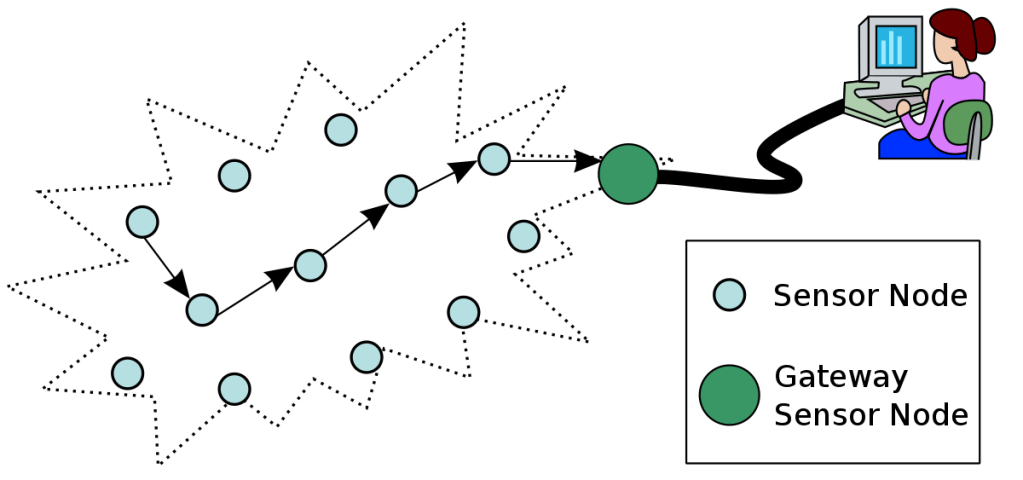
Elements of WSN
A typical wireless sensor network is made up of two parts. They are as follows:
- Sensor Node
- Network Architecture
Sensor Node
In a WSN, a Sensor Node has four fundamental components. They are as follows:
- Power Supply
- Sensor
- Processing Unit
- Communication System

The sensor takes analog data from the physical environment, which is then converted to digital data by an ADC. The main processing unit, which is generally a microprocessor or a microcontroller, processes and manipulates data intelligently.
A communication system consists of a radio system for data transmission and receiving, which is generally a short-range radio. Due to the fact that all of the components are low-power electronics.
Sensor Nodes include not just the sensing component, but also key characteristics like as processing, communication, and storage.
Network Architecture
The networking of these sensor nodes is requirements is to ensure when a large number of sensor nodes are put in a broad region to cooperatively monitor a physical environment. A sensor node in a WSN uses wireless communication to connect not only with other sensor nodes but also with a Base Station.
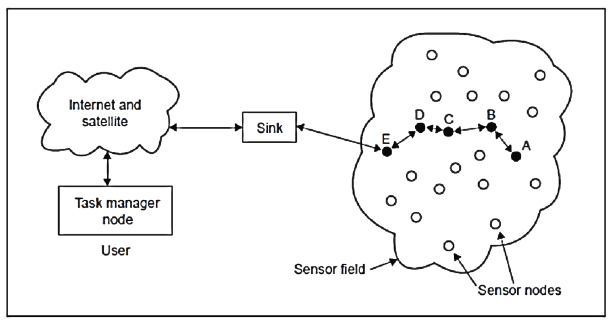
The base station delivers orders to the sensor nodes, and the sensor nodes collaborate to complete the task. The sensor nodes relay the data back to the base station after gathering the required information.
A base station can also connect to other networks through the internet. A base station receives data from sensor nodes and conducts basic data processing before sending the updated information to the user through the internet.
A single-hop network design is one in which each sensor node is linked to the base station.
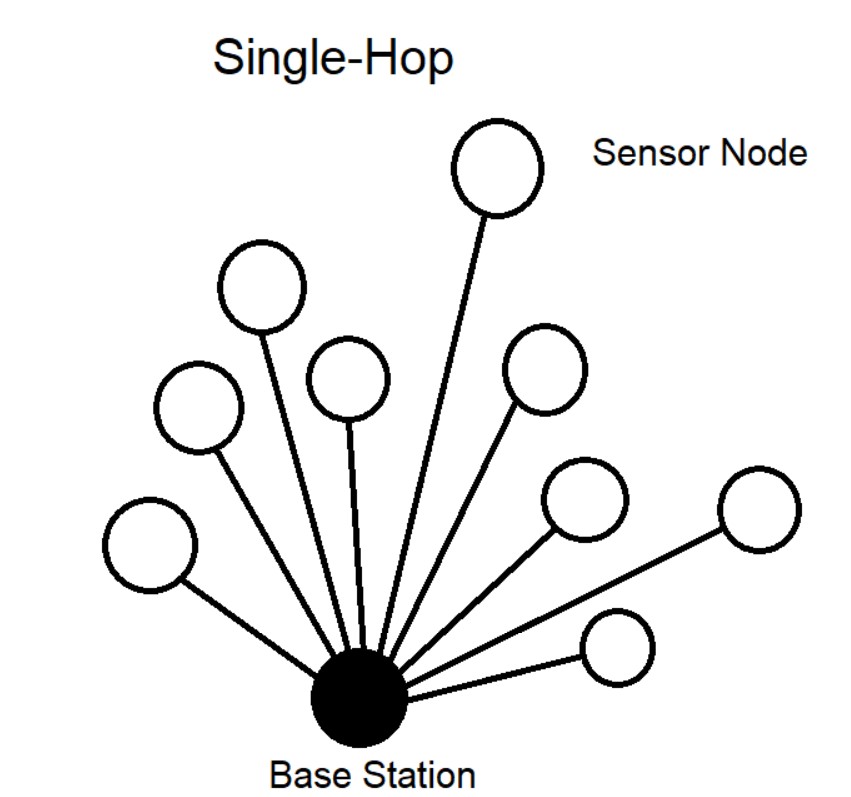
In Multi-hop network architecture, the data is sent through one or more intermediary nodes.

Network Topologies in WSN
A few alternative network topologies utilized in WSNs are listed below.
Star Topology
Every node in the network is connected to a single central node, known as a hub or switch, in a star architecture.

Tree Topology
A tree topology is a hierarchical network in which the top node is a single root node, which is connected to numerous nodes at the next level, and so on.

Mesh Topology
Apart from delivering its own data, each node in a mesh architecture also functions as a relay receiving data from other linked nodes. Fully Connected Mesh and Partially Connected Mesh are the two types of mesh topologies.
Each node in a fully connected mesh topology is connected to all other nodes, whereas a node in a partially connected mesh topology is connected to one or more surrounding nodes.
(The left diagram is fully connected mesh topology and the right diagram is partially connected mesh topology.)

Applications of Wireless Sensor Networks
Wireless Sensor Networks have an almost limitless number of uses. Heating, ventilation, and air conditioning (HVAC), air traffic control (ATC), automotive sensors, earthquake detection, disaster management, tsunami alert systems, industrial automation, personal health care, weather sensing, and monitoring are just a few of the applications of wireless sensor networks.

 Eduindex News
You must be logged in to post a comment.