

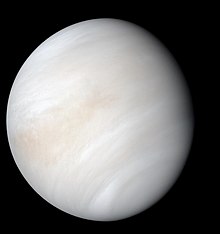
Venus is the second planet from the Sun. in our Solar System. It is the brightest natural object in Earth’s night sky after the Moon. Venus is one of the four terrestrial planets in the Solar System, meaning that it is a rocky body like Earth. It is similar to Earth in size and mass, and is often described as Earth’s “sister” or “twin”. The diameter of Venus is 12,103.6 km (7,520.8 mi)—only 638.4 km (396.7 mi) less than Earth’s—and its mass is 81.5% of Earth’s. Conditions on the Venusian surface differ radically from those on Earth because its dense atmosphere is 96.5% carbon dioxide, with most of the remaining 3.5% being nitrogen. The surface pressure is 9.3 megapascals and the surface temperature is 737 K (464 °C; 867 °F), above the critical points of both major constituents and making the surface atmosphere a supercritical fluid(distinct gaseous and liquid phases do not exist).
Some facts about Venus:
Diameter- 12,103.6 km
Orbital period- 224.7 days
Length of a day- 117 days
Axis tilt- 177.3 degrees
Distance from the Sun- 108 million km (0.72AU)
Moons- none
Atmosphere and climate
Venus has an extremely dense atmosphere composed of 96.5% carbon dioxide, 3.5% nitrogen—both exist as supercritical fluids at the planet’s surface—and traces of other gases including sulfur dioxide. The mass of its atmosphere is 92 times that of Earth’s, whereas the pressure at its surface is about 93 times that at Earth’s—a pressure equivalent to that at a depth of nearly 1 km (5⁄8 mi) under Earth’s oceans.

Studies have suggested that billions of years ago, Venus’ atmosphere could have been much more like the one surrounding the early Earth, and that there may have been substantial quantities of liquid water on the surface. After a period of 600 million to several billion years, solar forcing from rising luminosity of the Sun caused the evaporation of the original water. A runaway greenhouse effect was created once a critical level of greenhouse gases (including water) was added to its atmosphere. Although the surface conditions on Venus are no longer hospitable to any Earth-like life that may have formed before this event, there is speculation on the possibility that life exists in the upper cloud layers of Venus, 50 km (30 mi) up from the surface, where the temperature ranges between 303 and 353 K (30 and 80 °C; 86 and 176 °F) but the environment is acidic. The apparent detection of phosphine in Venus’ atmosphere, with no known pathway for abiotic production, led to speculation in September 2020 that there could be existing life currently present in the atmosphere.

Structure
The similarity in size and density between Venus and Earth suggests they share a similar internal structure: a core, mantle, and crust. Like that of Earth, the Venusian core is most likely at least partially liquid because the two planets have been cooling at about the same rate, although a completely solid core cannot be ruled out. The slightly smaller size of Venus means pressures are 24% lower in its deep interior than Earth’s. The predicted values for the moment of inertia based on planetary models suggest a core radius of 2,900–3,450 km.
Missions to Venus:
Many missions have been sent to Venus in the past decades. Venera 4 and 5, were the first to enter the atmosphere and send information. Venera 9 sent back the first images from Venus. Some other missions include- The Magellan Mission( a thirteen-year-long Venus radar mapping project ), The Pioneer Venus orbiters and Venus Express.
References: https://en.wikipedia.org/wiki/Venus#Atmosphere_and_climate https://en.wikipedia.org/wiki/Supercritical_fluid

 Eduindex